Financial Reporting
What Is an Impairment Test? ASC 350 and 360 for Your Auditor
A CFO's primer on impairment testing: when ASC 350 and ASC 360 apply, what the valuation file contains, what it costs and what your auditor reads first.
By 409.AI Team - 2026-11-05
# What Is an Impairment Test? ASC 350 and 360 for Your Auditor
Your company closed an acquisition, the deal model has not played out, and the audit team has started asking whether the goodwill on the balance sheet still holds. If you are the CFO or controller, that question lands on you, and the answer has to come with a number a specialist can defend. This primer explains what an impairment test is, which of two standards applies to which asset, and what the valuation file should contain when the auditor opens it.
What an impairment test actually asks
An impairment test asks one thing: is an asset still worth what your books say it is? If the answer is no, you write the carrying amount down and the difference runs through the income statement as a loss.
US GAAP splits the question across two standards, and mixing them up is the most common source of confusion:
- **ASC 350** covers goodwill and indefinite-lived intangible assets. Goodwill is tested for impairment at least once a year, and again between annual tests when something happens that makes a write-down more likely than not.
- **ASC 360** covers long-lived assets held and used, such as equipment, capitalized software, and the finite-lived intangibles you identified in the deal (customer relationships, developed technology). It has no annual test. It applies only when events or changes in circumstances suggest the carrying amount may not be recoverable.
One event can start both. A lost anchor customer can put the acquired business's goodwill and its customer-relationship intangible under review in the same quarter, so the work is usually one engagement with two answers.
The moments that make you run one
Nobody schedules an impairment test for fun. The moments are usually these:
1. The annual goodwill test date. A public company picks a date and keeps it. A private company that has not elected the alternatives below does the same. 2. A triggering event. ASC 350-20-35-3C lists examples: worsening macroeconomic conditions such as rising interest rates, a more competitive market, higher labor or input costs, negative or declining cash flows, a drop in sales, changes in key personnel, and an expected sale of all or part of a reporting unit. The list is not exhaustive, and no single item is a trigger by itself. You weigh the whole picture, including the positive factors. 3. A down round or a lost contract. For a venture-backed company, a priced round below the last one is a signal the auditor will ask about. It is not an automatic trigger, but you need a written view on why it does or does not matter for the acquired business. 4. The year-end audit. Even when nothing has changed, the file has to show that someone looked.
ASC 350: the goodwill test
Goodwill sits at the reporting-unit level: an operating segment or one level below it. The test has two possible entry points.
The first is optional. Under the qualitative assessment you weigh the events and circumstances and conclude whether it is more likely than not (more than a 50% chance) that the reporting unit's fair value is below its carrying amount. If you conclude it is not, you stop and document why. You may also skip it and go straight to the quantitative test.
The quantitative test is one comparison. Since ASU 2017-04 removed the old second step, you compare the fair value of the reporting unit with its carrying amount, and any shortfall is the impairment loss, capped at the goodwill allocated to that unit. The standard also asks you to consider the income tax effect of the goodwill when you measure the loss.
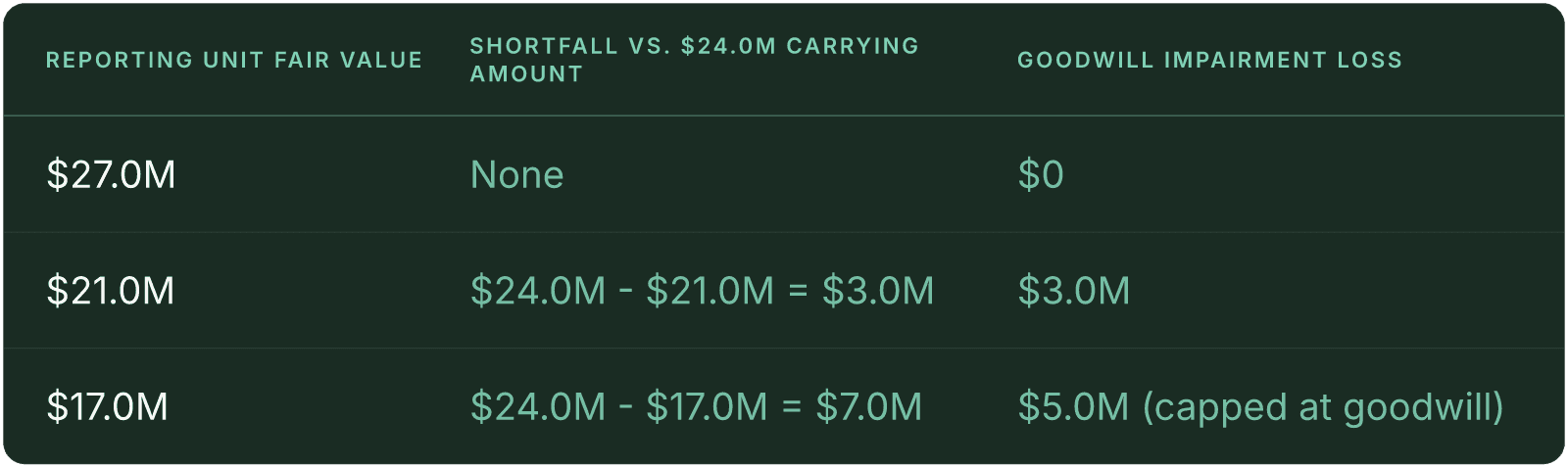
Here is how that plays out for a reporting unit with $5.0 million of goodwill and a carrying amount of $24.0 million:
[](https://www.409.ai/uploads/what_is_an_impairment_test_asc_350_asc_360_valuation_auditor_file_table_1_f645f2423a.png)
At $17.0 million the shortfall is $7.0 million, but only $5.0 million of goodwill exists to write off, so the loss stops there. An impairment of goodwill is also permanent under US GAAP: if the unit recovers, the write-down is not reversed.
ASC 360: the long-lived asset test
ASC 360 is a two-step test, and the first step does not use fair value at all.
Step one is recoverability. You group the asset with others at the lowest level where cash flows are identifiable and largely independent (the asset group). You then compare the group's carrying amount with the undiscounted cash flows it is expected to produce from use and eventual disposal. If the undiscounted cash flows are higher, the group passes and no loss is recorded, whatever fair value might be.
Step two is measurement. Only a group that fails step one is measured. The loss is the amount by which carrying amount exceeds fair value, and as with goodwill it is not reversed later.
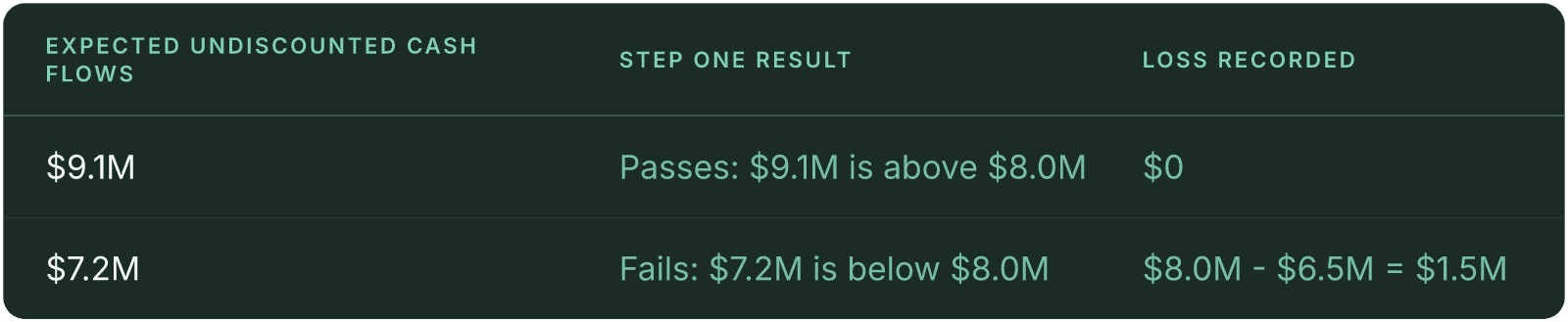
Take an acquired asset group made of customer relationships, developed technology and equipment, carried at $8.0 million, with a fair value of $6.5 million:
[](https://www.409.ai/uploads/what_is_an_impairment_test_asc_350_asc_360_valuation_auditor_file_table_2_5d5c122137.png)
The same group, with the same fair value, produces no loss in the first row and a $1.5 million loss in the second. That is why a competent impairment file carries the cash-flow forecast as well as the fair value, and why the order of the two standards matters. When a long-lived asset group and goodwill sit in the same reporting unit, the standards call for testing the assets under ASC 360 first, then the goodwill under ASC 350, so the carrying amount of the unit is current when you test it.
What changes for a private company
A private company has more room than a public one. Two options come from the Private Company Council and the FASB, and a company elects them as accounting policies, so they belong in your accounting-policy note and in the conversation with your auditor.
- **ASU 2014-02** lets an electing company amortize goodwill straight-line over 10 years or less, test only when a triggering event occurs, and test at the entity level instead of by reporting unit. Amortization shrinks the carrying amount over time, which usually reduces the size of a later impairment.
- **ASU 2021-03** lets a private company evaluate goodwill triggering events only as of the end of each reporting period, rather than monitoring for them continuously. It can be combined with the amortization alternative.
Both come with a catch. A company that goes public or is acquired by a SPAC has to unwind the triggering-event election retrospectively, so a company with an IPO in view should talk to its auditor before it elects. Our neighbouring article on [goodwill impairment for private companies](https://www.409.ai/articles/goodwill-impairment-private-company-asc-350) walks through those elections and a full private-company example in more detail.
What a valuation specialist delivers
Management owns the impairment number. The specialist produces the fair value support, and the auditor tests it. A report that survives that review usually contains:
- **Scope and definitions.** Which reporting unit or asset group, the valuation date, the standard of value (fair value under [ASC 820](https://www.409.ai/articles/asc-820-level-3-classification-significant-unobservable-input)), and the carrying amount you gave the specialist.
- **The forecast and where it came from.** The projections, how they tie to the budget the board approved, and a test of whether the plan matches what the business has actually delivered.
- **The income approach.** A discounted cash flow with the discount rate built up in the open: risk-free rate, equity risk premium, size and company-specific adjustments.
- **The market approach.** Multiples from comparable companies or transactions, adjusted for differences in growth and margin.
- **The reconciliation.** How the approaches were weighted and why, and for a unit acquired recently, how the result compares with the price paid in the deal.
- **For ASC 360, the asset group and the recoverability math.** The undiscounted cash flows, the remaining useful life of the primary asset, and the fair value of the group if step one fails.
The deal's own file is the starting point. If the acquisition was recorded with a [purchase price allocation](https://www.409.ai/articles/asc-805-purchase-price-allocation-startup-acquisition), the specialist reads it to see how much went to identifiable intangibles and how much stayed in goodwill, and what the auditor tested then is what they will test again now. The same discipline applies to the [cost of the allocation and what auditors look at in it](https://www.409.ai/articles/purchase-price-allocation-cost-asc-805-what-auditors-test).
What it costs and how long it takes
409.AI prices impairment testing (ASC 350 and ASC 360) at a flat $9,999. The site's standard delivery is a draft within 24 hours and the final report in five business days, with express available for one business day. The [impairment testing page](https://www.409.ai/products/impairment-testing) has the current scope and terms, and that page, not this article, is the reference if they differ. Plan the date backward from your audit fieldwork, not from your close, because the auditor will have follow-up questions on the discount rate and the forecast.
Questions finance teams ask
Do we need an impairment test if we have no goodwill?
Possibly still. Goodwill is the reason for the annual test, but ASC 360 can apply to any long-lived asset group when an indicator appears, and indefinite-lived intangibles are tested under ASC 350 as well. If you bought assets rather than a business, the [ASC 805 screen test](https://www.409.ai/articles/asset-acquisition-vs-business-combination-asc-805-screen-test-goodwill) decides whether goodwill exists in the first place.
Can we do it ourselves?
Nothing in the standards requires a third-party specialist. In practice, a reporting unit's fair value depends on a discount rate and a forecast that the auditor will challenge, and a file prepared by someone independent of the forecast is easier to defend than one the preparer wrote and reviewed alone.
Will the auditor accept a qualitative assessment?
Often, when the evidence is clean and documented. A weak qualitative memo that leans on one favorable factor is the version that gets sent back for a full quantitative test, usually late in fieldwork.
Does a down round force a write-down?
No. It is a prompt to evaluate, not a conclusion. What it does require is a documented answer to the question of whether the acquired unit is worth less than its carrying amount.
Where to start
If you carry goodwill from a deal and the business is behind its model, write down three things this week: your reporting-unit definition, the test date you follow (or your triggering-event election), and your last approved forecast for the acquired business. Those three documents are what a specialist asks for first, and having them in hand turns an audit surprise into a scheduled piece of work.