Compliance
What Is an ESOP Valuation? The Annual Appraisal a Trustee Orders
ESOP trustees, CFOs and boards: what the annual ESOP valuation is, why an independent appraiser signs it, what the report holds, and what it costs you.
By 409.AI Team - 2026-10-30
# What Is an ESOP Valuation? The Annual Appraisal a Trustee Orders
If your company's employee stock ownership plan holds shares that no exchange quotes, someone has to say what those shares are worth, every year, in writing. That someone is an independent appraiser, and the person who hires them is the plan's trustee. This guide is for the trustee, the CFO and the board of an ESOP-owned company, and for the owner who is thinking about selling to a plan and wants to know what the valuation work will look like.
It is a primer. It covers what an ESOP valuation is, why the law asks for an outside appraiser, what the report contains, when it is due, what it costs and how it differs from the 409A valuation a startup buys. For the legal standard behind the price in more depth, read our piece on the [adequate consideration standard](https://www.409.ai/articles/esop-valuation-adequate-consideration-2026).
What an ESOP valuation is
An ESOP is a retirement plan that invests mainly in the stock of the company that sponsors it. When that stock is public, the market sets the price every day. In a private company there is no market, so the plan needs a number that stands in for one.
The ESOP valuation, sometimes called the annual appraisal, is that number: the fair market value of the company's shares as of a stated valuation date, supported by a written report. Fair market value here is the price a willing buyer and a willing seller would agree on, neither forced to act, both reasonably informed. The plan uses the figure to price every share in every participant account, to set what the company pays a departing employee, and to price any purchase or sale of shares by the plan.
Two dates matter in every report. The valuation date is the point in time the value speaks to, usually the end of the plan year. The report date is when the appraiser signs. A buyer reading a report should always ask which one a number belongs to.
Why an independent appraiser, and who hires one
The Internal Revenue Code says a plan meets its requirements only if all valuations of employer securities that are not readily tradable on an established securities market are made by an independent appraiser, as defined by reference to the regulations under section 170(a)(1) (IRC section 401(a)(28)(C)). That is the statutory reason the appraisal cannot be done by the CFO or by the company's own accountant on a Tuesday afternoon.
ERISA adds the fiduciary layer. For an asset with no generally recognized market, the plan may transact at "adequate consideration", which ERISA section 3(18) ties to the fair market value of the asset as determined in good faith by the trustee or named fiduciary (29 U.S.C. 1002(18)). Good faith in practice means the trustee picks a qualified appraiser who has no stake in the answer, reads the report, asks hard questions and can explain why the final price is a reasonable one.
So the trustee is the client. The company supplies the data and pays the fee in most plans, but the appraiser works for the plan's fiduciary, and a company that tries to steer the number puts the trustee in an awkward position. Our note on the [auditor independence rule for valuation providers](https://www.409.ai/articles/auditor-independence-409a-valuation-provider-rule) shows the same logic from the startup side: the person who signs the number should not be the person who benefits from it.
The moments that call for one
Most ESOP companies meet the appraiser at three kinds of moments.
The annual valuation. Every plan year, the plan needs a fresh value for the stock it holds. This is the recurring job and the one this primer is mostly about.
A transaction with the plan. When an owner sells shares to a new ESOP, or the plan buys more, the trustee needs a valuation tied to that deal before the price is set. A seller who wants to defer tax on the gain will care a great deal about this report; we walk through that case in [selling to an ESOP and Section 1042](https://www.409.ai/articles/esop-sale-section-1042-gain-deferral-replacement-property-independent-appraisal).
A repurchase. Because the stock is not tradable, a participant who receives a distribution of shares has the right to require the company to buy them back under a fair valuation formula. The Code gives the participant a put option for at least 60 days after the distribution, and, if it is not used, for another period of at least 60 days in the following plan year (IRC section 409(h)). The price in both windows comes from the appraisal, which is why the annual report is a cash question as well as a compliance one.
What the report contains
An ESOP valuation report is long because it has to be defended later. Expect these parts:
- A description of the company, its industry, its history and its ownership, including the plan's share.
- The financial analysis: several years of statements, normalised for one-off items and owner-related expenses.
- The methods. Appraisers typically weigh an income approach (discounted cash flow or capitalised earnings), a market approach (comparable public companies and deals) and, where it applies, an asset approach. The reasoning for each weight should be in the text.
- The adjustments from enterprise value to the value of the shares: debt, the plan's repurchase obligation, and the discount for lack of marketability where it applies. The [discount for lack of marketability](https://www.409.ai/articles/discount-lack-marketability-dlom-409a-valuation) is the one that draws the most questions, because it moves the number directly.
- The conclusion, the valuation date, the standard of value, and the appraiser's statement of independence and qualifications.
If the company is an S corporation, the report also has to take a position on how the pass-through tax status affects value. That is a real judgment call, covered in our article on [tax affecting an S corporation](https://www.409.ai/articles/tax-affecting-pass-through-entity-s-corp-valuation).
Why the number moves cash
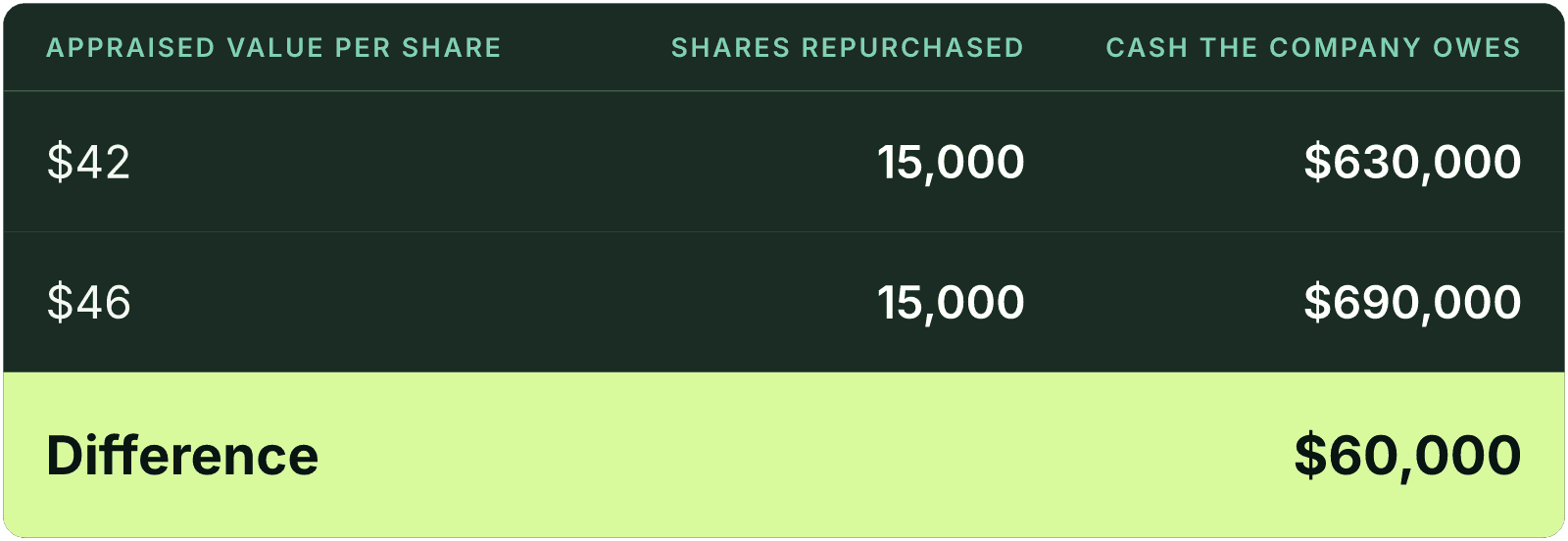
The repurchase obligation is where a per-share difference becomes a payroll-sized difference. Here is an illustration with made-up figures. A plan has to buy back 15,000 shares from employees who left this year.
[](https://www.409.ai/uploads/what_is_an_esop_valuation_annual_appraisal_trustee_independent_appraiser_table_1_7847f5cefd.png)
A four-dollar swing, about 9.5 percent, is the kind of movement a changed discount or a reweighted method can produce. It is $60,000 more cash out the door in one year on a modest repurchase, and the same swing reprices every account in the plan. This is why trustees read the method section and not just the last page.
The Code also limits how fast the company can pay. Distributions are generally made in substantially equal annual instalments over not more than five years, with a longer period for large balances (IRC section 409(o)). That spreads the cost out, and it also means the company is carrying a liability tied to each year's appraisal for several years. A company planning its cash needs the appraisal early enough to budget for it.
The annual calendar
A typical year runs like this, though each plan sets its own dates:
1. Plan year end (often December 31): the valuation date. 2. First quarter: the trustee confirms the appraiser, the company sends financial statements and a data request. 3. A few weeks later: the appraiser asks management questions, covering outlook, customers, pricing, capital needs, anything that changes the forecast. 4. Draft, review and final report: the trustee reviews the draft, raises questions and receives the signed report. 5. Afterwards: the value feeds participant statements, repurchase payments and the plan's annual filings.
Starting the data request early is the single best way to keep the report on time. The appraiser cannot finish before the year-end financial statements exist, so a late close pushes everything behind it.
Cost and turnaround at 409.AI
The 409.AI [ESOP valuation](https://www.409.ai/products/esop-valuation) is priced in three bands: $3,499, $5,499 and $7,499, as shown on the pricing page. The listed turnaround is three business days from a complete data package. As with any valuation, the clock starts when the documents arrive, which is why the [data request checklist](https://www.409.ai/articles/409a-turnaround-time-data-request-checklist) is worth reading before you place the order. Check www.409.ai/pricing for the current figures before you budget, since pricing pages change.
How it relates to the 409A
A startup that grants stock options needs a 409A valuation to set the strike price. An ESOP company needs an ESOP valuation to price a plan. Both rest on fair market value, both use the same family of methods, and both are done by an independent appraiser, so the work looks alike. Our [guide to the 409A](https://www.409.ai/articles/what-is-a-409a-valuation-a-comprehensive-guide) and the note on [409A versus fair market value](https://www.409.ai/articles/409a-valuation-vs-fair-market-value) explain the shared ground.
The differences are who is relying on the number and what for. A 409A protects option holders from a penalty tax on deferred compensation. An ESOP valuation protects a retirement plan's participants and the fiduciary who acts for them. A company that has both an ESOP and an option plan, which is common once it has grown, may need both reports, and the two should tell a consistent story about the business.
Frequently asked questions
Does the company or the trustee choose the appraiser? The trustee, as the plan fiduciary, selects and engages the appraiser. The company usually pays the bill and supplies the information.
How often do we need a valuation? At least once each plan year for a private company's plan, and at any time the plan buys or sells shares.
Can our CPA do it? Only if the CPA meets the independence and qualification standard the Code points to for an independent appraiser, and is not conflicted by other work for the company or its owner. Most plans use a firm that does valuation and nothing else for the plan.
Is the 409A enough for an ESOP? No. A 409A is built to set an option strike price and is not a valuation for plan purposes.
What if the value drops? The report should explain why, in the method and the numbers. A fall that follows a poor year is not a flaw in the appraisal. A fall the report cannot explain is the trustee's cue to ask questions before accepting it.
The takeaway
Treat the ESOP valuation as a yearly cash decision and not as paperwork. Book the appraiser before the year closes, send the data request the day the financial statements are final, and read the method section and the discount, because that is where a few dollars a share become six figures of repurchase cash. If your plan has no appraiser lined up for this year's valuation date, the [409.AI ESOP valuation](https://www.409.ai/products/esop-valuation) page is the place to start.