Equity
What Is an EMI Valuation? Getting Your Share Value Agreed With HMRC Before You Grant
Planning EMI options? An EMI valuation sets UMV and AMV for HMRC's VAL231. See who needs one, the steps, the 90-day window and what a funding round changes.
By 409.AI Team - 2026-10-31
# What Is an EMI Valuation? Getting Your Share Value Agreed With HMRC Before You Grant
If you run a UK company, or the UK arm of a US startup, and you are about to give employees Enterprise Management Incentive options, someone will tell you to "get the EMI valuation done first." This guide explains what that means, who needs one, what HMRC actually agrees, and what to prepare so the grant date does not slip.
What an EMI valuation is
An EMI option lets an employee buy shares later at a price fixed on the day of grant. The tax advantage depends on that price being no lower than what the shares were worth on that day. So someone has to put a number on the shares.
An EMI valuation is the report that supports that number. It is submitted to HMRC's Shares and Assets Valuation team (SAV) on form VAL231, and SAV can agree it. Once agreed, you have written comfort that HMRC accepts the value you used to set the exercise price.
The service is optional. HMRC's own manual describes the agreement of EMI valuations as [a voluntary service provided by SAV](https://www.gov.uk/hmrc-internal-manuals/shares-and-assets-valuation-manual/svm110050), and a company can grant options without an agreed value. Most venture-backed companies still ask for one, because the alternative is to grant on your own estimate and hope an enquiry never tests it. SAV may check a valuation before the grant and during the 12 months and 92 days after it.
Who needs one
Three kinds of company end up needing an EMI valuation:
- A UK startup granting its first options to the team, with no earlier share valuation on file.
- A UK subsidiary of a US parent whose UK employees will hold options over UK shares. Your US [409A valuation](https://www.409.ai/articles/non-us-startup-us-employee-stock-options-409a-strike-price) answers a US question and does not stand in for the HMRC process.
- Any EMI company making a new round of grants after something changed: new money in, a new class of shares, a change in the business.
The company must first qualify. For options granted from 6 April 2026, HMRC's manual sets the [gross assets test at £120 million](https://www.gov.uk/hmrc-internal-manuals/employee-tax-advantaged-share-scheme-user-manual/etassum52060) and the [employee limit at 500 full-time equivalents](https://www.gov.uk/hmrc-internal-manuals/employee-tax-advantaged-share-scheme-user-manual/etassum52070), both tested on the date of grant. Before that date the figures were £30 million and 250. The total of unexercised EMI options a company can have outstanding rose from £3 million to £6 million at the same time, and the longest exercise period went from 10 to 15 years for new options ([ETASSUM50500](https://www.gov.uk/hmrc-internal-manuals/employee-tax-advantaged-share-scheme-user-manual/etassum50500)). Our [guide to the 2026 EMI rules](https://www.409.ai/articles/emi-share-options-2026-uk-rules-hmrc-valuation) walks through those changes. This article starts one step later: you qualify, and now you need the number.
Each employee must also qualify. The core test is time: an employee must be required to spend at least [25 hours a week on the company's business, or if less, 75% of their working time](https://www.gov.uk/hmrc-internal-manuals/employee-tax-advantaged-share-scheme-user-manual/etassum53020). Someone who already holds a material interest in the company cannot receive EMI options.
Two values, two jobs
The valuation answers two questions, and HMRC wants both answers in the application. The manual says the submission must include [a valuation of both the Actual Market Value and the Unrestricted Market Value](https://www.gov.uk/hmrc-internal-manuals/shares-and-assets-valuation-manual/svm110050) of the shares under option.
Unrestricted Market Value (UMV) is what the shares would be worth if they carried no restrictions. EMI limits are tested against it.
Actual Market Value (AMV) is what they are worth with the restrictions in your Articles of Association taken into account: leaver provisions and transfer limits, for example. It is usually lower than UMV. Options are commonly granted at AMV.
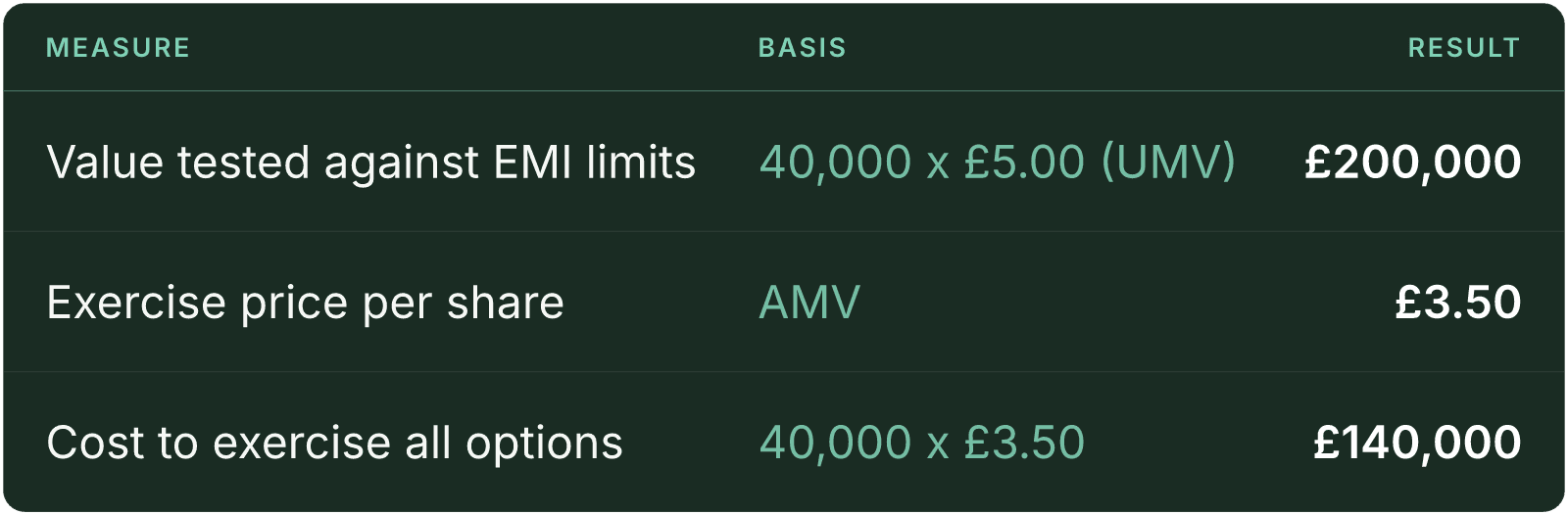
A short example shows how the two fit together. Say the report concludes UMV is £5.00 a share and AMV is £3.50 a share, and you plan to grant an employee options over 40,000 shares.
[](https://www.409.ai/uploads/what_is_an_emi_valuation_umv_amv_hmrc_val231_agreed_before_grant_table_1_684aa47e13.png)
The employee's grant uses £200,000 of the £250,000 that GOV.UK allows per employee over a three-year period, and the exercise price is the lower figure. The numbers are illustrative, not a benchmark. The point is that one report produces two figures that do different work. A report that gives only one of them is incomplete for this purpose.
Where the numbers come from
An EMI valuation is a valuation of ordinary shares in a private company, which is the same family of problem as a 409A. The appraiser builds the company's equity value from your financials and recent transactions, then allocates it across the share classes in your capital structure. If investors hold preferred shares with a liquidation preference, the ordinary shares sit behind them, which is why a defensible ordinary share value usually lands well below your last round price. We explain that gap in [why a 409A comes in below your post-money valuation](https://www.409.ai/articles/why-is-your-409a-valuation-lower-than-post-money-valuation), and the same logic applies here.
Then come the discounts that separate UMV from AMV. The main one for a private minority holding is marketability, covered in our piece on the [discount for lack of marketability](https://www.409.ai/articles/discount-lack-marketability-dlom-409a-valuation). HMRC does not take a discount on trust. The report has to show why the restrictions in your Articles justify it, which is why the methodology narrative matters as much as the figure.
The process, step by step
1. Prepare the company information. Financial statements, the latest management accounts, the cap table, the Articles, any investment agreement and the business plan are the usual starting point. 2. Get the valuation report. It sets out UMV and AMV, the method and the discount reasoning. 3. Complete and sign VAL231 and send it with the report to SAV, normally by email. 4. Wait for HMRC. SAV runs a risk assessment on what it receives. The manual warns that further examination [may mean more time is required or that the valuation is not accepted](https://www.gov.uk/hmrc-internal-manuals/shares-and-assets-valuation-manual/svm110050). Expect questions. In our experience a reply takes four to eight weeks. 5. Grant inside the window. An agreed valuation is valid for 90 days from the date of the agreement. 6. Notify HMRC of the grant. For grants on or after 6 April 2024, the deadline is [6 July following the end of the tax year in which the grant is made](https://www.gov.uk/guidance/submit-an-enterprise-management-incentives-emi-notification).
Step 4 is why timing matters. HMRC's manual says SAV [should not be approached until the company is in a position to grant the options](https://www.gov.uk/hmrc-internal-manuals/shares-and-assets-valuation-manual/svm110050). So have the board approval, the option agreements and the list of grantees ready before you file, not after the letter arrives. The 90 days are short if paperwork starts only once the agreement is back.
What a funding round does to an agreed value
The 90-day window is subject to a condition: no changes in the company's circumstances that could affect the share value before the options are issued. A priced round, a signed term sheet, a big contract win or loss, an acquisition approach: any of these can put an agreed value in doubt.
Two practical rules follow. If a round is close, decide whether to grant before it or after it, and value for that choice. Granting just before a round at yesterday's price, when the term sheet is already signed, is the situation an enquiry looks at hardest. And if the 90 days pass without a grant, the manual is plain: [a new application on a newly completed VAL231](https://www.gov.uk/hmrc-internal-manuals/shares-and-assets-valuation-manual/svm110050) is needed. How often the value needs refreshing is the same question US companies ask about their 409A, and our note on [trigger events that beat the calendar](https://www.409.ai/articles/409a-valuation-frequency-how-often-should-you-get-one) carries over well.
If your UK team may later trade shares on a private market platform, read the [PISCES and EMI article](https://www.409.ai/articles/pisces-emi-csop-options-april-2028-amendment-valuation) before you announce anything, because a completed trading window changes the next price.
What it costs and how long it takes
On our EMI valuation page, 409.AI prices the report from $3,499, a flat fee. That covers the valuation of UMV and AMV, the methodology narrative, the discount support and the materials for the VAL231 submission. HMRC's response time is outside anyone's control, so plan the whole sequence from report to grant letter as weeks, not days.
Questions founders ask
Do we need an EMI valuation to grant options? No, the agreement is optional. Without one you carry the valuation risk yourself, so most companies obtain it.
Can we reuse our 409A? Not for HMRC. A 409A is a US tax valuation of US common stock. EMI needs UMV and AMV of UK shares, prepared for VAL231.
Is a CSOP different? Yes. If the company falls outside EMI's limits, the Company Share Option Plan is the other route. Our [CSOP guide](https://www.409.ai/articles/csop-share-options-2026-uk-hmrc-valuation) covers where it fits.
What if HMRC disagrees? SAV may return questions or propose a different figure. The report's job is to make the reasoning easy to follow so that conversation stays short.
What to do this week
Check the company and employee tests against the 6 April 2026 figures. Line up the board approval and the grantee list so the 90 days start when you are ready to use them. Then commission the valuation with a clear grant date in mind, and keep that date away from any round or event you can see coming. If you want the report built around the VAL231 submission, the [EMI valuation service](https://www.409.ai/products/emi-valuation) is what 409.AI provides.
*This article is educational and not tax or legal advice. HMRC rules and thresholds change; confirm current figures on GOV.UK and speak to a qualified adviser before you grant options.*