Compliance
What Is a CSOP Valuation? The Market Value HMRC's Valuation Team Can Agree Before You Grant
Planning CSOP options? A CSOP valuation sets the market value HMRC can agree before you grant. See the £60,000 limit, the timing and how it differs from EMI.
By 409.AI Team - 2026-11-01
# What Is a CSOP Valuation? The Market Value HMRC's Valuation Team Can Agree Before You Grant
If you run a UK company and your finance lead, lawyer or an option-plan adviser has said "we'll need a CSOP valuation before the first grant," this guide explains what that means. It is written for the founder or finance lead of a UK company that sits outside EMI's rules, or has outgrown them, and wants to give employees tax-advantaged options anyway. We cover what the valuation is, why the whole scheme rests on it, what HMRC will and will not agree, and what to line up so the grant date does not slip.
What a CSOP valuation is
A Company Share Option Plan lets a company grant employees options to buy shares at a price fixed on the day of grant. The tax relief depends on that price being no lower than what the shares were worth then. So someone has to put a number on the shares, and be able to defend it.
A CSOP valuation is the report that supports that number. It sets out the market value of the shares under option at the grant date, the method behind it and the information it relies on. It is then the basis for a proposal to HMRC's Shares and Assets Valuation team (SAV), which can agree it.
The legal test is the market value rule that applies to capital gains, in section 272 of the Taxation of Chargeable Gains Act 1992. HMRC's user manual says shares that are not listed [fall under that general definition](https://www.gov.uk/hmrc-internal-manuals/employee-tax-advantaged-share-scheme-user-manual/etassum44170). Nobody publishes a price for a private company, which is the reason a valuation exists at all.
Why the scheme rests on one number
Exercise a CSOP option correctly and the income tax charge that would normally arise on exercise falls away. HMRC's manual sets the conditions: the option must be [exercised at least three years and no more than ten years after grant](https://www.gov.uk/hmrc-internal-manuals/employee-tax-advantaged-share-scheme-user-manual/etassum48150), or within three years for a good-leaver reason written into the scheme, or on certain company events. The employee's gain is then dealt with as a capital gain on sale.
All of that assumes the option was granted properly. The user manual is blunt about the failure case: if options are granted [at what transpires to be less than market value, the options will not have been granted in accordance with the provisions of Schedule 4](https://www.gov.uk/hmrc-internal-manuals/employee-tax-advantaged-share-scheme-user-manual/etassum44180), and the favourable tax consequences do not apply to them. A valuation mistake does not trim the relief at the edges. It can remove the relief from the grant it touches.
That is why the valuation is the load-bearing part of the plan, and why a company that carries a founder's own estimate is carrying a real risk.
What HMRC agrees, and what it does not require
Two points surprise people.
The agreement is recommended, not compulsory. The manual says that [it is not a statutory requirement](https://www.gov.uk/hmrc-internal-manuals/employee-tax-advantaged-share-scheme-user-manual/etassum44180) to agree market value with SAV before grant, but recommends that scheme rules for unlisted shares require it. Many do, and most venture-backed companies ask.
CSOP is agreed by letter, not on the EMI form. GOV.UK's page on [getting a share scheme valuation from HMRC](https://www.gov.uk/guidance/get-a-share-scheme-valuation-from-hmrc) separates the routes. EMI valuations use form VAL231. Form VAL230 appears under Share Incentive Plans. For a Company Share Option Plan, the same page tells you to write to SAV with a proposed value for the shares, three years of accounts before the valuation date (or whatever accounts exist for a newly trading company) and anything else relevant, such as plans to sell or float the business. Check the current page before you file, because HMRC changes its forms.
The proposal is the company's to make. HMRC's valuation manual says it is [for the company, through its agents, to suggest the price](https://www.gov.uk/hmrc-internal-manuals/shares-and-assets-valuation-manual/svm110090). SAV then tests whether the figure is reasonable, and a well-supported report makes that conversation short.
One value, not two: how CSOP differs from EMI
If you have read about EMI valuations, you know they produce two figures: unrestricted market value and actual market value, and options are commonly granted at the lower, actual one. CSOP works differently. For CSOP, HMRC's valuation manual says [the market value of shares subject to a restriction is determined as if they were not subject to the restriction](https://www.gov.uk/hmrc-internal-manuals/shares-and-assets-valuation-manual/svm110020), which is the unrestricted market value.
The effect is practical. The leaver clauses and transfer limits in your Articles, which can lower the value of an EMI option's shares, do not lower the CSOP price or the value tested against the participation limit. A CSOP valuation therefore concentrates on one question: what is a share worth with no restrictions taken off? Our guide to the [EMI valuation](https://www.409.ai/articles/what-is-an-emi-valuation-umv-amv-hmrc-val231-agreed-before-grant) shows the other approach.
The limit the value is tested against
Since 6 April 2023, the aggregate market value of shares an individual can hold under unexercised CSOP options is £60,000, up from £30,000. The user manual says the test is applied on the [date of grant](https://www.gov.uk/hmrc-internal-manuals/employee-tax-advantaged-share-scheme-user-manual/etassum41180), that restrictions on the shares are ignored when calculating it, and that the value is never recalculated afterwards if the share price falls.
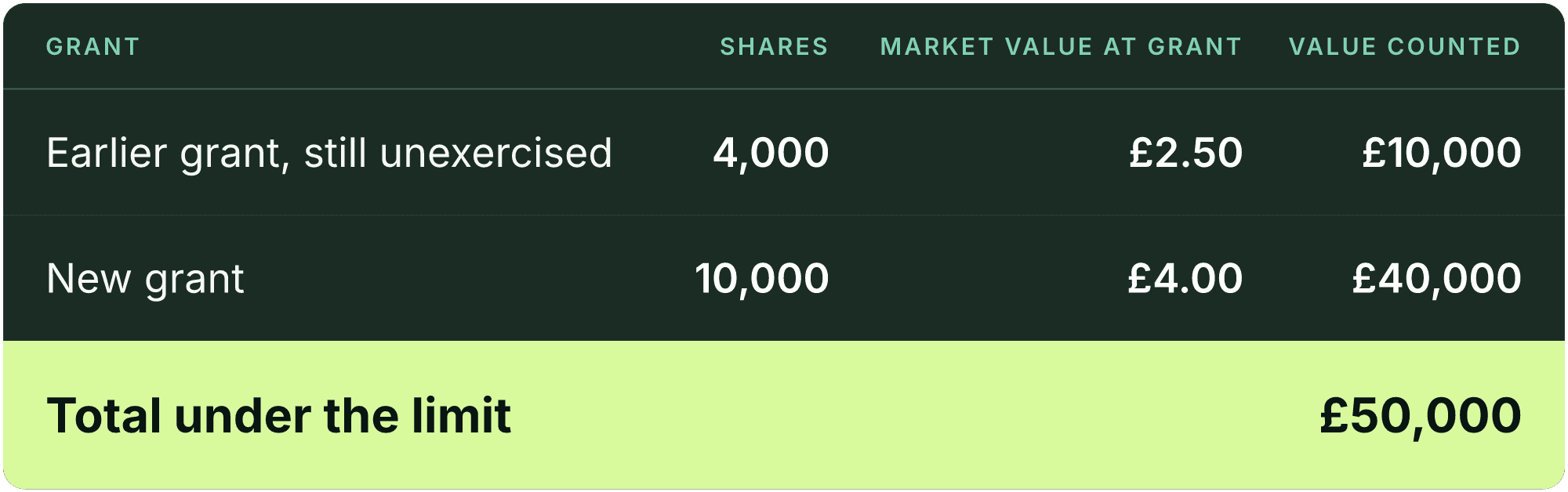
Take an employee who holds an earlier CSOP grant of 4,000 shares, valued at £2.50 each when granted. You now plan to grant 10,000 more shares, and the agreed market value is £4.00.
[](https://www.409.ai/uploads/what_is_a_csop_valuation_unrestricted_market_value_hmrc_sav_agreed_before_grant_table_1_66dacbb6e1.png)
The figures are illustrative. The employee has £10,000 of headroom left, which is 2,500 shares at £4.00. If the company wanted 14,000 new shares for this person, the excess would not qualify. Options that have been exercised, surrendered or have lapsed need not be counted, unless your scheme rules say otherwise.
Where a company also runs EMI, the two limits interact. The manual's example: a CSOP option with a market value of £60,000 [leaves £190,000 of the £250,000 EMI allowance](https://www.gov.uk/hmrc-internal-manuals/employee-tax-advantaged-share-scheme-user-manual/etassum41230). Our [CSOP guide](https://www.409.ai/articles/csop-share-options-2026-uk-hmrc-valuation) and the [EMI rules article](https://www.409.ai/articles/emi-share-options-2026-uk-rules-hmrc-valuation) cover when to use which.
Who needs one
Three situations bring a company to a CSOP valuation:
- A UK company in an excluded trade or above the EMI size limits that is granting options for the first time.
- A company that already runs EMI and wants to give a key employee more tax-advantaged options than EMI's per-person limit allows.
- A scheme that grants again after something changed: new money, a new share class, a shift in the business.
Eligibility of people is narrower than many expect. Only full-time directors and employees can receive options. The manual says [part-time directors cannot be added](https://www.gov.uk/hmrc-internal-manuals/employee-tax-advantaged-share-scheme-user-manual/etassum42110). Anyone who has, or in the previous 12 months had, a [material interest in a close company](https://www.gov.uk/hmrc-internal-manuals/employee-tax-advantaged-share-scheme-user-manual/etassum42310) is not eligible.
A US-parent company with UK employees should know the 409A answers a different question. Our note on [US option holders at non-US startups](https://www.409.ai/articles/non-us-startup-us-employee-stock-options-409a-strike-price) explains why a US report does not replace the UK process.
How long an agreed value lasts
Timing is where companies get caught. HMRC's user manual says SAV may be prepared to agree a market value on a particular day and accept that it can stand [for a specified period, usually the following 30 days](https://www.gov.uk/hmrc-internal-manuals/employee-tax-advantaged-share-scheme-user-manual/etassum44180). The valuation manual, for unlisted companies, describes a concession of [up to 90 days](https://www.gov.uk/hmrc-internal-manuals/shares-and-assets-valuation-manual/svm110110), always subject to no substantial change in the company's circumstances. The acceptance letter states which applies to you, so plan to the shorter figure.
A priced round, a signed term sheet or a sale approach can end an agreement early. If a round is close, decide whether to grant before it or after it and value for that choice. Our piece on [valuation triggers that beat the calendar](https://www.409.ai/articles/409a-valuation-frequency-how-often-should-you-get-one) works the same way here. And if your team may later trade shares on a private platform, read the [PISCES article](https://www.409.ai/articles/pisces-emi-csop-options-april-2028-amendment-valuation) first.
The steps, in order
1. Gather the company information. Three years of accounts, the cap table, the Articles, any investment documents and the business plan. 2. Commission the valuation. An independent report builds equity value from your financials and recent transactions, then allocates it across the share classes. The ordinary shares usually sit well below the last round price, because investor preferences rank ahead of them. Marketability discounts need support, as in our [discount for lack of marketability](https://www.409.ai/articles/discount-lack-marketability-dlom-409a-valuation) article. 3. Write to SAV with the proposal and the accounts. 4. Grant inside the agreed period. Have board approval and the grantee list ready first. 5. Register the scheme. Notice must reach HMRC by [6 July following the tax year of the first grant](https://www.gov.uk/hmrc-internal-manuals/employee-tax-advantaged-share-scheme-user-manual/etassum41130), with a declaration from the company secretary that the scheme meets the requirements.
What it costs, and what it sits beside
On our [CSOP valuation page](https://www.409.ai/products/csop-valuation), 409.AI prices the report at $3,499, a flat fee. HMRC's response time is outside anyone's control, so plan from report to grant in weeks. The accounting charge for the options in your accounts is a separate exercise from the tax valuation.
Questions UK founders ask
Do we have to agree the value with HMRC? No, it is recommended and not statutory. Without it, you carry the valuation risk.
Can we reuse our EMI valuation? Not as it stands. EMI uses an actual market value for the exercise price, while CSOP is tested at unrestricted market value, and the two schemes use different paperwork.
What if we get the price wrong? The manual says a grant made below market value falls outside the scheme and loses the tax advantages.
What to do this week
Confirm your people qualify, check each person's CSOP headroom against £60,000, and fix a grant date away from any round you can see coming. Then get the valuation done so the proposal goes to SAV with the accounts it asks for. If you want the report built for that submission, 409.AI's CSOP valuation service is made for it.
*This article is educational and not tax or legal advice. HMRC rules and forms change; confirm current requirements on GOV.UK and speak to a qualified adviser before you grant options.*