Tax
Wandry Clauses: Gift a Dollar Amount of Private Shares, Not a Count
For founders and estate attorneys: how a Wandry defined value clause fixes a gift of private shares in dollars, why Nelson lost, and what the appraisal carries.
By 409.AI Team - 2026-11-22
# Wandry Clauses: Gift a Dollar Amount of Private Shares, Not a Count
If you're a founder or family-business owner planning a year-end gift of private shares to a trust, and your estate attorney has suggested a "defined value" or Wandry clause, one sentence in the assignment decides whether that clause protects you. Write it one way and an IRS revaluation moves shares back to you, with no extra tax. Write it another way and the same revaluation becomes a seven-figure gift tax bill, which is what happened to the donors in *Nelson*.
This article is for that owner and for the attorney, CPA or wealth advisor drafting the gift. It covers what a defined value clause does, the two cases that set its limits, a worked example, and what the appraisal has to carry for the clause to work.
The problem the clause solves
A gift of private stock is valued at fair market value on the gift date: the price a willing buyer would pay a willing seller, both with reasonable knowledge of the facts ([26 CFR 25.2512-1](https://www.law.cornell.edu/cfr/text/26/25.2512-1)). There's no market price to point to, so the value is an appraiser's opinion, and the IRS can bring its own.
That's the risk. Say you transfer 250,000 shares because your appraiser values them at $60 each, a $15 million gift that uses exactly the 2026 basic exclusion. If the IRS later proves the shares were worth $75, you didn't give $15 million. You gave $18.75 million, and the $3.75 million above your exclusion is taxed at the top 40% rate of [26 U.S.C. § 2001(c)](https://www.law.cornell.edu/uscode/text/26/2001).
A defined value clause changes what was given. Instead of "250,000 shares", the assignment transfers "the number of shares whose fair market value equals $15,000,000". The dollar amount is fixed; the share count follows the value.
Why the IRS resists it
The IRS has fought adjustment clauses for eighty years. In *Commissioner v. Procter*, 142 F.2d 824 (4th Cir. 1944), a clause that undid part of a gift if a court found it taxable was held void as against public policy: it was a condition subsequent that would discourage collection of the tax, since any ruling that a gift was taxable would undo the very gift being taxed. The IRS built on that in Rev. Rul. 86-41, which says a clause that reconveys the excess to the donor after a revaluation is disregarded and the gift is valued without it.
The distinction the courts later drew is between a savings clause, which takes property back once the value is challenged, and a formula clause, which defines on day one a transfer measured in dollars. A formula clause gives away nothing more than the stated amount; the revaluation only tells you how many shares that amount always was.
Wandry: the formula clause that held
*Wandry v. Commissioner*, T.C. Memo. 2012-88, is the case owners mean when they say "Wandry clause". In 2004 the Wandrys gave each of their four children LLC units worth $261,000 and each of five grandchildren units worth $11,000, sized to their remaining exclusions. The assignment fixed the number of units by value as finally determined for federal gift tax purposes, and said the unit count would be adjusted if the IRS or a court reached a different value.
The gift tax returns, based on an appraisal, described the gifts as percentages of the company. The IRS revalued the units, and the parties later agreed the percentages given were worth $315,800 per child and $13,346 per grandchild. The IRS taxed the difference.
The Tax Court sided with the Wandrys. The documents transferred dollar amounts, not percentages; the capital accounts and the percentages on the returns didn't control. And unlike *Procter*, nothing came back to the donors after the gift: the units had always been limited to the stated value ([Journal of Accountancy summary](https://www.journalofaccountancy.com/issues/2013/feb/wandry/)).
The IRS dropped its appeal to the Tenth Circuit, then announced its nonacquiescence (2012-46 I.R.B. 543). It still treats the gifts as fixed percentages, so expect the argument on audit.
Nelson: the same idea, one phrase short
*Nelson v. Commissioner*, T.C. Memo. 2020-81, aff'd, 17 F.4th 556 (5th Cir. 2021), shows how little it takes to lose. Mary Pat Nelson gave a trust a limited partner interest "having a fair market value of $2,096,000", then sold it a further $20 million interest. The family partnership held mostly shares of a family operating company.
The gift assignment added a qualifier: the value was "as determined by a qualified appraiser within ninety (90) days" of the assignment ([Fifth Circuit opinion](https://www.ca5.uscourts.gov/Opinions/pub/20/20-61068-CV0.pdf)). The appraiser valued a 1% interest at $341,000, and the dollar amounts were converted to 6.14% and 58.65% of the partnership. The Tax Court found a 1% interest was worth $411,235. Gift tax followed: $87,942 each for 2008 and $920,340 each for 2009.
The Fifth Circuit read the clause by its plain words. The transfer was of the interests the appraiser determined to have the stated value, "no more and no less". Once the appraisal was done, the percentages were locked. The court set it against *Petter*, *Christiansen* and *Wandry*, whose documents tied the value to the value as finally determined for federal gift or estate tax purposes. It added a second gap: the Nelson documents said nothing about what happens to excess interests if the value is successfully challenged. *Wandry*'s said the unit count would be adjusted. *Petter* and *McCord* sent any excess to charity.
So the two drafting points are concrete. Tie the value to its final determination for federal gift tax purposes, not to an appraiser's report. And say where the excess goes.
A worked example
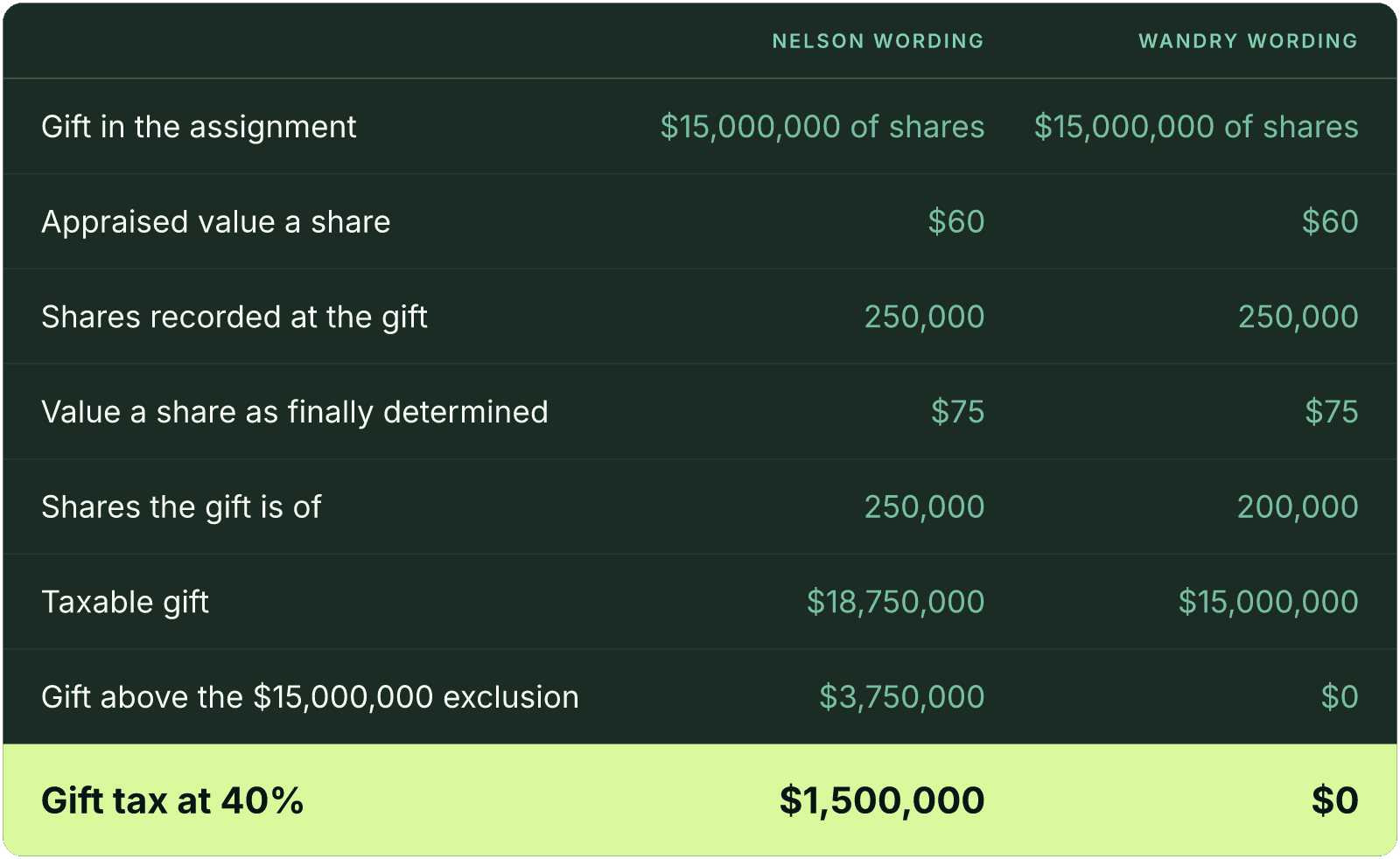
Take an illustrative owner of a family company who wants to use the full 2026 basic exclusion of $15 million ([Rev. Proc. 2025-32](https://www.irs.gov/pub/irs-drop/rp-25-32.pdf)) with a gift of common shares to a trust for the children, and who has made no earlier taxable gifts. The appraiser values the block at $60 a share, after the minority and marketability discounts; the IRS argues, and wins, $75. The table compares the two clauses: the Nelson wording ties the value to the appraiser, the Wandry wording to the value as finally determined.
[](https://www.409.ai/uploads/wandry_defined_value_clause_gift_private_shares_nelson_appraiser_table_1_4a56a8a177.png)
The Wandry wording doesn't make the extra value disappear. The 50,000 shares beyond the gift were never given: they're still the owner's, worth $3.75 million, and inside the estate. What it removes is the tax on a gift nobody intended to make.
The ratio matters too. A reported $60 against a final $75 is 80% of the final value, clear of the 65% line where the 20% penalty of Section 6662 starts, which our article on [the gift tax valuation penalty bands](https://www.409.ai/articles/gift-tax-valuation-penalty-section-6662-65-percent-40-percent-discounts) works through. A formula clause doesn't excuse a weak appraisal, and the penalty is measured on the value reported.
What the appraisal has to carry
A defined value clause shifts the question from "how much tax" to "how many shares". The appraisal is still the number everyone relies on for the next three years, and it does four jobs.
It sets the share count the company records. The trust, the share register, the next distribution and the K-1 all follow the count the appraisal produces. In *Nelson* the family reallocated past distributions to match a higher value they expected to settle on, and that bookkeeping is the price of any later adjustment. The more defensible the first number, the less likely anyone has to unwind it.
It starts the statute. The IRS has three years to revalue a gift only if the Form 709 discloses it adequately, including a qualified appraisal that meets [Treas. Reg. 301.6501(c)-1(f)(3)](https://www.law.cornell.edu/cfr/text/26/301.6501(c)-1). Without it the clause can be tested at any time, and a share count that might move for decades isn't a plan. The disclosure requirements are in our article on [Form 709 adequate disclosure for founder stock](https://www.409.ai/articles/form-709-adequate-disclosure-founder-stock-gift).
It values the exact block given. A gift of 250,000 non-voting shares to a trust is a minority interest with no market. The discounts for lack of control and marketability are where the IRS and the taxpayer usually part ways, so the report has to support each one on that block, as [our article on the lack-of-control discount](https://www.409.ai/articles/discount-lack-of-control-dloc-409a-gift-tax-valuation) explains. A 409A report for the same company is a starting point, not the gift report, for the reasons in [Can I use my 409A for a gift?](https://www.409.ai/articles/409a-vs-gift-tax-valuation-form-709-founder-stock)
It ties to the other numbers that depend on value. If the trust is a dynasty trust, the GST exemption is allocated against the same value and the inclusion ratio moves with it ([GST exemption on a gift of private shares](https://www.409.ai/articles/gst-exemption-allocation-private-shares-dynasty-trust-inclusion-ratio)). If the gift sits beside a sale to the same trust, as in *Nelson*, the note is priced off the appraisal too ([selling private stock to a grantor trust](https://www.409.ai/articles/sale-to-idgt-private-stock-appraisal-note-afr-gift-tax)).
Drafting points to settle before the gift date
Most of these belong to your attorney. They're listed here so the owner knows what to ask for and the appraiser knows what the documents will say.
- The assignment transfers a dollar amount of shares, measured at fair market value as finally determined for federal gift tax purposes, not as determined by the appraiser.
- It says what happens to any excess: the share count adjusts, or the excess passes to a charity or a marital or incomplete-gift trust. Each choice has its own consequences, and the charity route is what *Petter* and *McCord* relied on.
- The company's records show the gift as a dollar amount with the share count derived from the appraisal, not as a fixed number of shares.
- The Form 709 describes the transfer the same way the assignment does. In *Wandry* the returns reported percentages, and the IRS used them.
- The appraisal is dated to the gift date, values the block actually given, and is delivered in time for the return.
The takeaway
A defined value clause is worth having on a large gift of private shares, but it protects you only through its wording and the appraisal behind it. "As finally determined for federal gift tax purposes" is what held in *Wandry*; "as determined by a qualified appraiser" is what lost in *Nelson*, at a cost of nearly $1 million in gift tax per spouse for one year. Get the assignment drafted first, then commission a [gift and estate tax valuation](https://www.409.ai/products/gift-estate-tax) that values the exact block on the gift date and supports the Form 709. If you're still deciding between a December and a January gift, [the 2027 exclusion changes that choice](https://www.409.ai/articles/december-or-january-gift-private-shares-2027-exclusion-rev-proc-2026-35) as well.