Financial Reporting
Trade Name Impairment Under ASC 350-30: How the Annual Test Works
For the acquirer's CFO or controller: how an indefinite-lived trade name is tested under ASC 350-30, a relief-from-royalty example, and the auditor's file.
By 409.AI Team - 2026-11-14
# Trade Name Impairment Under ASC 350-30: How the Annual Test Works
If your company bought a business and the purchase price allocation put a trade name on the balance sheet with no amortization, that number has to be tested for impairment every year. This post is for the CFO or controller of that acquirer, and for the auditor reviewing the year-end file: what the ASC 350-30 test asks, how the fair value is usually built, and the three judgments that decide whether a write-down lands this December.
The trade name is the asset most finance teams forget about. Goodwill gets a test date on the close calendar. Customer relationships amortize quietly. The trade name sits there at its acquisition-date value until someone asks whether the brand still earns what the deal model said it would.
Why a trade name is often not amortized
Under ASC 350-30-35-4, an intangible asset's useful life is indefinite when no legal, regulatory, contractual, competitive, economic or other factor limits the period over which it is expected to contribute cash flows. A registered trademark can usually be renewed at little cost, so a brand the buyer intends to keep using often qualifies.
Indefinite does not mean infinite. It means nobody can point to the year the brand stops earning. Because it is not amortized, the standard replaces amortization with a test: at least once a year, and in between whenever events or changes in circumstances indicate that the asset is more likely than not impaired (ASC 350-30-35-18).
Two details are worth knowing before year-end. The standard does not fix the date of the annual test, and a change in that date may not leave more than twelve months between tests or be used to avoid a loss (PwC's guide to [indefinite-lived intangible impairment](https://viewpoint.pwc.com/dt/us/en/pwc/accounting_guides/business_combination/business_combination__28_US/chapter_8_accounting_US/83_impairment_of_ind_US.html) walks through both). And the life itself has to be reassessed every reporting period (ASC 350-30-35-16), which matters more than most teams expect. We come back to it below.
Step zero: the qualitative assessment
Since ASU 2012-02, a company may start with a qualitative look instead of computing fair value. The question is whether it is more likely than not, meaning a likelihood above 50%, that the trade name is impaired. If the answer is no, the test stops there. If the answer is yes, or the company skips the step, it moves to the quantitative test.
The factors to weigh are listed in ASC 350-30-35-18B and group into cost factors, financial performance, legal and regulatory changes, entity-specific events, industry and market conditions, and macroeconomic conditions. None of them is a trigger on its own. A 6% revenue miss on the branded line does not force a quantitative test; a 6% miss, a higher cost of capital and a plan to sell the product under the parent's name together probably do.
In practice the qualitative route is only as strong as the headroom from the last full valuation. If last year's fair value cleared the carrying amount by 40%, a short memo covering the factors is usually enough. If it cleared by 5%, an auditor will ask what evidence shows the brand did better than plan, and the honest answer is often a new valuation.
The quantitative test is one comparison
Here the trade name test differs from the long-lived asset test most teams know. There is no recoverability step with undiscounted cash flows. ASC 350-30-35-19 compares the asset's fair value with its carrying amount, and if fair value is lower, the impairment loss equals the difference. The written-down amount becomes the new accounting basis, and ASC 350-30-35-20 prohibits reversing the loss later, even if the brand recovers.
That single comparison makes a trade name more fragile than the asset groups around it. An asset group under ASC 360 can sit below its fair value for years without a charge as long as its undiscounted cash flows recover the carrying amount, a test we unpack in our post on [ASC 360 asset groups](https://www.409.ai/articles/asc-360-asset-group-lowest-level-cash-flows-recoverability-test-impairment-loss). A trade name gets no such cushion.
How the fair value is usually built: relief from royalty
The common method for a trade name is relief from royalty. The logic: because the company owns the brand, it avoids paying someone else a royalty to use it. The value of the brand is the present value of those avoided royalties, after tax.
The inputs an auditor will test are the revenue the brand supports, the royalty rate (supported by comparable licensing agreements), the tax rate, the discount rate and the long-term growth rate. Most valuations also add a tax amortization benefit, because a market participant buying the trade name on its own could amortize it for tax over 15 years under [IRC Section 197](https://www.law.cornell.edu/uscode/text/26/197). The same inputs fed the acquisition-date value in the purchase price allocation, so the year-end test is in effect a refresh of that model with today's forecast and today's rates. If the deal model's rates do not reconcile, the impairment file inherits the problem; our post on [reconciling the IRR, WACC and WARA](https://www.409.ai/articles/purchase-price-allocation-reconcile-irr-wacc-wara-goodwill-return-asc-805) explains why.
A worked example
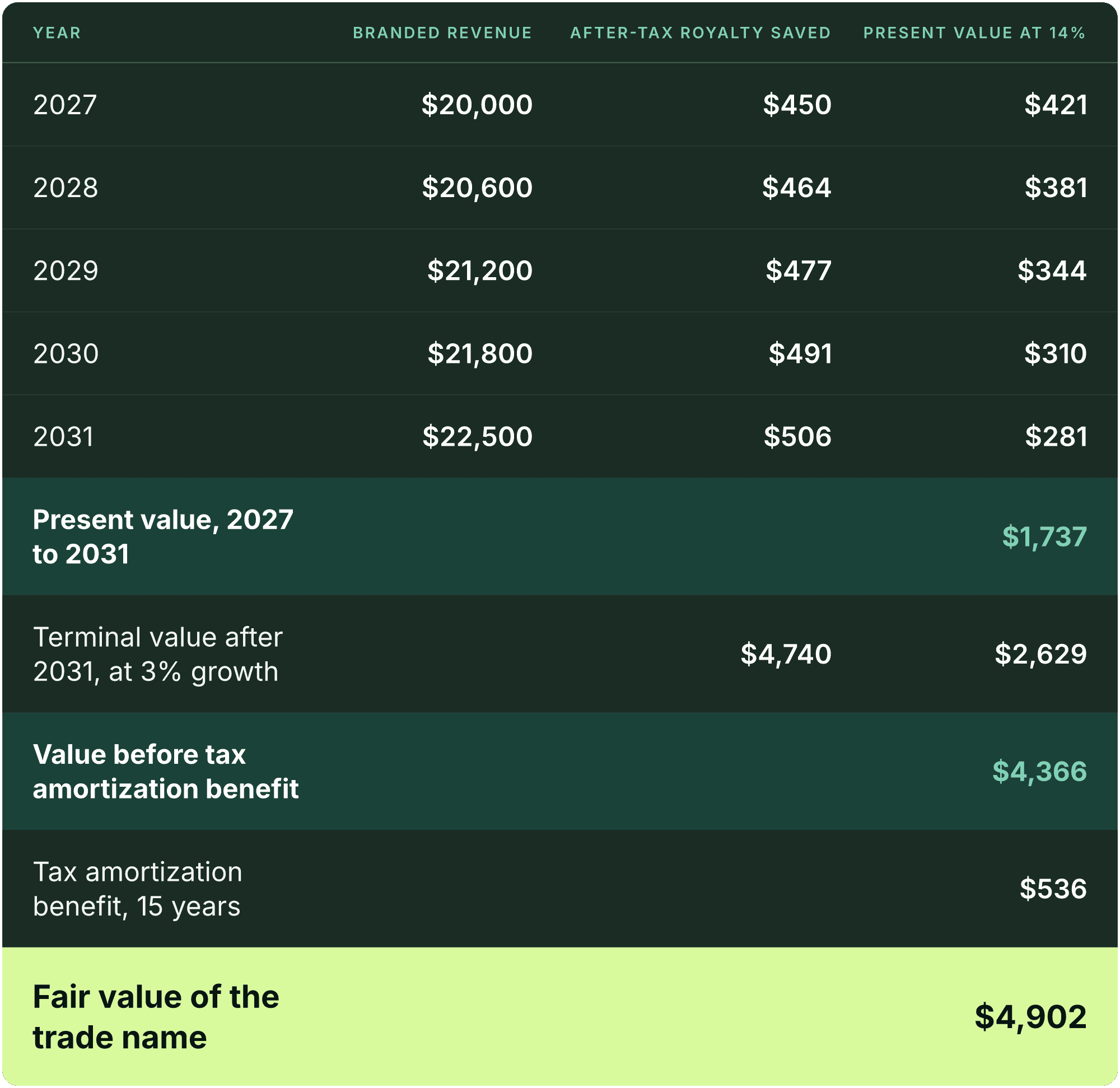
An illustrative acquirer bought a consumer brand in 2024 and recorded the trade name at $6.0 million as indefinite-lived. The deal model assumed the branded line would reach $28 million of revenue by 2027. It is now on track for $20 million in 2027, growing about 3% a year. The valuation uses a 3% royalty rate, a 25% tax rate, a 14% discount rate (mid-year convention) and 3% terminal growth.
The table below builds the fair value in thousands of dollars.
[](https://www.409.ai/uploads/trade_name_impairment_asc_350_30_indefinite_lived_intangible_relief_from_royalty_table_1_308dddf811.png)
Against a carrying amount of $6,000, the brand is short by $1,098. That is the impairment charge, reported in continuing operations before income taxes (ASC 350-30-45-2), and $4,902 becomes the new basis. Notice what drove it: not the royalty rate or the discount rate, but a revenue line nearly 30% below the deal model. When the brand's revenue resets, the trade name almost always follows.
If the acquisition was a stock deal, the trade name probably carried a deferred tax liability for the gap between its book and tax basis. Cutting the book value shrinks that liability, so part of the charge comes back as a deferred tax benefit. Our post on [deferred taxes in a purchase price allocation](https://www.409.ai/articles/deferred-tax-liability-purchase-price-allocation-stock-deal-goodwill-asc-805) shows where that liability came from.
Three judgments that decide the result
The unit of accounting
The default unit is the individual trade name. Separately recorded indefinite-lived intangibles are combined only when they are operated as a single asset and are essentially inseparable (ASC 350-30-35-21 to 35-28). A brand registered separately in the US, Canada and the UK but marketed as one brand may qualify; two brands sold on their own shelves usually do not. A unit can never include goodwill or long-lived assets. Combining a weak country registration with a strong one can avoid a charge, which is exactly why the auditor will want the indicators documented rather than asserted.
The order of the tests
When a trade name, an ASC 360 asset group and goodwill are tested in the same period, the trade name goes first. Its write-down reduces the carrying amount of the asset group, and the goodwill test comes last (ASC 350-20-35-31). Run them in the wrong order and the goodwill charge is overstated, the trade name charge is lost, or both. Our [goodwill impairment guide for private companies](https://www.409.ai/articles/goodwill-impairment-private-company-asc-350) covers the goodwill side of that sequence.
Whether the life is still indefinite
This is the judgment most teams skip. If the company decides to fold the acquired brand into its own name over three years, the life is no longer indefinite. ASC 350-30-35-17 then requires a final impairment test as an indefinite-lived asset before amortization starts, and amortization over the remaining life after that. A rebranding decision in the fourth quarter therefore does two things to this year's statements: it can trigger a write-down at the old value, and it starts an expense line in next year's income statement.
What changes for a private company
Less than finance teams hope. The private-company alternatives are written for goodwill: amortizing goodwill under ASU 2014-02, and, under ASU 2021-03, checking for goodwill triggering events only at the reporting date ([KPMG's summary](https://kpmg.com/us/en/frv/reference-library/2021/fasb-goodwill-private-company-alternative.html) notes it does not change the triggering-event rules for other assets). A trade name carried as indefinite-lived is still tested under ASC 350-30.
The one alternative that touches the brand is ASU 2014-18, and it does not remove it. A private acquirer may leave certain customer relationships and noncompete agreements inside goodwill, but a trade name is still recognized and valued separately. Our post on [the ASU 2014-18 election](https://www.409.ai/articles/asu-2014-18-private-company-election-first-add-on-goodwill-cost) explains what folds in and what stays out.
What the auditor will ask for
A year-end file that survives review usually holds the qualitative memo or the valuation report, the branded revenue forecast with a bridge from the deal model, support for the royalty rate, the discount rate build, the unit-of-accounting analysis if registrations were combined, and a note confirming the life is still indefinite. The overview in [what an impairment test is](https://www.409.ai/articles/what-is-an-impairment-test-asc-350-asc-360-valuation-auditor-file) lists the rest of the impairment package.
If the trade name's last valuation had thin headroom, or the branded line missed the deal model this year, it pays to have the fair value done before the audit fieldwork starts rather than during it. That is the work behind [409.AI's impairment testing](https://www.409.ai/products/impairment-testing): the relief-from-royalty model, the inputs documented for the auditor, and the order of tests set out alongside goodwill and the asset groups.
The takeaway
An indefinite-lived trade name is tested on one number, fair value against carrying amount, with no cushion and no reversal. Before December 31, compare the brand's actual revenue with the deal model, check the headroom from the last valuation, and ask whether anyone has decided to retire the name. If any of those three answers is uncomfortable, the qualitative memo is not going to carry the file.