Education
409A for a Token-Issuing Startup: What the Token Treasury Does to Your Equity Value
Token-issuing founders: ASU 2023-08 skips your own token, but a 409A still counts it. See how treasury, token promises and discounts move your strike price now.
By 409.AI Team - 2026-11-06
# 409A for a Token-Issuing Startup: What the Token Treasury Does to Your Equity Value
A founder of a protocol company closes a priced round, then asks the question that stalls every grant that quarter: what's the strike price? The company holds ETH it bought, a large block of its own token, and a stack of agreements that promise tokens to investors and partners. The balance sheet shows one picture. The cap table shows another. The 409A has to reconcile them.
This is written for the founder or finance lead of a token-issuing startup who is about to grant options after a token sale or a priced equity round. The accounting standard for crypto changed recently, and people assume it settles the valuation question. It doesn't. It settles part of one.
What the accounting standard covers, and what it leaves out
ASU 2023-08 (ASC 350-60) moved crypto assets to fair value through net income. It applies to assets that meet six criteria, including that they're fungible, sit on a distributed ledger, are secured by cryptography and give the holder no enforceable rights to other assets. The sixth criterion matters most here: the asset must not be "created or issued by the reporting entity or its related parties" ([ASU 2023-08](https://storage.fasb.org/ASU%202023-08.pdf)).
The FASB made that exclusion on purpose. In its basis for conclusions, the Board noted that stakeholders "did not ask that the Board address an issuer's accounting," and that many issuers didn't support measuring their own crypto assets at fair value. The amendments took effect for fiscal years beginning after December 15, 2024. We walk through the six tests and the adoption mechanics in our piece on [ASC 350-60 for private companies](https://www.409.ai/articles/asc-350-60-crypto-assets-private-company-fair-value), so we won't repeat them.
The consequence for a token issuer is simple. The ETH the company bought is marked to fair value in the financial statements. The company's own token is not covered by the new standard, so the financial statements can show it at little or nothing while its market price says millions.
A 409A doesn't care which way the accounting went. Treasury Regulation §1.409A-1(b)(5)(iv)(B) says the fair market value of private company stock is set by the reasonable application of a reasonable valuation method, and that the factors to consider include "the value of tangible and intangible assets of the corporation" ([26 CFR §1.409A-1](https://www.law.cornell.edu/cfr/text/26/1.409A-1)). A token treasury is an asset, whatever the ledger says. Whether a token is a security is a legal question that belongs with your counsel; the valuation takes the legal structure as given and values what the company owns and owes.
Three questions an appraiser has to answer
What does the company own? Purchased crypto is the easy part. A quoted price in the principal market, adjusted for any contractual sale restriction, gets close. The company's own token is harder, because the company is not a price-taker. It created the supply, it controls the release schedule, and it is probably the largest holder. A quoted price of $0.50 is the price for a few thousand tokens on a Tuesday. It isn't a price for ten million tokens.
What does the company owe? Token sales often come with side agreements: a SAFT, a token warrant attached to an equity round, a partner allocation, a vesting schedule for the team. Each one is a promise to deliver tokens the company holds, or will hold. Those tokens belong to someone else in economic terms. Counting them in the treasury at full value while the promises sit in a footnote overstates what equity holders own.
Who shares the rest? Once the appraiser has an equity value, it still has to be split among common stock, preferred stock, options, and any warrants that convert into shares. Token-linked instruments that settle in tokens rather than shares sit outside that split. Instruments that convert into equity sit inside it. The difference decides whose slice shrinks. Our guide to [OPM, PWERM and backsolve allocation](https://www.409.ai/articles/409a-allocation-methods-opm-pwerm-backsolve) covers the mechanics, and [how SAFEs affect a 409A](https://www.409.ai/articles/how-safes-affect-your-409a-valuation) covers the first step of untangling convertible paper.
A worked example
Take a company we'll call Lattice Labs. All figures are illustrative.
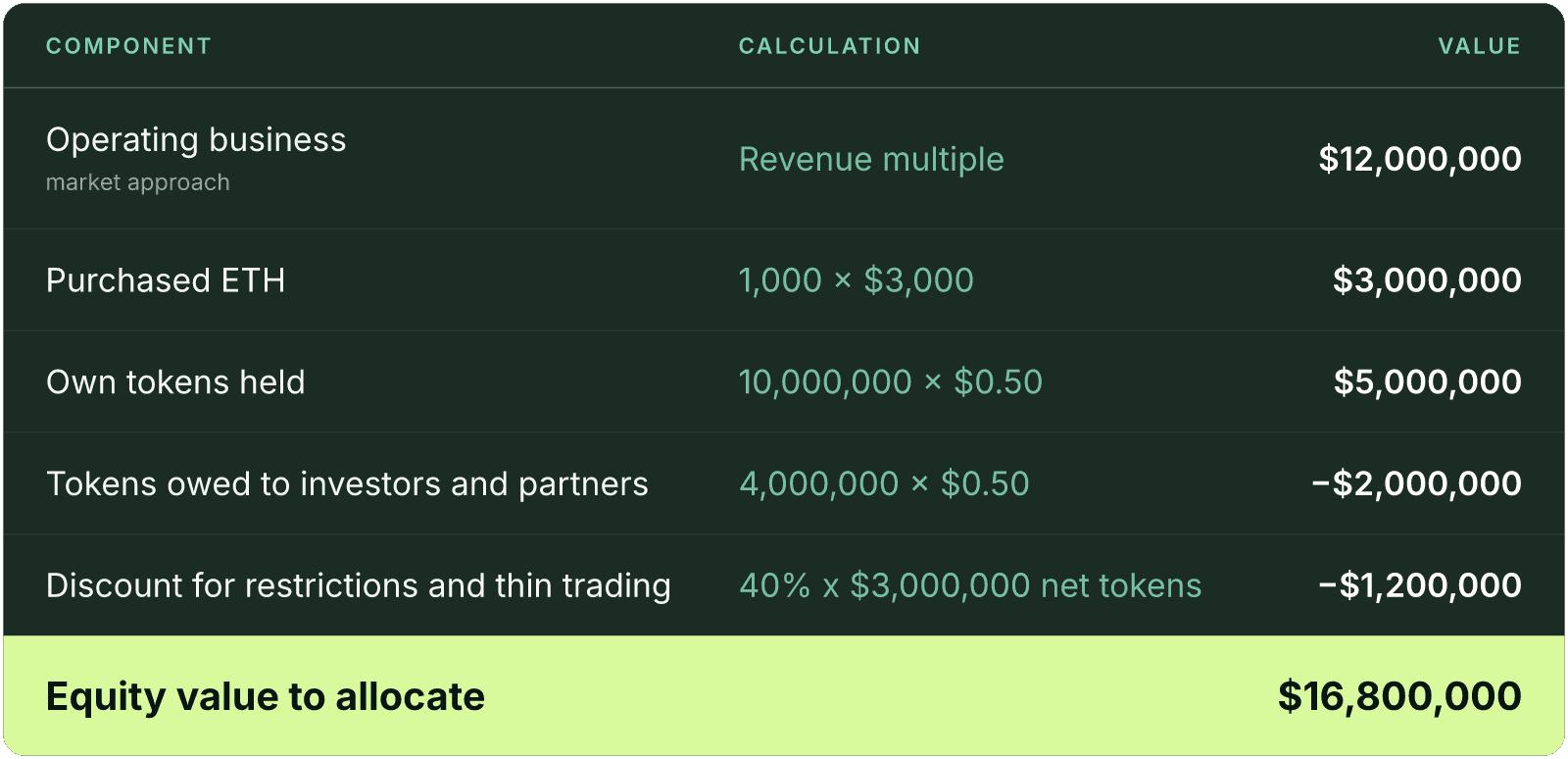
The operating business, a protocol developer with licensing revenue, comes to $12 million on a market approach. The company also holds 1,000 ETH it bought as treasury, priced at $3,000 each, and 10 million of its own tokens, quoted at $0.50. It has promised 4 million tokens to investors and partners through token warrants and a SAFT. Daily trading volume is thin and a third of supply is still locked, so the appraiser applies a 40% discount to the net token position for blockage and restrictions.
[](https://www.409.ai/uploads/token_issuing_startup_409a_token_treasury_asu_2023_08_table_1_4723877405.png)
The headline token treasury of $5 million shrinks to $1.8 million once the delivery promises and the discount are in. If the appraiser had taken the quoted price at face value and ignored both the promises and the discount, equity value would have come out near $20 million, about $3.2 million too high. That gap flows straight into the strike price, and with it into the spread an employee will later be taxed on.
Whether a 40% discount is right is a judgment about this company's token, and nothing here says it is. Restricted-stock studies and option-based models are the usual tools for sizing it, and an appraiser should show which one drove the number.
When the treasury moves, the valuation moves
The same example shows the second problem. Treasury assets don't hold still. Suppose ETH halves, from $3,000 to $1,500. The purchased position falls from $3.0 million to $1.5 million, a $1.5 million drop, or about 9% of the $16.8 million. Suppose the token halves too, from $0.50 to $0.25. The net token value falls from $1.8 million to $0.9 million, another $0.9 million, about 5%. Together that's $2.4 million, or roughly 14% of equity value, with no change at all in the operating business.
The regulation addresses this. A previously calculated value is not reasonable later if it "fails to reflect information available after the date of the calculation that may materially affect the value of the corporation," or if it was calculated for a date more than 12 months earlier ([26 CFR §1.409A-1](https://www.law.cornell.edu/cfr/text/26/1.409A-1)). The regulation's examples are the resolution of material litigation and the issuance of a patent. A 14% swing driven by two assets the company actually owns is a plausible fit for that test, and the safe harbor is what you lose if you grant off the old number. Our guide to [how often to refresh a 409A](https://www.409.ai/articles/409a-valuation-frequency-how-often-should-you-get-one) explains why the calendar is only the outer limit, and [the bridge round case](https://www.409.ai/articles/bridge-round-409a-material-event-option-grant-timing) shows the same logic for a financing.
For a token company, a practical rule follows. Agree with your appraiser before the valuation what price movement in the treasury would trigger a refresh. Writing a threshold down in advance beats debating it after the token has already moved.
The earnings trap
One more effect catches teams who read the standard's headline and stop there. Because purchased crypto now runs through net income at fair value, a strong quarter for ETH makes the company look more profitable. A valuation that capitalizes earnings or applies a multiple to net income would count that gain as if the business earned it.
The fix is mechanical. Strip the unrealized crypto gains and losses out of any earnings measure before applying a multiple, and value the purchased crypto separately as a non-operating asset, as in the table above. An appraiser who doesn't do that hands you a number your auditor will question in the first audited year, the moment someone compares the 409A to the financial statements. We cover what that review tests in [what a first audit asks about your 409A](https://www.409.ai/articles/first-audit-409a-valuation-au-c-540-assumptions).
What to bring to the engagement
Before the appraiser starts, collect five things:
- A schedule of every crypto holding, split into purchased and self-issued, with units, acquisition date and any lockup.
- Every agreement that promises tokens, with the number of tokens, the delivery date and the conditions.
- The token's trading history: exchanges, average daily volume and the release schedule.
- The cap table, including any warrants that convert to equity.
- Your reading, from counsel, of how each instrument is classified.
The first two items carry most of the work. If the token promises aren't on a list, they can't reach the valuation. For a first look at what the process involves, start with [the 409A valuation service](https://www.409.ai/products/409a), and if this is your first valuation, [what to expect before your first option grant](https://www.409.ai/articles/first-409a-valuation-pre-revenue-startup-before-first-option-grant) covers the basics.
The takeaway: the accounting rule decides what your financial statements show for the tokens you bought. It says nothing about the tokens you issued, and a 409A that treats the two the same will misprice your options in one direction or the other.