Financial Reporting
Tender Offer Above Fair Value: The ASC 718 Compensation Cost Your Auditor Will Look For
Startup CFOs running a tender: when a price above the fair value of common stock becomes ASC 718 compensation cost, even when an investor pays, with an example.
By 409.AI Team - 2026-11-18
# Tender Offer Above Fair Value: The ASC 718 Compensation Cost Your Auditor Will Look For
If you are the CFO or controller of a venture-backed company that just let employees sell shares in a tender offer, the cash is the easy part. The harder question arrives at year-end, when the auditor asks why the price paid in the tender was $12.00 a share while the fair value of your common stock, according to your own valuation, was $8.50 on the same day.
That $3.50 gap does not vanish into a footnote. Under ASC 718, the excess of the price paid over fair value is usually compensation cost, recognized in the income statement, and it can be large enough to move a year's operating loss. This article walks through when a tender or secondary sale creates that expense, how to measure it, and what the file should contain before fieldwork starts.
The rule in one paragraph
ASC 718-20-35-7 deals with an entity that repurchases an equity award. The cash paid, up to the fair value of the instruments on the repurchase date, is charged to equity. Anything above that fair value is additional compensation cost. RSM's June 2024 stock compensation guide restates it plainly: if the repurchase price exceeds fair value, only the amount up to fair value goes to equity, and the excess is recognized as compensation cost.
The logic is simple once you see it. Fair value is what the share is worth. If the company pays an employee more than that, the extra is a payment for something else, and the only thing the employee gives the company besides the share is service.
Who is buying matters less than you think
Many tenders today are not company buybacks at all. A new or existing investor buys common stock directly from employees, and the company only runs the process. It is tempting to conclude that a sale between two shareholders never touches the company's books.
ASC 718-10-15-4 closes that door. A share-based payment made by a related party or another holder of an economic interest in the company, for services provided to the company, is accounted for by the company as if it had made the payment itself, unless the payment is clearly for some other purpose. The substance, as RSM explains it, is that the investor made a capital contribution which the company then used to compensate its people: debit compensation cost, credit additional paid-in capital. "Economic interest" is defined broadly in the ASC Master Glossary. It covers equity, debt, leases and service contracts, so a lead investor with a board seat plainly qualifies.
So the real question is not who wrote the check. It is whether the premium was paid, at least in part, because the sellers work for you.
Signs that a premium is compensation
There is no bright-line test in the Codification. The accounting firms that write on this point to the same handful of facts, and an auditor will look for them in your tender documents.
The company shaped the deal. CBIZ (August 2022) lists connecting buyers and sellers, deciding who may take part, negotiating the price or the number of shares, and giving the buyer information other shareholders do not have. Equity Methods (July 2024) adds a price set by the company with the investor rather than negotiated between buyer and seller, and limits on which employees may sell or how much.
The sellers are employees, and senior ones. A sale by a long-serving executive looks more like a reward than a sale by someone hired last month. A buyer and seller with a close personal relationship can point the other way, toward a gift.
There is a pattern. A company that has bought employee shares above fair value before will struggle to call this one a one-off.
The company benefits. Using the tender to settle obligations to former employees, or to retain people before a hard year, makes the premium look like pay.
In the other direction, a price set by a large, informed investor who wanted the stake for its own reasons, in a process open to all holders on the same terms, can be evidence that the price simply is fair value. That brings in the second half of the problem.
The circular part: the tender price is also a fair value input
Your fair value is not a fixed number sitting beside the tender. The tender is itself a transaction in your common stock, and a valuation has to weigh it. A price agreed by willing buyers and sellers in an orderly transaction is strong evidence. A sale that was forced, tiny or full of non-market terms is weaker. Our [guide to how tender offers affect a 409A](https://www.409.ai/articles/tender-offers-secondary-sales-409a-valuation) covers how appraisers calibrate to a secondary price.
This is why the two questions must be answered together and in the same file:
- If the valuation gives the tender full weight, fair value equals the tender price and there is no excess to expense.
- If the valuation gives the tender partial or no weight, fair value sits below the tender price, and the gap is presumptively compensation, unless the facts show another purpose.
What a company cannot do is argue both ways at once: little weight on the tender to keep the 409A strike price low for next month's grants, and no compensation cost because the tender was really at fair value. An auditor who reads both documents will see the contradiction.
The AICPA is updating its accounting and valuation guide on privately held equity securities issued as compensation, the "cheap stock guide" last revised in 2013, to address exactly this. KPMG reports that a working draft was issued for comment on December 21, 2025, with comments due June 1, 2026; it covers how secondary transactions and repurchases affect fair value and whether they carry a compensatory element. Until a final guide is out, the draft shows the direction of travel, and your auditor has likely read it.
A worked example
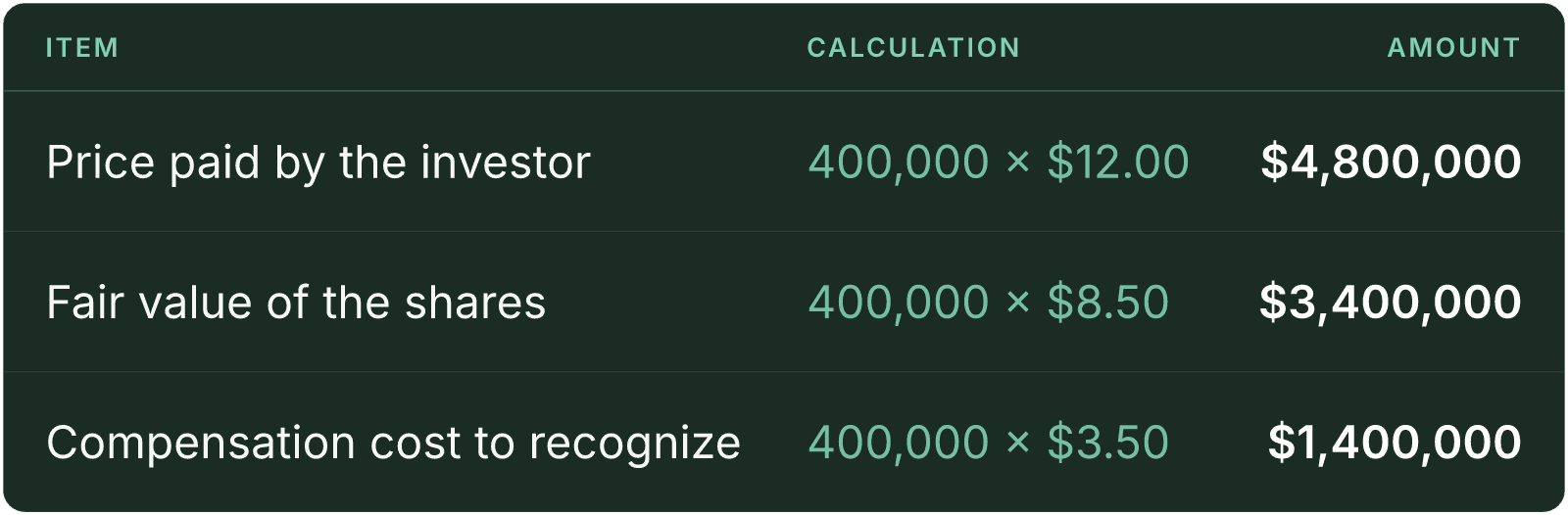
Assume a Series B company runs a tender in which its lead investor buys 400,000 common shares from 25 employees at $12.00 a share. The company picked the eligible employees, capped each at 20% of their vested holdings and agreed the price with the investor. The valuation as of the tender date weighs the tender alongside the income and market approaches and concludes on $8.50 for a share of common stock. These figures are illustrative.
[](https://www.409.ai/uploads/tender_offer_above_fair_value_asc_718_compensation_cost_secondary_sale_table_1_01d350254e.png)
Because the company shaped the deal, the premium is treated as paid on its behalf. The entry is a debit to compensation cost of $1,400,000 and a credit to additional paid-in capital for the same amount, under ASC 718-10-15-4. Had the company bought the shares itself, the $3,400,000 up to fair value would go to equity as treasury stock and the $1,400,000 excess to compensation cost under ASC 718-20-35-7. Either way, the income statement carries $1,400,000.
The cost is recognized when the tender closes, because the shares sold were vested and no further service is required. It is classified with the rest of stock-based compensation in the functional lines where those employees' pay sits, and it belongs in the stock compensation disclosure.
Two traps inside the same tender
Unvested shares and options. A tender sometimes lets holders sell shares from an early exercise that are still subject to repurchase, or cashes out options. Buying back an award for which service has not been rendered accelerates it: RSM, following Example 12, Case D of ASC 718 (718-20-55-102), explains that a cash settlement of nonvested options effectively vests them, so all remaining unrecognized grant-date cost is recognized on the settlement date, on top of any excess over fair value. In that example, settling at exactly fair value still brought forward $9.79 per option of unrecognized cost.
Liability classification. Awards that the holder can put back for cash, or that the company has a practice of repurchasing soon after vesting or exercise, can fail equity classification under ASC 718-10-25-9. A first tender rarely does this alone. A tender every year, open to shares held only briefly, starts to look like a policy, and RSM notes that a history of repurchases is a reason to consider whether awards have been modified to liabilities. Our [article on buying back a leaver's shares](https://www.409.ai/articles/repurchase-departing-employee-shares-409a-price-not-the-rule) covers the six-month point in more detail.
What to have in the file before the audit
The auditor will want to rebuild your conclusion, not just read it. Five documents do most of the work:
1. The tender offer documents: who could sell, any caps, how the price was set and who negotiated it. 2. A memo on the compensation question that walks through the factors above and reaches a conclusion under ASC 718-10-15-4 or 718-20-35-7. 3. A valuation of the common stock as of the tender date that states how much weight the tender received and why. A report dated three months earlier is weak support for a fair value on the tender date. 4. The calculation of any excess, by seller if the price or the fair value differs across classes. 5. Board minutes approving the tender and, where relevant, the investor's side letter.
If your 409A report is also serving as the current price input for ASC 718, check that it meets the conditions in our [ASU 2021-07 checklist](https://www.409.ai/articles/asu-2021-07-409a-asc-718-current-price-checklist) on the tender date as well.
Where this leaves the employees
Nothing in the accounting changes what the sellers receive. The tax treatment of their sale is a separate analysis with its own rules; for holders of incentive stock options, our [guide to a disqualifying disposition](https://www.409.ai/articles/iso-disqualifying-disposition-sell-early-ordinary-income-basis) shows how an early sale splits the gain. Whether a premium is also compensation for tax purposes is a question for your tax advisor, and it should be asked before the tender closes, not after.
The takeaway
A tender above the fair value of your common stock is usually a stock compensation event, even when an investor writes the check. The size of the expense is the gap between the tender price and a fair value measured on the tender date, and that fair value has to explain how much weight it gave the tender itself. Settle both numbers in one file before the tender closes, and the year-end conversation with your auditor is short.
If you need the fair value behind that file, our [ASC 718 valuation](https://www.409.ai/products/asc-718) measures it as of the tender date, with the weighting explained for the auditor. For the full picture of how stock compensation reaches your statements, start with our [ASC 718 guide for startups](https://www.409.ai/articles/asc-718-stock-based-compensation-startup-guide) and [what an ASC 718 valuation report contains](https://www.409.ai/articles/what-is-an-asc-718-valuation-grant-date-fair-value-report-auditor-asks-for).
*Sources: FASB ASC 718-10-15-4, 718-10-25-9, 718-20-35-7 and 718-20-55-102 (Example 12, Case D); RSM US, A Guide to Accounting for Stock Compensation (June 2024), sections 1.3.4 and 6.6; CBIZ, Secondary Market Transactions: What Companies Should Know About Accounting for Sales of Shares (August 2022); Equity Methods, Private Company Update: Valuation and Compensation Implications of Private Transactions (July 2024); KPMG, AICPA issues working draft of updated cheap stock guide (2026).*