Financial Reporting
Tax-Deductible Goodwill Impairment: Why the Loss Is Bigger Than the Gap
For CFOs testing goodwill from an asset deal: why ASC 350-20-35-8B grosses the impairment up for deferred taxes, with the formula and a worked $4M example.
By 409.AI Team - 2026-11-20
# Tax-Deductible Goodwill Impairment: Why the Loss Is Bigger Than the Gap
Your reporting unit's fair value came in $3 million below its carrying amount, so the goodwill impairment is $3 million. That's how the one-step test reads, and for most reporting units it's the right answer. If the goodwill was born in an asset deal, a Section 338(h)(10) election or the purchase of an LLC, though, the right answer is probably $4 million, and the auditor will ask why your file says three.
This article is for the CFO or controller who owns the year-end goodwill test of a reporting unit with tax-deductible goodwill, and for the valuation team building that file. It covers the rule FASB wrote for this case, why the arithmetic loops, the one formula that closes the loop, and what has to be in the workpapers before fieldwork.
Why the one-step test needed a tax rule
ASU 2017-04 removed Step 2, the hypothetical purchase price allocation that used to measure the loss. Since then the loss is simply the amount by which a reporting unit's carrying amount exceeds its fair value, limited to the goodwill allocated to that unit (ASC 350-20-35-8). Every company now tests this way, public or private. If the test itself is new to you, start with [what an impairment test is and what the auditor reads](https://www.409.ai/articles/what-is-an-impairment-test-asc-350-asc-360-valuation-auditor-file).
The catch sits in what "carrying amount" includes. Deferred income taxes are part of a reporting unit's carrying amount (ASC 350-20-35-7, which the FASB's basis for conclusions to ASU 2017-04 cites in BC53). When goodwill has a tax basis, a change in book goodwill changes a deferred tax balance. So the moment you book the loss, the carrying amount moves again.
FASB saw this and wrote paragraph 350-20-35-8B. If a reporting unit has tax-deductible goodwill and recognizing the loss "may cause a change in deferred taxes that results in the carrying amount of the reporting unit immediately exceeding its fair value," the entity calculates the loss and its deferred tax effect the way a business combination does, under ASC 805-740-55-9 through 55-13. The total loss still can't exceed the unit's goodwill. You can read the paragraph in the [full text of ASU 2017-04](https://viewpoint.pwc.com/dt/us/en/fasb_financial_accou/asus_fulltext/2017/asu_201704simplifyin/asu_201704simplifyin_US/asu_201704simplifyin_US.html).
Where tax-deductible goodwill comes from
Goodwill is deductible for US tax when the buyer gets a cost basis in the target's assets. That happens in an asset purchase, in a stock purchase with a Section 338(h)(10) or 336(e) election, and usually when a buyer acquires the interests of an LLC taxed as a partnership. The buyer then amortizes the tax goodwill straight-line over 15 years under [IRC Section 197](https://www.law.cornell.edu/uscode/text/26/197).
A plain stock deal with no election is different. The buyer inherits the target's tax basis, there's usually no tax goodwill at all, and none of what follows applies. We walked through that structure, and why it grows book goodwill, in [deferred taxes in a purchase price allocation](https://www.409.ai/articles/deferred-tax-liability-purchase-price-allocation-stock-deal-goodwill-asc-805).
Once tax goodwill exists, book and tax drift apart. Tax amortizes over 15 years. Book goodwill isn't amortized at all for a company that tests annually, and it's amortized over ten years or less for a private company that elected the alternative in [ASU 2014-02](https://www.409.ai/articles/goodwill-impairment-private-company-asc-350). The gap between the two is a temporary difference, and the deferred tax on it sits inside the reporting unit.
The loop, in one example
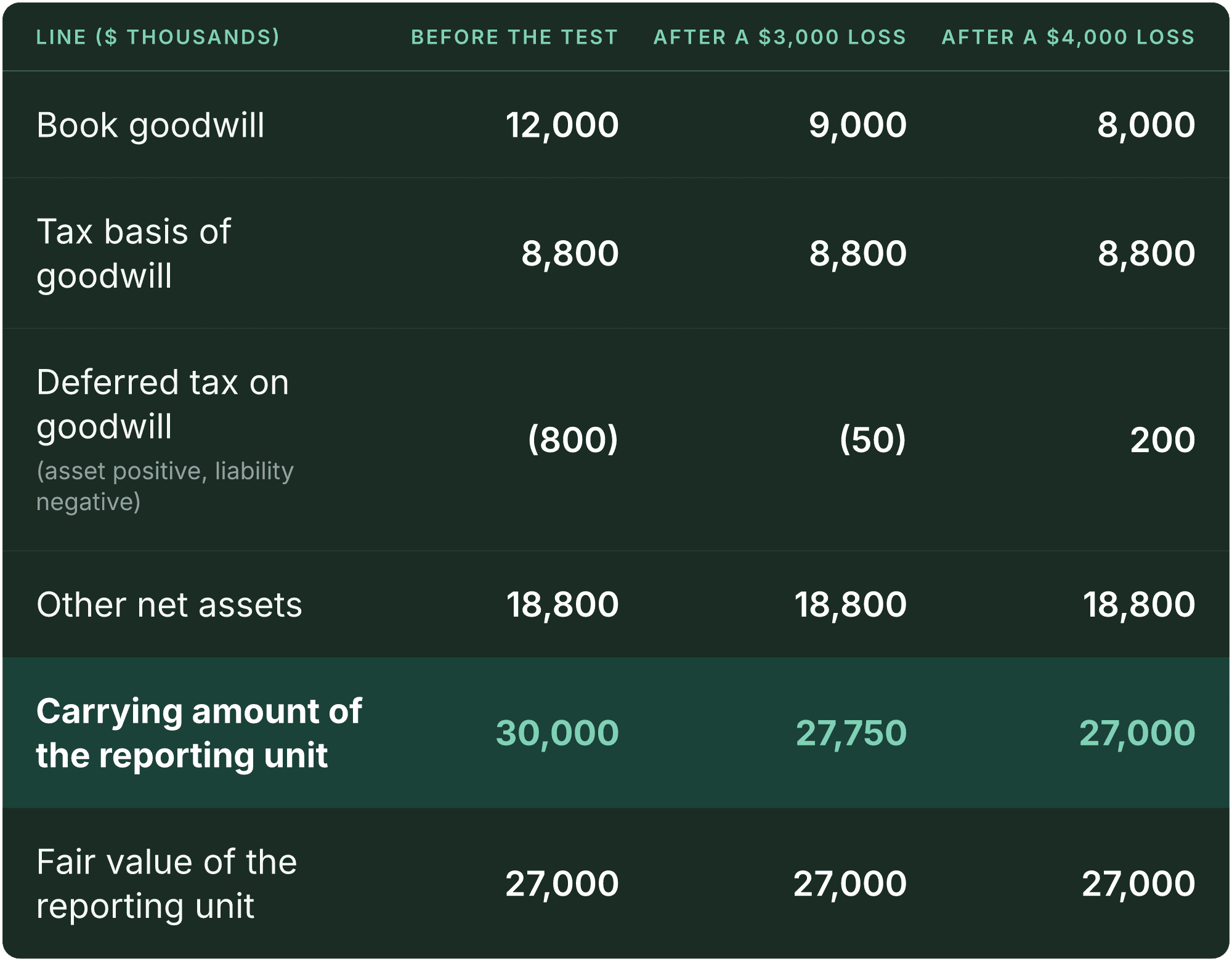
Take a distribution business bought in an asset deal on January 1, 2023. Book goodwill and tax goodwill were both $12.0 million at the close. The buyer is a private company that didn't elect amortization, so book goodwill is still $12.0 million. Tax goodwill has been amortized for four years, $800,000 a year, so its tax basis at December 31, 2026 is $8.8 million. With a 25% blended rate, used here for round numbers, the reporting unit carries a deferred tax liability of $800,000 on goodwill ($3.2 million x 25%).
The rest of the reporting unit's net assets are $18.8 million. Its carrying amount is $30.0 million. The valuation at the test date puts its fair value at $27.0 million.
Here is what happens if you book the obvious $3.0 million.
[](https://www.409.ai/uploads/tax_deductible_goodwill_impairment_asc_350_20_35_8b_simultaneous_equation_table_1_b676a5e4f8.png)
The $3.0 million loss cuts book goodwill to $9.0 million, which is only $200,000 above its tax basis, so the deferred tax liability falls from $800,000 to $50,000. That $750,000 release raises net assets, and the carrying amount lands at $27.75 million. It still exceeds fair value, by exactly the tax effect of the loss you just booked. Book another $750,000 and the same thing happens on a smaller scale. That is the loop paragraph 35-8B is written to stop.
The formula that closes it
Each dollar of book goodwill you write off moves deferred taxes by the tax rate, in the opposite direction. So a loss of L lowers the carrying amount by only L x (1 - t). Setting that equal to the shortfall gives the answer directly:
Loss = (carrying amount - fair value) / (1 - tax rate)
Here that's $3.0 million / 0.75 = $4.0 million, with a deferred tax benefit of $1.0 million. Book goodwill drops to $8.0 million, $800,000 below its tax basis, so the liability of $800,000 turns into a deferred tax asset of $200,000. The carrying amount is $27.0 million, equal to fair value, and the loop is closed. The income statement shows a $4.0 million impairment in operating expenses and a $1.0 million benefit in the tax line, for a net hit of $3.0 million.
FASB's own illustration in ASC 350-20-55-23A through 55-23D does the same thing with smaller numbers: $400 of fully deductible goodwill, a $200 deferred tax asset, $400 of other net assets, a 40% rate and a fair value of $900. The $100 shortfall becomes a $167 impairment and a $67 deferred tax benefit, which is 40% / (1 - 40%) x $100.
Two points keep the result honest. The gross-up is a fixed relationship only when one rate applies and the deferred tax asset is realizable. PwC's income tax guide (section 10.8.2.2) notes the formula needs adjusting for more than one rate or a valuation allowance, and if the new asset would sit behind a full valuation allowance, the tax benefit you're grossing up for doesn't arrive. And the cap still binds: if fair value had come in at $20.0 million, the formula would ask for $13.3 million, but the loss stops at the $12.0 million of goodwill.
When only part of the goodwill is deductible
Many deals leave book goodwill above tax goodwill from day one, for example a stock purchase where the target already carried some tax goodwill. ASC 805-740 splits book goodwill into component 1, up to the amount of tax-deductible goodwill, and component 2, the excess. No deferred tax is ever recorded on component 2, and a later write-down of it is a permanent difference.
That changes the gross-up. An impairment has to be split between the two components, and only the component 1 share moves deferred taxes. The standard doesn't prescribe the split; PwC's guides illustrate allocating the loss in proportion to the book balance of each component before the test, and then solving the same equation with only the component 1 share tax-effected. Whatever method you pick, write it down and apply it the same way every year. Your auditor will test it against the component schedule that came out of the [purchase price allocation](https://www.409.ai/articles/asc-805-purchase-price-allocation-startup-acquisition).
Three things that move the number before the formula does
The formula only works on inputs that are right. Three of them deserve a second look before the file goes to the auditor.
The fair value's tax assumption. ASC 350-20-35-25 through 35-27 cover whether the reporting unit's fair value assumes a buyer would acquire it in a taxable or a nontaxable transaction. The basis for conclusions to ASU 2017-04 (BC54) notes that the impairment under an assumed taxable transaction generally comes out lower. The valuation and the carrying amount should rest on a consistent view, and the memo should say which one and why.
The order of the tests. If other assets in the reporting unit are tested at the same time, they're tested first and goodwill last (ASC 350-20-35-31). A write-down of a customer list or an [ASC 360 asset group](https://www.409.ai/articles/asc-360-asset-group-lowest-level-cash-flows-recoverability-test-impairment-loss) changes both the carrying amount and its deferred taxes before the goodwill equation runs.
The tax basis itself. The tax basis of goodwill comes from the return, not from the books. A basis schedule that still shows the opening amount, or one that mixes two acquisitions in the same reporting unit, puts the wrong temporary difference into the equation. Reconcile it to the Form 4562 amortization before you solve anything.
A private company that elected the accounting alternative isn't exempt from any of this. Paragraph 350-20-35-73 measures its loss the same way, at the entity or reporting unit level it chose, and tells it to consider the income tax effect of deductible goodwill under 35-8B.
What the file should show
An auditor reading a test with deductible goodwill wants to follow every line without reaching for a calculator. In practice that means the fair value conclusion and its tax assumption; the carrying amount with deferred taxes shown separately; the book and tax goodwill roll-forward from the acquisition date; the component 1 and component 2 split, if there is one; the rate used and why; the equation with its inputs; and the proof that the carrying amount after the loss equals fair value. The proof matters most. A one-line check that the post-loss carrying amount equals fair value is the fastest way to show the loop has been closed.
409.AI's [impairment testing service](https://www.409.ai/products/impairment-testing) delivers the ASC 350 and ASC 360 file with the reporting unit's fair value, the carrying amount reconciliation and, where the goodwill is deductible, the tax-effected loss worked out line by line, so the auditor can tie it to your tax schedules.
The takeaway
If your goodwill came from an asset deal, an election or an LLC purchase, the difference between carrying amount and fair value is not your impairment. Divide it by one minus the tax rate, check the cap, and prove the carrying amount lands on fair value. Book the gap alone and the auditor will send the test back: at a 25% rate, the right loss is a third larger than the gap.