Equity
Stock Splits and Option Strike Prices: When an Adjustment Is Not a Repricing
A forward or reverse split can leave options untouched under Section 409A, if shares and strike move together. A guide for founders and finance leads.
By 409.AI Team - 2026-10-27
# Stock Splits and Option Strike Prices: When an Adjustment Is Not a Repricing
A board votes a 4-for-1 forward split ahead of a Series B, or a 1-for-4 reverse split ahead of an IPO filing. Then somebody asks the question that stalls the closing checklist: what happens to the options already granted, and what do we do with the 409A report that is still inside its 12 months?
The answers are cleaner than most finance leads expect, but only if the adjustment is done in one specific way. Do it right and the Treasury regulations say nothing was modified. Do it loosely, with a rounded price here and a discount there, and you may have repriced every option on the cap table.
This guide is for the founder or finance lead who owns the equity plan and has to document a split without creating a Section 409A problem.
What the regulation says about a split
Section 409A applies to stock rights that are granted below fair market value on the grant date. A stock option struck at or above fair market value is exempt, and the exemption is lost if the option is later modified in a way that counts as a new grant. So the question for a split is whether adjusting an outstanding option is a "modification."
Treasury Regulation [§1.409A-1(b)(5)(v)(H)](https://www.law.cornell.edu/cfr/text/26/1.409A-1) answers it. A change that only increases the number of shares is generally treated as the grant of a new additional right. But the regulation carves out the split: if the exercise price and the number of shares are proportionally adjusted to reflect a stock split (a reverse split included) or a stock dividend, and the only effect is to increase or decrease on a pro rata basis the number of shares each holder of that class owns, there is no modification, provided the aggregate exercise price is not less than it was before the split.
Three conditions sit in that sentence, and each one is a place to slip:
1. Proportional. The share count and the per-share price move by the same ratio, in opposite directions. 2. Pro rata for every holder. The split hits every shareholder of the class equally. A recapitalization that changes some holders differently is not a split for this purpose. 3. Aggregate exercise price not reduced. The total the optionee would pay to exercise everything must be the same or higher after the adjustment.
The same logic is why the rollover in an acquisition is tested differently. A substitution in a merger runs through paragraph (D) and the ratio test, which we cover in [how the §424(a) ratio test works for options rolled over in an acquisition](https://www.409.ai/articles/stock-options-acquisition-rollover-section-424a-ratio-test). A plain split is simpler and lives in paragraph (H).
A worked example: 4-for-1 forward split
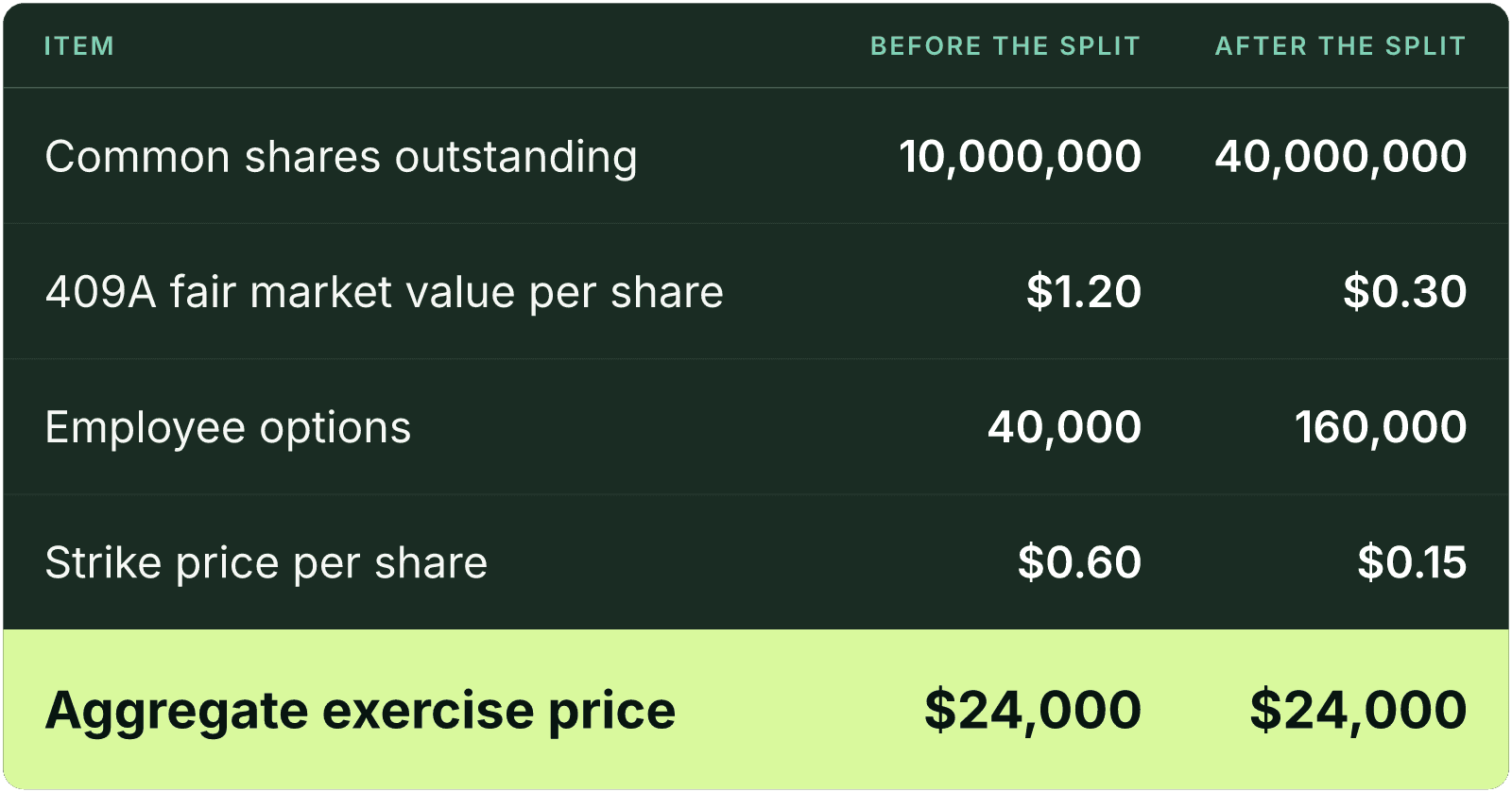
Take a company with 10,000,000 common shares outstanding and a current 409A fair market value of $1.20 per common share. The board approves a 4-for-1 forward split. One employee holds 40,000 options struck at $0.60.
The adjustment multiplies shares by four and divides the strike by four. The table shows the before and after.
[](https://www.409.ai/uploads/stock_split_option_strike_price_409a_proportional_adjustment_no_modification_table_1_6ca30ea547.png)
Nothing moved in economic terms. The employee's right to buy, the total cost, and the share of the company the options represent (0.4% before and after) are identical. The aggregate exercise price line is the one the regulation tests, and it matches.
The part that needs attention is the second row. The value of one common share is now a quarter of what it was, so the valuation on file is no longer a per-share number you can use as it stands.
The valuation report after the split
A 409A report states a per-share value for a specific share count on a specific date. After a split, that per-share figure is stated in units that no longer exist. There are two clean ways to handle it.
Restate the existing report. If the split is purely mechanical and nothing else changed, the valuation provider can issue a restated or bring-down letter that converts the conclusion to post-split shares: $1.20 becomes $0.30 on a 4-for-1. The enterprise value and the equity allocation are untouched. Only the denominator changed.
Commission a fresh valuation. If the split is bundled with a financing, a new class of stock, an option pool increase or anything else a valuation would have to reflect, a restatement is not enough. The 12-month clock and the material-information test both apply as usual. Our guide to [how often you should get a 409A](https://www.409.ai/articles/409a-valuation-frequency-how-often-should-you-get-one) walks through when information forces a new report before the anniversary.
Either way, the board file for the next grant should show a post-split fair market value and the report or letter it came from. A grant approved after the split at the pre-split number is wrong in one direction or the other, and which direction decides how bad it is.
Where the real exposure is: the reverse split
A forward split that is misapplied tends to overprice new options. Take the same company: if the board approves new grants at $1.20 after the split, the strike is four times fair market value. That is a bad deal for employees and a retention problem, but it is not a Section 409A violation, because the option is not discounted.
The reverse split runs the other way. A 1-for-4 reverse split takes a $0.30 common share to $1.20. If the board approves a grant the week after the split using the old $0.30 figure, the option is struck at a quarter of fair market value. That is a discounted option from the first day.
The consequences are the ones covered in [what happens when a stock option is granted below fair market value](https://www.409.ai/articles/discounted-stock-option-correction-notice-2008-113): the optionee can face income inclusion, an additional 20% tax and interest under §409A at vesting rather than at exercise, and an incentive stock option loses its ISO status if the exercise price is below fair market value on the grant date. A reverse split before an IPO is common, and it is the same stretch of time when companies tend to grant a burst of pre-IPO options. The two collide in the cap table.
The control is mechanical. After any split, the person who prepares board consents updates the equity plan administration system and the grant template with the post-split fair market value on the same day the split takes effect.
Rounding is where adjustments go wrong
Splits rarely divide cleanly. A 1-for-3 reverse split on 100 options leaves 33.33 shares. The plan's adjustment clause should say what happens to the fraction, and the regulation tells you which direction is safe.
Round the share count down to a whole share and round the strike up to the nearest cent. That keeps the aggregate exercise price at or above what it was, which is the third condition above. Round the other way, share count up or strike down, and the aggregate falls below the original: you have handed the employee a small additional benefit, and the exception no longer covers the adjustment.
The amounts are usually small, a few dollars per grant. They matter for the paperwork, not the economics: a clean file says every option was adjusted under the same documented formula, and an audit sees no difference between the first and the four-hundredth grant.
Put it in the board file
Before the split takes effect, the file should contain:
- the board resolution approving the split and the adjustment of outstanding options under the plan's adjustment clause (and, where the split is made by charter amendment, the stockholder approval Delaware requires for it);
- a one-page adjustment schedule listing each grant, its pre-split shares and strike, its post-split shares and strike, and the aggregate exercise price before and after;
- the post-split fair market value, from a restated report or a new valuation, with its date;
- a note on the rounding rule and where any fractions went.
If the options are incentive stock options, check the plan document for the language that preserves their status through the adjustment. Our guide to [setting the grant date and strike with board approval](https://www.409.ai/articles/option-grant-date-board-approval-409a-strike-price) covers how the next grant should reference the new value. Auditors reviewing share-based compensation will also ask how the strike per share relates to the fair value used for expense, and the same post-split number should appear in both places. If a pre-IPO split sits near a run of recent grants, the SEC staff's questions on [cheap stock before an IPO](https://www.409.ai/articles/cheap-stock-pre-ipo-409a-sec-option-grants) are easier to answer when the adjustment schedule is already on file.
The takeaway
A split is one of the few corporate actions where the regulation hands you a safe path in a single sentence: adjust shares and price proportionally, for every holder, without lowering the aggregate exercise price. Keep to it and no option is modified.
The risk sits next to the split, not in it. Before the effective date, get the post-split fair market value in writing, load it into the grant template, and pause new approvals until it is there. A restated report from your valuation provider usually takes a few days and costs a fraction of correcting a discounted option later. If you want that restatement, or a fresh valuation to pair with the split, [409.AI's 409A valuation](https://www.409.ai/products/409a) is built for that handoff.