Financial Reporting
The Last Round Is 18 Months Old: How a Fund Updates a Level 3 Mark Without a New Price
A fund CFO with a venture position still carried at an 18-month-old round price: how to calibrate and roll the ASC 820 mark forward, with a worked example.
By 409.AI Team - 2026-11-09
# The Last Round Is 18 Months Old: How a Fund Updates a Level 3 Mark Without a New Price
A fund CFO opens the year-end valuation file and finds a familiar problem. The portfolio company's last priced round closed in February 2025. Nothing has happened since: no new round, no tender, no offer. The position is still carried at the round price, and the auditor has already asked what, exactly, makes that number a December 31, 2026 fair value.
That question is fair, and "the last round" is only a partial answer. This piece is for the fund CFO, controller or GP who has to defend a mark built on a stale round, and for the administrator or auditor reading the file. It walks through what a stale round still tells you, what it no longer does, and a calibrated roll-forward you can show line by line.
Why a round price ages
ASC 820 defines fair value as the price that would be received to sell an asset in an orderly transaction between market participants at the measurement date. The date matters. A round price was a fair value on the day the round closed, and for a new investment the transaction price is usually the best evidence of that value. By the next quarter end it is an observation about the past.
What changes in between is not mysterious. The company's revenue grows or stalls. Cash burns down. The public companies that investors compare it with reprice, sometimes by a third in a year. A competitor raises at a different multiple. Each of those moves shifts what a buyer would pay today, whether or not anyone has written a term sheet.
Carrying the position at cost is therefore a conclusion, not a default. When it is the right answer, the file should show that the inputs moved little. When it is not, the file should show the movement. Our piece on [how a fund buys its first Level 3 valuation](https://www.409.ai/articles/how-fund-buys-first-level-3-valuation-asc-820-scope-quote-december-31-file) covers the scoping side of that work.
What the round still gives you
A stale round is not worthless. It is the anchor of a calibration, and ASC 820 asks for one. When a transaction price is the fair value at initial recognition and you later use a technique that relies on unobservable inputs, the technique should be calibrated so that it reproduces that transaction price on day one (ASC 820-10-35-24C). The AICPA's valuation guide for portfolio company investments of venture capital and private equity funds builds its guidance on the same idea, and the SEC staff has pointed to calibration in its own statement on private asset valuation. We covered the staff's position in [our note on calibration and NAV](https://www.409.ai/articles/sec-staff-statement-private-asset-fair-value-calibration-nav).
In practice, calibration turns the round into a set of implied inputs. If the company was valued at $50 million post-money on $5 million of annualized revenue, the round implied a 10.0x revenue multiple. That number is the bridge between the old price and the new date. It is also the check on your technique: a multiple of 6x applied to the same revenue would not reproduce the round, and the file would need to explain why a market participant paid more than the model says.
The roll-forward, step by step
The method has four moves. Take the round's implied multiple. Measure how the market's multiple has changed since the round. Apply the company's own operating change. Convert enterprise value back to the fund's security.
Here is a worked example. The numbers are illustrative.
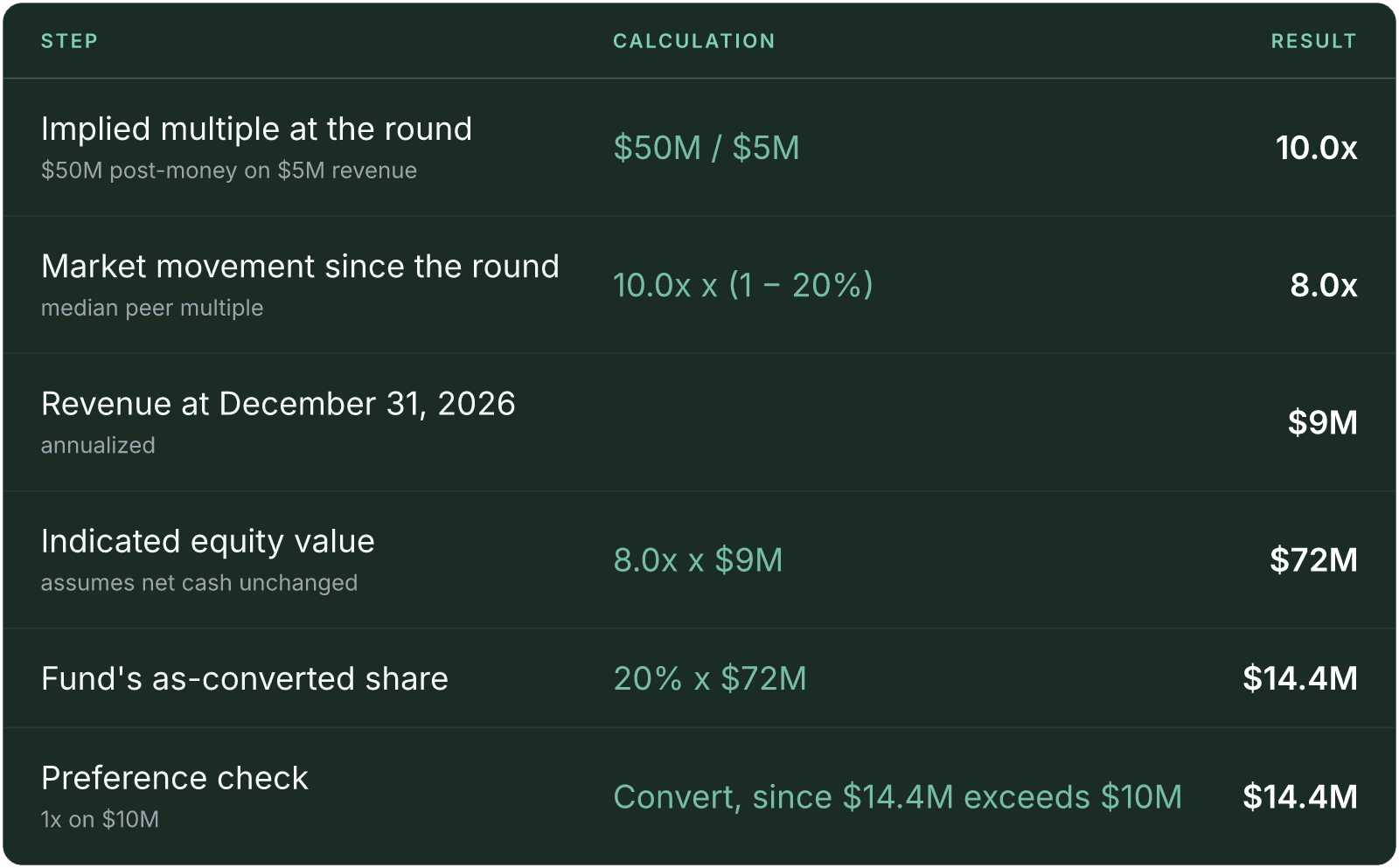
A fund invested $10 million for 1,000,000 Series A preferred shares at $10.00 in February 2025, at a $50 million post-money valuation. The fund owns 20% on an as-converted basis, and the preferred carries a 1x non-participating preference. At closing the company had $5 million of annualized revenue. At December 31, 2026 its annualized revenue is $9 million. A basket of comparable public companies has seen its median revenue multiple fall 20% since February 2025.
[](https://www.409.ai/uploads/stale_round_fund_level_3_mark_asc_820_calibrated_roll_forward_no_new_price_table_1_6d1f16786d.png)
The fund's position moves from $10.0 million to $14.4 million, a 44% increase, even though no one has paid a new price. Revenue growth added value. The falling market took some back. Neither effect shows up if the file only says "last round".
The paragraph that follows the table in the file matters as much as the table. It should say that the peer set was chosen for business model and growth, that the multiple was applied to the same revenue measure used at the round, and that the preference check was run because a junior or participating preferred can behave very differently. For senior terms and multiple share classes, see [our look at marking junior preferred through a liquidation waterfall](https://www.409.ai/articles/fund-mark-junior-preferred-liquidation-waterfall-asc-820-latest-round-price).
Test the answer against what could be wrong
A roll-forward is only as good as its weakest input, so the file should show the ones that could move the result.
Take the peer multiple first. If the market had held flat, the implied multiple stays 10.0x, equity value is $90 million and the position is $18.0 million. If peers had fallen 40%, the multiple is 6.0x, equity value $54 million and the position $10.8 million. A 20-point swing in the peer multiple moves the mark by roughly $3.6 million either way. That is the sensitivity the auditor will ask about, and the file should show it before they do.
Then the company-specific inputs. Annualized revenue can be a poor measure if it contains one large non-recurring contract. The runway matters too: a company with four months of cash and no committed financing does not trade at the same multiple as one with two years, and a market participant would price that in. If the company will need to raise within the next two quarters, the inside view of the next round's likely terms belongs in the file. Our note on [insider-led rounds and market terms](https://www.409.ai/articles/insider-led-round-fund-mark-asc-820-related-party-price-market-terms) covers what to do when that round is led by your own fund.
Finally, check the Level 3 classification. The multiple was calibrated to an unobservable round and adjusted with company-specific data, so the input is significant and unobservable. That keeps the position in Level 3, with the disclosures that come with it, a subject we explain in [our piece on Level 3 classification](https://www.409.ai/articles/asc-820-level-3-classification-significant-unobservable-input).
When a roll-forward is the wrong tool
A calibrated roll-forward assumes the company is still the company the investors priced. When that stops being true, the technique has to change.
A material event since the round is the clearest case: a lost customer that was 40% of revenue, a failed financing, a signed offer. A signed term sheet or a bridge on distressed terms is evidence of a price, and it should carry more weight than a multiple adjusted from a market index. For a mark built on an offer, our article on [a signed merger that has not closed](https://www.409.ai/articles/signed-merger-not-closed-fund-mark-asc-820-deal-price-probability-quarter-end) shows how to weigh it. And if a round closes after December 31 but before the financial statements are issued, the question is whether it reflects conditions at the balance sheet date, which we address in [our January round note](https://www.409.ai/articles/january-round-december-31-mark-asc-855-subsequent-events-fund).
Two other situations deserve a flag in the file. If the company has no meaningful revenue, a revenue multiple has nothing to multiply, and a milestone or scenario approach is a better fit. If the preferred has complex terms and the exit is far away, an option pricing model across the capital structure beats a single as-converted share.
What the auditor will test
The audit of a Level 3 mark is a test of the valuation process as much as the number. Expect the auditor to ask where each input came from, whether the peer set could reasonably have been different, and how the result compares with the prior quarter's mark and the fund's own history. Management specialists and their work fall under the auditor's own standards, covered in [our guide to SAS 143 and valuation firms](https://www.409.ai/articles/fund-valuation-firm-sas-143-auditor-tests-management-specialist-file).
A good file answers four questions without being asked. What was the calibrated input on day one? How did it move, and why? What does the result do if the main input is 20% wrong? And how did the last few marks compare with what the fund eventually received?
The takeaway
When there is no new price, the work is in showing how the old one aged. Write down the multiple the round implied, update it for the market and for the company, run the preference check, and put the sensitivity next to the answer. A mark that moved from $10.0 million to $14.4 million with that file behind it is easier to defend than a mark that stayed at $10.0 million because nothing was documented.
409.AI prepares ASC 820 valuations for funds with this file structure, including the calibration, the sensitivity and the preference check: [https://www.409.ai/products/asc-820](https://www.409.ai/products/asc-820).