Financial Reporting
Signed Merger, Not Yet Closed: How a Fund Marks the Portfolio Company at Quarter-End
A portfolio company signed a merger but hasn't closed. Fund CFOs: how to mark it at quarter-end under ASC 820, weighing deal price, escrow and odds of closing.
By 409.AI Team - 2026-10-29
# Signed Merger, Not Yet Closed: How a Fund Marks the Portfolio Company at Quarter-End
A portfolio company signs a merger agreement on December 12. The deal is expected to close in the first quarter. On December 31 the fund CFO still has to put a number on the position, and the auditor will ask one question first: why is the mark what it is?
Both easy answers are wrong. Holding the mark at the last round ignores the best evidence of what a buyer will pay. Booking the full deal price as if the cash were already in the bank ignores the risk that the deal does not close, the escrow that may never be released and the months until it does. ASC 820 asks for something in between, and the file has to show how you got there.
This article is for the CFO, controller or GP of a venture, growth or private equity fund that holds a Level 3 position in a company with a signed, unclosed sale, and for the auditor who will test that mark.
Why a signed deal is not the same as a closed one
ASC 820 defines fair value as the price that would be received to sell an asset in an orderly transaction between market participants at the measurement date. The [FASB Codification](https://asc.fasb.org) is explicit that this is a market-based measurement, not an entity-specific one. What your fund hopes to receive does not matter. What a market participant would pay for your position on December 31 does.
A signed agreement is strong evidence of that price. A third party has put real money behind a number, after diligence, against a counterparty that negotiated. That is more than most Level 3 marks ever get. But the evidence has limits, and each one is a place where the mark can drift away from the headline price:
- **The deal can fail.** Antitrust review, a financing condition, a shareholder vote or a material adverse change clause can each end it.
- **The cash arrives later.** Between the measurement date and the closing, a market participant would want a return for waiting.
- **Part of the price is contingent.** Escrows, holdbacks and earnouts pay out only if conditions are met, and sometimes only in part.
- **The price may not be yours.** Headline price per share often differs from what a given security receives once the liquidation waterfall, management carve-outs and debt payoffs are applied.
Step 1: Translate the headline price into your security
Start with the proceeds your instrument actually receives. If the fund holds preferred stock, run the deal's equity value through the waterfall, including any carve-out for management and any transaction expenses the target bears. Our article on [marking junior preferred through a liquidation waterfall](https://www.409.ai/articles/fund-mark-junior-preferred-liquidation-waterfall-asc-820-latest-round-price) walks through that mechanic.
This step often moves the number more than any discount rate will. A $12.00 headline price per fully diluted share can be $9.80 for a junior preferred class and $12.40 for a senior one.
Step 2: Split the proceeds by when and how they are paid
Cash at closing, escrow and earnout are three different instruments. Treat each as its own cash flow with its own timing and its own odds.
The AICPA's valuation guide for portfolio company investments, which sits under ASC 946, tells funds to calibrate their model to a recent transaction and then update for changes between the transaction date and the measurement date ([Journal of Accountancy summary](https://www.journalofaccountancy.com/issues/2018/jul/portfolio-company-investments-valuation/)). A signed agreement is that kind of transaction evidence. Calibration here means your model, fed with the deal's terms, should land at the deal's economics before you adjust it for the closing risk.
For the escrow and earnout pieces, the logic matches what a fund does after a sale closes. We covered the measurement in [valuing an escrow or earnout receivable](https://www.409.ai/articles/fund-exit-escrow-earnout-receivable-fair-value-asc-820-after-portfolio-company-sale). The difference before closing is that you carry both the deal risk and the contingent-payment risk.
Step 3: Weigh the deal path against the standalone path
The simplest defensible structure is a probability-weighted expected value with two branches:
1. The deal closes. Value of your proceeds, discounted from the expected closing date, with the contingent pieces haircut. 2. The deal does not close. The value of the company without the deal, which is rarely the pre-announcement mark. A failed deal can leave a company with lost customers, a distracted team and a cash balance reduced by fees.
The probability is the judgement call, and it is a Level 3 input. Anchor it to facts: conditions still open, regulatory filings and their status, the buyer's financing, shareholder approvals already received and the termination fee. A deal that is only waiting for a customary closing certificate is a different risk than one in a second request from the FTC. Our note on [what makes an input significant and unobservable](https://www.409.ai/articles/asc-820-level-3-classification-significant-unobservable-input) explains why this probability usually keeps the position in Level 3 even when the deal price is public.
A worked example
A fund holds 2,000,000 common shares of a portfolio company. The fund's prior mark was $9.00 per share, from the last financing round. The company signs a merger agreement for $12.00 per share: $11.00 in cash at closing and $1.00 held in escrow for twelve months after closing. Closing is expected in about five months. The standalone value, if the deal fails, is estimated at $7.50 per share. The illustrative inputs below are chosen to show the mechanics; they are not market benchmarks.
[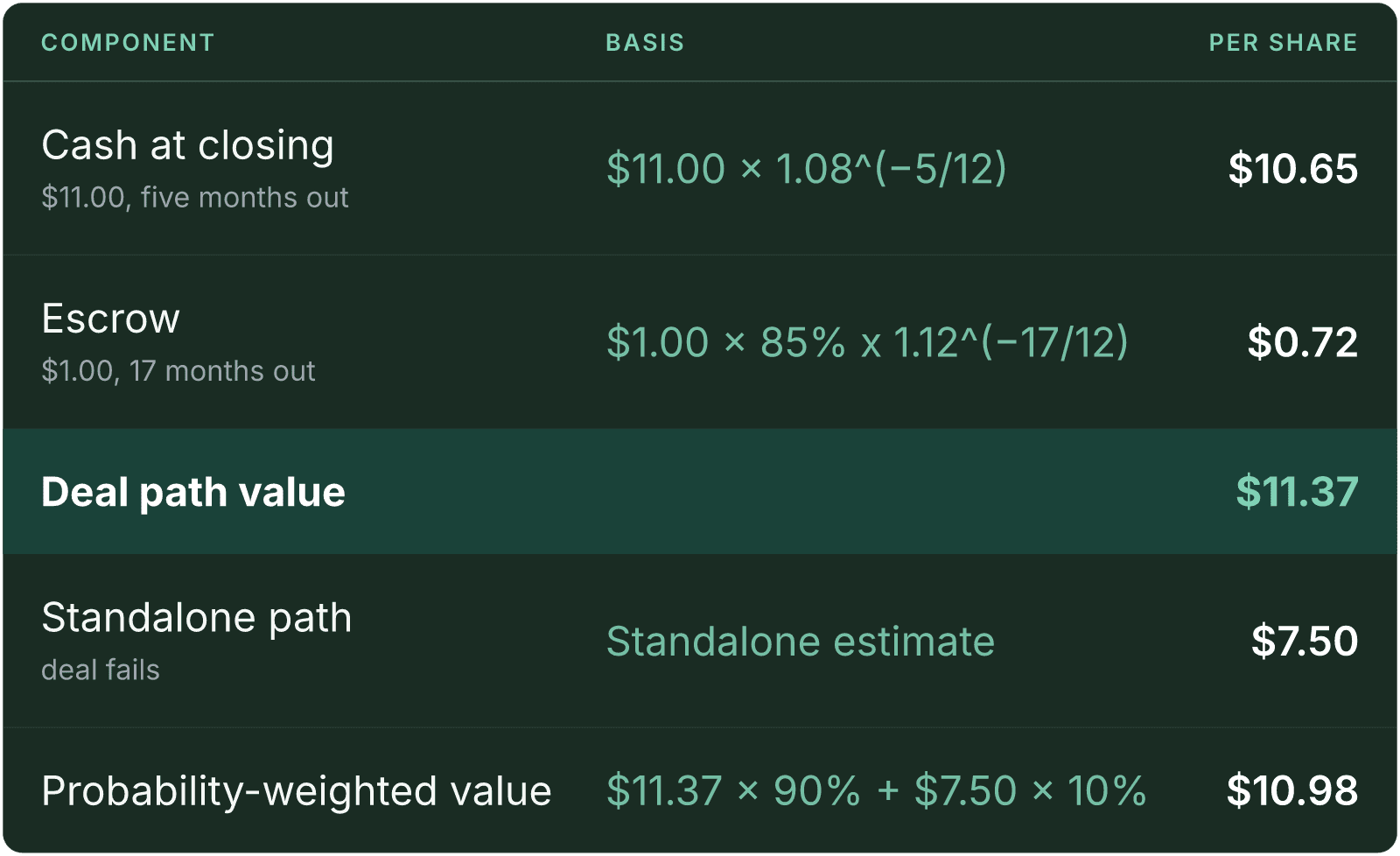](https://www.409.ai/uploads/signed_merger_not_closed_fund_mark_asc_820_deal_price_probability_quarter_end_table_1_c9bb709ec2.png)
The fund's position is 2,000,000 shares times $10.98, or $21,960,000, against $18,000,000 at the prior mark. That is a gain of $3,960,000 for the quarter, and $1.02 per share below the $12.00 headline price. Every one of the three discounts in that gap (time, escrow recovery, deal risk) needs a sentence in the file explaining the input.
Notice what the table does not do. It does not apply a marketability discount to the deal price, because the deal price already reflects what the buyer will pay for the whole company. And it does not treat the 90% as a number you can defend by saying "most deals close." It needs the open conditions listed next to it.
Step 4: Update it every quarter, and when a condition changes
A mark built on a pending deal is only good as of the date it was built. If the shareholder vote passes in January, the probability rises. If the buyer's financing wobbles, it falls. Each quarter's file should show the previous probability, the new one, and the event that moved it.
Subsequent events matter too. A deal that signs on January 10 usually describes conditions that did or did not exist on December 31, and whether it adjusts or only gets disclosed depends on the facts. We looked at that line for funds in [a January round and the December 31 mark under ASC 855](https://www.409.ai/articles/january-round-december-31-mark-asc-855-subsequent-events-fund). The same reasoning applies to a deal that is announced, amended or terminated after the balance sheet date.
What the auditor will test
Expect four requests: the signed agreement and every amendment, a list of closing conditions with status, the waterfall or allocation that gets from headline price to your security's proceeds, and the support for the discount rate and the probability. If a valuation firm helped, the auditor will also want to see how management understood and challenged that work. Our piece on [auditor tests of a management specialist's file](https://www.409.ai/articles/fund-valuation-firm-sas-143-auditor-tests-management-specialist-file) covers that.
Your valuation policy should say, before any deal comes along, how the fund treats a signed agreement. Writing it in advance is the difference between a method and a mark chosen to fit a result. The [valuation policy and audit file article](https://www.409.ai/articles/fund-valuation-policy-asc-820-audit-sec-exam) lists what belongs in it.
When the deal closes, compare the proceeds to your last mark. A pattern of marks well below or above final proceeds is the kind of thing a [back-test of marks against exit prices](https://www.409.ai/articles/back-testing-fund-marks-exit-prices-asc-820-disposition-analysis) is built to catch, and it feeds the next quarter's probability judgement.
The takeaway
For every signed, unclosed deal in the portfolio, build the mark in four lines before the quarter ends: your security's share of the price, the cash and contingent pieces on their own timelines, the odds of closing with the open conditions named, and the standalone value if it fails. If the file can show those four, the number follows, and the auditor's first question has an answer on one page.
If you want an independent ASC 820 valuation file for a position with a pending sale, see [409.AI's ASC 820 valuation service](https://www.409.ai/products/asc-820).