Tax
Seller Financing a Business Sale: What the Note Is Really Worth
Selling your business with a seller note? See what the note is worth today, how the IRS imputes interest below the AFR, and how installment gain is taxed.
By 409.AI Team - 2026-10-17
# Seller Financing a Business Sale: What the Note Is Really Worth
A buyer offers you $2,000,000 for your business. They will pay $500,000 at closing and sign a note for the other $1,500,000, payable over five years. It sounds like a $2,000,000 sale. It is not, and the gap between the headline and what you actually receive is the subject of this article.
This is for the owner of a small private company who is thinking about selling, and for the CPA, attorney or business broker helping them compare offers. The question to settle before you accept is simple: what is the note worth today, and how will the IRS treat it?
The price on the page and the price in your pocket
A seller note is a loan from you to the buyer. Like any loan, it has a value that depends on its interest rate, its term and the odds that it gets paid. A $1,500,000 note that pays 0% interest over five years is worth far less than $1,500,000, because you wait years for money you could have invested or spent now.
Appraisers call the result a cash-equivalent price: the cash at closing plus the present value of the note, discounted at the rate a lender would charge a buyer like this one. [Rev. Rul. 59-60](https://www.409.ai/articles/revenue-ruling-59-60-small-business-valuation-eight-factors) asks for the same discipline in valuing a business: what a willing buyer and a willing seller would agree on, with both knowing the facts. A note that pays below-market interest is a price cut that the headline number hides.
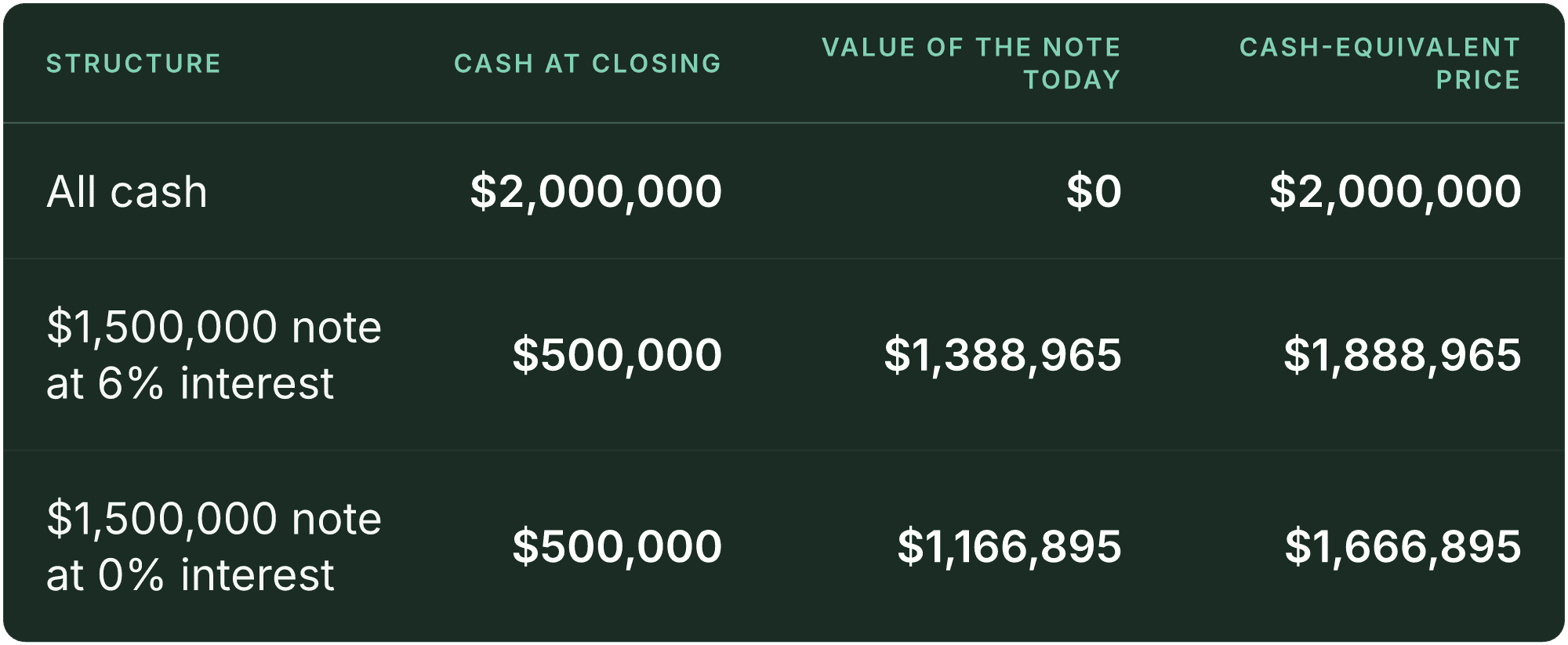
Here is a worked example. The buyer's market borrowing rate is an assumption of 9% a year, which stands in for what a bank or a lender would charge a small, closely held buyer. The note is repaid in five equal principal payments of $300,000, one at the end of each year, with interest paid on the unpaid balance.
The table compares three ways to structure the same $2,000,000 headline.
[](https://www.409.ai/uploads/seller_financed_business_sale_note_value_installment_sale_imputed_interest_table_1_c7a5c92bc1.png)
The 6% note costs the seller about $111,000 of value against an all-cash sale at the same price. The interest-free note costs about $333,000. Same business, same headline, three different deals. If you are comparing a cash offer of $1,800,000 with a $2,000,000 offer that carries a 0% note, the cash offer is the better one by roughly $133,000 before you count the risk of default.
Default risk is the second part of the discount. A note from a new owner is only as good as the business you just sold them. If you are the person lending, the buyer's cash flow, the collateral and any personal guarantee matter as much as the rate. A valuation of the business, such as the [owner compensation and add-back analysis](https://www.409.ai/articles/owner-compensation-add-backs-small-business-valuation-sde-ebitda) a lender will run, tells you how much debt the company can carry before you become its largest and least secured creditor.
The IRS sets a floor on the interest rate
You cannot avoid the discount by calling a note interest-free. The Internal Revenue Code expects an installment sale to carry a minimum rate of interest, and if it does not, the IRS recharacterizes part of the price as interest.
[IRS Publication 537](https://www.irs.gov/publications/p537) explains it. If the contract's stated interest is too low, part of the principal can be treated as interest. Depending on the deal, that is called unstated interest (section 483) or original issue discount (section 1274). Interest is inadequate when the stated rate is below a test rate, and the test rate is based on the applicable federal rates, or AFRs, the IRS publishes every month. The rate depends on how long the note runs: short-term for three years or less, mid-term for more than three and up to nine years, and long-term for more than nine.
For October 2026, [Rev. Rul. 2026-19](https://www.irs.gov/pub/irs-drop/rr-26-19.pdf) sets the mid-term AFR at 4.61% with annual compounding. Pub. 537 says the test rate is the lowest AFR in the three-month period that applies to the contract, so the number in your deal may differ from October's. For a five-year note, October's mid-term rate is a good illustration.
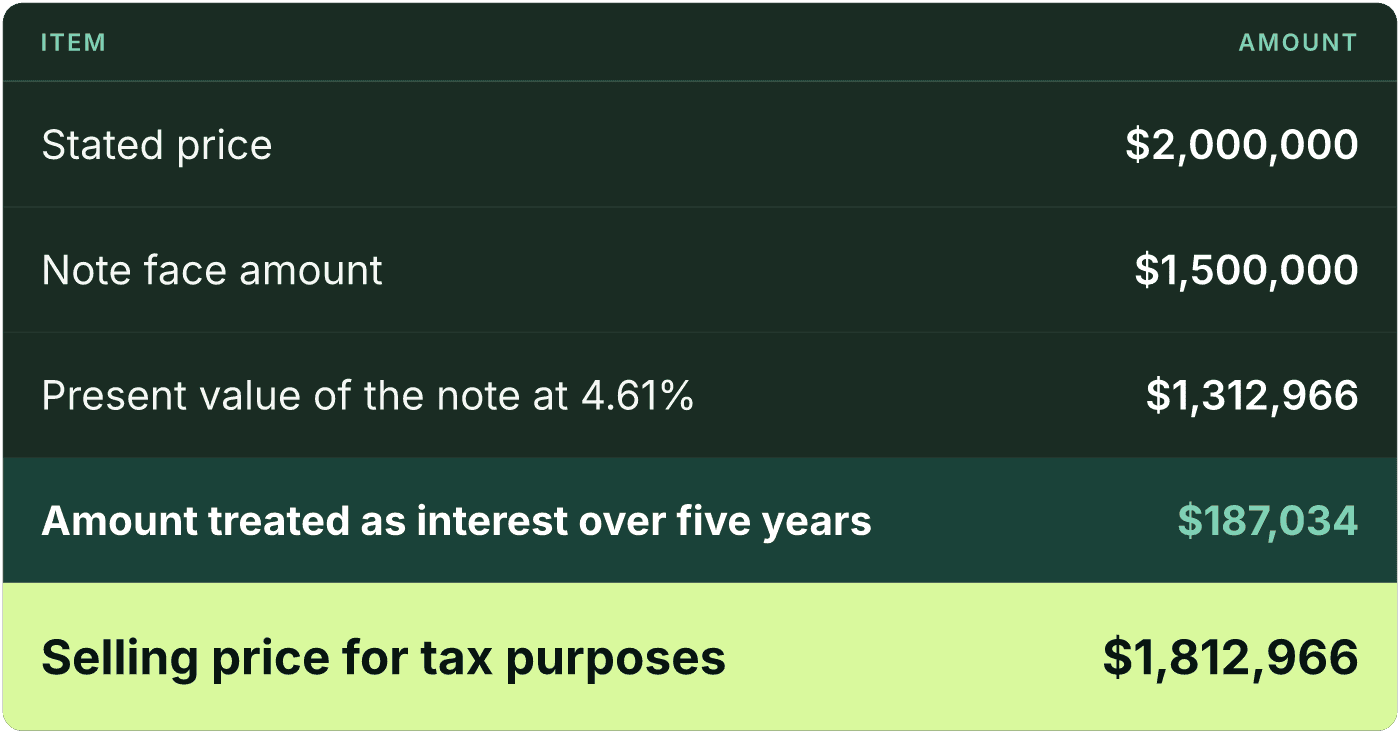
Run the 0% note through that test. Discounted at 4.61%, the five payments of $300,000 are worth $1,312,966 today. The other $187,034 of the $1,500,000 face amount is treated as interest. As Pub. 537 puts it for the seller, the stated selling price is reduced by the amount treated as interest, and that amount is reported as interest income. For the buyer, the same amount reduces the price paid for the business and becomes interest expense. The buyer's cost basis in the business assets is lower, and the seller's gain on the sale is lower, but part of what the seller receives is now taxed as interest rather than as gain on the sale.
The table shows the effect on the interest-free deal.
[](https://www.409.ai/uploads/seller_financed_business_sale_note_value_installment_sale_imputed_interest_table_2_ec3a6cbc12.png)
An interest rate at or above the test rate avoids this. In the 6% example the stated rate is above 4.61%, so no interest is imputed. Whether to charge more than the minimum is a commercial decision, because every point of interest moves the cash-equivalent price in the first table.
How the gain is taxed under the installment method
The installment method lets a seller report gain as payments arrive instead of all in the year of sale. Pub. 537 defines an installment sale as a sale where you receive at least one payment after the tax year of the sale. Each payment carries a share of gain equal to the gross profit percentage, which is gross profit divided by the contract price.
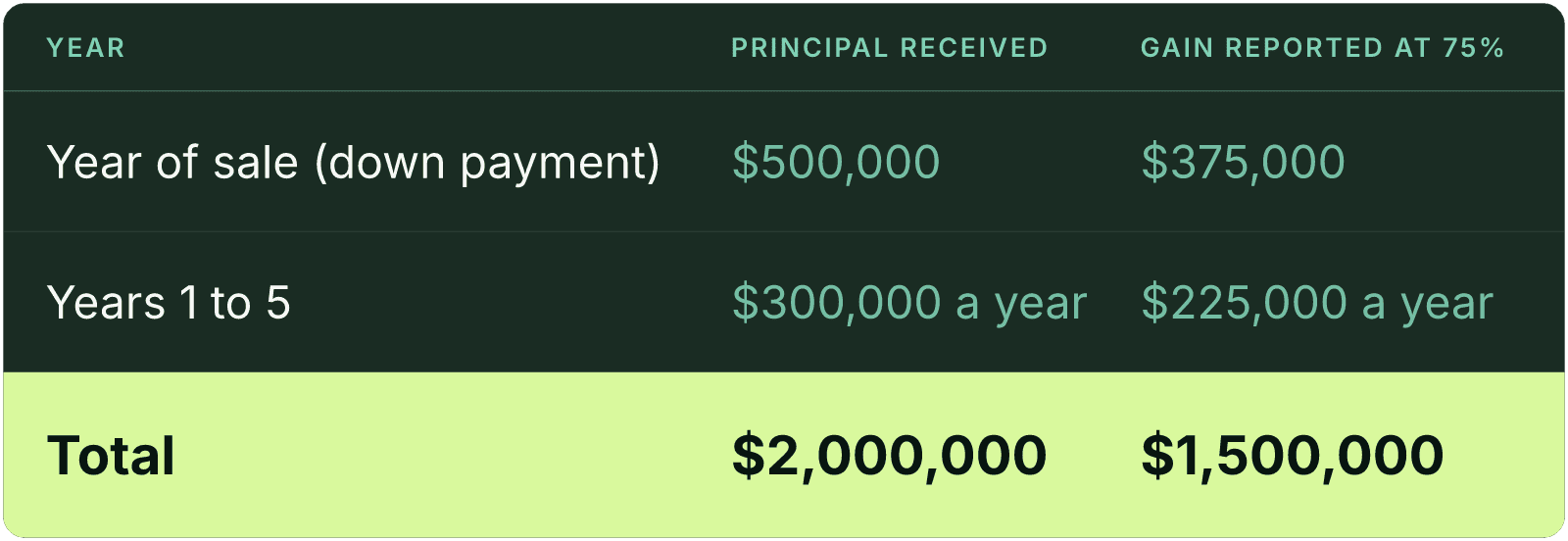
Take the 6% deal. Say the owner's adjusted basis in the business is $500,000 and there are no assumed debts and no depreciation recapture. Gross profit is $1,500,000 and the contract price is $2,000,000, so the gross profit percentage is 75%. Interest is reported separately as ordinary interest income.
The table shows how that plays out.
[](https://www.409.ai/uploads/seller_financed_business_sale_note_value_installment_sale_imputed_interest_table_3_fdf210c3e4.png)
Three limits matter in practice. First, depreciation recapture is not deferred. Pub. 537 says recapture income is reported in full in the year of sale, whether or not you receive a payment that year, and only the gain above it uses the installment method. A business that owns equipment it has depreciated can owe tax in year one on money it has not yet collected. Second, the method is for gains: Pub. 537 says you cannot use it to report a loss, which is deductible in the year of sale. Third, you can elect out of the installment method and report the whole gain in the year of sale, which sometimes makes sense when a seller expects higher tax rates later or wants to use losses this year. The election is a tax decision for the owner's CPA, not a valuation decision.
The sale of a business is usually an asset sale in which the price is split across inventory, equipment, goodwill and other assets, and the split changes how each piece is taxed. Our article on [Form 8594 and asset allocation](https://www.409.ai/articles/form-8594-asset-allocation-small-business-sale) walks through how buyer and seller report it. If part of the price is personal goodwill of a C corporation owner, the [Martin Ice Cream case](https://www.409.ai/articles/personal-goodwill-c-corp-asset-sale-martin-ice-cream-tax-court) shows how much the facts matter.
Questions to ask before you accept a note
Most seller-financing problems start with a handshake number. A few questions put the offer on a comparable footing with every other.
- **What rate does the note carry, and is it above the AFR?** A rate below the test rate shrinks your tax price and hands part of your sale to the interest line.
- **What is the cash-equivalent price?** Discount the note at a rate that reflects the buyer, not at the rate you hope to earn. A rate of 9% is an assumption in this article. Your buyer's actual rate could be higher or lower.
- **What secures it?** A lien on the assets, a personal guarantee and a clause that accelerates the note if the buyer sells the business or misses a payment change its value as much as the rate does.
- **How does the buyer's lender view it?** When a buyer finances part of the purchase with a bank or an SBA loan, the lender decides how a seller note is treated. The [SBA's rules for a change of ownership](https://www.409.ai/articles/sba-sop-50-10-8-1-business-valuation-change-of-ownership) set what valuation the lender needs, and a seller note has to fit inside what the lender will allow.
- **Who owns the price if the buyer later sells?** If the sale is to a partner, relative or co-owner, a buy-sell agreement may already fix the price and the terms, and the [Section 2703 rules](https://www.409.ai/articles/buy-sell-agreement-price-section-2703-family-business-estate-tax) decide whether that price holds for estate tax.
This article describes how the federal tax rules and valuation arithmetic work. It does not tell you how to structure your sale, and the choice of method, the election and the interest rate belong to your CPA and attorney.
The number to take to the table
Before you compare offers, convert each one to the same basis: the cash you receive at closing, plus the note discounted at the rate the buyer would pay a lender, less the tax you expect on each piece. The [409.AI small business valuation](https://www.409.ai/products/smb-valuation) work starts from the same place, the business's value to a hypothetical buyer, so the price you negotiate rests on something firmer than a round number.
An offer of $2,000,000 with a $1,500,000 interest-free note, in this example, is closer to a $1,670,000 cash offer. Ask for the cash-equivalent figure in writing, and you will know which offer you are weighing.