Tax
Section 453A: The Interest Charge on a Seller Note Above $5 Million
Selling your business for a note above $5 million? Section 453A charges interest on the deferred tax, and pledging the note triggers tax. A worked $12M example.
By 409.AI Team - 2026-11-17
# Section 453A: The Interest Charge on a Seller Note Above $5 Million
You own a family manufacturer and you have two offers on the desk. One buyer will pay $12,000,000, with $4,000,000 at closing and an $8,000,000 note paid over five years. The other will pay less, all in cash. Your CPA is building the after-tax comparison, and the installment method looks like the reason the note offer wins: you pay tax on the gain as the principal arrives instead of all in the year of sale.
That deferral is real, but above a certain size it isn't free. Section 453A of the Internal Revenue Code charges interest on part of the tax you defer once your seller notes from the year pass $5,000,000. It also contains a second rule, the pledge rule, that can make the deferral disappear the day you borrow against the note. This article walks through both with the numbers from that $12,000,000 offer.
What section 453A charges, and when
The installment method itself is the subject of our article on [what a seller note is really worth](https://www.409.ai/articles/seller-financed-business-sale-note-value-installment-sale-imputed-interest): you report gain in proportion to the principal you collect, using the gross profit percentage. Section 453A sits on top of that.
The [statute](https://www.law.cornell.edu/uscode/text/26/453A) reaches any installment obligation from a sale whose price exceeds $150,000. For the interest charge, two more conditions apply. The obligation has to be outstanding at the end of the tax year, and the face amount of all such obligations you hold that arose during the year and are still outstanding at its end has to exceed $5,000,000. That figure is written into the statute as a flat $5,000,000, with no inflation adjustment.
Two details in that test matter for a business sale. All sales that are part of the same transaction or a series of related transactions count as one sale. And the threshold looks at every qualifying note that arose in the year, so a seller who sells the operating company and the building in the same year to different buyers adds the two notes together.
When the test is met, your tax for the year goes up by an amount the statute calls interest:
- the **deferred tax liability**, which is the gain not yet recognized at year end multiplied by the maximum tax rate that will apply to it;
- times the **applicable percentage**, which is the part of the year's qualifying notes above $5,000,000 divided by their total face amount;
- times the **underpayment rate** under section 6621(a)(2) for the month in which your tax year ends.
[IRS Publication 537](https://www.irs.gov/publications/p537) adds two points the statute leaves implicit. The applicable percentage is computed in the year of sale and used for every later year. And the charge comes back each year the note is still outstanding at year end. The publication tells individuals to report it as additional tax on Schedule 2 (Form 1040).
The exceptions are narrow. Sales of farm property and an individual's personal-use property are outside the rule. A family manufacturer is neither.
The rate that applies to a 2026 closing
For a long-term capital gain, the statute points to the maximum rate under section 1(h). The IRS's [Topic 409 on capital gains](https://www.irs.gov/taxtopics/tc409) puts that at 20%, with higher maximums for some gain types: 25% for unrecaptured section 1250 gain on real property, 28% for collectibles. If part of the deferred gain will be ordinary income when recognized, the top ordinary rate applies to that part instead.
For a calendar-year individual, the underpayment rate is the one in effect for December. The IRS announced on August 21, 2026 ([IR-2026-98](https://www.irs.gov/newsroom/interest-rates-remain-the-same-for-the-fourth-quarter-of-2026)) that the rate for the quarter beginning October 1, 2026 is 7% for individuals. So a sale that closes this year uses 7% for its first charge. The rate resets every quarter; later years use whatever December's rate turns out to be.
The $12,000,000 offer, worked through
Take the note-heavy offer. Assume the owner sells the stock of the company, has an adjusted basis of $2,000,000, and the whole gain is long-term capital gain taxed at the 20% maximum rate. Gross profit is $10,000,000 on a contract price of $12,000,000, so the gross profit percentage is 83.33%.
The $4,000,000 at closing carries $3,333,333 of gain, taxed in 2026. The $8,000,000 note carries the other $6,666,667 of gain, and at 20% that is a deferred tax liability of $1,333,333 at the end of 2026.
The applicable percentage is fixed now: ($8,000,000 - $5,000,000) / $8,000,000 = 37.5%. The first year's charge is $1,333,333 x 37.5% x 7% = $35,000.
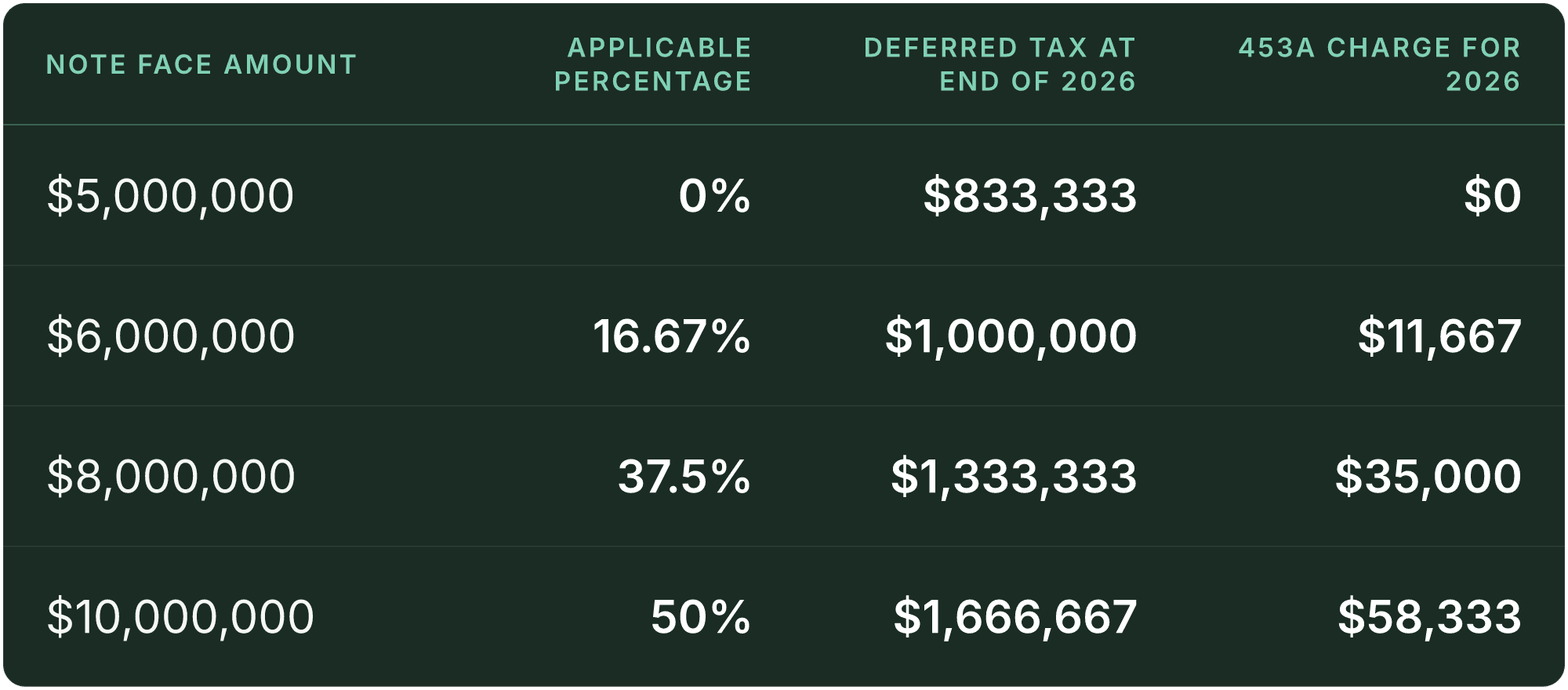
How much the charge bites depends on how much of the price sits in the note. The table holds the price, the basis and the 7% rate constant and changes only the split between cash and note.
[](https://www.409.ai/uploads/section_453a_interest_charge_installment_sale_seller_note_over_5_million_table_1_351a7a5c45.png)
The threshold is not a cliff. A $6,000,000 note doesn't make all of the deferred tax subject to interest, only the slice that corresponds to the $1,000,000 above the line. The charge grows faster than the note, though, because the applicable percentage and the deferred tax both rise with it.
Year by year until the note is paid
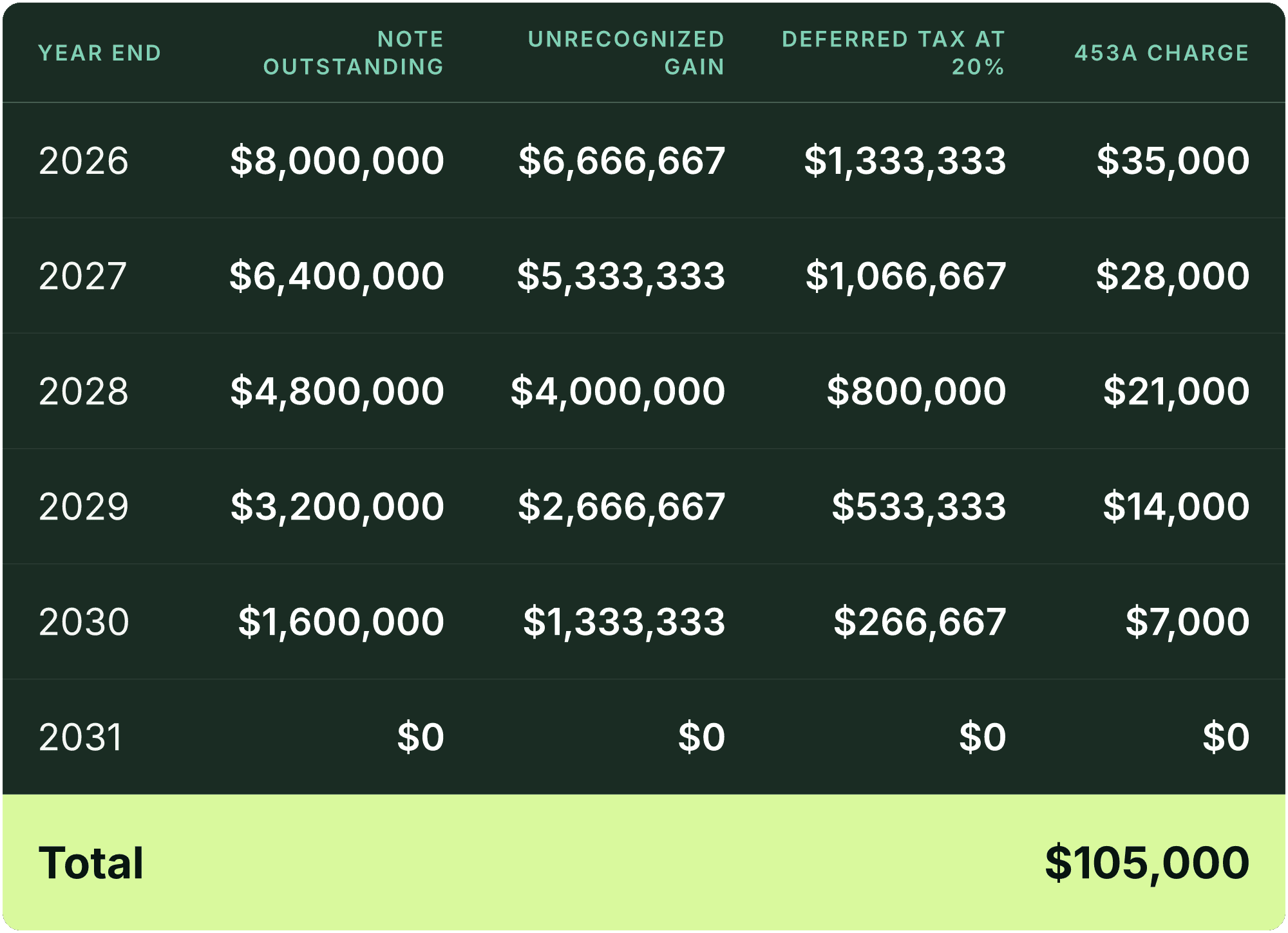
Now follow the $8,000,000 note through its life. Principal comes in five equal payments of $1,600,000, the first at the end of 2027. Each year the unrecognized gain falls, the deferred tax falls with it, and the 37.5% stays where it was set in 2026. The 7% rate after 2026 is an assumption for illustration.
[](https://www.409.ai/uploads/section_453a_interest_charge_installment_sale_seller_note_over_5_million_table_2_a74042fadf.png)
Over the life of the note the seller pays $105,000 of interest charge, in cash, from years when the note may be the main source of income. That money comes out of the after-tax proceeds your CPA is comparing against the cash offer.
There is a simpler way to read it. The installment method is, in effect, an interest-free loan from the Treasury of the tax you haven't paid yet. Section 453A takes 37.5% of that loan and charges 7% on it. The deferral on the tax tied to the first $5,000,000 of the note stays free; the deferral on the rest costs the underpayment rate. Whether that still beats paying the full tax in 2026 depends on what the seller earns on the money in the meantime and on the note's own interest rate, which has to clear the applicable federal rate test our [seller financing article](https://www.409.ai/articles/seller-financed-business-sale-note-value-installment-sale-imputed-interest) explains.
Pub. 537 also confirms that a seller can elect out of the installment method and report the whole gain in the year of sale. That ends both the deferral and the 453A charge. It's a decision for the owner and their CPA, made with these numbers in front of them.
The second trap: borrowing against the note
Sellers with a large note often want cash sooner. A bank will lend against a well-secured note from a creditworthy buyer. Section 453A(d) turns that loan into a taxable event.
If any debt is secured by an installment obligation the section covers, the net proceeds of the debt are treated as a payment received on the note, at the later of the date the debt becomes secured or the date you receive the proceeds. This rule has no $5,000,000 threshold. It applies to any note from a sale above $150,000, so a $2,000,000 note is caught as surely as an $8,000,000 one. Since 1999, the statute also treats a debt as secured by the note when an arrangement lets you satisfy the debt with the note, which catches structures that never use the word "pledge."
Back to the example. In 2027, before the first principal payment, the owner borrows $3,000,000 from a bank and pledges the note. The $3,000,000 counts as a payment on the note. At 83.33%, that brings $2,500,000 of gain into 2027, and at 20% the tax is $500,000, due on money that came from a loan the owner still has to repay.
The statute does prevent double taxation. Later payments on the note are not taxed again until they add up to the amount already treated as received, here the first $3,000,000 of principal. The total gain over the life of the deal doesn't change. The timing does, and the timing was the reason to take the note in the first place.
Pub. 537 lists the same exclusions as for the interest charge: farm property, personal-use property and qualifying sales of timeshares and residential lots.
Before you sign the note-heavy offer
A seller note changes three numbers in the comparison, and section 453A touches two of them.
- **The note's value today.** Discount it at the rate a lender would charge this buyer and price in the risk that the business you sold has to pay it. If the buyer is also using an [SBA 7(a) loan](https://www.409.ai/articles/sba-7a-seller-note-full-standby-equity-injection-business-sale-price), the lender's standby terms can push your payments back.
- **The tax on the gain and when it's due.** Model the installment schedule, and add the 453A charge for every year the note sits above the threshold, at the underpayment rate in effect each December.
- **Your liquidity plan.** If you expect to borrow against the note, model the pledge as a payment. A seller who needs the cash early may be better served by more cash at closing than by a bigger note and a bank loan.
The price itself still has to hold up first. How the purchase price is split among assets, covered in our article on [Form 8594](https://www.409.ai/articles/form-8594-asset-allocation-small-business-sale), decides how much of the gain is capital and how much is ordinary, which sets the rate inside the deferred tax liability. And the headline number should rest on [what the business is worth to a buyer](https://www.409.ai/articles/revenue-ruling-59-60-small-business-valuation-eight-factors), not on the size of the note.
The number to put beside the offer
For a note above $5,000,000, ask your CPA for one more line in the comparison: the section 453A charge, year by year, until the note is paid. On the $8,000,000 note in this example, it is $105,000 at a 7% rate, and $500,000 of tax comes forward if the note is pledged for $3,000,000. With those two figures, the note-heavy offer and the cash offer can finally be compared on the same terms.
A [409.AI small business valuation](https://www.409.ai/products/smb-valuation) gives you the fair market value of the company before the negotiation over cash and notes begins, so the trade-off you're weighing is between two structures, not between two guesses at the price.