Financial Reporting
A Secondary Sale Priced Below Your Mark: Is It Evidence Your Auditor Will Make You Use?
A fund CFO's guide to weighing a secondary sale priced below your Level 3 mark: the orderly test, comparability, a weight sensitivity and the audit file.
By 409.AI Team - 2026-10-18
# A Secondary Sale Priced Below Your Mark: Is It Evidence Your Auditor Will Make You Use?
Your fund carries a Series B position at $12.00 a share. In October, another Series B holder sells 40,000 shares of the same class at $9.60. Your controller forwards the notice with one line: "Do we need to mark down?"
The honest answer is neither yes nor no. ASC 820 asks you to measure fair value as an exit price in an orderly transaction between market participants. A secondary sale is one data point about that price. It is not the price itself, and it is not something you can ignore because it is inconvenient. This article is for the fund CFO, controller or GP who has to decide how much weight such a trade deserves at the next quarter-end, and what to put in the file so the auditor can follow the reasoning.
Why the trade cannot be waved away
Fair value under ASC 820 is the price that would be received to sell an asset in an orderly transaction at the measurement date. A completed sale of the same security, by a knowledgeable seller to a willing buyer, looks a lot like that definition. Auditors know it. When a sale in your portfolio company's stock closed near quarter-end at a discount to your carrying value, expect the question before you raise it.
The trade also does not decide the mark on its own. A secondary price can reflect a seller who needed cash, a buyer who wanted a discount for a stake with no information rights, or a block too small to say anything about your position. PKF O'Connor Davies makes the same point in a [2026 note on secondary transactions](https://www.pkfod.com/insights/secondary-transactions-and-fair-value-what-market-prices-really-mean-under-asc-820/): a secondary-market price is not automatically a new fair value, and it has to be assessed against the interest sold, the process, the timing and the conditions at the measurement date.
So the work has three parts. Decide whether the trade was orderly. Decide how comparable it is to your position. Decide how much weight it gets next to your other evidence. Then write all three down.
Step 1: Was the transaction orderly?
ASC 820 lists circumstances that may indicate a transaction is not orderly. The list sits in ASC 820-10-35-54I, and [Deloitte's Roadmap](https://dart.deloitte.com/USDART/home/codification/broad-transactions/asc820-10/roadmap-fair-value-measurements-disclosures/chapter-10-subsequent-measurement/10-7-identifying-transactions-that-are) reproduces it. The indicators include:
- there was not adequate exposure to the market for the marketing activities that are usual and customary for such assets;
- the seller marketed the asset to a single market participant despite a usual marketing period;
- the seller is in or near bankruptcy or receivership, or must sell to meet a regulatory or legal requirement;
- the transaction price is an outlier compared with other recent transactions in the same or a similar asset.
The standard asks for judgment on the weight of the evidence. If the evidence points to a transaction that is not orderly, you place little, if any, weight on that price compared with other indications of fair value. A drop in the volume of activity does not, by itself, make a transaction disorderly. Neither does financial pressure alone: PKF notes that a seller's stress does not make a deal non-orderly, though a sale driven by a near-term need for cash may be less persuasive evidence.
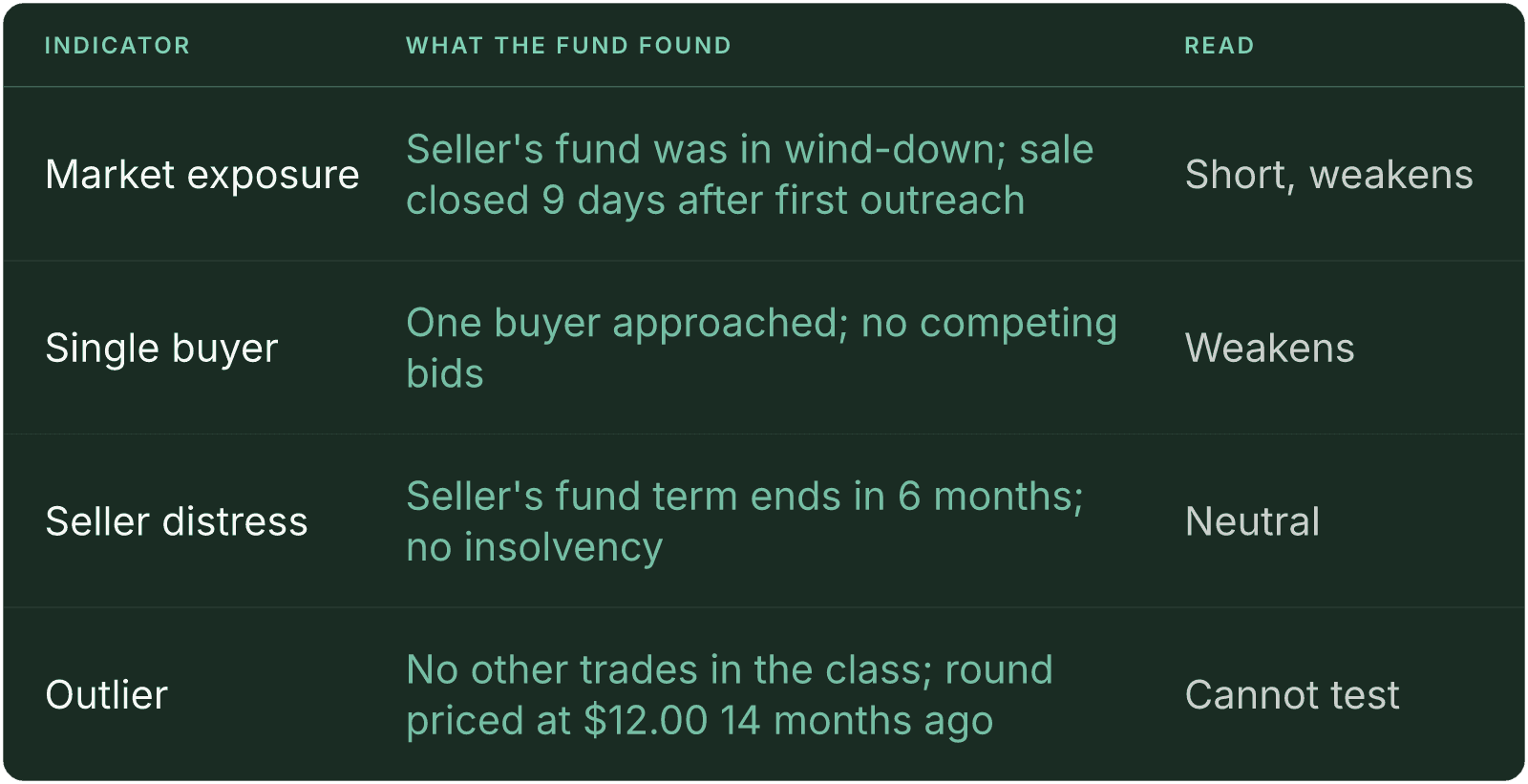
Here is how the Series B trade might look in an illustrative file.
[](https://www.409.ai/uploads/secondary_sale_below_fund_mark_asc_820_orderly_transaction_weight_table_1_2ae76a71b3.png)
The table does not prove the trade was disorderly. It shows two weak points, a nine-day process and a single buyer, and one gap you cannot close, because there is no second trade to compare against. A reasonable conclusion is that the trade is a real but low-quality data point.
Step 2: How comparable is it to your position?
Even an orderly trade may not describe your shares. Ask four questions.
Same security? A sale of Series B preferred tells you more about your Series B than a sale of common stock does. If the trade was common stock, the gap to your preferred mark is partly a difference in rights, which your [liquidation waterfall analysis](https://www.409.ai/articles/fund-mark-junior-preferred-liquidation-waterfall-asc-820-latest-round-price) already prices.
Same size? A 40,000-share block against your 200,000 shares is one fifth of your position. Large blocks and small blocks can price differently, and the direction depends on the facts. Record the size and do not guess at the direction.
Same information? If the buyer had no financials and you receive monthly reporting, the buyer was pricing uncertainty you do not carry. If the buyer had the same information you hold, the price is stronger evidence.
Same date? A trade three weeks before quarter-end says more about December 31 than a trade eleven months earlier. A trade after the measurement date may still carry information about conditions that existed on it, which is the reasoning behind the treatment in [our guide to a January round and a December 31 mark](https://www.409.ai/articles/january-round-december-31-mark-asc-855-subsequent-events-fund).
Step 3: Weight it against everything else
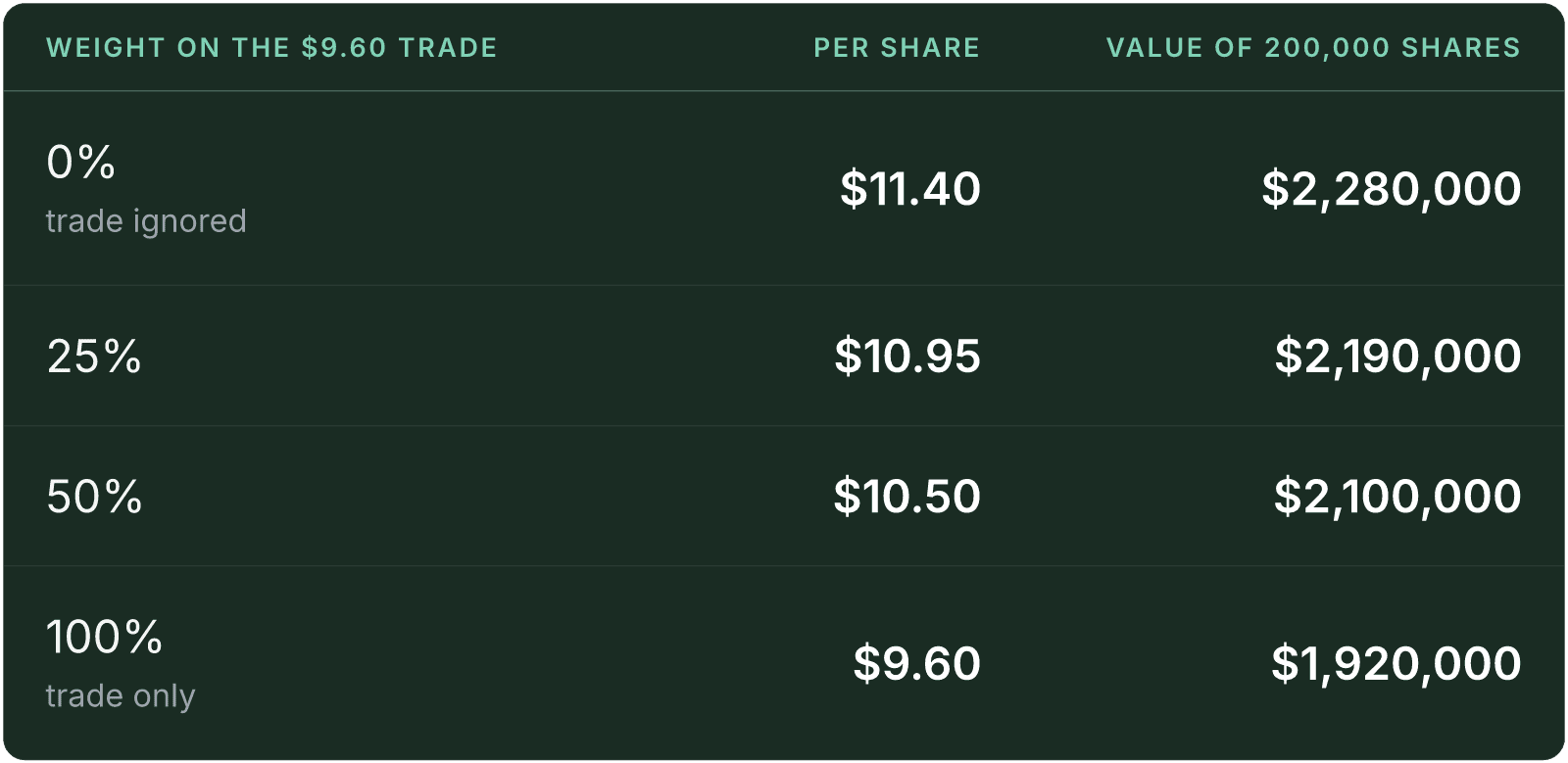
The fund rarely has only one input. Suppose the valuation model, calibrated to the $12.00 round and rolled forward with current public comparables and the company's results, now indicates $11.40 a share. The secondary trade says $9.60. The question is what weight the $9.60 deserves.
There is no prescribed formula, and PKF is direct about it: the aim is not to quantify weighting with artificial precision. What you can do is show the reviewer what each plausible weight would do, so the choice is visible and a number is not buried inside a spreadsheet.
[](https://www.409.ai/uploads/secondary_sale_below_fund_mark_asc_820_orderly_transaction_weight_table_2_fbf4e77dab.png)
Each row is $11.40 minus the weight times $1.80, the gap between the model and the trade. The span from top to bottom is $360,000, or 15.8% of the model value. That is the range of the disagreement. Where the mark lands inside it is a judgment about the trade's quality.
For the trade above, a fund might settle near the 10% to 25% weight range, and say why: nine days of marketing and one buyer limit the weight, while a real closed trade in the same class limits how little weight is defensible. A fund that gave it zero would need a reason stronger than "we disagree with the buyer." A fund that gave it 100% would be saying the buyer's process matches an orderly market sale, and the facts above do not say that.
Either answer can survive review. What does not survive is no answer, a weight that appears with no explanation, or a different weight every quarter on similar facts.
Calibration and the next quarter
Your model was calibrated to the $12.00 round when the fund invested. Calibration means the unobservable inputs were set so the model reproduced that transaction price at initial recognition, as ASC 820 expects when the transaction price is fair value, and as we cover in [our piece on the SEC staff's view of calibration and NAV](https://www.409.ai/articles/sec-staff-statement-private-asset-fair-value-calibration-nav). A later secondary trade is a reason to ask whether the calibrated inputs still hold. Ask what the $9.60 trade implies about the discount rate, the multiple or the scenario weights, and whether public comparables moved by a similar amount since the round. If comparables fell 12% and the model already reflects it, the trade may be consistent with your $11.40 rather than a contradiction of it.
Then record the outcome. One quarter later, the company either closes a financing, gets acquired, or shows results that settle the question. Our piece on [back-testing marks against exit prices](https://www.409.ai/articles/back-testing-fund-marks-exit-prices-asc-820-disposition-analysis) describes how a fund compares what it recorded against what actually happened, which is the best way to learn whether a weight you chose was too high or too low.
What goes into the audit file
An auditor reviewing a Level 3 mark will want to see, for any secondary trade you knew about:
1. the trade itself: date, security, size, price, how you learned of it and what source confirmed it; 2. the orderly-transaction assessment against the ASC 820-10-35-54I indicators, including the ones you could not test; 3. the comparability assessment: security, size, information, timing; 4. the sensitivity of the mark to the weight you gave it, as in the second table above; 5. the weight you chose and the sentence that explains it; 6. a note on how the valuation policy told you to treat this kind of evidence.
The last item matters because the policy decides whether you were consistent. A fund whose [valuation policy](https://www.409.ai/articles/fund-valuation-policy-asc-820-audit-sec-exam) says transactions in the same security within 90 days of quarter-end are considered, and gives the factors, can point to it. A fund with a silent policy is deciding in the moment, which is the situation an auditor probes hardest.
One more point. You may never hear about a trade in a portfolio company where you hold no board seat. Fund-level practice should say how you look: ask the company about tenders and secondary transfers, and check any transfer-restriction notices it sends. A trade you did not know about is not an ASC 820 error. A trade you were told about and did not assess is.
The takeaway
When a secondary sale prints below your mark, do three things before quarter-end: test whether it was orderly, test whether it is comparable to your shares, and show a sensitivity of the mark to the weight you give it. Then write the reason for the weight in one sentence a stranger could follow. Our [ASC 820 valuation service](https://www.409.ai/products/asc-820) produces that file for funds that want an independent view on the weight, and the broader method for Level 3 positions is in [our overview of ASC 820 for fund portfolios](https://www.409.ai/articles/asc-820-level-3-fair-value-fund-portfolio-valuation).