Education
Seller Note on Full Standby: What Your Buyer's SBA 7(a) Loan Does to the Price You Accept
Selling your business to an SBA 7(a) buyer? See how a seller note on full standby works under SOP 50 10 8.1, how big it gets, and what it is worth to you today.
By 409.AI Team - 2026-11-10
# Seller Note on Full Standby: What Your Buyer's SBA 7(a) Loan Does to the Price You Accept
You've found a buyer for your business at $1,500,000. Their lender is an SBA 7(a) lender, and the term sheet that comes back asks you for something you didn't expect: a seller note that pays you nothing, not even interest, for the next ten years.
That request has a name, full standby, and it comes straight from the rules SBA lenders work under. If you're the owner selling to an SBA-financed buyer, or the business broker or CPA structuring the deal, the standby note is where the headline price and the money you actually receive start to come apart. This article walks through what the rules require, how much of your price can end up on standby, and what that note is worth to you today.
What "full standby" means
SBA's lending rules sit in a single document, SOP 50 10, and the current version, [SOP 50 10 8.1](https://legacy.sba.gov/sites/default/files/2026-10/SOP%2050%2010%208.1%20Technical%20Policy%20Updates%20effective%20%2010.1.2026.docx), took effect on October 1, 2026. Its change of ownership rules say that seller debt "that is subordinated to the Lender and on full standby (no payments of principal or interest for the term of the 7(a) loan) may be considered as equity for SBA's purposes."
Read that as the lender does. The buyer has to put equity into the deal, and a seller note can count as part of it, but only if the seller agrees to be paid after the bank. The SOP spells out the conditions:
- The lender documents the arrangement on [SBA Form 155](https://www.sba.gov/document/sba-form-155-standby-creditors-agreement), the Standby Creditor's Agreement, or its own equivalent, with a copy of your note attached.
- Interest may accrue during the standby period, be added to the balance, and be amortized after the 7(a) loan is paid in full.
- You subordinate any lien on the business's assets to the lender, and you can't take action against the buyer or that collateral without the lender's consent.
- The provider of standby debt may not take an equity investment in the business.
"The term of the 7(a) loan" is a long time. Under the same SOP, a 7(a) loan that finances a change of ownership can't amortize over more than 10 years, except for certain special purpose properties where real estate is 85% or more of the project cost. For a typical business sale with no building, you should plan on a decade with no payments.
How much of your price can sit on standby
Two rules decide the size of the standby note: the buyer's equity requirement, and the cap the lender's valuation puts on debt.
For an Initial Acquisition, where an outside buyer purchases the business, the buyer must inject equity of at least 10% of total project cost, and the SOP says this requirement "cannot be reduced or eliminated." Total project cost counts everything needed to close and operate, not only your price, so closing costs and working capital raise it. Seller standby debt is a "limited" equity source, and limited sources may provide no more than half of the required injection. The other half has to come from unlimited sources such as the buyer's own cash that isn't borrowed.
The second rule is where valuation enters. The SOP limits "the total debt eligible to support a change of ownership transaction (including seller debt that is not on full standby)" to the business valuation amount. When your price is above what the lender's valuation supports, the SOP allows additional limited equity sources to fill the gap, and "any additional funds provided must be on full standby." We covered why that valuation became mandatory on every 7(a) change of ownership in [our article on SOP 50 10 8.1](https://www.409.ai/articles/sba-sop-50-10-8-1-business-valuation-change-of-ownership).
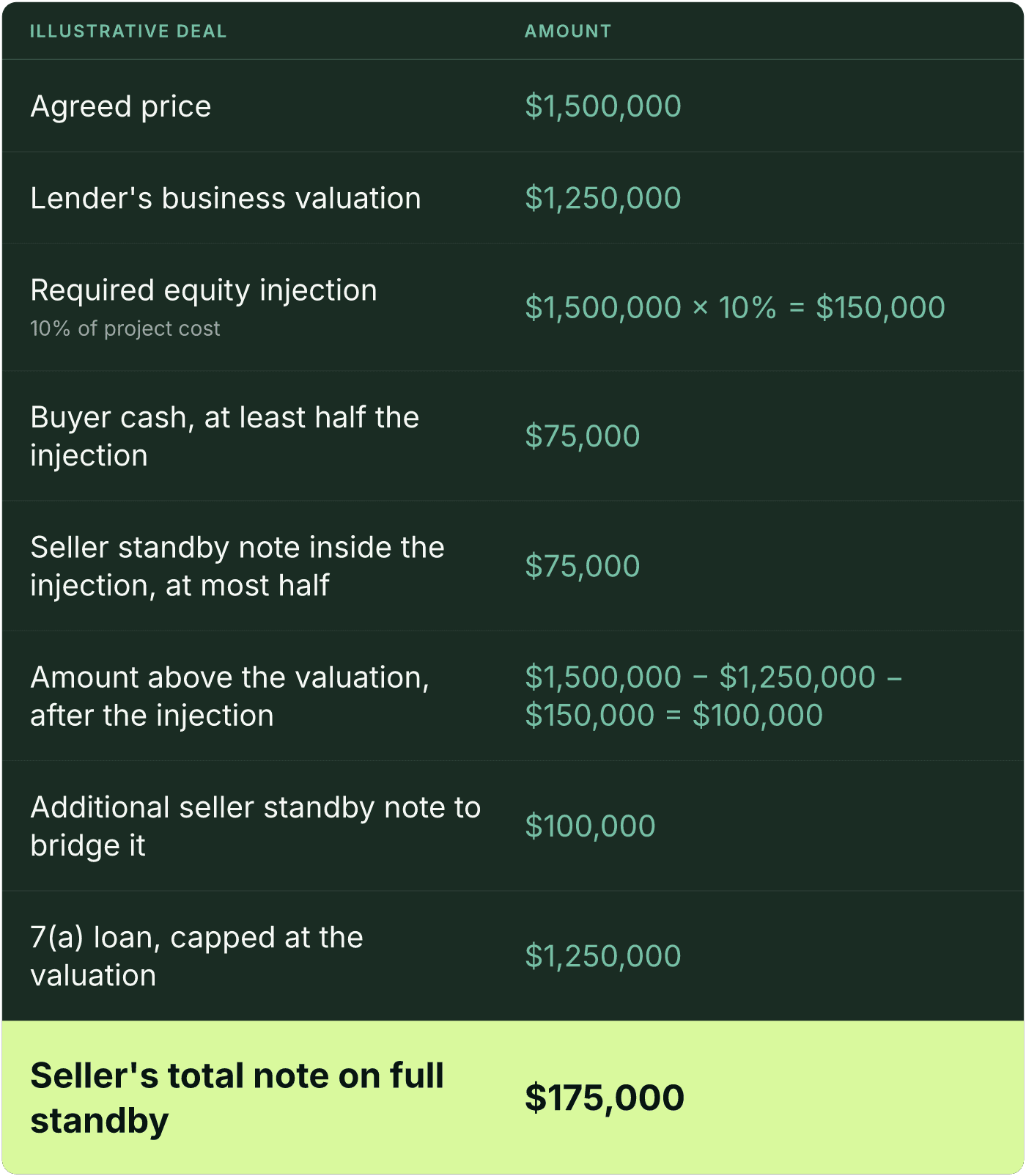
Here is how the two rules combine on an illustrative deal. To keep the arithmetic clean, assume total project cost equals the $1,500,000 price and the lender's valuation comes back at $1,250,000.
[](https://www.409.ai/uploads/sba_7a_seller_note_full_standby_equity_injection_business_sale_price_table_1_cedc4cd650.png)
The numbers tell you the seller's real position. Cash at closing is the 7(a) loan plus the buyer's cash: $1,325,000. The remaining $175,000, about 12% of the price, sits behind the bank for ten years. The lender decides how these pieces fit together, and some lenders will want more buyer cash rather than more seller paper, so treat the table as one structure the rules allow, not the only one.
If the valuation had supported the full price, only the $75,000 inside the injection would have needed to sit on standby, and only if the buyer asked for it. The gap between your price and the lender's appraisal is what turns a small standby note into a large one, which is why it's worth knowing where that number is likely to land before you accept an offer. Our article on [why rule-of-thumb multiples rarely survive a lender](https://www.409.ai/articles/rule-of-thumb-multiples-vs-appraisal-small-business-valuation-sde) explains where the gap usually comes from.
What a standby note is worth to you today
A $175,000 note that pays nothing for ten years is not worth $175,000. How much less depends on its terms and on the return you'd demand for waiting behind a bank.
Take the generous case: the note accrues interest at 6% a year, compounding, and after the 7(a) loan is paid off it amortizes over five years at the same rate. By year 10 the balance has grown to about $313,400. From year 11 to year 15 you'd collect about $74,400 a year, roughly $372,000 in total.
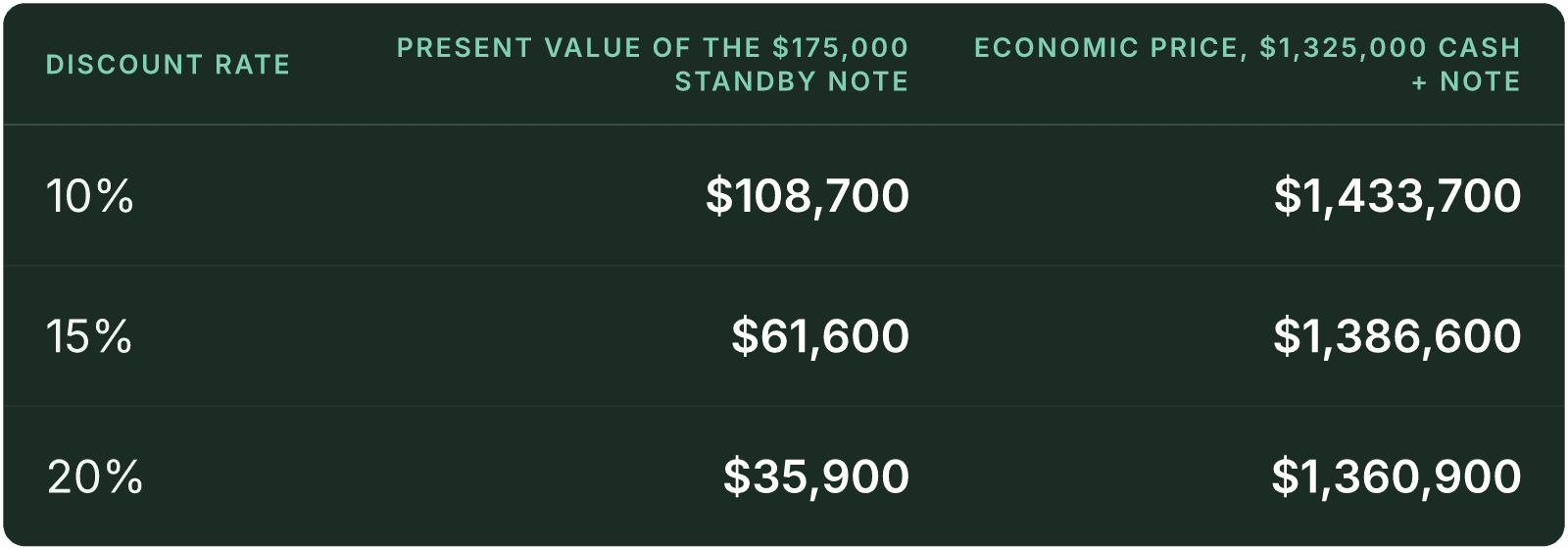
Now discount those payments back to today. The rate is a judgment, and it should be high, because the note is subordinated, its lien sits behind the bank's for a decade, and it's repaid only if the business survives under its new owner. Here is the present value at three illustrative rates:
[](https://www.409.ai/uploads/sba_7a_seller_note_full_standby_equity_injection_business_sale_price_table_2_f322ed8110.png)
At 15%, the $1,500,000 deal is worth about $1,386,600 to you on closing day. At 20%, it's worth less than a clean offer at $1,375,000 with no standby paper. And that's with interest accruing: a standby note that carries no interest at all is worth far less.
None of this means you should refuse a standby note. It means you should compare offers on what they're worth, not on the headline. The same discounting logic applies to any seller note, and our article on [what a seller note is really worth](https://www.409.ai/articles/seller-financed-business-sale-note-value-installment-sale-imputed-interest) covers the ordinary amortizing note, the interest rate the IRS imputes when a note's rate is too low, and how installment gain is taxed. How the accrued interest on a standby note is taxed while you wait is a question for your CPA before you sign, not after.
The rules that close the usual escape routes
Sellers and brokers often reach for the same workarounds. The SOP closes most of them.
No earnout. Seller earnouts are prohibited in a 7(a) change of ownership. A rebate from the seller to the buyer based on the business's performance is allowed, and the buyer has to apply it to the 7(a) loan's principal. So you can't bridge a valuation gap by promising yourself more if the business does well.
No early refinance of a standby note. Seller debt can be refinanced with a new 7(a) loan only after it has been in place and current for 36 months, and the SOP specifies current means "not on standby." A note sitting on full standby doesn't build that history. An amortizing seller note that the buyer pays on time can qualify after three years, as long as the refinance cuts the installment by at least 10% and doesn't reduce the lender's exposure.
No staying on as an owner or employee. In an Initial Acquisition the seller may not remain as an officer, director, stockholder or employee. If the business needs a transition, it can hire you as a consultant for no more than 24 months in total, extensions included.
No seller-commissioned valuation. The business valuation must be requested by and prepared for the lender, and the lender may not use one prepared for the buyer or the seller. You can't hand over your own appraisal to lift the cap. What you can do is get your own estimate before you negotiate, so the lender's number doesn't surprise you.
Where you have room to negotiate
Once you see the standby note as a discounted asset, the negotiation gets clearer.
First, argue about the split, not only the price. A $1,400,000 offer that's almost all cash at closing can beat a $1,500,000 offer with $175,000 on standby, as the table shows. Brokers who quote only the headline do their clients no favors.
Second, push for interest to accrue on the standby note. The SOP allows it, and the difference between a note that grows at 6% and one that doesn't is large after ten years.
Third, if part of your note can sit outside the standby, the amortizing portion counts against the valuation cap and has to fit the buyer's debt service coverage. That limits how much you can carry on regular terms, but whatever fits gets paid now rather than in year 11. Our walk-through of [buying out a partner with a 7(a) loan](https://www.409.ai/articles/sba-7a-partner-buyout-existing-owner-partial-change-guaranty-valuation-cap) shows the same cap at work in an owner buyout, where the equity rules are more flexible.
Fourth, settle the working capital and asset allocation terms at the same time. The [working capital peg](https://www.409.ai/articles/working-capital-peg-small-business-sale-closing-price-adjustment) can move your closing cash by tens of thousands, and the way the price is split on [Form 8594](https://www.409.ai/articles/form-8594-asset-allocation-small-business-sale) changes what you keep after tax.
The number to know before you sign
The standby note is sized by the gap between your price and the lender's valuation. So the most useful number you can have before you accept an SBA-financed offer is a credible estimate of what an independent appraiser will say the business is worth. If it supports the price, the standby note stays small or disappears. If it doesn't, you can decide on your own terms whether to reprice, carry paper behind the bank for a decade, or wait for a different buyer.
A [small business valuation](https://www.409.ai/products/smb-valuation) prepared for you won't replace the lender's report, but it tells you where that report is likely to land, and how much of your price is likely to end up on standby.