Education
Buying Out a Partner With an SBA 7(a) Loan: Who Signs, Who Guarantees, and What the Valuation Caps
Buying out a business partner with an SBA 7(a) loan? See who must co-borrow, who guarantees, and how the lender's valuation caps the debt under SOP 50 10 8.1.
By 409.AI Team - 2026-10-20
# Buying Out a Partner With an SBA 7(a) Loan: Who Signs, Who Guarantees, and What the Valuation Caps
You and your partner have agreed on a number. Then the lender sends a list of who has to sign, who has to guarantee, and an appraiser you didn't hire. Most owners learn the SBA rules for a partner buyout at this point, after the price is already set in a handshake.
This guide is for the owner buying out a partner with a 7(a) loan, and for the CPA or attorney building the deal. It covers the rules in SBA's SOP 50 10 8.1 technical updates, effective October 1, 2026, that decide how the deal is shaped. It isn't legal advice about your loan. Your lender and your attorney confirm how it applies to you.
Two buyout categories, two sets of signatures
SBA sorts a change of ownership into four types. Buying out a partner is an Owner Buyout, and Owner Buyouts split into two categories ([SBA SOP 50 10 8.1 technical updates, Appendix 15](https://legacy.sba.gov/sites/default/files/2026-10/SOP%2050%2010%208.1%20Technical%20Policy%20Updates%20effective%20%2010.1.2026.docx)).
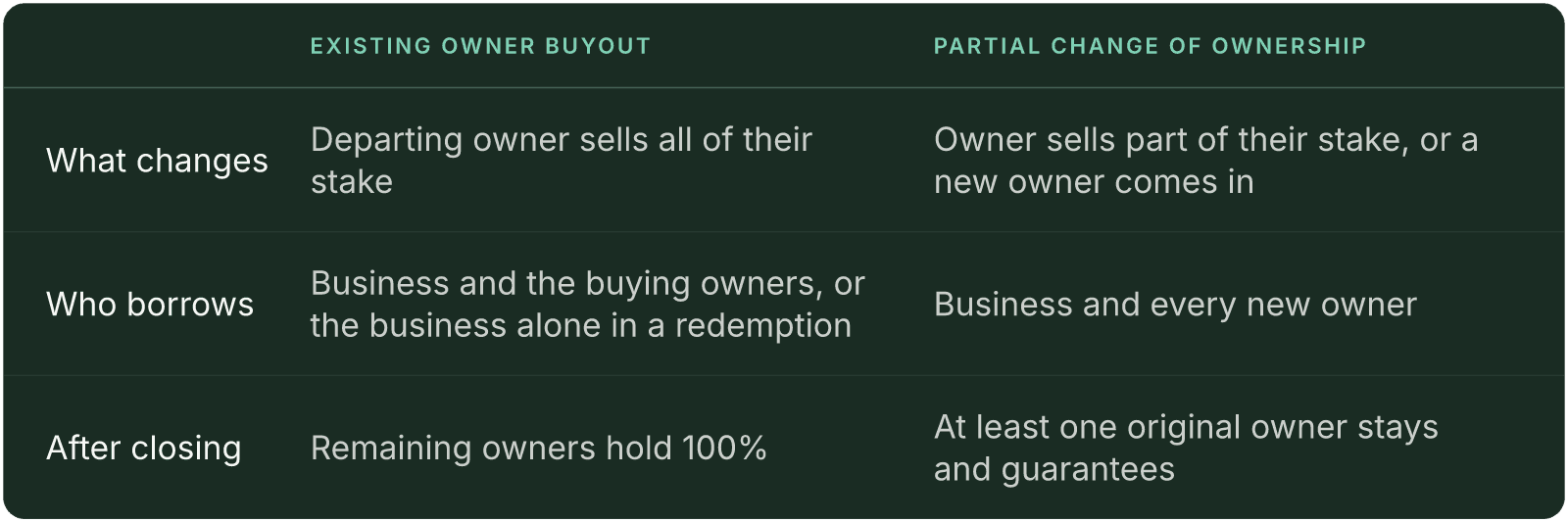
An Existing Owner Buyout is the clean exit. One or more current owners or employees buy the entire interest of another owner, and the remaining people end up owning 100% of the business. The buyers must have taken an active part in running the business for at least the last 24 consecutive months. The business and the buying owners sign the loan together as co-borrowers. If the company itself redeems the departing partner's share instead, the business is the borrower and the remaining owners guarantee under SBA's usual guaranty rules.
A Partial Change of Ownership is the messier one. A partner sells only part of their stake, or the deal brings in someone new, and at least one original owner stays on and personally guarantees the loan. Here the business and every new owner must be co-borrowers, even if that person gets 1% of the company. New owners who hold their shares through an entity must also guarantee personally.
[](https://www.409.ai/uploads/sba_7a_partner_buyout_existing_owner_partial_change_guaranty_valuation_cap_table_1_00c13f1e0b.png)
The table shows why the label matters. Two partners who plan to "split it over a few years" are asking for a partial change, with more signatures than they expected. Our post on [how the standard of value changes a partner buyout](https://www.409.ai/articles/partner-buyout-fair-market-value-vs-fair-value-small-business-standard-of-value) covers the price side of that conversation.
The selling partner who stays
This is the rule that surprises sellers. If a selling owner takes loan proceeds, keeps some ownership and ends up with less than 20% of the business, SBA requires a full guaranty of the whole loan from that seller. The guaranty runs for at least two years after the final disbursement. The seller can be released only if the loan has been current for the 12 consecutive months before the release.
There is one concession. SBA doesn't require these two-year guarantors to pledge personal assets, such as a home, if the collateral falls short.
For a retiring partner, that is a real trade. Selling 85% and keeping 15% looks like a soft landing, but it also leaves them on the hook for the full loan for years. Some sellers will prefer a full exit under the Existing Owner Buyout, and a CPA should put both versions side by side before the deal is priced.
Other limits shape the structure:
- Buyers employed by the business for less than 24 months can acquire less than 50% of the equity, and they can't become the largest owner. Ownership held through holding companies or trusts is added up. A deal that fails this test is processed under the stricter Initial Acquisition credit standards, with a minimum equity injection that can't be reduced.
- Seller earnouts are prohibited. A rebate to the buyer based on the business's performance is allowed, and it goes to pay down the loan's principal.
- Multi-step partial changes are not eligible. If the owners form a new company to become the 100% owner of the operating company, with the continuing owners and the buyer holding shares in that new company, the 7(a) loan can't fund it.
The valuation, and the cap it puts on the loan
Every change of ownership needs a business valuation. The lender has to order it, from a person SBA calls a Qualified Source: someone who regularly gets paid for business valuations, holds one of five listed credentials (ASA, CBA, ABV, CVA or BCA), and is independent of the lender's loan production and of the approval. A valuation prepared for you or for the seller doesn't count. The SOP also lets a lender do its own valuation on smaller deals, unless there's a close relationship between buyer and seller. Partners should ask the lender early whether that exception applies to them. For the detail on the threshold, read our post on [how the October 1 change reshapes SBA business valuations](https://www.409.ai/articles/sba-sop-50-10-8-1-business-valuation-change-of-ownership).
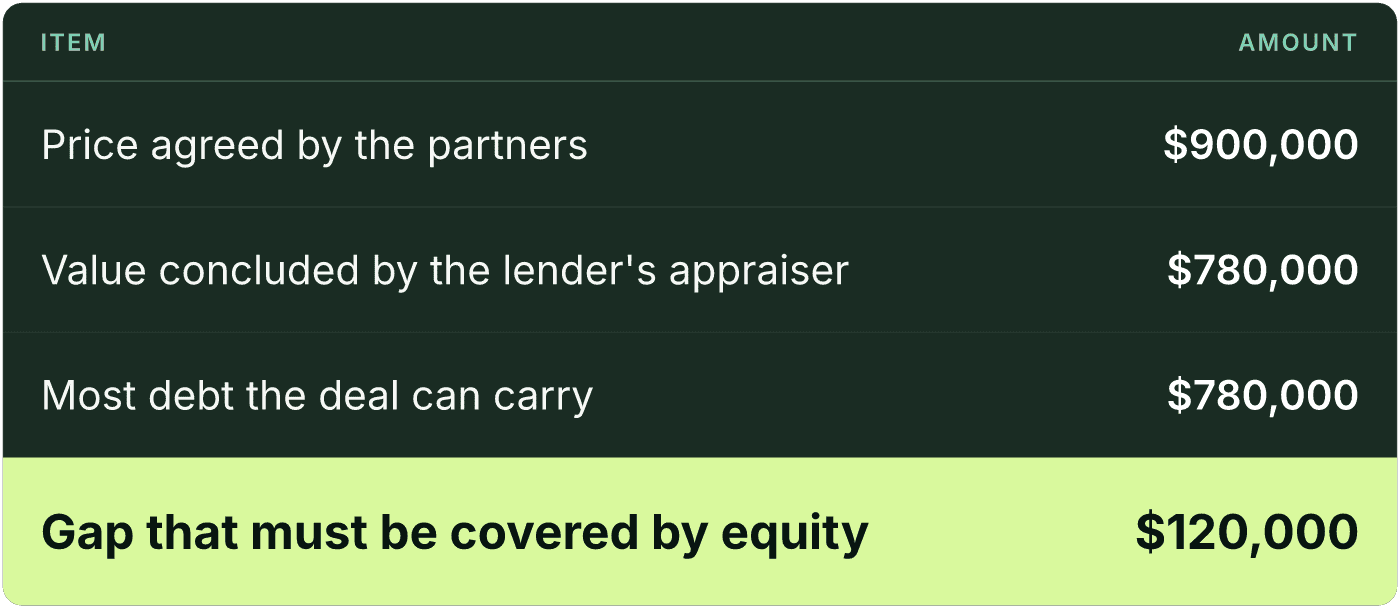
Here is the rule that does the damage. The total debt eligible to support the deal, including any seller note that isn't on full standby, is limited to the business valuation amount. The valuation must support the Business Purchase Price however the debt is structured, and if the price paid exceeds the valuation, the difference must be made up by equity.
Take two partners who shake hands at $900,000 for the departing partner's half of a service business. The lender's appraiser concludes the business is worth $780,000.
[](https://www.409.ai/uploads/sba_7a_partner_buyout_existing_owner_partial_change_guaranty_valuation_cap_table_2_f325313fbb.png)
The $120,000 is not a negotiation point with the lender. It is a hole in the financing. The SOP says extra funds used to cover a price above the supported value must sit on full standby, which means no principal or interest payments for the life of the 7(a) loan. Buyers can cover the gap with cash, or they can go back to the seller and reprice, or restructure the part of the price above the appraised value as a standby note. The lender decides how these pieces fit with the usual 10% equity requirement, which the lender may reduce or waive for an owner buyout when the business has enough liquidity and working capital.
What the appraiser looks at matters as much as the conclusion. The lender has to check the financial data the appraiser relied on against the seller's IRS tax transcripts. Normalizing the owner's pay and the add-backs is where valuations of small companies move most, which is why our guide to [owner pay, SDE and EBITDA add-backs](https://www.409.ai/articles/owner-compensation-add-backs-small-business-valuation-sde-ebitda) is worth reading before you hand over your books. A partnership where one owner is the face of the company may also see a [key person discount](https://www.409.ai/articles/key-person-discount-small-business-valuation-owner-dependence) in the number.
What an owner buyout doesn't need
One piece of good news. SBA requires a Quality of Earnings report only for Business Expansion and Initial Acquisition deals where the purchase price is $3 million or more. Owner Buyouts are not subject to it. SBA's reasoning is that the remaining owners already know the business, and the buyout changes neither the management nor the operating structure.
Owner Buyouts still have to show debt service coverage of at least 1.25 to 1, and the lender runs the numbers on the business as it stands.
Questions to settle before you sign a price
1. Which category are we in? If the seller is keeping any shares, you're probably in a partial change, and a new owner means a new co-borrower. 2. Will the seller stay below 20%? If so, price in the two-year full guaranty, and decide whether a clean exit is better for both sides. 3. Does anything in the price depend on future performance? An earnout can't be part of the loan. Reshape it before the application. 4. Who orders the valuation, and when? Ask your lender before you agree on a price, and use the gap example above to learn what happens if the appraiser lands lower. 5. What do the partners' buy-sell terms already say? An existing agreement may fix a price or a formula. Our post on [buy-sell agreements after Connelly](https://www.409.ai/articles/buy-sell-agreement-valuation-connelly-life-insurance) shows how that language gets tested.
If you want an independent read on what your business is worth before you open the conversation with a lender, [409.AI's small business valuation](https://www.409.ai/products/smb-valuation) is built for these moments. A number you've seen before the lender's appraiser does is a number you can plan around, and you won't first meet the $120,000 gap in the loan file.