Tax
Selling Private Stock to a Grantor Trust: The Appraisal Sets the Note, the Gift and the Audit Risk
Founders selling private stock to a grantor trust for a note: how the appraisal sets the price, what a higher IRS value costs, and what the Form 709 must show.
By 409.AI Team - 2026-11-05
# Selling Private Stock to a Grantor Trust: The Appraisal Sets the Note, the Gift and the Audit Risk
A founder owns shares that could be worth three times as much in five years. An estate attorney proposes a sale to an intentionally defective grantor trust, often called an IDGT sale. The founder sells stock to a trust for the children, takes back a promissory note, and the growth above the note's interest rate lands outside the estate. The structure is common, and with private stock it has one weak point: the price. Nobody can look up what the shares are worth, so the price is an appraisal.
This article is for the founder or business owner considering the sale, and for the estate attorney, wealth advisor and CPA who build it. It shows where the valuation enters, what a different IRS value does to the numbers, and what the report needs to say.
How the sale works
You create an irrevocable trust for your family and draft it so that you, not the trust, owe the income tax on its earnings. That is the "defective" part: defective for income tax, effective for estate tax. You then sell the trust a block of stock for a note.
Because the trust is a grantor trust, the sale is ignored for income tax. The IRS said so in Rev. Rul. 85-13: a transaction between a grantor and their own grantor trust is not a taxable event. You report no gain on the sale, and the note's interest is not income to you. The trust pays you interest on the note, usually at the applicable federal rate (AFR), and any growth above that rate stays in the trust.
Three features matter for the valuation:
- **The note must carry at least the AFR.** Section 1274(d) sets the rates, and the IRS publishes them monthly. For November 2026, [Rev. Rul. 2026-21](https://www.irs.gov/pub/irs-drop/rr-26-21.pdf) puts the mid-term AFR, used for notes of more than three and up to nine years, at 5.08% with annual compounding. The long-term AFR, for notes over nine years, is 5.52%.
- **The trust needs substance.** Practitioners usually seed the trust with a gift of about 10% of the value being sold, so the trust has its own assets behind the note. The 10% is a convention, not a rule in the Code, and your attorney sets the number.
- **Paying the trust's income tax is not a further gift.** The IRS addressed that in Rev. Rul. 2004-64. That is one reason the trust grows faster than a trust that pays its own tax.
Where the valuation enters
The price of the sale is the fair market value of the exact block you sell, on the day you sell it. For stock with no market, that is the same standard as a gift: the price a willing buyer and willing seller would agree, neither under pressure, both with reasonable knowledge of the facts (26 CFR 25.2512-1).
Three things follow.
The block is what gets valued, not the company. A 12% minority stake without a right to force a sale or a dividend is worth less per share than the company's total equity value divided by its share count. The discounts for lack of control and lack of marketability apply to the block. We explain the first in [Discount for Lack of Control](https://www.409.ai/articles/discount-lack-of-control-dloc-409a-gift-tax-valuation) and the second in [Discount for Lack of Marketability](https://www.409.ai/articles/discount-lack-marketability-dlom-409a-valuation).
A 409A is not the answer. A 409A values common stock to price options. It is written for a different purpose, it does not apply the control discount the way a gift valuation does, and it is not built to meet the Treasury's qualified-appraisal content. [This comparison of a 409A and a gift tax valuation](https://www.409.ai/articles/409a-vs-gift-tax-valuation-form-709-founder-stock) shows what carries over and what gets rebuilt.
The date has to match. The valuation date is the closing date of the sale. A signed term sheet, a new round or a customer loss between the appraisal and the closing changes the value, and the appraiser needs to know.
A worked example
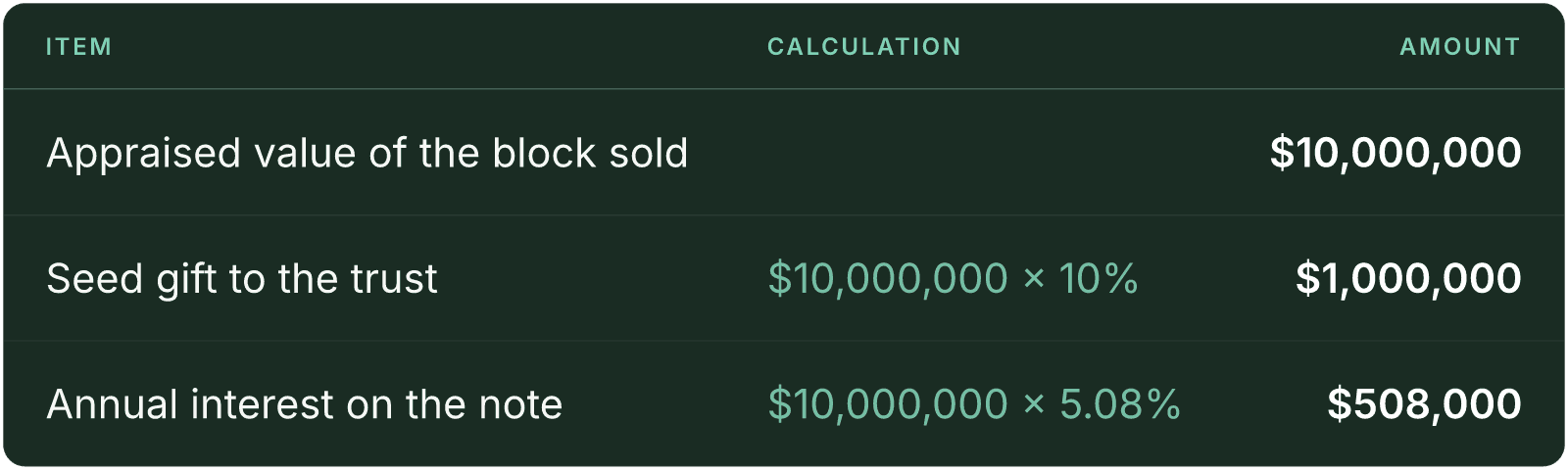
The numbers below are illustrative, not a recommendation. A founder sells a block that an independent appraisal values at $10,000,000 after discounts. The trust is seeded first, then buys the block for a nine-year note at the mid-term AFR of 5.08%.
[](https://www.409.ai/uploads/sale_to_idgt_private_stock_appraisal_note_afr_gift_tax_table_1_d09d96d949.png)
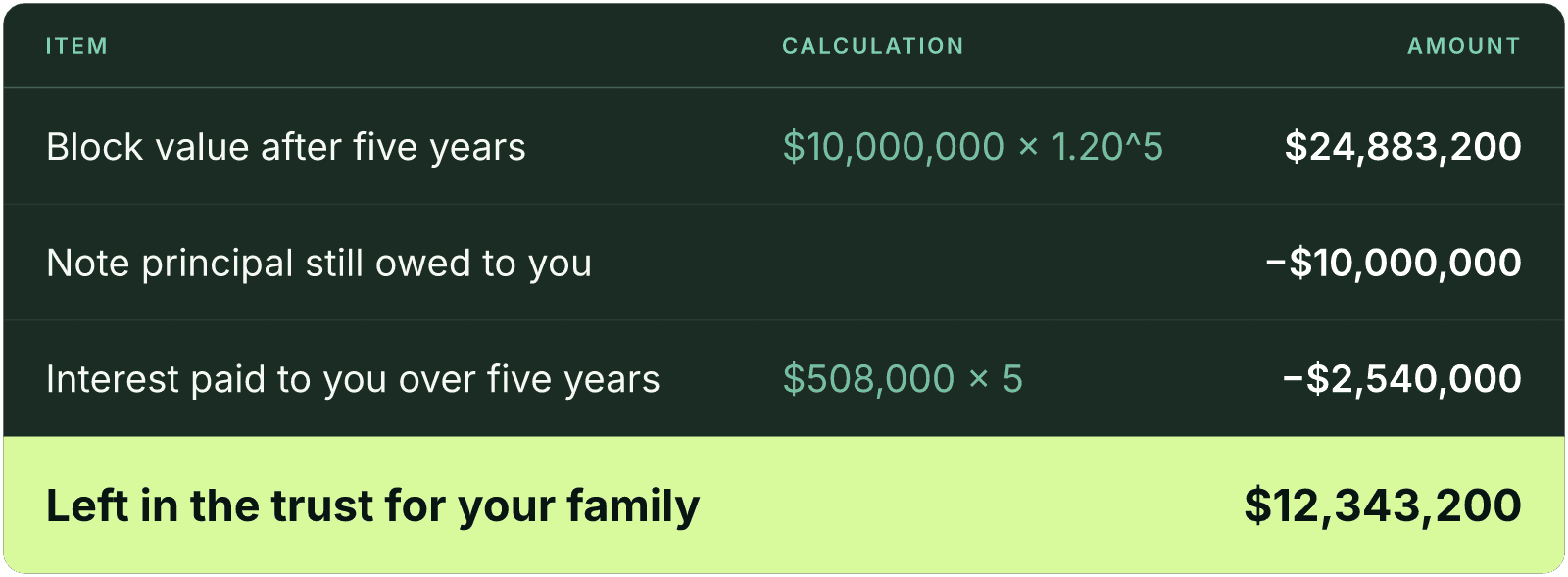
Now suppose the stock grows 20% a year for five years. That is a strong outcome for a venture-backed company and not a forecast.
[](https://www.409.ai/uploads/sale_to_idgt_private_stock_appraisal_note_afr_gift_tax_table_2_20dedccfed.png)
The $12.3 million moved with no taxable gift on the growth, because the sale was for full value. That only holds if the $10 million was the right price.
What happens if the IRS values the block higher
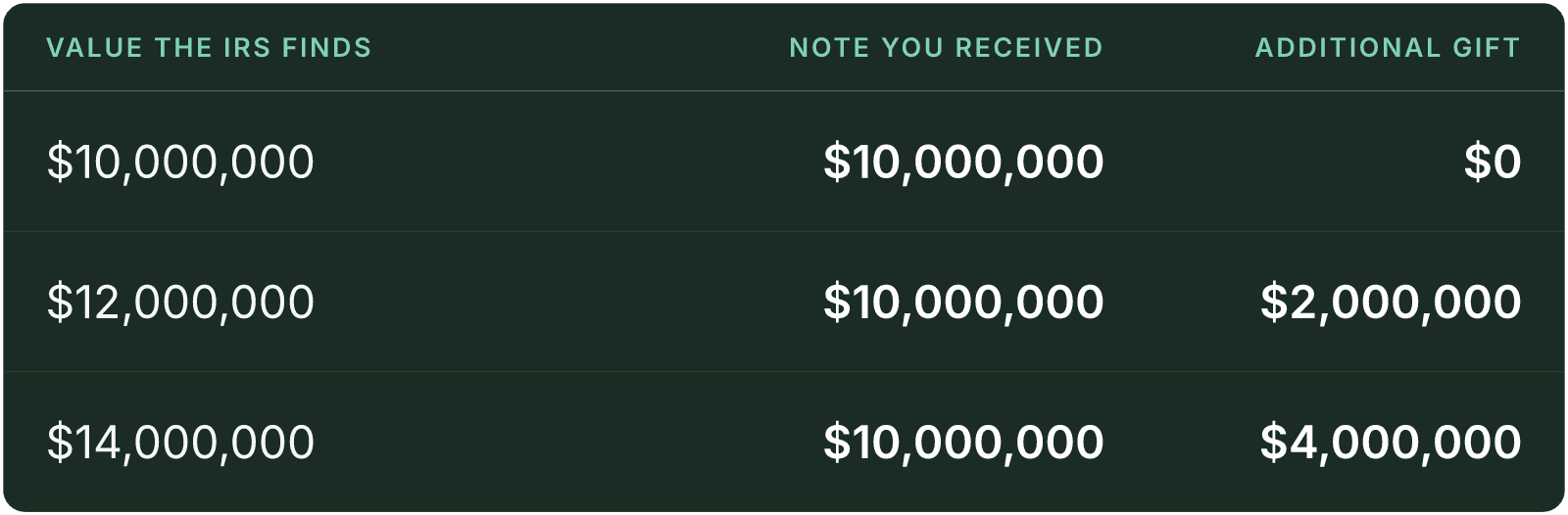
The sale is a gift to the extent the block was worth more than the note. The seed gift is reported on Form 709, and so is the sale, described as a transaction that is not a gift. If the IRS later finds a higher value, the difference is a gift you did not report as one.
[](https://www.409.ai/uploads/sale_to_idgt_private_stock_appraisal_note_afr_gift_tax_table_3_7862fd4122.png)
In 2026 the basic exclusion is $15 million per person, so an extra $2 million gift is often absorbed by exclusion rather than taxed. It still uses exclusion you meant to keep, it can draw penalties under section 6662 if the reported value was far too low, and it can open the question of whether the trust really had a sale at all. Some attorneys add a clause that adjusts the price if the value is later changed. Whether one fits is a drafting decision for your attorney, and the courts have treated these clauses differently.
The protection is the statute of limitations. The three-year assessment period only starts when the return adequately discloses the transaction, which means describing the property, the parties, the sale terms and the method used to value it, and attaching the appraisal. Treas. Reg. 301.6501(c)-1(f) lists the content. [Adequate Disclosure on Form 709](https://www.409.ai/articles/form-709-adequate-disclosure-founder-stock-gift) walks through it.
The trade-off most plans state too briefly
Assets that stay outside your estate do not receive a new income tax basis when you die. The IRS confirmed that in [Rev. Rul. 2023-2](https://www.irs.gov/pub/irs-drop/rr-23-02.pdf) for an irrevocable grantor trust whose assets are not included in the gross estate. If the trust later sells the stock, the gain is measured from the trust's basis, not from a stepped-up value.
So the sale trades estate tax against income tax. With a $15 million exclusion and a company that may grow far beyond it, the trade often favors the sale. For a smaller estate, the lost step-up can cost more than the estate tax saved. The appraisal does not answer this, but it supplies the numbers both sides of the calculation need.
A GRAT or a sale?
A grantor retained annuity trust is the other common tool for moving growth. A GRAT does not need a seed gift and has no note risk, but the annuity is valued with the section 7520 rate and the grantor must outlive the term. We covered it in [Funding a GRAT With Private Stock](https://www.409.ai/articles/grat-private-company-stock-valuation-annuity-gift-tax). A sale to a grantor trust can use a lower rate and a longer term, and it uses some exclusion for the seed. Both depend on the same appraisal. If the plan also involves QSBS, the trust design matters for the section 1202 exclusion, which [IRC 643(f) and QSBS trust stacking](https://www.409.ai/articles/qsbs-trust-stacking-irc-643f-treasury-guidance) explains. For the wider gifting picture, read [Gifting Startup Equity in 2026](https://www.409.ai/articles/gifting-startup-equity-2026-estate-tax-exemption).
What to ask for in the appraisal
Check five things before you sign the note:
1. The valuation date equals the closing date of the sale. 2. The block valued is the block sold, with its voting rights, transfer restrictions and any buy-sell terms. 3. Each discount is explained with data, not a flat percentage. 4. The report states the valuation methods and why it weighs them as it does. 5. It is written to meet the adequate disclosure content, so the Form 709 can attach it.
The takeaway
A sale to a grantor trust turns the AFR into the hurdle your company has to beat. Your appraisal decides whether the sale price stands, and a price that holds is what makes the move of growth permanent. Order the appraisal for the exact block and the exact closing date before the trust signs the note, seed the trust, and file the Form 709 with the report attached. For a gift valuation built for Form 709, see [409.AI Gift & Estate Tax valuation](https://www.409.ai/products/gift-estate-tax).
This article is educational and is not legal or tax advice. Your estate attorney drafts the trust and the note, and your CPA files the return.