Tax
S Corp ESOP Synthetic Equity: How Your Share Price Sets the 409(p) Test
S corp ESOP CFOs and trustees: how the appraised share price converts phantom stock and deferred pay into 409(p) synthetic shares, and when the 50% tax hits.
By 409.AI Team - 2026-11-21
# S Corp ESOP Synthetic Equity: How Your Share Price Sets the 409(p) Test
If you're the CFO, board member or trustee of an S corporation owned by an ESOP, the annual appraisal does more than set the price on participant statements. It also decides how many shares your executives' phantom stock and deferred pay count as under Section 409(p) of the Internal Revenue Code. A lower share price makes the same dollar promise count as more shares. Cross the wrong line and the company owes a 50% excise tax.
Most management teams know the S corporation ESOP structure is generous. The company pays no entity-level income tax, and the ESOP trust's share of the income isn't taxed as unrelated business income ([26 U.S.C. § 512(e)(3)](https://www.law.cornell.edu/uscode/text/26/512)). Section 409(p) is the price of that treatment. It exists to stop a handful of insiders from capturing the plan's benefits, and it measures them partly through rights that aren't shares at all.
What Section 409(p) prohibits
The rule is short. An ESOP holding S corporation stock must provide that no plan assets attributable to that stock accrue or are allocated to a "disqualified person" during a "nonallocation year" ([26 U.S.C. § 409(p)(1)](https://www.law.cornell.edu/uscode/text/26/409)).
Two definitions carry the weight.
A disqualified person is someone whose deemed-owned shares are at least 10% of the plan's deemed-owned shares, or at least 20% when the shares of family members are added together ([§ 409(p)(4)](https://www.law.cornell.edu/uscode/text/26/409)). Deemed-owned shares are the stock allocated to the person's ESOP account plus their share of any unallocated stock the plan still holds, such as shares in a loan suspense account.
A nonallocation year is a plan year in which disqualified persons own at least 50% of the corporation's shares at any time during the year, under the attribution rules of Section 318 as modified by 409(p)(3).
On allocated shares alone, few ESOP companies get close to either line. The plan typically holds shares for dozens or hundreds of employees, and allocation formulas tied to pay rarely put one person above 10%. Synthetic equity is where the numbers move.
Synthetic equity is broader than most executives expect
Section 409(p)(5) lets synthetic equity be treated as outstanding stock and as deemed-owned by the person who holds it, when that treatment would make someone a disqualified person or make the year a nonallocation year. The statute lists the obvious items: stock options, warrants, restricted stock, deferred issuance stock rights, stock appreciation rights and phantom stock units ([§ 409(p)(6)(C)](https://www.law.cornell.edu/uscode/text/26/409)).
The Treasury regulation goes further. Under [Treas. Reg. § 1.409(p)-1(f)(2)](https://www.law.cornell.edu/cfr/text/26/1.409(p)-1), synthetic equity also includes cash-settled rights whose value tracks the stock, rights to acquire interests in related entities, and nonqualified deferred compensation. That last category covers deferred pay that isn't tied to the share price at all: a supplemental retirement promise, a deferred bonus, a long-term incentive paid in cash after the year it was earned. A narrow grandfather rule exists for deferred compensation outstanding on December 17, 2004 that meets the conditions of § 1.409(p)-1(f)(2)(iv)(B); everything newer counts.
So the management incentive plan many ESOP companies adopt after the transaction, often phantom stock or a cash SAR to keep the team in place, sits squarely inside the test. So does a plain deferred compensation agreement with the founder who sold. If those plans also fall under Section 409A, our post on [nonqualified deferred compensation under 409A](https://www.409.ai/articles/409a-nonqualified-deferred-compensation-plans) covers that separate set of rules.
How a dollar promise turns into a share count
This is where the appraisal comes in. The regulation converts each kind of synthetic equity into a number of shares ([§ 1.409(p)-1(f)(4)](https://www.law.cornell.edu/cfr/text/26/1.409(p)-1)):
- an option or restricted stock counts as the shares it covers, without regard to the exercise price or vesting;
- a right paid in cash counts as the number of shares whose fair market value equals the payment;
- a stock appreciation right counts only the shares equal to the appreciation;
- nonqualified deferred compensation and other synthetic equity count as **the present value of the right divided by the fair market value of one share** on the determination date.
For the last three, the share price is the denominator. When the appraised value of a share falls, a fixed dollar promise is suddenly worth more shares. Nothing about the executive's deal changed. The plan's math did.
The regulation gives the plan some control over timing. The share count may be determined annually or more often, on reasonable dates such as the first day of the plan year, and the plan may fix the count for up to three years before redetermining it, provided the fair market value used isn't unrepresentative and the plan applies its terms consistently ([§ 1.409(p)-1(f)(4)(iii)](https://www.law.cornell.edu/cfr/text/26/1.409(p)-1)). Changing the determination date takes a plan amendment adopted before the new date. Those choices belong in the plan document and with ERISA counsel, but they all lead back to one number: the per-share fair market value the independent appraiser signs.
One adjustment matters when the ESOP owns less than all of the company. If taxable shareholders outside the plan hold some of the stock, the synthetic share count is reduced ratably by their share ([§ 1.409(p)-1(f)(4)(iv)](https://www.law.cornell.edu/cfr/text/26/1.409(p)-1)). The regulation's own example uses an option on 100 shares in a company where the ESOP holds 75% of the stock: it counts as 75 shares.
A worked example: same promise, lower price
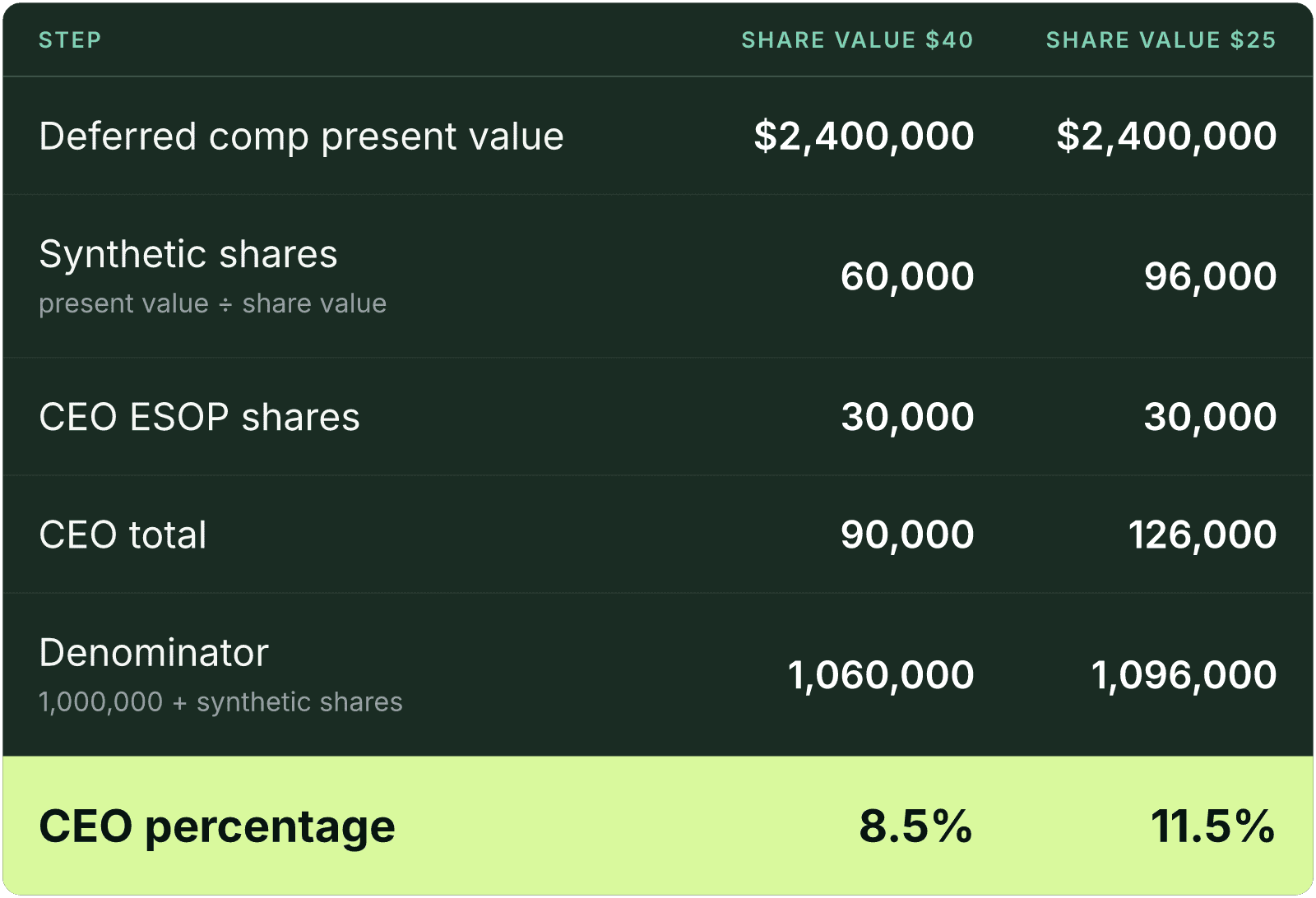
Take an illustrative S corporation that the ESOP owns 100%, with 1,000,000 shares outstanding, all allocated to participant accounts. The CEO has 30,000 shares in their ESOP account and a deferred compensation arrangement with a present value of $2.4 million. No family member of the CEO participates.
The test that matters for the CEO is § 1.409(p)-1(d)(1)(ii): the CEO's deemed-owned shares plus their synthetic equity, divided by all deemed-owned ESOP shares plus the CEO's synthetic equity. The threshold is 10%.
[](https://www.409.ai/uploads/s_corp_esop_synthetic_equity_409p_disqualified_person_share_value_table_1_62082adf5b.png)
At $40 a share, the CEO is below the line. At $25, with the same $2.4 million promise and the same ESOP account, the CEO is a disqualified person.
A drop from $40 to $25 isn't exotic. It can follow a bad year, a lost customer, a lower multiple in the market, or a leveraged transaction in which the company takes on acquisition debt and the equity value per share falls well below the price the plan paid. The repurchase liability matters here too: as [the ESOP repurchase obligation](https://www.409.ai/articles/esop-repurchase-obligation-put-option-409h-cash-forecast-share-price) grows, the cash the company sets aside to fund it is cash the appraiser weighs when valuing the stock.
Being a disqualified person isn't a violation by itself. The prohibited allocation only happens in a nonallocation year, when disqualified persons together own 50% or more. That second test has two forms in § 1.409(p)-1(c)(1): one using shares only, and one that adds the synthetic equity held by disqualified persons to both the numerator and the denominator. Synthetic equity held by people who aren't disqualified stays out. The regulation's examples show how options tip both tests. Without the options, disqualified persons in its Example 1 hold 47.9% and the year is clean. In Example 2, two executives' options make them disqualified persons, which brings their ESOP shares into the count: 52.1% on shares alone, 58.9% with the options added. A management team with several executives in the CEO's position, each with ESOP accounts and deferred pay, can reach that line faster than the board expects.
What the failure costs
The consequences stack, and they fall mostly on the company.
First, the plan is treated as distributing the prohibited allocation to the disqualified person, who has income without receiving cash ([§ 409(p)(2)](https://www.law.cornell.edu/uscode/text/26/409)).
Second, Section 4979A imposes an excise tax equal to 50% of the amount involved, and the S corporation pays it ([26 U.S.C. § 4979A(a), (c)](https://www.law.cornell.edu/uscode/text/26/4979A)). The tax applies to a prohibited allocation, and separately to any synthetic equity owned by a disqualified person in any nonallocation year. For synthetic equity, the amount involved is the value of the shares the synthetic equity is based on. For the first nonallocation year, the amount involved includes the total value of all deemed-owned shares of all disqualified persons, whether or not anything was allocated ([§ 4979A(e)(2)](https://www.law.cornell.edu/uscode/text/26/4979A)).
Read that against the example. If the CEO's 96,000 synthetic shares were held in a nonallocation year at $25 a share, the shares behind them are worth $2.4 million, and 50% of that is a $1.2 million tax on the synthetic equity alone. In the first nonallocation year, the deemed-owned shares of every disqualified person come into the base too.
Third, the regulation's own example of a prohibited allocation ends with the plan ceasing to be an ESOP and the corporation losing its S election, because a non-qualifying trust can't hold S corporation stock ([§ 1.409(p)-1(b)(2)(iv)](https://www.law.cornell.edu/cfr/text/26/1.409(p)-1)). For a company built on the ESOP's exemption from income tax, that is the larger loss.
What the annual appraisal file should carry
Section 401(a)(28)(C) already requires an independent appraiser for ESOP stock that isn't readily tradable, and [the annual ESOP valuation](https://www.409.ai/articles/what-is-an-esop-valuation-annual-appraisal-trustee-independent-appraiser) is the document the trustee relies on. For an S corporation ESOP, three things make that appraisal useful for the 409(p) work as well:
1. A per-share value as of the plan's determination date. If the plan determines synthetic shares on the first day of the plan year, the value should speak to that date, not only to the year-end statement date. 2. The synthetic equity reflected in the valuation. Phantom stock, SARs and deferred compensation are claims on the company's value. The appraiser should know about each plan and how it was treated, so the share value and the 409(p) share count rest on the same facts. 3. The tax treatment the value assumes. An S corporation owned by its ESOP pays no federal income tax on its earnings, and whether and how the appraiser tax-affects those earnings changes the share value. Our post on [tax affecting an S corp valuation](https://www.409.ai/articles/tax-affecting-pass-through-entity-s-corp-valuation) explains why the question gets argued.
The trustee's standard doesn't change either. The value the plan uses must reflect fair market value under ERISA's [adequate consideration standard](https://www.409.ai/articles/esop-valuation-adequate-consideration-2026), which means no one should steer the appraisal up to keep an executive under 10%. The value is what it is. The work is to run the 409(p) test against that value every time it changes, before the next allocation, and to design incentive plans with the test in view, as our post on [phantom stock and SARs](https://www.409.ai/articles/phantom-stock-sars-private-company-409a-asc-718) does from the accounting side.
The takeaway
In an S corporation ESOP, the per-share value is also the denominator of the 409(p) test. When the appraisal comes in lower, rerun the synthetic equity count for every executive with phantom stock, SARs or deferred pay, using the plan's own determination date, before the plan allocates anything for the year. A falling share price and a fixed dollar promise are exactly how a company crosses 10% and 50% without anyone granting a new share.
If your plan needs that annual value from an independent appraiser, 409.AI prepares [ESOP valuations](https://www.409.ai/products/esop-valuation) reviewed by a valuation expert.