Education
Rule-of-Thumb Multiples vs. a Real Appraisal: Why "2.5x Earnings" Rarely Survives a Lender or a Court
Small business owners and their advisors: a 2.5x earnings rule of thumb rarely survives a lender or court. See what an appraiser changes, with a worked example.
By 409.AI Team - 2026-10-27
# Rule-of-Thumb Multiples vs. a Real Appraisal: Why "2.5x Earnings" Rarely Survives a Lender or a Court
Every business owner hears the same sentence sooner or later: "Businesses like yours sell for two to three times earnings." It's a useful number for a first conversation at the kitchen table. It's a poor number for a bank loan, a buyout agreement, a divorce or an estate filing, because the person on the other side is going to ask where it came from.
This article is for the owner of a small private company, and for the CPA, attorney, broker or lender beside them, who needs to know what a rule of thumb can and can't do, and what an appraiser changes when one is asked to support a number.
Where rules of thumb come from
A rule of thumb is a pattern in past sales, boiled down to one multiple. Brokers watch what restaurants, dental practices or landscaping companies sell for, and a range settles into folklore: "2x seller's discretionary earnings," "0.8x revenue," "three times EBITDA."
The pattern is real. The problem is what gets averaged away. A rule of thumb treats every business in an industry as the same business. It knows nothing about your largest customer, your lease, your owner's role or how steady your last three years were. Those are the things a buyer pays for or discounts.
The IRS has said this for decades. Revenue Ruling 59-60, the document most valuation work for tax purposes still starts from, states that no formula can be devised that is generally applicable to the multitude of different valuation issues. It asks the appraiser to weigh the specifics of the company in front of them. You can read it on the [IRS website](https://www.irs.gov/pub/irs-tege/rr59-60.pdf), and we walk through its factors in [Revenue Ruling 59-60 for small businesses](https://www.409.ai/articles/revenue-ruling-59-60-small-business-valuation-eight-factors).
What a lender, a court or the IRS actually wants
A rule of thumb is a conclusion. A lender, a judge or an IRS examiner wants the reasoning behind a conclusion: which earnings, adjusted how, capitalized at what rate and why.
That's why a report built on "the industry multiple is 2.5" tends to stall. Nobody can test it. A report that shows the earnings base, each adjustment, the multiple and the reason for that multiple can be checked line by line, and that's the point of the exercise. If you're heading into an SBA-backed purchase or a change of ownership, the lender's rules decide when a written valuation is required, and [our summary of the SBA's change-of-ownership requirements](https://www.409.ai/articles/sba-sop-50-10-8-1-business-valuation-change-of-ownership) covers what the current procedures say.
The same business, two answers
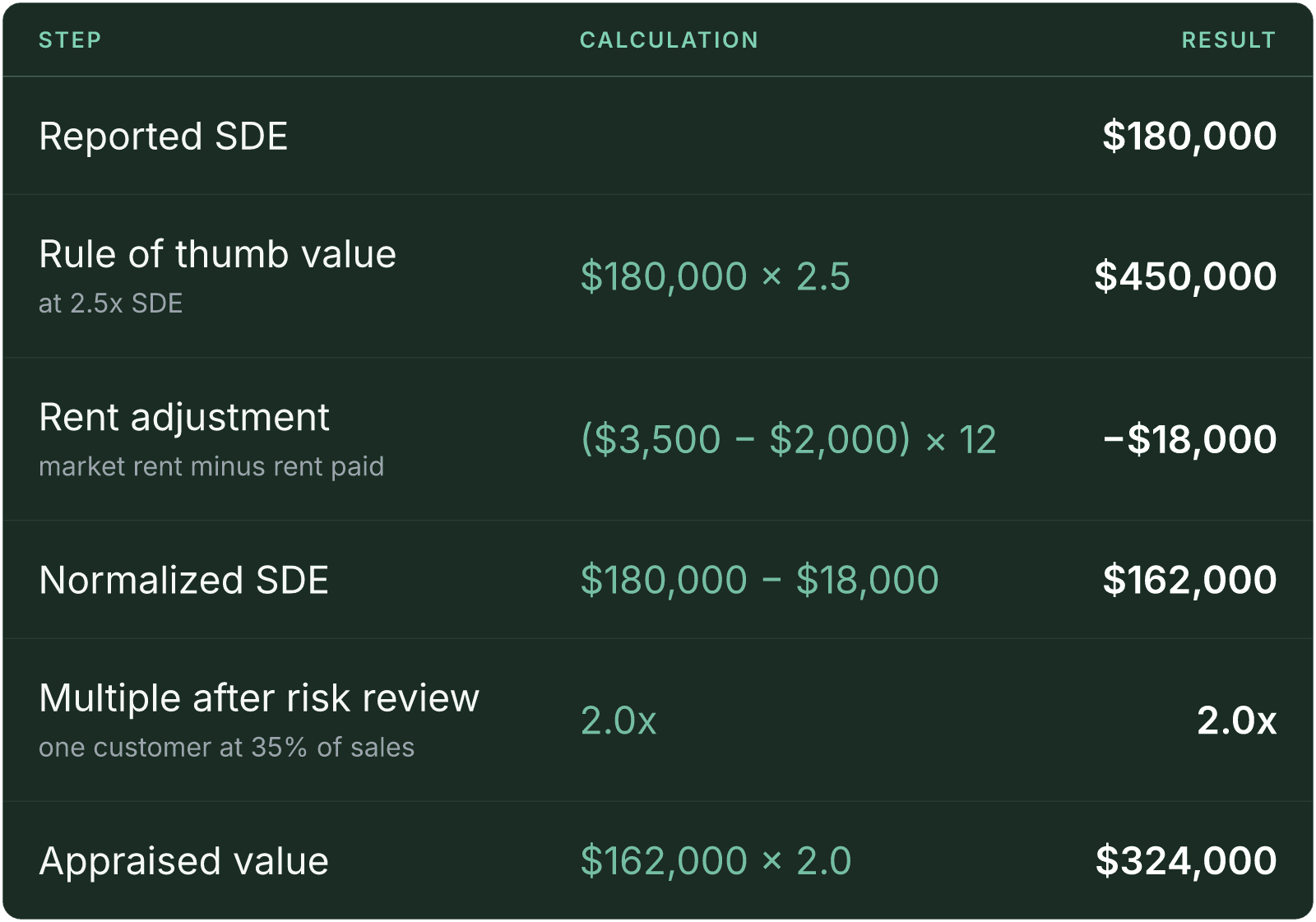
Take an illustrative example. A bakery-cafe reports seller's discretionary earnings (SDE) of $180,000 for the last year. SDE is what the business earns before one owner's pay, benefits and one-time items. A broker's rule of thumb for this kind of shop is 2.5 times SDE.
An appraiser starts from the same $180,000 and then tests it. Two facts turn up. The owner personally owns the building and charges the business $2,000 a month, while similar space in the area rents for $3,500. And one wholesale customer accounts for 35% of sales.
[](https://www.409.ai/uploads/rule_of_thumb_multiples_vs_appraisal_small_business_valuation_sde_table_1_4800cb5e95.png)
The two answers sit $126,000 apart. Neither is a typo. The first one describes an average bakery. The second describes this one.
Notice that the appraiser didn't throw out the market evidence. The 2.5x came from somewhere, and a good appraisal uses comparable sales as a starting point. What changes is that every step away from the average is written down and defended.
The adjustments that move the number most
Three adjustments account for most of the gap between a rule of thumb and a defensible value.
Owner pay. A rule of thumb assumes a standard owner role. If the owner takes a salary well above or below what it would cost to hire a manager, earnings have to be restated. We cover the mechanics in [owner compensation and add-backs](https://www.409.ai/articles/owner-compensation-add-backs-small-business-valuation-sde-ebitda).
Related-party arrangements. Rent paid to the owner, family members on payroll, personal expenses run through the business. Each one has to be put at market terms before earnings mean anything. The rent in the bakery example is the typical case, and [the full treatment of owner-owned buildings](https://www.409.ai/articles/related-party-rent-small-business-valuation-owner-owns-building) shows how the adjustment runs in both directions.
Concentration and dependence. A business that lives on one customer, one supplier or one person's relationships carries more risk than the industry average, and the multiple has to say so. [Customer concentration](https://www.409.ai/articles/customer-concentration-small-business-valuation-largest-customer-risk) is the one that surprises sellers most, because the revenue looks healthy right up to the day the customer leaves.
Why the multiple moves, not just the earnings
The multiple in the table isn't a taste. A multiple is the inverse of a capitalization rate, and the rate reflects risk and expected growth. When risk goes up, the rate goes up and the multiple falls. That relationship, and why a discount rate and a capitalization rate aren't the same thing, is the subject of [capitalization rate vs. discount rate](https://www.409.ai/articles/capitalization-rate-vs-discount-rate-small-business-valuation-earnings-multiple).
This is also where a rule of thumb is most likely to mislead. It presents the multiple as a fact about the industry. In an appraisal, the multiple is an output, built from the risks you can name.
When a rule of thumb is still the right tool
None of this makes rules of thumb useless. They're good for three things:
- A sanity check. If an appraisal lands at half or double the usual range, the report should explain why, and you should read that explanation closely.
- A first conversation. A broker or buyer uses the range to decide whether to talk at all.
- Early planning. An owner five years from selling can see roughly what moves the needle.
They're a poor fit when someone has to sign something that depends on the number: a loan application, a buy-sell price, a settlement, a gift or estate return. There, a number that can't show its work becomes a number someone else will rewrite for you.
What to do before you quote a multiple
Before you repeat a rule of thumb to a lender, a partner or a spouse's attorney, write down three things: which earnings figure it applies to, which adjustments that figure still needs, and what about your business is better or worse than the average one in your industry. If the list is short, the rule of thumb may be close enough. If the list has a related-party lease or a customer that's a third of sales on it, expect the appraised number to move, and plan for it before the other side does.
If you need a number that will hold up with a lender, a court or the IRS, [409.AI's small business valuation](https://www.409.ai/products/smb-valuation) shows the earnings base, every adjustment and the reasoning behind the multiple in one report.