Equity
Restricted Stock Awards: Do You Need a 409A Before You Issue Them?
Founders issuing restricted stock to first hires: why Section 409A steps aside, why Section 83 still needs a fair market value, and when options take over.
By 409.AI Team - 2026-11-13
# Restricted Stock Awards: Do You Need a 409A Before You Issue Them?
You're a founder about to hire your first engineers, and your lawyer suggests restricted stock instead of options. Someone on the team asks the obvious question: if this isn't an option, do we still need a 409A valuation? The short answer is that Section 409A itself mostly steps aside for restricted stock, but the fair market value question doesn't go anywhere. It moves to Section 83, and it comes back at every vesting date unless the employee files an 83(b) election.
This article is for early-stage founders and the first finance or operations hire deciding how to grant equity to the first employees and advisors. It covers what the tax code actually asks for, what a 409A valuation does for a restricted stock award (RSA), and the point at which options become the better tool.
Why Section 409A doesn't apply to restricted stock
Section 409A governs deferred compensation: a promise today to pay something in a later year. A stock option is a right to buy later, which is why the 409A regulations exempt it only if the strike price is at least the fair market value on the grant date.
Restricted stock is different. The employee owns the shares on day one, subject to vesting. The regulations say so directly: under [Treas. Reg. 1.409A-1(b)(6)(i)](https://www.law.cornell.edu/cfr/text/26/1.409A-1), "there is no deferral of compensation merely because the value of the property is not includible in income" because it is substantially nonvested under Section 83 or taxed early through an 83(b) election.
So an RSA is outside Section 409A. There is one catch in paragraph (b)(6)(ii) of the same regulation: a legally binding promise to transfer shares in a future year can itself be deferred compensation if the shares will already be vested when they arrive. "We'll give you 50,000 fully vested shares next year" is not an RSA. It is a promise, and it needs its own analysis.
Where the fair market value question goes instead
[Section 83 of the Internal Revenue Code](https://www.law.cornell.edu/uscode/text/26/83) taxes property transferred in connection with services. When restricted stock vests, the employee has ordinary income equal to the fair market value of the shares at that moment, minus whatever they paid. The statute measures that value without regard to any restriction other than one that by its terms will never lapse, so vesting conditions don't earn a discount.
Section 83(b) offers the alternative. The employee can elect, no later than 30 days after the transfer, to be taxed on the value at grant instead. If they paid full fair market value for the shares, the income is zero, and later growth is capital gain when they sell. The 30 days don't move, and the IRS has offered an optional standard form for the election, [Form 15620](https://www.irs.gov/pub/irs-pdf/f15620.pdf), since November 2024.
Either way, someone has to put a number on the common stock. With an 83(b), it's the value on the grant date. Without one, it's the value on every vesting date for four years.
A worked example: one hire, two paths
Take an illustrative company that has just closed a small friends-and-family round. Its independent 409A puts the common stock at $0.05 a share. It issues its first engineer 200,000 restricted shares, vesting 25% a year over four years, and the engineer pays $0.05 a share, or $10,000.
On the first path, the engineer files an 83(b) within 30 days. Paid price equals fair market value, so the taxable income is zero. The holding period for capital gains starts now, because [Section 83(f)](https://www.law.cornell.edu/uscode/text/26/83) counts it from the first time the shares are vested or the election is made.
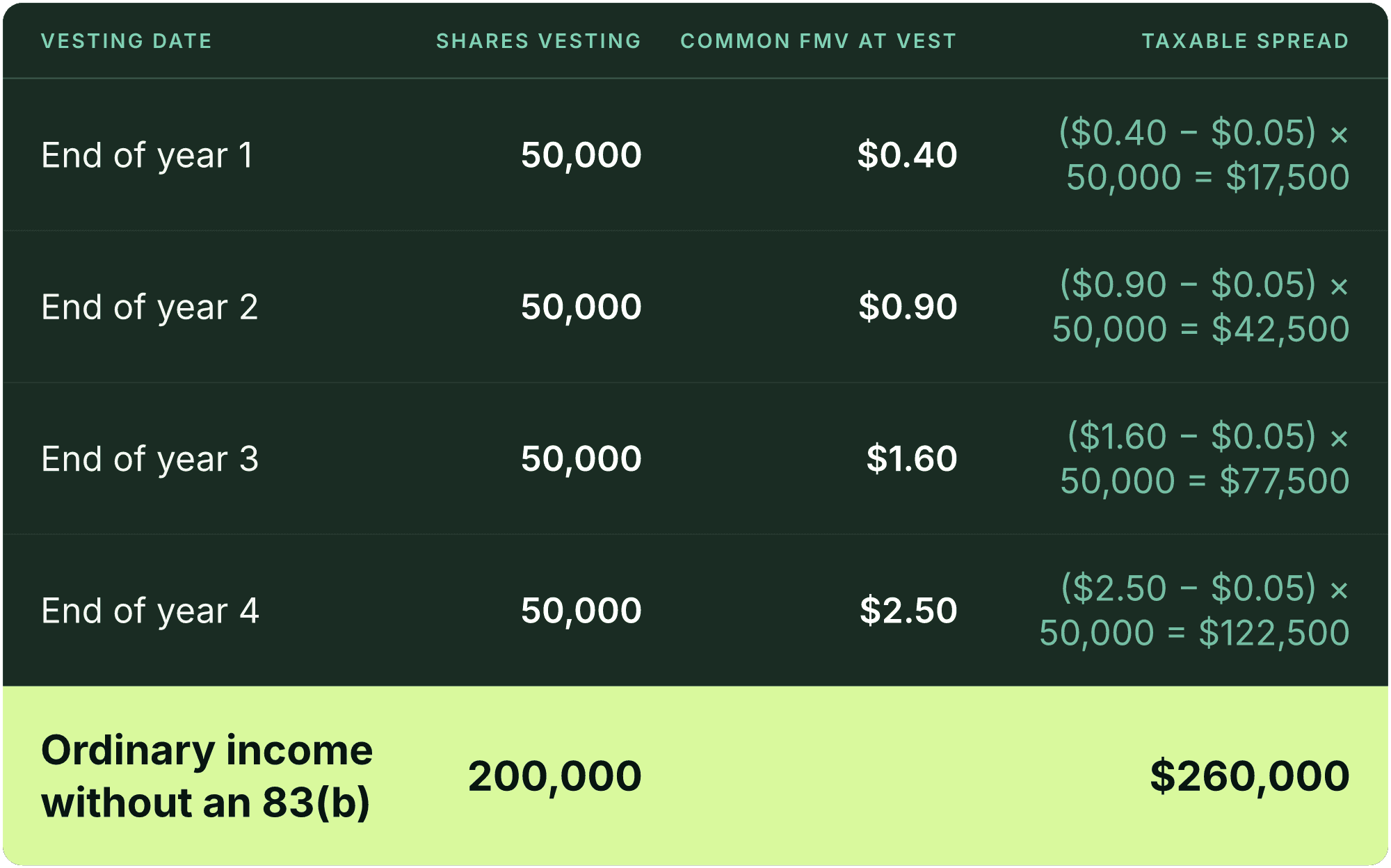
On the second path, the engineer forgets. Each annual tranche is taxed when it vests, at whatever the common stock is worth that day. Assume the company keeps growing and its 409A rises with it.
[](https://www.409.ai/uploads/restricted_stock_award_startup_409a_section_83_fair_market_value_table_1_7c81598b2d.png)
Same shares, same company, same employee. One path produces no income at grant. The other produces $260,000 of ordinary income over four years, taxed like salary, on stock the engineer can't sell. Missing the 30-day window is one of the most expensive paperwork mistakes in startup equity, which is why our [83(b) election guide](https://www.409.ai/articles/the-83b-election-explained-for-founders) spends so long on the mechanics.
Notice what drives the second column of figures: the fair market value of the common on each vesting date. That number has to come from somewhere, and for a private company it nearly always comes from the 409A in effect at the time.
What the 409A actually does for an RSA
Strictly, the 409A safe harbor presumption is a creature of the Section 409A regulations. Section 83 has no matching presumption written into it. Its standard is plain fair market value. In practice, though, an independent appraisal that meets the 409A standard is the best evidence of that value an early-stage company can produce, and it does three jobs on an RSA.
It sets the purchase price. If the employee pays at least fair market value, the 83(b) election reports zero income. If the company guesses low and the IRS later concludes the stock was worth more, the difference is unreported compensation for the employee and an unwithheld wage for the company.
It supports the number on the 83(b) election. The election states the fair market value at transfer. A value backed by a dated appraisal is a defensible figure; a value someone typed in because it matched par is not.
It values each vesting date when there is no election. Here timing bites. If a tranche vests two weeks after a priced round closes and the company is still relying on the pre-round 409A, the value used for that vesting may already be stale. The same material-event logic that governs option grants applies, as we cover in [how a bridge round changes 409A timing](https://www.409.ai/articles/bridge-round-409a-material-event-option-grant-timing) and [how often to refresh a 409A](https://www.409.ai/articles/409a-valuation-frequency-how-often-should-you-get-one).
A very early company sometimes skips the appraisal and issues restricted stock at a nominal price right after incorporation, before any money or traction exists. That can be reasonable for founders on day one. It gets harder to defend once the company has raised a SAFE, signed customers or hired a team, because the common stock plainly has value by then. Our piece on [the first 409A before the first option grant](https://www.409.ai/articles/first-409a-valuation-pre-revenue-startup-before-first-option-grant) walks through when that moment arrives.
Paying with a note can turn the award into an option
Some companies let employees buy their restricted shares with a promissory note. Be careful with the terms. [Treas. Reg. 1.83-3(a)(2)](https://www.law.cornell.edu/cfr/text/26/1.83-3) says that when the price is paid with a debt secured by the shares and the employee carries no personal liability for all or a substantial part of it, the purchase "may be in substance the same as the grant of an option." Whether it is depends on the facts, including how much of the risk of a fall in value the employee really bears.
If a nonrecourse note recharacterizes the award as an option, the analysis you were trying to avoid comes back: an option priced below fair market value on its grant date sits inside Section 409A. A full-recourse note, actually expected to be repaid, keeps the award in the restricted stock frame.
When options take over
Restricted stock works well while the common is cheap. It stops working when it isn't.
Go back to the example. Hire the same engineer a year later, after a seed round, when the 409A puts common at $0.60. The 200,000 shares now cost $120,000 to buy at fair market value. If the company grants them for free instead, the 83(b) election puts $120,000 of ordinary income on the employee's return in the year of grant, with no cash from the stock to pay the tax. Very few employees can do either.
That's the moment most companies switch to options. An option costs the employee nothing at grant, and tax arrives only at exercise (or at sale, for an ISO that meets its holding periods). The trade-off is that the strike now has to be at least the 409A value on the grant date, the 12-month validity window starts to matter for every grant, and the employee may face AMT or a taxable spread later. The comparison is laid out in [ISO vs NSO taxation](https://www.409.ai/articles/iso-vs-nso-how-stock-options-are-taxed), and early exercise, which lets an option holder get close to the RSA result, is covered in [our early exercise and 83(b) guide](https://www.409.ai/articles/early-exercise-stock-options-83b-election-iso-nso-qsbs).
One more reason to care about the 83(b) on restricted stock: for founders and early employees hoping for the Section 1202 exclusion on qualified small business stock, the holding period runs from vesting unless the election is made, so each tranche can start its own clock.
A short checklist before the board approves an RSA
- Confirm the shares will be unvested at transfer, so the award stays outside Section 409A.
- Price them at a fair market value the company can defend on that date, which past the earliest days means a current independent 409A.
- Give the employee the 83(b) form and the 30-day deadline in writing on the day of the grant.
- If a note pays for the shares, make it full recourse and expect it to be repaid.
- Before each vesting date for an employee without an election, check that the valuation in effect still reflects the company after any round or other material event.
The takeaway
Restricted stock doesn't need a 409A to satisfy Section 409A. It needs a fair market value to satisfy Section 83, at grant if the employee files an 83(b) and at every vesting date if they don't. The independent appraisal you'd order for options is the cleanest way to get that number, and the day it shows a common price your next hire can't afford to buy is the day to move to options. If you're at that point, a [409A valuation from 409.AI](https://www.409.ai/products/409a) gives you the dated value for both.