Equity
Buying Back a Departing Employee's Shares: Which Price Applies, and What the 409A Does Not Decide
Founders and finance leads buying back a leaver's exercised shares: why the 409A price is an input, not the rule, and what tax, ASC 718 and the board need.
By 409.AI Team - 2026-11-02
# Buying Back a Departing Employee's Shares: Which Price Applies, and What the 409A Does Not Decide
A founder loses a senior engineer in March. The engineer exercised 40,000 options last year, holds the shares, and wants out. The company has cash, the board likes the idea of keeping the cap table tidy, and someone says, "Just use the 409A price." Before anyone signs, that sentence deserves a closer look.
This article is for the founder, the finance lead and the general counsel who handle a repurchase of vested, exercised shares from a former employee. The 409A valuation is a useful input. It is not the rule that sets the price, and treating it as one creates tax and accounting problems that surface in the next audit.
What the 409A actually covers
A 409A valuation supports one decision: the strike price of a stock option. Under the regulations at 26 CFR 1.409A-1(b)(5), an option granted at or above the fair market value of the underlying stock is outside the deferred compensation rules, and a reasonable valuation by a qualified appraiser, dated within the last 12 months and not made stale by a material event, gets you a presumption of reasonableness. If you want the full picture of that presumption, our piece on the [409A safe harbor and the qualified appraiser](https://www.409.ai/articles/409a-safe-harbor-price-vs-qualified-appraiser) walks through it.
Nothing in that framework sets the price at which a company may buy shares back. The valuation reports the value of common stock on a minority, non-marketable basis at one date. A repurchase happens on another date, between two parties with their own contract rights, and the price is whatever the documents say.
Start with the documents, not the valuation
Three documents usually decide the price, in this order.
The stock option agreement and the equity plan. Many plans give the company a call right on shares acquired by exercise after termination. The plan states the call price: fair market value, the original exercise price, or the lower of the two. A call at exercise price applies only to shares that are still unvested, which is the early-exercise case. For vested shares, companies generally cannot take the shares back at cost unless the employee agreed to that, and many plans do not say so.
The stockholders' or right-of-first-refusal agreement. If the employee finds a buyer, or wants to sell to the company, the ROFR sets the mechanics and sometimes the price formula.
A negotiated repurchase letter. When the documents are silent, the price is a negotiation. This is the case most startups actually face, and where the 409A gets misused.
For early-exercised shares that are still unvested, the usual repurchase price is the lower of cost and fair market value. We covered the mechanics in [early exercise, the 83(b) election and QSBS](https://www.409.ai/articles/early-exercise-stock-options-83b-election-iso-nso-qsbs).
Why the 409A price is a floor for your analysis, not an answer
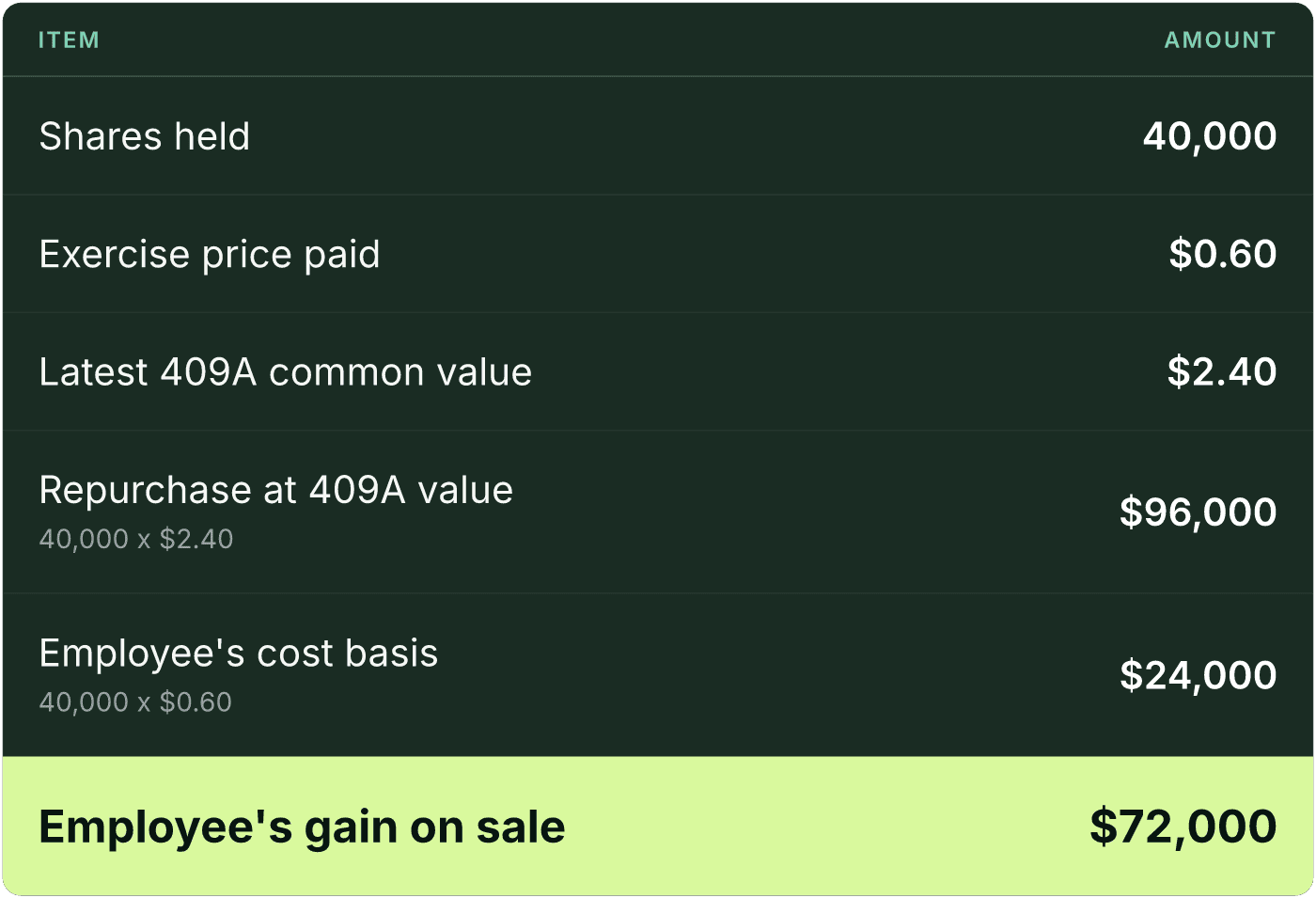
Say the latest 409A put common stock at $2.40 a share. The engineer holds 40,000 shares bought at a $0.60 strike.
[](https://www.409.ai/uploads/repurchase_departing_employee_shares_409a_price_not_the_rule_table_1_4e4ae3d320.png)
That table is a simplification: the gain is capital if the shares were exercised from NSOs and held more than a year, or if ISO holding periods apply, and the details depend on the facts. The point is the price. If the board approved a priced round three months after that 409A, the $2.40 is stale for any purpose, and a price built on it can be too low or too high against the true value of the shares.
Two risks follow.
Paying above fair market value. If the company pays $4.00 a share to keep an executive happy, the excess over fair market value can be compensation, not sale proceeds. The IRS treats a payment by an employer to an employee in connection with the employment relationship as wages unless the facts show otherwise. The company then owes withholding and payroll tax on the excess, and the employee reports ordinary income.
Paying below fair market value. A low price on a voluntary sale invites a dispute, and in some cases a claim from a former employee who learns about a financing or acquisition interest later. Companies often protect themselves with a release and a representation that the seller had the chance to ask for information, but the price should still be defensible.
The safer practice is a fresh look at value at the repurchase date. A board that knows of a term sheet, a letter of intent or a bridge should treat the old 409A as history. Our article on [letters of intent and stale grants](https://www.409.ai/articles/letter-of-intent-409a-stale-option-grants-before-acquisition-closes) explains how a pending deal changes the picture, and the same logic applies to a buyback.
The accounting side: ASC 718 and the six-month rule
The company's finance lead has a separate question. How is the repurchase booked?
Under ASC 718, repurchasing vested equity from an employee at fair value is generally a charge to equity. Paying more than fair value produces additional compensation expense for the excess. That is why the fair value on the repurchase date matters to the auditor, and why a stale 409A is a weak support for it.
There is also a classification trap. ASC 718 treats a share that the holder can force the company to repurchase for cash soon after exercise or vesting as a liability, not equity. FASB's guidance refers to a period of six months after the shares are issued or vest. A plan or side letter that gives employees a put right, even informally, can pull awards into liability accounting, with remeasurement each period. If you plan to offer repurchases regularly, a tender-style program with a documented, board-approved policy is easier to defend than ad hoc promises. Our article on [tender offers and secondary sales](https://www.409.ai/articles/tender-offers-secondary-sales-409a-valuation) covers how a program differs from a one-off.
Corporate law limits the buyback itself
A company can only buy back stock if it has the legal capacity. Delaware, for example, bars a repurchase when it would impair the corporation's capital (DGCL Section 160). A startup with an accumulated deficit and a small cash pile has to check that its stock is not being bought out of capital it does not have. This is a question for corporate counsel, not for the valuation provider, and it sometimes means a repurchase has to be paid in installments or deferred.
QSBS and the redemption rules
If the shares might qualify for Section 1202, a company repurchase can taint the stock issued during a window around it. The significant redemption rules are narrower than most founders assume, but they are real, and our article on [QSBS redemptions and stock buybacks](https://www.409.ai/articles/qsbs-redemption-rules-stock-buybacks-section-1202) lays them out. Check them before the check goes out, because a buyback of one employee's shares can affect everyone else's.
A practical sequence
1. Read the plan, the option agreement and any stockholder agreement. Find out whether a call right exists and at what price. 2. Ask whether anything has happened since the last 409A that a buyer would care about: a priced round, a bridge, an offer, a major customer win or loss. 3. If yes, update the valuation or have the board document why the existing one still holds. If no, record that finding in the minutes. 4. Confirm the legal capacity to repurchase and the tax treatment with counsel. 5. Document the price in a repurchase agreement with a release, and have the board approve it. 6. Give the auditor the valuation, the minutes and the agreement. The auditor will ask for all three.
The takeaway is narrow but useful. The 409A tells you what a share of common stock was worth for option pricing on a specific date. A buyback needs a price for a specific transaction, and the 409A can support it only while nothing material has changed. When something has, get a current opinion of value before the company writes the check. If you need a current valuation to support a decision like this, the [409A valuation service](https://www.409.ai/products/409a) is built for exactly that handoff to the board and the auditor.