Tax
Repricing Underwater EMI Options After a Down Round: What HMRC Treats as a New Grant
For UK founders after a down round: why HMRC treats a repriced EMI option as a new grant, which limits it tests again, and the BADR clock that restarts.
By 409.AI Team - 2026-11-22
# Repricing Underwater EMI Options After a Down Round: What HMRC Treats as a New Grant
If you run a UK startup that has just closed a down round, some of your team's EMI options are probably underwater: the exercise price you set against last year's HMRC-agreed value is now above what an ordinary share is worth. This piece is for the founder, finance lead or accountant deciding whether to reprice those options, top them up, or leave them alone. The choice looks like a board formality. Under the EMI code it decides the tax rate your employees pay on a sale, and for some of them whether they keep EMI at all.
Why a lower exercise price is a new option
There's no repricing provision in Schedule 5 of the Income Tax (Earnings and Pensions) Act 2003. What exists is HMRC's view of amendments, set out in its [Employee Tax Advantaged Share Scheme manual at ETASSUM54060](https://www.gov.uk/hmrc-internal-manuals/employee-tax-advantaged-share-scheme-user-manual/etassum54060).
HMRC names three fundamental terms of an option: the number of shares, the price, and when they can be acquired. A change to one of them that improves the holder's rights by more than a de minimis amount "will amount to the grant of a new option", and the existing EMI option is released. Cutting the exercise price from £1.20 to £0.30 is not de minimis by any reading.
So a repricing is really two events: the old option is given up, and a fresh option is granted on the day of the change. Everything EMI tests at grant is tested again on that day.
Two side points follow from the statute. Section 483 of ITEPA says that when an option is released in exchange for another, the new option is not counted as consideration for the release, so swapping one for the other doesn't create a taxable payment on its own. And a variation that adds shares to an existing option is a separate problem: [section 536(1)(a)](https://www.legislation.gov.uk/ukpga/2003/1/section/536) makes a variation that increases the market value of the shares under option a disqualifying event, which starts the 90-day clock covered in our guide to [EMI disqualifying events](https://www.409.ai/articles/emi-disqualifying-events-90-day-exercise-window-hmrc-market-value).
What gets tested again on the new grant date
The company still has to qualify. Gross assets of no more than £120 million and fewer than 500 employees for most companies since 6 April 2026 ([ETASSUM50500](https://www.gov.uk/hmrc-internal-manuals/employee-tax-advantaged-share-scheme-user-manual/etassum50500)), a qualifying trade, and independence. That last one deserves a look after a rescue round. If a corporate investor ends up controlling the company, or holding it as a 51% subsidiary, new options can't qualify, and under [section 534](https://www.legislation.gov.uk/ukpga/2003/1/section/534) the change of control is itself a disqualifying event for the options already in place.
The exercise price has to be at least the market value on the new date. Under [section 531](https://www.legislation.gov.uk/ukpga/2003/1/section/531), an option granted below market value carries income tax on exercise, on the lower of the discount at grant and the gain at exercise. HMRC works through the arithmetic at [ETASSUM57030](https://www.gov.uk/hmrc-internal-manuals/employee-tax-advantaged-share-scheme-user-manual/etassum57030). A repricing that skips the valuation and guesses low hands every holder that charge.
The employee limit is recounted. [Paragraph 5 of Schedule 5](https://www.legislation.gov.uk/ukpga/2003/1/schedule/5/paragraph/5) caps the unexercised qualifying options an employee holds at £250,000, measured at the unrestricted market value of the shares on each option's grant date. Released options are no longer held, so they drop out of this count.
The three-year rule can block the grant entirely. [Paragraph 6](https://www.legislation.gov.uk/ukpga/2003/1/schedule/5/paragraph/6) says that once an employee has been granted qualifying options worth £250,000, no further option granted within three years of the last of them can qualify, "whether or not the qualifying options already granted have been exercised or released". An employee who received a full £250,000 grant in March 2025 can't receive a qualifying repriced option before March 2028. Release their option and regrant it, and what they get is an unapproved option.
The company limit is recounted too. [Paragraph 7](https://www.legislation.gov.uk/ukpga/2003/1/schedule/5/paragraph/7) caps unexercised qualifying options at £6 million across the company, again at grant-date values.
The new grant needs its own notice. Under [paragraph 44](https://www.legislation.gov.uk/ukpga/2003/1/schedule/5/paragraph/44), HMRC must be notified by 6 July following the end of the tax year of grant. A repricing in December 2026 sits in the 2026 to 2027 tax year, so the deadline is 6 July 2027.
The clocks restart
This is the cost most boards miss. Business Asset Disposal Relief on EMI shares, under [TCGA 1992 section 169I(7A)](https://www.legislation.gov.uk/ukpga/1992/12/section/169I), needs the option grant date to fall at least two years before the disposal. HMRC's capital gains manual at [CG64052](https://www.gov.uk/hmrc-internal-manuals/capital-gains-manual/cg64052) puts it plainly: the shares must be disposed of at least two years after the grant of the option. A repriced option has a new grant date, so the two years start again.
The gap in rates is real. [GOV.UK's relief page](https://www.gov.uk/business-asset-disposal-relief) gives 18% on qualifying gains from 6 April 2026, against the 24% a higher or additional rate taxpayer pays on other gains ([Capital Gains Tax rates](https://www.gov.uk/capital-gains-tax/rates)). The exercise window restarts as well, at 10 or 15 years from the new grant ([ETASSUM57010](https://www.gov.uk/hmrc-internal-manuals/employee-tax-advantaged-share-scheme-user-manual/etassum57010)), which is the one clock that helps the employee.
The replacement option rules, which carry the original grant date across, don't help here. They apply when another company takes control of yours, as our piece on [EMI options in a company sale](https://www.409.ai/articles/emi-options-company-sale-exercise-90-day-window-replacement-option-hmrc-value) explains, not when you reprice your own options.
A worked example
Take an illustrative company. In March 2025 it granted an engineer 100,000 EMI options over ordinary shares, with an HMRC-agreed actual market value of £1.20 and an unrestricted market value of £1.60. The exercise price was £1.20, and the grant used £160,000 of her £250,000 limit.
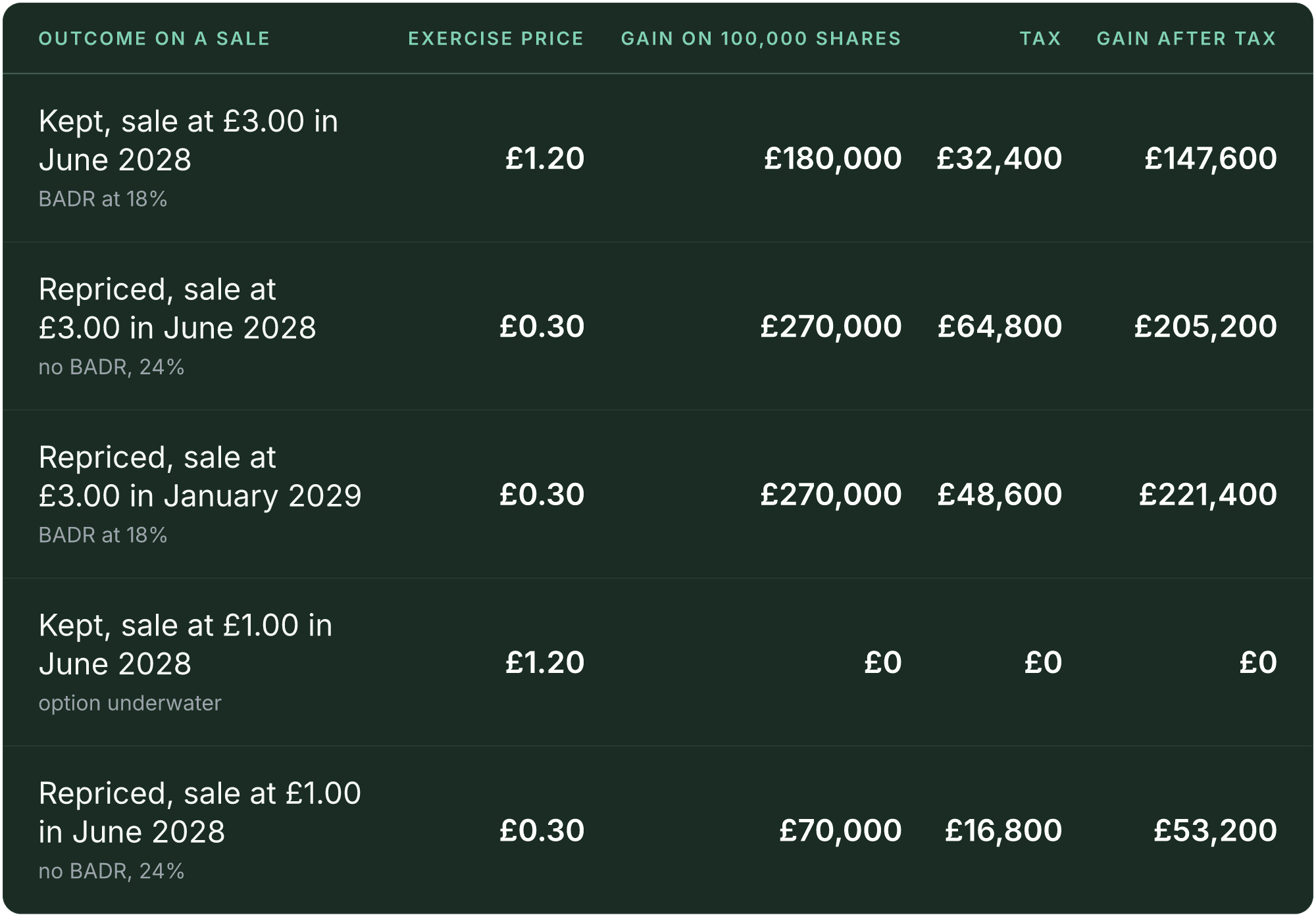
In November 2026 the company closes a down round. The new preference shares rank ahead of the ordinary shares, and the agreed values fall to £0.30 actual and £0.45 unrestricted. The board considers releasing her option and granting 100,000 new options at £0.30 in December 2026. The table below compares the after-tax gain with and without the repricing, assuming she exercises on a sale, pays tax at the higher rate, and leaving out the £3,000 annual exempt amount.
[](https://www.409.ai/uploads/reprice_underwater_emi_options_down_round_release_regrant_hmrc_new_grant_table_1_ca86f1c9ec.png)
The repricing wins in every row here, because the price cut is large next to the six-point rate difference. That won't always hold. Where the cut is small, the old option is close to its two-year mark and a sale is near, the lost relief can cost more than the lower price saves. Run the same five rows with your own numbers before the board meeting, not after.
Her limit works out cleanly: the released option drops out, and the new one counts at 100,000 × £0.45, or £45,000. Had her 2025 grant used the full £250,000, paragraph 6 would have ruled the new option out until March 2028.
Topping up instead of repricing
The alternative is to leave the old options alone and grant additional options at the new, lower value. The old grant date survives, and so does the BADR clock on those shares.
The catch is the limit. Unexercised options count at their grant-date value, so the old underwater grant still uses £160,000 of the engineer's £250,000, even though it's worth little today. A top-up of 200,000 options at an unrestricted value of £0.45 adds £90,000 and takes her to exactly £250,000. That's allowed, since the cap bites only above £250,000. It also means paragraph 6 now applies: no further qualifying option for her until three years after the top-up.
Employees given big grants at a high value have the least room to top up. For them a release and regrant may be the only way to get options priced at today's value inside EMI, and for those at the full limit, neither route works before the three years run out.
The valuation that sets the new price
Whatever route you take, the new exercise price rests on a fresh value for the ordinary shares. HMRC's Shares and Assets Valuation team agrees EMI values through [form VAL231](https://www.gov.uk/guidance/get-a-share-scheme-valuation-from-hmrc), where you propose both the unrestricted and actual market value, and an agreed value is valid for 90 days from the agreement. The same page lists arm's length share transactions and changes to share capital among the significant events, which is why the value agreed before the round can't be used after it.
A down round rarely moves the ordinary shares in step with the headline price. New preference shares with a liquidation preference take the first slice of any exit, so the ordinary value can fall further than the round price. The proposal you send HMRC needs to show that allocation, and our guide to [what an EMI valuation contains](https://www.409.ai/articles/what-is-an-emi-valuation-umv-amv-hmrc-val231-agreed-before-grant) walks through how unrestricted and actual market value are built.
Two other workstreams usually run beside the tax one. If the company reports under IFRS, the repricing is a modification with incremental fair value to expense, covered in our article on [IFRS 2 repricing](https://www.409.ai/articles/ifrs-2-repricing-underwater-options-modification-incremental-fair-value). If US employees hold options in a US plan, their repricing follows a different rulebook, set out in [repricing underwater options after a down round](https://www.409.ai/articles/down-round-409a-underwater-options-repricing).
Questions founders ask
Can we just amend the price in the option agreement? You can, but HMRC treats the amended option as a new grant under ETASSUM54060, with every consequence above.
Do we need a new HMRC valuation if one was agreed a month before the round? The round is a significant event on HMRC's own list, so the earlier agreement is no longer a safe basis for the new price.
Does a repricing lose EMI on the old option? The old option is released, not disqualified. What matters is whether the new option qualifies on its own terms.
Is the 90-day disqualifying event window relevant? Only if something during the process is a disqualifying event, such as a change of control or a variation that increases the shares under option.
The decision to make first
Before anyone drafts a release, list every holder with three numbers: their grant date, the grant-date unrestricted value of what they hold, and how far they are from the two-year BADR mark. Those three figures tell you who can be repriced inside EMI, who can only be topped up, and who should probably wait. An [EMI valuation](https://www.409.ai/products/emi-valuation) agreed with HMRC after the round then sets the one number the new grants depend on.