Financial Reporting
Replacement Options in an Acquisition: What Goes Into the Purchase Price and What Is Expense
For the acquirer's CFO who rolled a startup's options: how ASC 805 splits replacement awards into purchase price and expense, with a worked $36M deal and tax.
By 409.AI Team - 2026-11-15
# Replacement Options in an Acquisition: What Goes Into the Purchase Price and What Is Expense
You closed the deal, and the target's employees now hold your options instead of theirs. If you are the acquirer's CFO or controller, that swap is not one number in the purchase price allocation. ASC 805 cuts every replacement award in two: a slice that counts as consideration paid for the business, and a slice you expense as compensation after the close. The line between them moves goodwill, sets your first quarters of stock comp and is one of the first things the auditor recomputes.
Our earlier piece on [what happens to options when a startup is acquired](https://www.409.ai/articles/stock-options-acquisition-rollover-section-424a-ratio-test) covers the employee's side: the Section 424 ratio test that keeps a rolled ISO an ISO. This one is about the acquirer's books.
The rule in one formula
Both awards are measured at the acquisition date with the fair-value-based method of ASC 718: the target's awards as they stood just before the close, and the replacement awards you issued. Grant-date values from the target's old option ledger don't count. Then ASC 805-30-55-8 and 55-9 split the target award's value:
Precombination portion = fair value of the target's award x service completed before the close / the greater of (a) the total service period of the replacement award and (b) the original service period of the target's award.
The precombination portion is part of the consideration transferred. Everything else is postcombination compensation cost: the rest of the target award's value, plus any amount by which your replacement is worth more than the award it replaced (ASC 805-30-55-10). That excess is never purchase price. It is something you chose to give employees after you owned them.
The "greater of" denominator is what catches people. Extend the vesting and the denominator grows, so less goes into the purchase price. Shorten it and the denominator stays at the original period, so you can't buy your way into a larger purchase price by accelerating vesting yourself.
PwC's Business Combinations guide (BCG 3.4, updated February 28, 2026) walks through the cases. Its Example BCG 3-12 is the cleanest: target awards worth $100 with a four-year cliff, three years served, replaced at the close with fully vested awards worth $100. The precombination portion is $75 (three years of four). The other $25 is expensed immediately after the close, because the acquirer, not the original terms, removed the last year of service.
Only an obligation puts anything in the purchase price
The split applies only when you were obligated to replace the awards: the merger agreement requires it, the target's plan requires it, or the law does (ASC 805-30-30-9). Obligated is the common case in a startup acquisition, because the merger agreement usually says how options will be treated.
If you had no obligation and the target's awards would have lapsed at the close, ASC 805-30-30-10 sends the whole fair value of your replacements to postcombination cost. None of it is purchase price. Read the option section of the merger agreement and the target's plan before you build the schedule, because that one question can move every dollar of the replacement awards out of goodwill.
A worked example: a $36 million acquisition
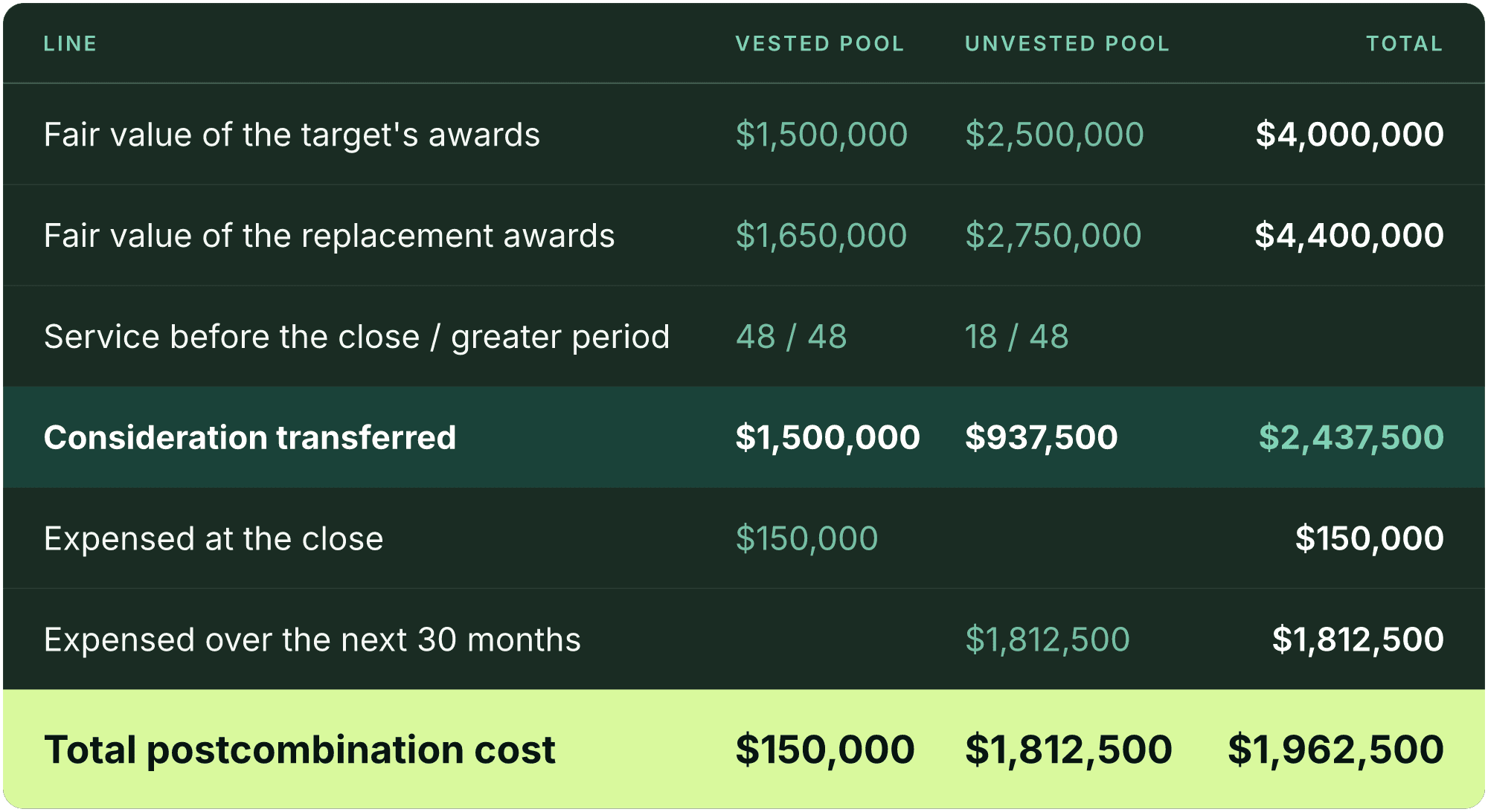
Say your company buys a software startup for $36 million in cash and, as the merger agreement requires, replaces two pools of the target's employee options. Both pools were granted with four years of service. The target's awards are worth $4.0 million at the acquisition date; your replacements are worth $4.4 million, because the exchange ratio rounded in the employees' favour. The figures are illustrative.
- **The vested pool** has served all 48 months. The replacements need no further service.
- **The unvested pool** was granted 18 months before the close. The replacements keep the remaining 30 months, so total service stays at 48.
[](https://www.409.ai/uploads/replacement_options_acquisition_asc_805_consideration_transferred_postcombination_expense_table_1_5969627b05.png)
So the consideration transferred is $38,437,500: $36 million of cash plus $2,437,500 of replacement awards. That figure is what the identifiable net assets are subtracted from, which means goodwill is $2,437,500 higher than in a model that left the options out.
The postcombination side lands fast. The vested pool's $150,000 of excess value has no service left to attach to, so it is expensed on day one. The unvested pool's $1,812,500 is recognized over 30 months, about $60,417 a month on a straight-line policy. Your first full quarter after the close carries $181,250 from the unvested pool, and the quarter that contains the close also takes the $150,000.
Who accelerated the vesting changes the answer
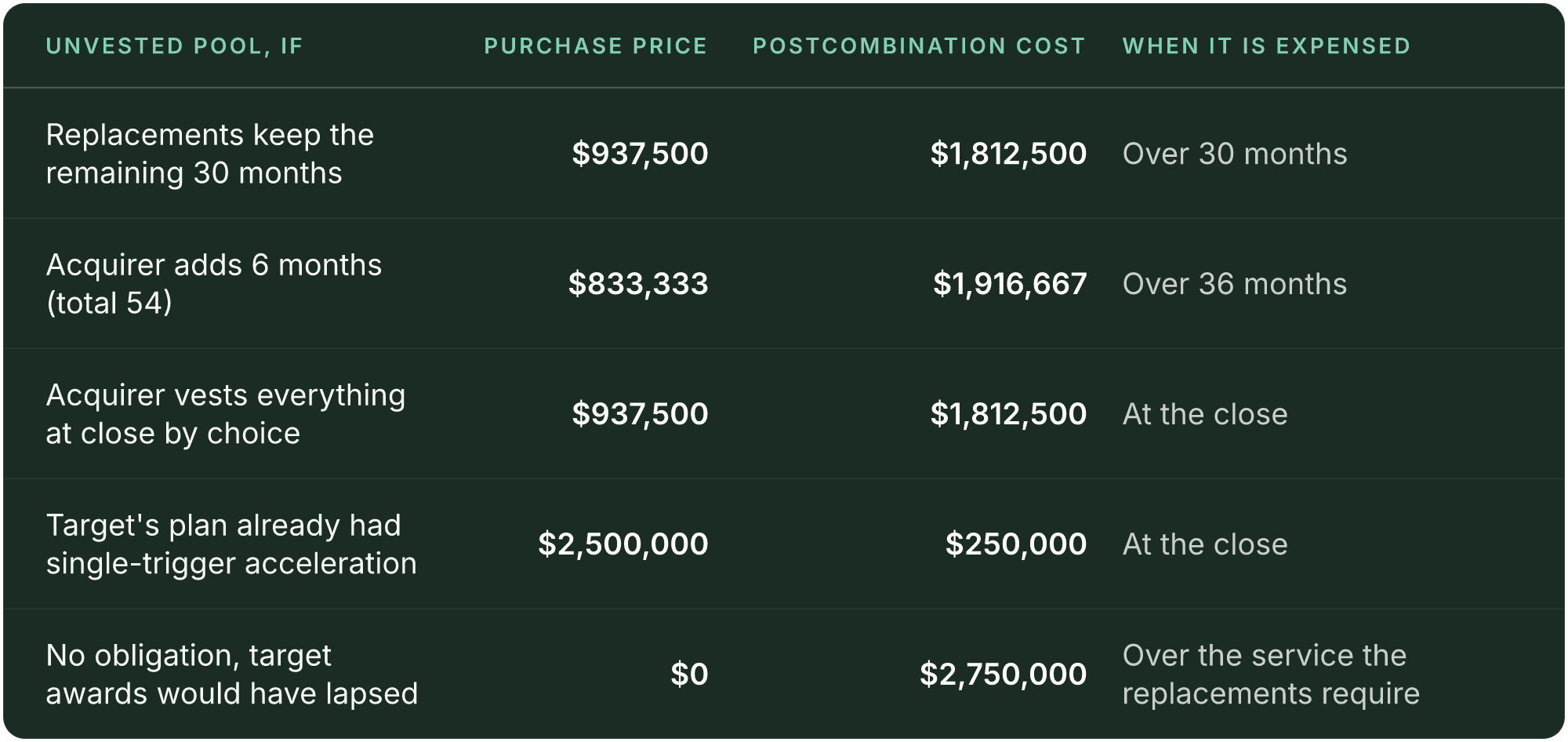
The same unvested pool gives five different answers depending on the terms. Here is how each version splits its $2.5 million target value and the $250,000 of extra value in the replacements.
[](https://www.409.ai/uploads/replacement_options_acquisition_asc_805_consideration_transferred_postcombination_expense_table_2_3fb5740483.png)
Two rows look alike and aren't. When you decide at the close to vest everything, the purchase price stays at $937,500 and the rest is expensed immediately. When the target's own plan already accelerated vesting on a change in control, the employees had earned the whole award before you arrived, so its full $2.5 million value is consideration transferred, and only the $250,000 excess hits your income statement. BCG 3.4 treats that preexisting acceleration as its own scenario for exactly this reason. Pull the target's plan document and every individual grant agreement, because single-trigger terms are often negotiated grant by grant.
The extended case is the "greater of" rule at work: 18 months over 54 is 33.3%, not 37.5%, so $104,167 less goes into the purchase price than when vesting stays at 48 months.
Forfeitures and graded vesting
Two policy choices shape the schedule, and only one of them is yours to make.
You must estimate forfeitures for the precombination portion, whatever your policy for your own grants (ASC 805-30-55-11). PwC's Example BCG 3-8: $100 of target value, three of four years served, 20% expected to forfeit. Consideration transferred is $60, not $75. On the postcombination side your policy applies: $20 of expense if you estimate forfeitures, $40 if you recognize them as they occur, because the excluded precombination amount then runs through expense until the forfeitures happen.
Attribution follows your policy, not the target's (ASC 805-30-55-12). If you use graded attribution, the precombination portion of a graded award is larger than straight-line gives: in PwC's Example BCG 3-9, the same $600 of replacement awards splits $100 and $500 straight-line, and $392 and $208 graded. Awards with performance or market conditions need graded attribution whatever your policy.
The tax line most schedules leave out
For awards that ordinarily produce a tax deduction, such as nonqualified options, the acquirer records a deferred tax asset at the acquisition date on the precombination portion (ASC 805-740-25-10). It is part of the acquisition accounting, so it reduces goodwill. PwC's income tax guide (section 17.13, Example TX 17-4) shows the arithmetic: $37.5 of precombination value at a 25% rate gives a $9.4 deferred tax asset at the close. In our example, if both pools were nonqualified options and the rate were 25%, the deferred tax asset would be $609,375 ($2,437,500 x 25%), and goodwill would fall by the same amount. The deferred tax asset on the postcombination portion builds as the expense is recognized, with no goodwill entry.
ISOs are different. They don't ordinarily produce a deduction for the employer, so no deferred tax asset is recorded at the close (ASC 805-740-25-11). If an employee later makes a disqualifying disposition, the tax benefit goes through the income statement in that period. Since startups grant ISOs to most employees, check the award type pool by pool rather than applying one rate to the whole schedule.
When an option is finally exercised, the actual deduction rarely equals the deferred tax asset. The difference goes to income tax expense, never back to goodwill (ASC 718-740, as PwC section 17.13.1 describes).
What the auditor will ask for
Expect the replacement awards to be tested with the rest of the [purchase price allocation](https://www.409.ai/articles/purchase-price-allocation-cost-asc-805-what-auditors-test). The file should hold:
- the option section of the merger agreement and the target's plan, which establish the obligation and any preexisting acceleration;
- an award-by-award schedule with grant dates, original service periods, service completed at the close and the replacement terms;
- the acquisition-date fair value of both the target's awards and the replacements, with the inputs (share price, volatility, expected term), which for a private target means valuing its common stock as of the close, much like an [ASC 718 valuation](https://www.409.ai/articles/what-is-an-asc-718-valuation-grant-date-fair-value-report-auditor-asks-for);
- the forfeiture estimate for the precombination portion and the attribution policy applied;
- the tax character of each pool and the deferred tax entry.
The replacement awards feed straight into goodwill, so an error here flows into every later [goodwill impairment test](https://www.409.ai/articles/goodwill-impairment-private-company-asc-350) and into the [deferred tax balances of the allocation](https://www.409.ai/articles/deferred-tax-liability-purchase-price-allocation-stock-deal-goodwill-asc-805). If the fair values are still provisional at your first reporting date, the measurement period of ASC 805 lets you finish them, but the obligation, the service periods and the tax character are facts you can settle the week after the close. Cash paid to cancel options sits in the same analysis, along with [earnouts and other contingent consideration](https://www.409.ai/articles/earnout-contingent-consideration-valuation-asc-805), so model them together.
The takeaway
Before the first close entry, answer three questions for every pool of options: were you obligated to replace them, did the target's own terms already accelerate them, and do they produce a tax deduction? Those answers decide how much of the replacement value is purchase price, how much is expense and when, and whether a deferred tax asset reduces goodwill. The fair values come last, and they are the part to have measured independently. 409.AI prepares [purchase price allocations under ASC 805](https://www.409.ai/products/purchase-price-allocation), replacement awards included, for the acquirer's first audit after the close.