Financial Reporting
When You Own the Building: Normalizing Rent in a Small Business Valuation
Owners who rent their own building to the company: how appraisers swap related-party rent for market rent, and what it does to the value. For owners and CPAs.
By 409.AI Team - 2026-10-22
# When You Own the Building: Normalizing Rent in a Small Business Valuation
If you run your company out of a building you own personally, or through a separate LLC, your valuation has a quiet problem. The rent your business pays you is a number you set, and a buyer, a lender, a divorce court or an estate appraiser will not take it on faith. This article is for owners in that position and for the CPAs, attorneys, business brokers and lenders who have to put a defensible number on the business anyway.
The short version: appraisers replace the rent you actually pay with what an unrelated tenant would pay, then value the operating company and the real estate as two separate things. Get that wrong in either direction and the business is worth tens of thousands of dollars more or less than it should be.
Why the rent you pay yourself is not evidence
Fair market value is the price at which property changes hands between a willing buyer and a willing seller, neither under compulsion, both with reasonable knowledge of the facts. That definition comes from Treasury Regulation 20.2031-1(b) and is repeated in Revenue Ruling 59-60. A lease between you and your own LLC does not meet it. Nobody negotiated against you.
Owners set related-party rent for sound reasons that have nothing to do with value. Some charge a low rent because the building is paid off and the business is tight on cash. Others charge a high rent because it moves money out of the operating company and into a separate entity for liability or tax reasons. Both are legitimate choices. Neither tells a buyer what the business earns when it pays market rent to a stranger.
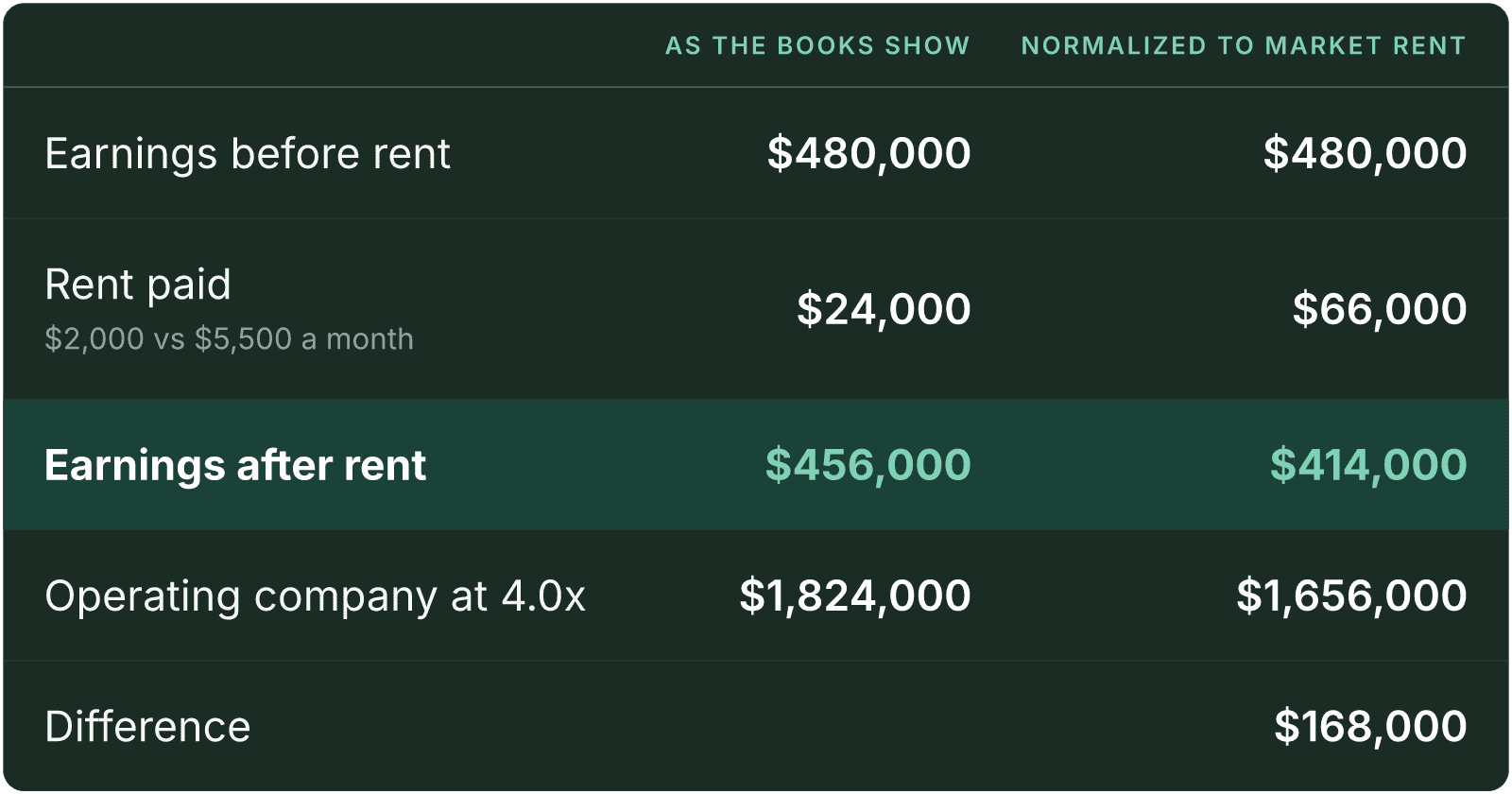
Because a buyer will pay a stranger, the appraiser asks that question instead. If the company paid $24,000 a year and a stranger would charge $66,000, the real earnings of the business are $42,000 lower than the books suggest. If the company paid $90,000 for a space that rents for $66,000, they are $24,000 higher.
This is the same logic as the salary adjustment we cover in [owner pay, SDE and EBITDA add-backs](https://www.409.ai/articles/owner-compensation-add-backs-small-business-valuation-sde-ebitda). Revenue Ruling 59-60 asks the appraiser to separate recurring from nonrecurring items and to question officer salaries that seem excessive. A below-market rent is the mirror image of an above-market salary: a cost the owner chose not to charge.
A worked example
Take an HVAC service company. After normalizing the owner's pay to what a hired general manager would cost, earnings before rent are $480,000 a year. The company operates from a building owned by the owner's LLC and pays $2,000 a month. A broker who works the local market says a comparable building leases for about $5,500 a month on a triple-net basis, which means the tenant also pays taxes, insurance and maintenance.
The illustration uses a 4.0 times earnings multiple for the operating company and a 7.5% capitalization rate for the building. Both are made up for the example, since the right figures depend on the market, the industry and the size of the business.
[](https://www.409.ai/uploads/related_party_rent_small_business_valuation_owner_owns_building_table_1_db0bcec2c3.png)
The books overstate the operating company by $168,000. That is not a rounding error. It is the amount a lender or buyer would find in diligence and use to renegotiate, or the amount an opposing expert in a divorce or a shareholder dispute would use to attack your number.
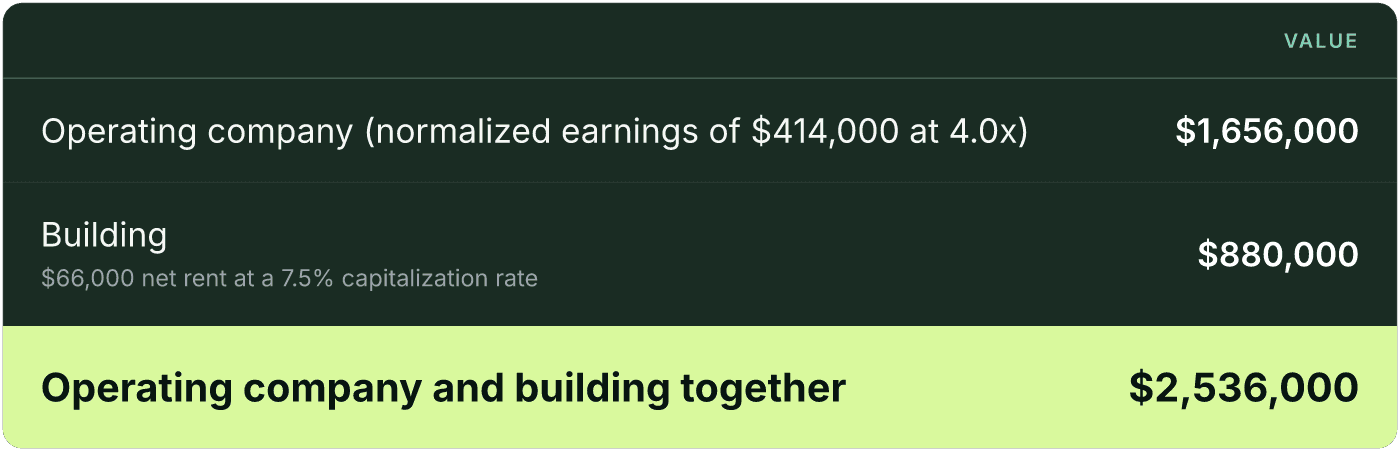
The $66,000 of rent does not vanish. It is real income to whoever owns the building, so the building has a value of its own.
[](https://www.409.ai/uploads/related_party_rent_small_business_valuation_owner_owns_building_table_2_feb4db2014.png)
The two pieces answer two different questions. The first is what the business is worth to someone who rents the space at market. The second is what the building is worth to someone who collects that rent. Which total matters depends on what is being sold, divided or lent against.
Three situations, three answers
You sell the business and keep the building. The buyer signs a lease with your LLC, and the lease becomes part of the deal. Buyers and their lenders will test whether the rent is at market, because that rent is a cost of the business they are buying. Set it too low to make the business look better and the lease can be challenged. Set it too high and the buyer's numbers stop working. A market rent supported by a written opinion from a broker or an appraiser is the cleanest path.
You sell both. Now the allocation matters twice. The buyer sees one price, but the purchase price is split among the assets, and real estate and equipment fall in Class V of the allocation on Form 8594. The split changes the buyer's depreciation and your tax. Our article on [Form 8594 and asset allocation in a small business sale](https://www.409.ai/articles/form-8594-asset-allocation-small-business-sale) walks through how the classes work. Ask your CPA early, before the purchase agreement is drafted.
The value is needed for a family or legal event. In a divorce, an estate or a buyout between partners, the question is usually what the business is worth as a going concern. Whether the building belongs inside that number or beside it is often a matter of how the property is titled and what the governing documents or the court require, which is a question for your attorney, not the appraiser. Our piece on [personal versus enterprise goodwill in a divorce](https://www.409.ai/articles/divorce-business-valuation-personal-vs-enterprise-goodwill-small-business) covers a related split, and the appraiser can usually show both versions side by side.
What the IRS ruling says about assets the business does not need
Revenue Ruling 59-60 asks the appraiser to review the balance sheet for assets the company does not need to operate, and to restate investment-type assets at market value instead of cost. A building is not always in that group. If the company operates from it, the building is part of how the business earns. If the building is larger than the company needs and a third of it sits vacant or is leased to someone else, the unused part looks more like an investment. Appraisers often treat that portion as a separate asset worth its own value, and the earnings of the operating company are adjusted so the same income is not counted twice.
Our guide to [Revenue Ruling 59-60 and its eight factors](https://www.409.ai/articles/revenue-ruling-59-60-small-business-valuation-eight-factors) explains where that factor sits in the larger analysis.
Mistakes that cost owners money
Using the tax return rent without comment. The return shows what was paid, not what the space is worth. Give your appraiser the lease, the date it was signed, who signed for each side and how the number was set.
Normalizing rent in only one direction. Owners sometimes ask for a market-rate adjustment only when the rent is too high. An appraiser who adjusts selectively loses credibility with a lender, and the report can be rejected.
Counting the same dollar twice. If the building is valued at $880,000 on its $66,000 of rent, the operating company cannot also keep that $66,000 as profit. Check that the two valuations use the same rent figure.
Skipping maintenance and taxes. A triple-net rent assumes the tenant pays property tax, insurance and repairs. If your related-party lease is gross and you pay those costs, the comparison to a market rent has to be made on the same basis, or the numbers will not line up.
What to bring to the appraiser
Gather the current lease and any amendments, three years of rent actually paid, property tax and insurance bills, a recent rent opinion or a few comparable listings, and a statement of how much of the building the business uses. Then decide with your CPA or attorney whether the building is going to be sold, kept or divided, so the report values what is actually on the table.
An owner who walks in with those documents spends less time and less money than one who leaves the appraiser to reconstruct them, and ends with a number that survives questions from the other side. If you want an independent estimate of the operating company before you decide how to handle the building, [409.AI's small business valuation](https://www.409.ai/products/smb-valuation) is built for owners and the advisors beside them.
The rent you pay yourself is a decision about your own money. The rent a stranger would pay is a fact about your business, and valuation runs on facts.