Tax
QSBS and the 10x Basis Cap: How the 409A at Exercise Can Raise Your Exclusion
For startup employees and finance leads: how the 409A value at an option exercise sets QSBS basis, and when 10x basis beats the $15M Section 1202 dollar cap.
By 409.AI Team - 2026-11-20
# QSBS and the 10x Basis Cap: How the 409A at Exercise Can Raise Your Exclusion
If you hold vested options in a startup that still passes the QSBS size test, the day you exercise sets more than your holding period. The fair market value on that day, usually the company's current 409A value, also sets your basis. Under Section 1202, basis decides whether your exclusion stops at the $15 million dollar limit or climbs higher.
This piece is for employees and early hires at Series A to C companies weighing an exercise, and for the startup finance leads who answer their questions. It explains the second cap that rarely appears in an exercise model, why nonqualified options and incentive stock options land in very different places under it, and when paying tax at exercise actually buys you something.
Two caps, and the greater one wins
Section 1202 caps the gain you can exclude from one company's stock. The cap is the greater of two amounts ([26 U.S.C. 1202(b)(1)](https://www.law.cornell.edu/uscode/text/26/1202)):
- a dollar limit, $15 million for stock acquired after July 4, 2025 ($10 million for older stock), reduced by gain you already excluded from that company; or
- 10 times the aggregate adjusted basis of that company's qualified stock you sold during the year.
Most founders never think about the second amount, and for good reason. Founder stock bought for a few hundred dollars has a basis of a few hundred dollars, and ten times that is nothing.
The dollar limit is now indexed. For 2027, Rev. Proc. 2026-35 sets it at $15.48 million, while the 10x multiple is not indexed at all ([Holland & Knight, November 16, 2026](https://www.hklaw.com/en/insights/publications/2026/11/irs-releases-2027-inflation-adjustments-to-section-1202-qsbs-limits)). The figure that applies is the one for the year you sell.
One detail in the statute matters for everything below. Basis for the 10x test is measured "without regard to any addition to basis after the date on which such stock was originally issued." Whatever basis you have on the day the shares are issued to you is the basis that counts. Nothing you do later raises it.
What your basis is on the day you exercise
For QSBS purposes, exercising an option is an original issuance: the company issues new shares to you, for cash, as compensation for your services, and Section 1202(c)(1)(B) accepts both. For shares that are vested when you exercise, the holding period starts just after the shares are transferred to you, not at grant ([Treas. Reg. 1.83-4(a)](https://www.law.cornell.edu/cfr/text/26/1.83-4)). The basis depends on the kind of option.
A nonqualified stock option (NSO). The spread between the stock's fair market value and your strike is compensation income at exercise, reported on your W-2 ([Treas. Reg. 1.83-7](https://www.law.cornell.edu/cfr/text/26/1.83-7)). The same regulation that taxes the spread adds it to your basis: your basis is "the amount paid for the property increased by the amount of such difference included in gross income" ([Treas. Reg. 1.61-2(d)(2)(i)](https://www.law.cornell.edu/cfr/text/26/1.61-2)). Because that income arises at exercise, the issue date, it counts in full for the 10x test.
An incentive stock option (ISO). There is no regular income tax at exercise ([26 U.S.C. 421(a)](https://www.law.cornell.edu/uscode/text/26/421)), so your regular-tax basis is the strike you paid. The spread can still create alternative minimum tax, which our article on [ISO exercises and the 2026 AMT](https://www.409.ai/articles/iso-exercise-amt-2026-lower-phaseout-threshold) walks through, but it does not build regular-tax basis.
That is where the 409A comes in. A private company has no market price, so it measures the NSO spread, and withholds on it, with its current 409A value, as our piece on [NSO exercise withholding](https://www.409.ai/articles/nso-exercise-private-company-withholding-exercise-date-value) explains. The same number that sets your tax bill at exercise sets the floor of your exclusion years later.
A worked example
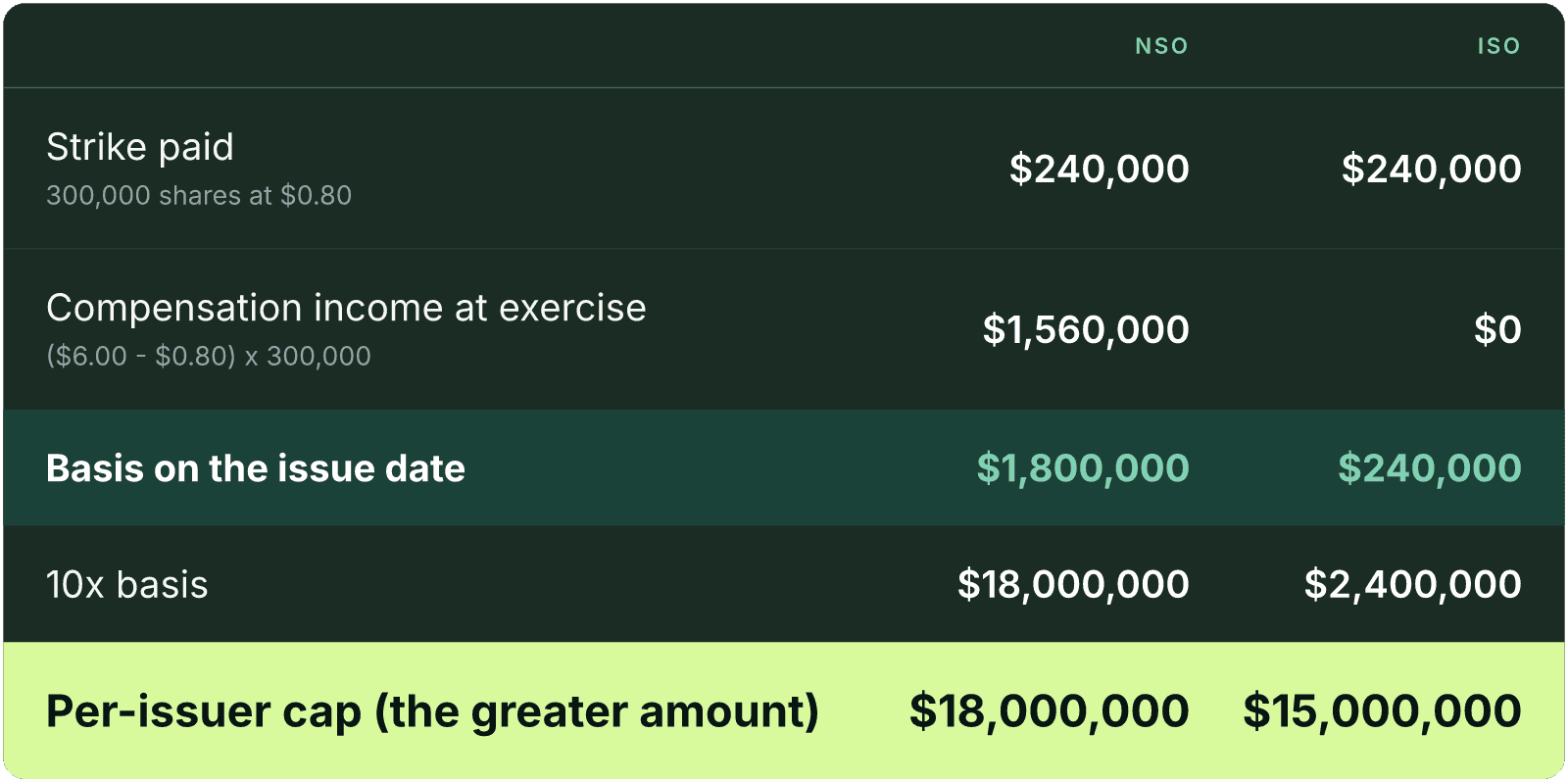
Illustrative example. An engineer at a Series B company holds 300,000 vested options with a strike of $0.80. The company's current 409A value is $6.00 a share, and its aggregate gross assets stay well under the $75 million ceiling after the exercise. She exercises all 300,000 options.
Here is how her basis comes out under each kind of option.
[](https://www.409.ai/uploads/qsbs_10x_basis_cap_option_exercise_409a_nso_iso_section_1202_table_1_8decec6b83.png)
The NSO holder's cap is $18 million because her basis includes the $1.56 million she was taxed on. The ISO holder falls back to the dollar limit. To keep the arithmetic readable, the example uses $15 million and ignores indexing; in the actual year of sale the dollar limit will be somewhat higher, which narrows the gap a little.
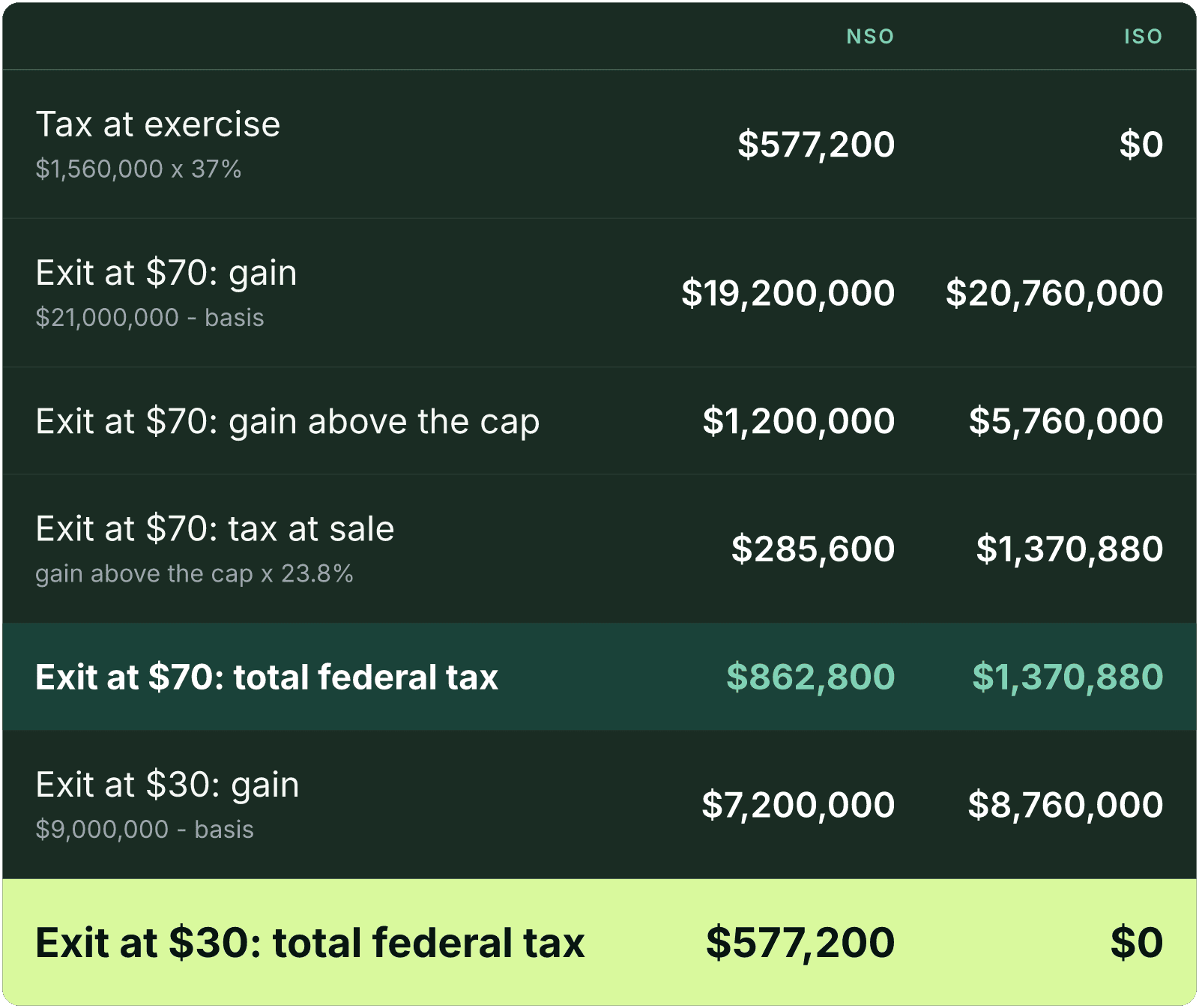
Now fast-forward more than five years, so 100% of eligible gain is excluded. Below are two exits, with illustrative federal rates of 37% on ordinary income and 23.8% on long-term gain (20% plus the 3.8% net investment income tax).
[](https://www.409.ai/uploads/qsbs_10x_basis_cap_option_exercise_409a_nso_iso_section_1202_table_2_aa63279f9a.png)
At $70 a share, the NSO route costs $508,080 less in federal tax, before Medicare and other payroll tax on the NSO spread and before any AMT the ISO exercise triggers. At $30 a share, both gains fit under $15 million and are fully excluded, so the NSO holder simply paid $577,200 for nothing.
That is the rule in one line: the 10x cap pays off only when your gain is large enough for the dollar limit to bind. Below that, tax paid at exercise buys no extra exclusion.
Who actually ends up with NSOs
Few employees get to pick their option type, but more people hold NSOs than their offer letters suggest.
- **The ISO $100,000 limit.** Options first exercisable in one calendar year above $100,000 of grant-date value are treated as NSOs. A large grant at a decent 409A value tips over that line quickly; see our article on the [$100K ISO limit](https://www.409.ai/articles/iso-100k-limit-409a-grant-date-fair-market-value).
- **Leaving the company.** An ISO has to be exercised within three months of the end of employment to keep ISO treatment ([26 U.S.C. 422(a)(2)](https://www.law.cornell.edu/uscode/text/26/422)). An extended post-termination window turns it into an NSO after that.
- **Advisors and contractors.** ISOs are for employees only, so everyone else holds NSOs.
There is one comfort for ISO holders. A QSBS sale needs at least three years of holding after exercise, which is longer than the ISO holding periods of two years from grant and one year from exercise. A sale that qualifies for the QSBS exclusion is never a disqualifying disposition of the ISO.
The clock versus the cap
The trade-off shows up most sharply when you compare early exercise with waiting.
[Early exercise with an 83(b) election](https://www.409.ai/articles/early-exercise-stock-options-83b-election-iso-nso-qsbs) usually happens when the 409A value equals the strike, so there is no spread, no tax, and almost no basis. You start the QSBS clock early and your cap is the dollar limit.
Exercising vested NSOs after a priced round, when the 409A has risen, does the opposite. You start the clock later and pay ordinary tax now, but you buy a cap that can exceed the dollar limit. Neither is right in general. Your expected exit value decides it, and that number is a guess.
Three facts limit how far the 10x route goes.
First, the company must still be a qualified small business when your shares are issued. Gross assets are tested immediately after each issuance, and an exercise is an issuance. Once the company's cash plus the tax basis of its other assets passes $75 million ($77.39 million for 2027 issuances, per Rev. Proc. 2026-35), every later exercise produces stock that is not QSBS at all, whatever its basis. Our article on the [gross assets test](https://www.409.ai/articles/qsbs-gross-assets-test-section-174a-capitalized-rd) explains why the post-money valuation is not the measure.
Second, the 10x amount counts only the basis of shares you sell in that taxable year. Selling a block in one year and the rest the next splits the calculation, while the dollar limit shrinks by whatever you have already excluded.
Third, the cap only matters if the stock is QSBS in every other respect: a C corporation, a qualified trade or business, no disqualifying redemptions. The [2025 changes to Section 1202](https://www.409.ai/articles/qsbs-one-big-beautiful-bill-act-section-1202-changes) set out the full list.
What the company should keep on file
For a finance lead, the employee's question turns into a records question. Each exercise needs three facts on the issue date: the 409A value used to measure the spread, the amount reported as income, and the company's aggregate gross assets immediately after the issuance.
The first two set the holder's basis. The third decides whether the shares are QSBS at all. A 409A dated within 12 months and refreshed after the last round is what makes the spread defensible, and a [409A valuation](https://www.409.ai/products/409a) that is stale at exercise invites a question about the income figure, and therefore about the basis too.
Holders who plan to claim the exclusion often ask for a [QSBS attestation letter](https://www.409.ai/products/qsbs) that records the gross assets and the issuance facts. Our explainer on [what a QSBS attestation letter documents](https://www.409.ai/articles/what-is-a-qsbs-attestation-letter-section-1202-facts-gross-assets-original-issue) lists what goes in it.
The takeaway
If you hold vested NSOs at a company still under the gross assets ceiling, the 409A value on your exercise date is the start of your QSBS basis, and ten times that basis can beat the $15 million limit. Run the exercise twice before you sign: once with an exit where your gain stays under the dollar limit, where tax at exercise buys nothing, and once with an exit where it does not, where every dollar of spread taxed today can shelter ten dollars of gain later. Then check the company's gross assets on the day you plan to exercise, because above the ceiling neither number matters.