Compliance
Pulley Is Shutting Down on December 8: What It Means for Your 409A
Pulley closes on December 8, 2026. A founder's guide to what stays valid, what to export before then, and how to get the next 409A without buying a platform.
By 409.AI Team - 2026-10-15
# Pulley Is Shutting Down on December 8: What It Means for Your 409A
If your cap table lives on Pulley, you have had the email by now. Pulley has announced that it will cease all operations and services on December 8, 2026, and that it has entered an exclusive partnership with Carta to migrate its customers. This article is for the founder or finance lead at a Pulley company who is wondering what that does to the 409A valuation sitting in the platform, what has to be downloaded before the lights go out, and how to get the next report without buying a platform to get it.
The short version: your current 409A is fine, your files are at risk, and your next valuation is a separate decision from your next cap table.
What Pulley has actually announced
Pulley's shutdown notice and FAQ, published on its site in October 2026, set out four things that matter for a 409A.
First, the date. Pulley stops on December 8, 2026. After that the app is no longer accessible in the ordinary way and the Pulley team is no longer available to support your organization.
Second, the migration. Carta will move your cap table and its history. To use that collaborative process, Pulley asks you to opt in by November 30, 2026, after which it offers no guarantee on timing, pricing or disruption. Opting in is not a commitment, but the migration itself requires a new 12-month Carta agreement, signed within about two weeks of receiving it. Pulley says your current pricing is honoured for the first full year on Carta, and that any unused prepaid balance comes back as a credit.
Third, the data. Pulley says your data stays accessible in a limited format through the Pulley app until January 31, 2027. That is the hard stop.
Fourth, the valuation. Pulley's FAQ says Carta can accept Pulley's existing 409A and fair market value as they stand, that customers only need to provide a copy, and that Carta will support defending Pulley's prior work. Once that report expires, Carta's valuation team becomes the provider for customers who migrated.
Those are Pulley's terms, stated in good faith from its own notice. Confirm them in your own account before you act on them.
Your current 409A does not expire because Pulley does
The safe harbor that protects your option grants is in the Treasury regulations, not in a software subscription. Under [Treas. Reg. §1.409A-1(b)(5)(iv)(B)](https://www.ecfr.gov/current/title-26/chapter-I/subchapter-A/part-1/subject-group-ECFR3c2fc4a7d6b2f04/section-1.409A-1), a valuation of non-public stock by an independent appraiser is presumed reasonable if it is no more than 12 months old at the grant date, and the IRS can rebut that presumption only by showing the method or its application was grossly unreasonable. The 12 months run from the valuation date in the report, and the presumption falls away earlier if something happens that makes the old value unreliable, such as a priced round.
A vendor closing its doors is not an event in your company's life. Nothing about your revenue, your cap table, your preferred stock or your prospects changed because Pulley announced a shutdown. A report dated, say, June 30, 2026 still supports grants through June 30, 2027, or until a material event, whoever issued it and whatever happened to the platform it sat in. We covered the mechanics in [Your Cap Table Platform Is Shutting Down: Is Your 409A Still Safe?](https://www.409.ai/articles/cap-table-platform-shutdown-409a-valuation-still-valid), and the Pulley case changes none of it.
So the first instruction is the boring one: keep granting at the current strike price while the report is inside its window. The board still has to approve each grant at or above fair market value on the grant date, a point we explained in [Option Grant Date: Board Approval Sets the Strike, Not the Offer Letter](https://www.409.ai/articles/option-grant-date-board-approval-409a-strike-price), and that approval is the piece most companies forget to document in a hurry.
What you can actually lose: the file behind the number
What a shutdown does put at risk is the evidence. If the IRS, an acquirer's diligence team or your auditor asks in 2028 how the June 2026 strike price was derived, "it was in Pulley" is not an answer. You need the report and the inputs, outside the platform, named by valuation date.
Export these before December 8, and do not rely on the January 31 limited access to catch what you missed:
The final 409A report for every valuation date, as a PDF. The cap table export each report was built on, including the share classes and the option pool at that date. The inputs and assumptions the appraiser used, such as the financing terms, the financial projections and the volatility and discount inputs where the report shows them. The engagement letter and the appraiser's credentials, which are what make the "independent appraiser" prong of the safe harbor demonstrable. The board consents approving each grant and the grant ledger with grant dates and strike prices. Any correspondence with the valuation team about method or inputs.
The cost of a gap is not theoretical. Under [IRC §409A(a)(1)(B)](https://www.law.cornell.edu/uscode/text/26/409A), an option found to have been granted below fair market value is treated as deferred compensation that failed the rules: the holder owes ordinary income tax on the spread as it vests, plus an additional 20% tax, plus interest. An employee with 20,000 options and a $0.80 spread has $16,000 of income and $3,200 of additional tax before interest, and the company has a withholding and reporting problem of its own. The defense against that is a report you can produce and an appraiser you can name.
Your next cap table and your next 409A are two decisions
Here is the part the migration emails blur. Pulley's offer bundles two choices into one: where your cap table lives next, and who prepares your next valuation. They are separable, and separating them is usually cheaper.
Carta is a reasonable home for a cap table, and if you want it, take the migration on its merits. The 12-month agreement, the honoured first-year price and the credit for your prepaid balance are the terms to weigh, and November 30 is the date to weigh them by.
The 409A is a different purchase. It is a report prepared by an independent appraiser from your cap table data, your financials and your financing history. That data is a spreadsheet export. It does not care which platform generated it. An independent report works with Carta, with a spreadsheet, or with whatever you choose next, and the strike price it supports lives in your option agreements and board consents, not in any vendor's database.
Several valuation vendors are now running "switch from Pulley" promotions. Read the condition on each one: the discounted 409A is tied to moving your cap table to that vendor by a deadline. The price is on the migration, not on the report. If you would not have chosen that cap table on its own, the discount is paying you to make a decision you did not want to make.
The 409.AI offer for Pulley customers
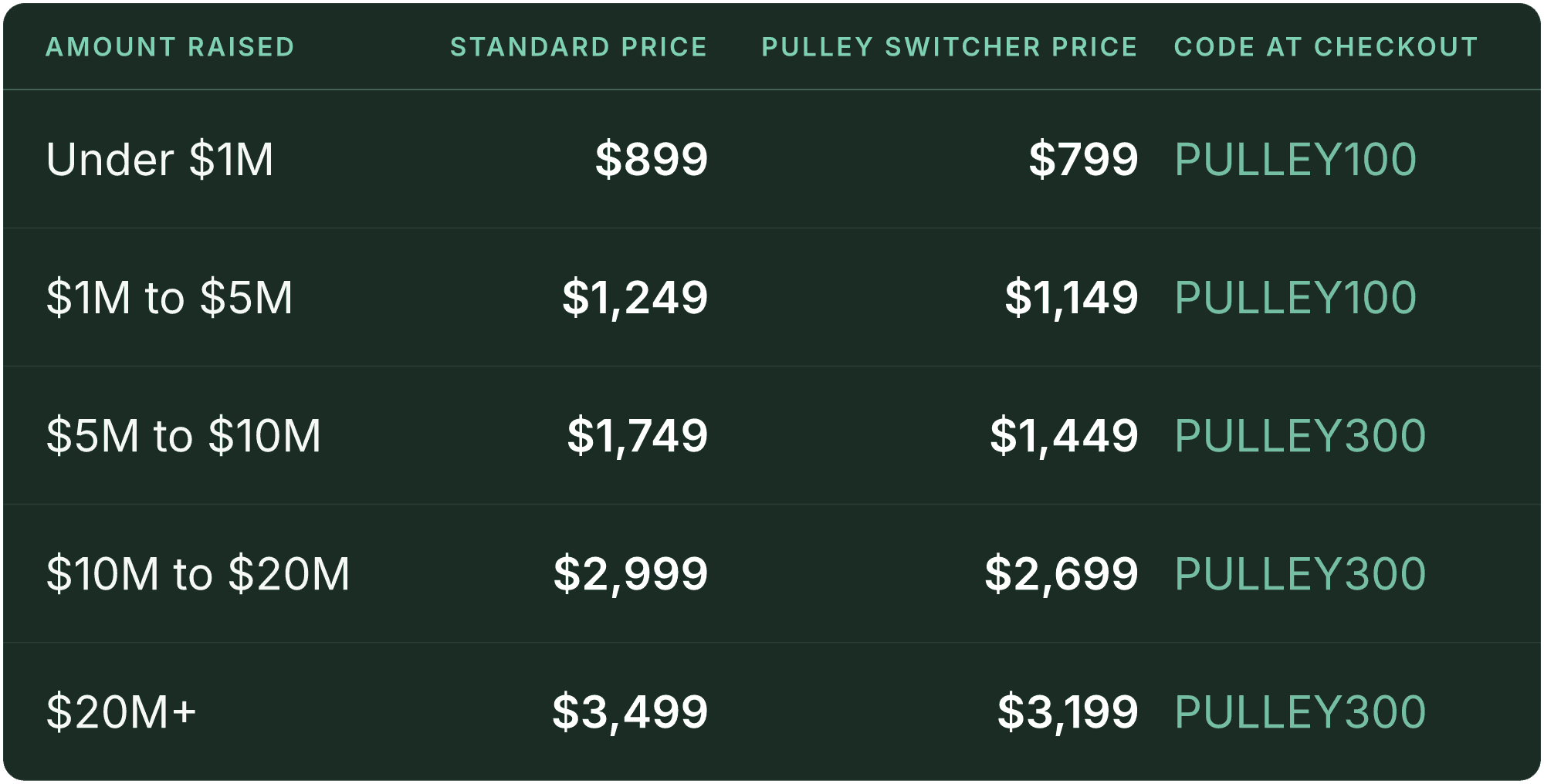
409.AI prices the report on its own, with no platform to join and no annual plan. A 409A is published by amount raised, from $899, with an expert-reviewed draft in 24 hours and the final report in 5 business days, or 1 business day on express. Every report is reviewed by a valuation expert, prepared for safe harbor reliance, and comes with the first two hours of audit support included, then $175 an hour, with someone who worked on the report.
For companies that were Pulley customers when the shutdown was announced, two promotion codes apply on their first 409A with 409.AI, entered on the checkout page.
[](https://www.409.ai/uploads/pulley_shutting_down_december_8_2026_what_it_means_for_your_409a_table_1_80d366e459.png)
The codes are valid through January 31, 2027, which is after Pulley has closed. That is deliberate: if your current report still has months left and nothing material has happened, there is no reason to order a new one in November. Keep granting at the current price, export your files, pick your cap table, and order the new report when the old one is close to expiry or a round is coming. The switcher price will still be there. One code per company, the discount applies to the report rather than to add-ons, and it does not stack with another promotion. The full comparison, with Pulley's dates side by side with the migration terms, is at [409.AI vs Pulley](https://www.409.ai/compare/409ai-vs-pulley).
A worked timeline for a typical Pulley company
Take a seed-stage company that raised $3.5M, has a 409A dated April 15, 2026 at $0.42 a share, and plans a hiring push in the first quarter of 2027.
In October 2026 the founder exports the April report, its cap table, the engagement letter and every board consent since April, and files them in the company's data room by valuation date. Grants approved by the board in October and November go out at $0.42, documented as usual.
By November 30 the founder decides on the cap table: opt in to the Carta migration, or move the export to another platform. Either way the 409A is untouched.
In December Pulley closes. The company has everything it needs outside the platform and nothing changes for option holders.
The April report supports grants until April 15, 2027, unless a priced round or another material event comes first. A company planning Q1 2027 grants that will run past that date, or that expects to close a round in the spring, orders a new 409A in February or March 2027 so the new price is in place before the board meets. With $3.5M raised the standard price is $1,249; with the PULLEY100 code it is $1,149, and the draft is back in 24 hours.
If the hiring push moves earlier, or if a term sheet lands in December, the order moves earlier with it. The trigger is the grant date and the material event, never the vendor's calendar.
What to do this week
Download the reports, the inputs and the consents today, before the platform is busy with everyone else's migration. Check the valuation date on your newest report and write the 12-month expiry in the board calendar. Decide the cap table question by November 30 on its own terms, and if you are still at the stage where the first grants are coming, our guide to [when a pre-revenue startup actually needs its first 409A](https://www.409.ai/articles/first-409a-valuation-pre-revenue-startup-before-first-option-grant) covers the timing. Then order the next report when the grant calendar, not the shutdown, says it is time. A platform closing is a logistics problem. Treat it as one, and keep the valuation decision where it belongs: with the company, its board and an appraiser it can name.