Financial Reporting
Why the 409A on Your Portfolio Company Sits Below Your Fund Mark
A fund CFO guide to reconciling a Level 3 preferred mark with the portfolio company's 409A: why the gap is expected, when it is a red flag, and the audit file.
By 409.AI Team - 2026-10-30
# Why the 409A on Your Portfolio Company Sits Below Your Fund Mark
Your auditor opens the Level 3 file for a Series B position and finds your December 31 mark at $9.10 a share. Then they open the portfolio company's data room request, find its latest 409A, and see common stock at $3.30. The question arrives within the hour: which number is wrong?
Usually neither. The two numbers answer different questions about different securities for different readers. But "usually neither" only holds if the file can show why they differ, and a surprising number of fund files cannot. This post is for the fund CFO, controller or valuation designee who owns the mark, and who will be asked to reconcile it with a document someone else commissioned.
Two valuations, two jobs
A fund's mark is a fair value measurement under ASC 820: the price at which a market participant would buy your specific security, in an orderly transaction, at the measurement date. Your security is the Series B preferred, with its liquidation preference, its conversion right and its seat in the stack. If you serve a registered fund, Rule 2a-5 adds a good-faith fair value process run by the board or its valuation designee, with written reporting at least quarterly and an obligation to [test the accuracy of the methods](https://www.law.cornell.edu/cfr/text/17/270.2a-5).
A 409A valuation is a different instrument. It supports the strike price of options on the company's common stock. Treasury Regulation §1.409A-1(b)(5)(iv)(B) requires a value determined by the [reasonable application of a reasonable valuation method](https://www.law.cornell.edu/cfr/text/26/1.409A-1), and gives a presumption of reasonableness to an independent appraisal made no more than 12 months before the grant, provided nothing material has changed since. The security is common stock. The reader is the IRS, and later the company's own auditor.
ASC 820 is also not the accounting standard behind the company's option expense. Share-based payments sit under ASC 718, which uses a "fair-value-based" measure of its own, and ASC 820's scope carves most of Topic 718 out. That is one more reason a 409A cannot be dropped into your file as if it were a second opinion on your mark.
None of this makes the 409A irrelevant to you. It makes it evidence of a particular kind: how an independent appraiser, with the company's management, read the same business on a nearby date.
The gap is built into the capital structure
Consider an illustrative company that raised a Series B 12 months ago at $10.00 a share. Your fund holds 1,000,000 Series B shares, bought at that price, for a cost of $10,000,000. Since then the company has grown, public comparables have softened and no new round has priced.
At year-end you calibrate your model to the $10.00 entry price, roll it forward to the December 31 inputs, and run the equity value through the waterfall. That is the discipline we describe in [how to calibrate peer multiples to the entry price](https://www.409.ai/articles/peer-multiples-fund-level-3-mark-calibrate-entry-price-asc-820). The result for the Series B, in this example, is $9.10 a share.
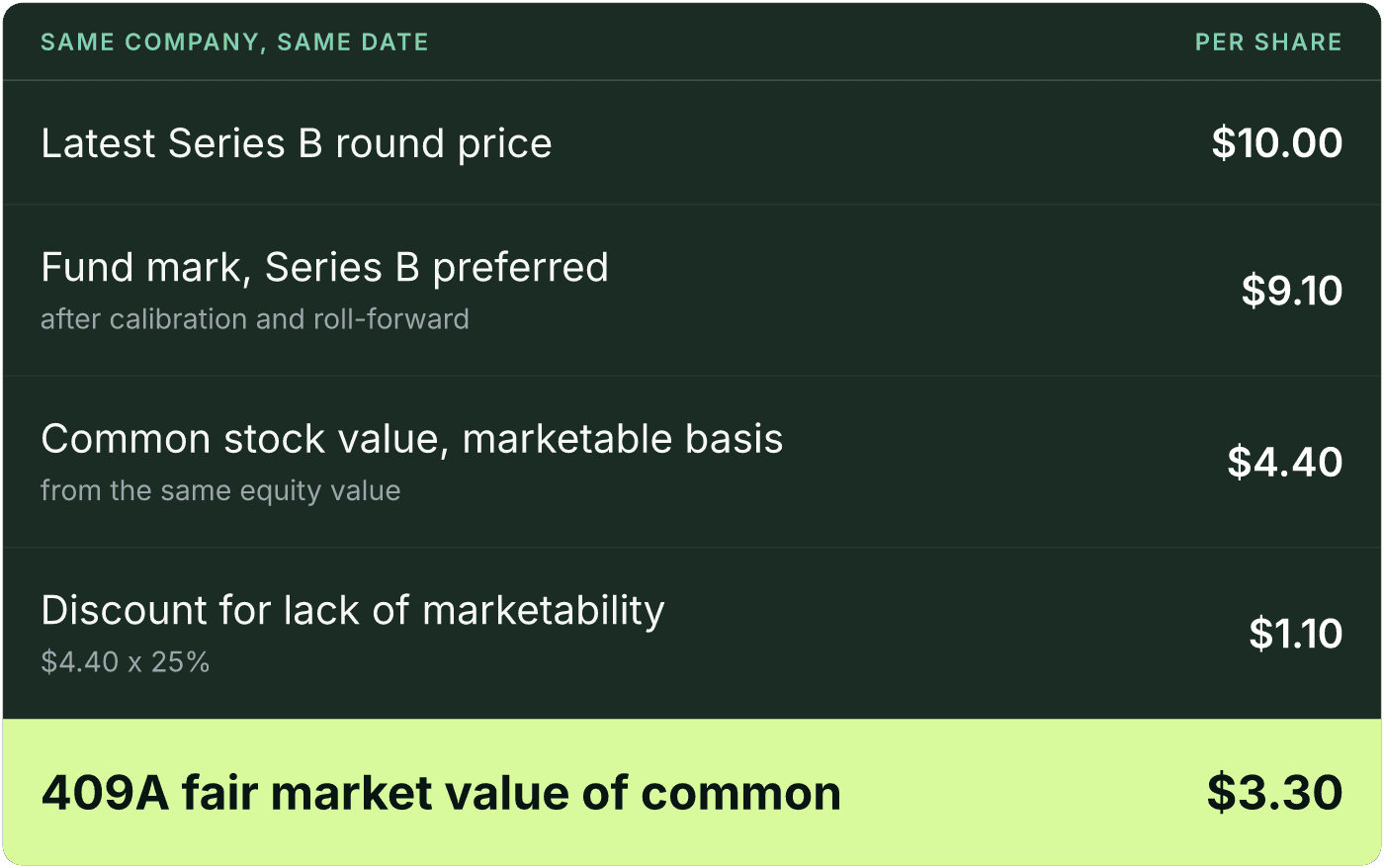
The company's appraiser starts from a similar equity value and allocates it too, often with an option pricing model, but the output they need is the common. Common sits behind the preferences, so it carries less of the downside protection and more of the upside optionality. In this example the allocation gives a marketable value of $4.40 for a common share. Then the appraiser applies a discount for lack of marketability, because a private-company common share cannot be sold freely. At 25%, that takes $1.10 off.
Here are the three numbers side by side:
[](https://www.409.ai/uploads/portfolio_company_409a_below_fund_mark_asc_820_common_preferred_gap_reconciliation_table_1_28687782ad.png)
The 409A value is 36% of the fund mark, and nothing in that ratio is a red flag. Preferred stock carries a senior claim and common does not, and the marketability discount applies to the common and not to your preferred. How the allocation turns one equity value into different prices for different classes is the subject of [our comparison of OPM, PWERM and backsolve](https://www.409.ai/articles/409a-allocation-methods-opm-pwerm-backsolve), and [why a junior preferred position is not worth the latest round price](https://www.409.ai/articles/fund-mark-junior-preferred-liquidation-waterfall-asc-820-latest-round-price) shows the same mechanics from the fund's side.
The ratio between common and the last preferred price moves a lot with stage, structure and time to exit. Treat any single percentage as a feature of this example, not a benchmark to tune your mark against.
Where the gap is a problem
The mechanical gap is expected. These patterns are the ones an auditor writes down.
The 409A is higher than your mark on the same class. Suppose the company's appraiser implies an equity value 30% above the one in your model. You hold the same preferred shares. One of you is using different inputs, and the auditor will ask whether yours are stale. Maybe the appraiser had Q3 management accounts and you carried Q1. Maybe your peer set is wider. The reconciliation is an input-by-input comparison, and your file should hold it before the question arrives.
The 409A is much lower, and your mark has not moved. If your Series B has been held at $10.00 for three quarters while the appraisal behind the company's grants implies an equity value well below the round, you have a downward data point you did not weigh. The IPEV Guidelines and the SEC staff's recent statement both press the same point: a prior price is evidence, not a standing answer. We walked through that in [what the SEC staff said about calibration and year-end marks](https://www.409.ai/articles/sec-staff-statement-private-asset-fair-value-calibration-nav).
The 409A predates a material event. The regulation does not allow a previously calculated value to be used if it is no longer reasonable, which includes after a material event. A bridge round, a signed term sheet or a [down round](https://www.409.ai/articles/down-round-409a-underwater-options-repricing) can make the company's appraisal stale on the very date your mark is more current. In that case the 409A is the weaker evidence, and your file should say so rather than quietly lean on it. The same logic runs the other way for options, as in [our note on bridge rounds and grant timing](https://www.409.ai/articles/bridge-round-409a-material-event-option-grant-timing).
Nobody can say which equity value each side used. The most common failure is not a wrong number. It is that neither file records the enterprise or equity value behind the share price, so no reconciliation is possible.
Building the reconciliation
You do not need the company's full appraisal to do this well. You need a short bridge, kept with the position memo, that an auditor can follow in a few minutes.
Request the latest 409A report in the quarter's information package, with its valuation date, its equity value, its method and its marketability discount. A fund with information rights should ask for it. If the company will not share it, record that and its date range, and treat the absence as limited information under your policy.
Then line up the two valuations on the same footing: the dates, the equity value, the market multiple or discount rate, and the class values the appraiser derived. Explain each difference in one sentence, such as "appraisal dated September 30, ours December 31, comparables moved 6%" or "appraiser applied a 25% DLOM to common, which does not apply to our preferred".
Finally, state what you concluded and why. If your mark is above the implied preferred value from the appraisal, say what you know that the appraiser did not. If it is below, say why. The conclusion can differ from the appraiser's; it cannot be silent about it.
The AICPA publishes two guides that auditors on both sides draw on: the Accounting and Valuation Guide on valuing portfolio company investments of venture capital and private equity funds, and the one on privately held company equity securities issued as compensation. Neither is binding the way a codification paragraph is, but they explain why auditors expect to see this bridge. They also set the vocabulary for it, which helps when the company's auditor and yours end up on the same call.
What the auditor tests
Private fund audits follow AU-C 540, so the testing is on your assumptions, your data and your management review, as covered in [what happens when an auditor tests valuation assumptions](https://www.409.ai/articles/first-audit-409a-valuation-au-c-540-assumptions). A 409A in the file strengthens that testing when it agrees with you and invites more of it when it does not. The auditor does not have to accept either document as the answer. They have to see that you looked at it.
If your valuation policy mentions only the investment team's model, add one line: for positions where the company has commissioned an independent appraisal within the last year, the valuation committee compares it with the mark and records the reconciliation. That single sentence closes the gap between your policy and your practice, and it fits the broader point of [why auditors and the SEC read your valuation policy](https://www.409.ai/articles/fund-valuation-policy-asc-820-audit-sec-exam).
Before the year-end file closes
Pick your ten largest Level 3 positions. For each, find the latest 409A, write down its date and the equity value it implies, and compare it with the equity value inside your mark. Where the two sit within a range you can explain in a sentence, you are done. Where they do not, you have found the question your auditor would have asked in January, while you still have time to answer it.
If you would rather have an independent view on the positions that carry the most judgement, 409.AI's [ASC 820 valuation service](https://www.409.ai/products/asc-820) is built for exactly that year-end file.