Tax
Personal Goodwill in a C-Corp Asset Sale: What the Tax Court Looked At
C-corp owners selling assets face two taxes on goodwill. See what the Tax Court weighed on personal goodwill and what a valuation must show to support it.
By 409.AI Team - 2026-10-14
# Personal Goodwill in a C-Corp Asset Sale: What the Tax Court Looked At
If you own a C corporation and a buyer wants its assets, the price is taxed twice. The company pays corporate tax on the gain, and you pay again when the cash reaches you. Personal goodwill is the argument that part of the price was never the company's to sell. It belonged to you, so you sell it directly and the corporate layer never applies. It is a real argument, it has won in court, and it has lost more often than owners expect. This article is for the owner of a C-corporation service business negotiating an asset sale, and for the CPA who has to structure the allocation before signing.
Why two layers of tax make the question worth asking
In an asset sale, the corporation sells and the corporation is taxed. The federal rate on a C corporation's income is a flat 21% under [IRC §11](https://www.law.cornell.edu/uscode/text/26/11). To get the proceeds out, the company then liquidates or pays a dividend. A liquidating distribution is treated as an exchange of your stock under [IRC §331](https://www.law.cornell.edu/uscode/text/26/331), and a dividend is taxed to you directly. Either way, the second layer lands on whatever the first layer left.
Goodwill is usually the biggest piece of a service business sale, so it is where the double tax bites hardest. We covered how the buyer and seller split a price across asset classes in [how Form 8594 splits the price](https://www.409.ai/articles/form-8594-asset-allocation-small-business-sale). Personal goodwill asks an earlier question: how much of that goodwill does the company own at all?
What personal goodwill is
Goodwill is the value of a business's ability to earn more than its tangible assets would suggest: customer relationships, reputation, know-how, a trusted name. For a company with a brand, a sales team and written customer contracts, nearly all of that sits inside the company. For a company built on one person, some of it may sit inside the person.
The legal point is simple. A corporation can only sell what it owns. If a customer relationship belongs to the owner personally, the company has nothing to sell and nothing to be taxed on. The owner sells that relationship to the buyer in a separate transaction, and the proceeds are the owner's own long-term capital gain.
What the Tax Court weighed
Two decisions anchor the argument, and one appellate case shows how it fails.
Martin Ice Cream. In *Martin Ice Cream Co. v. Commissioner*, 110 T.C. 189 (1998), the founder had built the company's relationships with supermarket chains himself, through long personal dealings. He had no employment agreement and no non-compete with the company. The Tax Court held that those relationships were his personal assets, not the corporation's, so the corporation had no gain on them.
Bross Trucking. In *Bross Trucking, Inc. v. Commissioner*, T.C. Memo. 2014-107, the same logic carried the day. The customer relationships were the owner's because of his close personal ties to the customers, there was no agreement tying him to the company, and the company's own intangibles were weak.
Howard. In *Howard v. United States*, 448 F. App'x 752 (9th Cir. 2011), a dentist had signed an employment agreement with a non-compete in favor of his professional corporation. The court treated the practice's goodwill as the corporation's. The agreement was the company telling the world that the relationships were its own.
Read together, the courts looked at the same facts each time:
- **Who built the relationships**, and whether customers stayed because of the person or because of the firm.
- **Whether the owner had a non-compete or employment agreement** with the company. One is strong evidence that the company owns the goodwill.
- **What the company owned on its own:** brand, trade name, contracts, a workforce, systems that run without the owner.
- **How the deal was documented:** who the seller was, what each party signed, and what the buyer paid for.
These are fact-driven decisions. None of them promises that your facts will land the same way, which is why the valuation matters.
The employment agreement problem
The most common way an owner loses this argument is by an agreement the owner signed years ago. Many owners sign an employment contract with their own company on the advice of a lawyer who was thinking about payroll, benefits or a bank loan. If it contains a non-compete, it can read as proof that the company owns the goodwill the owner promised not to take elsewhere.
A buyer may also ask for a new non-compete from the owner at closing. That is normal, and a payment for a covenant is a separate item with separate tax treatment. But a covenant tied to the company, signed before the sale, sends the opposite signal from the one the owner wants. Ask the attorney to review the agreements before the letter of intent turns into a purchase agreement, not after.
A worked example
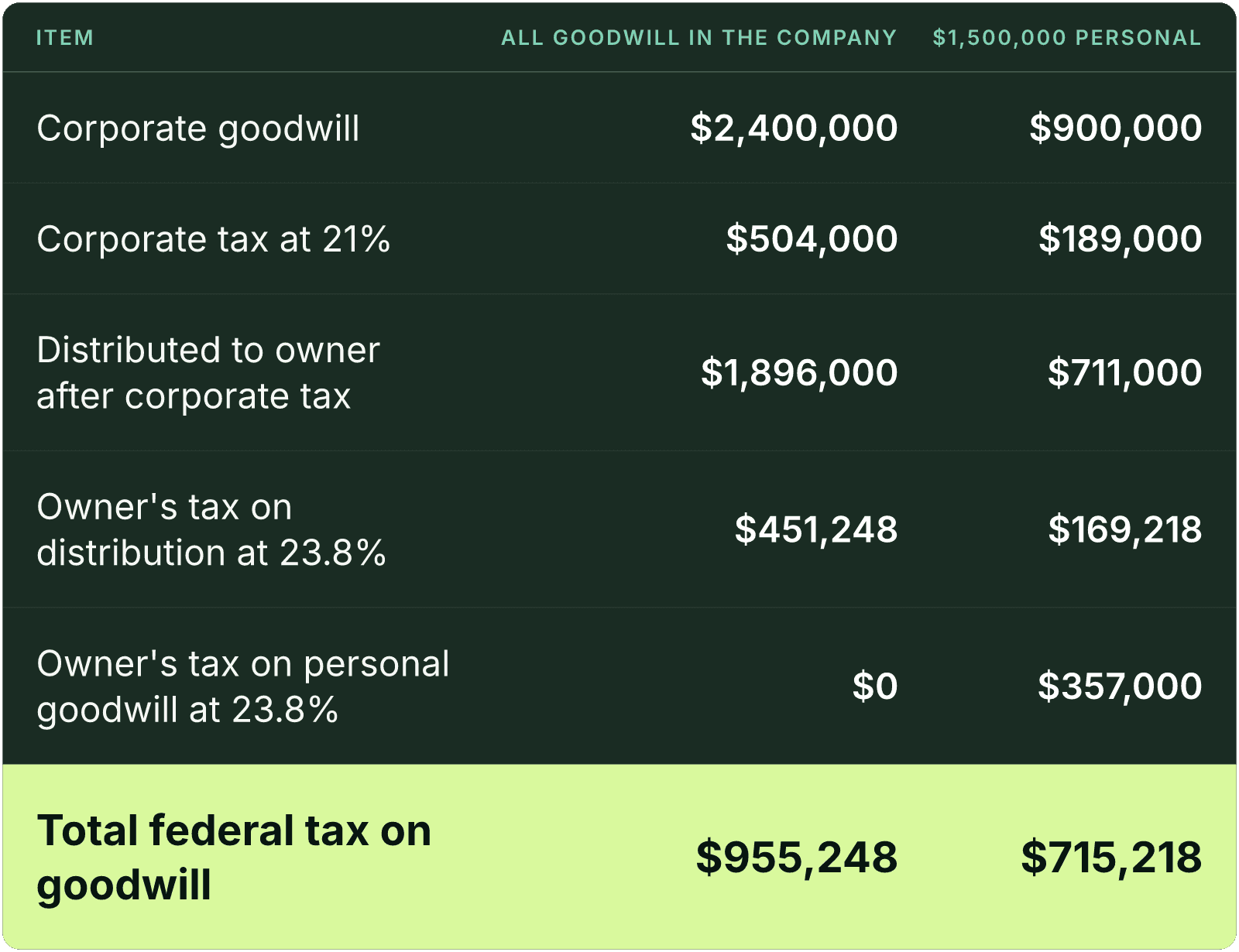
Take a C-corporation consulting firm selling its assets for $3,000,000. Say $2,400,000 of the price is goodwill with no tax basis, and the owner has no basis in the stock. To keep the figures simple, assume federal tax only, a 21% corporate rate, and a 23.8% rate on the owner's long-term gain (20% plus the 3.8% net investment income tax, which may not apply to every owner).
First, all the goodwill is the company's. Then the valuation supports $1,500,000 of it as the owner's personal goodwill, with the other $900,000 staying in the company.
[](https://www.409.ai/uploads/personal_goodwill_c_corp_asset_sale_martin_ice_cream_tax_court_table_1_f2a2f3fbe1.png)
The difference is $240,030 on the same $2,400,000 of goodwill. The split does not make the goodwill disappear. It moves $1,500,000 of it from a double-taxed column to a single-taxed one. State tax, stock basis and the owner's actual rate will change every number above, so treat the table as a picture of the mechanism, not a forecast.
A saving of that size is also exactly what the IRS reads a return for. The personal goodwill number has to hold up on its facts, and it has to be supported by something other than the tax result.
What the valuation has to show
A personal goodwill allocation is a valuation question before it is a tax question. A report that supports it usually does five things.
1. Values the whole business first. The enterprise value comes from an income approach or market multiples, with the owner's pay normalised to what a replacement would earn. The pieces we described in [how Revenue Ruling 68-609 values small business goodwill](https://www.409.ai/articles/revenue-ruling-68-609-excess-earnings-method-small-business-goodwill) apply here. 2. Identifies the company's own intangibles and values them: the trade name, written contracts, the workforce, the processes that run without the owner. This is the same exercise a buyer's accountant performs in a [purchase price allocation under ASC 805](https://www.409.ai/articles/asc-805-purchase-price-allocation-startup-acquisition). 3. Isolates the part of the earnings that depends on the owner. How much revenue would walk out the door if the owner left? Which customers have said so, in email, in writing or by past behavior? A with-and-without analysis answers that: value the business with the owner's relationships, then without them, and the gap is the starting point for personal goodwill. 4. Tests the facts against the cases. Is there an employment agreement or non-compete? Did the owner build the relationships before the company existed or on their own time? Do customers contract with the company or with the person? 5. Ties to the deal documents. The purchase agreement should name the owner as the seller of the personal goodwill and the buyer's allocation should match. A report that reaches one number while the contract says another undoes the work.
Where this sits next to other planning
Personal goodwill is not the only way to ease a double tax on exit. An owner thinking about a pass-through structure should read [the built-in gains tax that follows a C-to-S conversion](https://www.409.ai/articles/c-corp-to-s-corp-conversion-built-in-gains-tax-valuation-date), which prices a different route to the same worry. And if the owner is also party to a buyout agreement, [the buy-sell valuation questions after Connelly](https://www.409.ai/articles/buy-sell-agreement-valuation-connelly-life-insurance) can change what the company is worth on the day of sale.
The practical takeaway
If a sale is on the calendar this quarter, three things belong on the CPA's list now. Pull every agreement the owner has with the company and read it for a non-compete. Write down, with names and dates, which customers came because of the owner. And get the valuation done before the allocation schedule is negotiated, because an allocation drafted first and justified later is the one that looks like tax planning. A [409.AI SMB valuation](https://www.409.ai/products/smb-valuation) report separates enterprise value from the owner-dependent portion, with the reasoning written out for your attorney, your CPA and, if it ever comes to it, a reviewer who was not in the room.