Financial Reporting
Pay-to-Play Down Round: What Is the Fund's Year-End Mark?
For VC fund CFOs: an insider pay-to-play price buys new shares and keeps the old preferred. How to set a year-end ASC 820 mark the auditor will accept.
By 409.AI Team - 2026-11-22
# Pay-to-Play Down Round: What Is the Fund's Year-End Mark?
A portfolio company is closing a down round before December 31, and the term sheet has a pay-to-play clause: every existing preferred holder buys its pro rata share of the new series, or its preferred converts into common. If you're the CFO or controller of the venture fund holding that position, you now have two decisions. The partners decide whether to write the check. You decide what the position is worth at year-end, and the obvious answer, marking the new shares at the round price, is often wrong.
The clause isn't rare. Cooley's [Q2 2026 venture financing report](https://www.cooley.com/news/insight/2026/2026-08-17-q2-2026-venture-financing-report), covering 166 financings, put pay-to-play provisions at 8.4% of deals, up from 7% in the first quarter, with down rounds at 12.1%. A pay-to-play round is, by design, a round the existing investors are pushed to fund, and that's where the year-end file gets harder.
How a pay-to-play round works
The mechanics come from the company's charter and the financing documents, so read them before modelling anything. In the usual form, an existing preferred holder that doesn't buy its pro rata allocation of the new round has its preferred converted. Goodwin's [founder guide to pay-to-play](https://www.goodwinlaw.com/en/insights/publications/2025/08/insights-technology-pif-the-15-minute-founders-guide-pay-to-play) describes conversion into common as the usual penalty, a "cram down", sometimes one for one and sometimes at a punitive ratio such as one common share for every ten preferred. Morrison Foerster's [note on the NVCA pay-to-play provisions](https://www.mofo.com/resources/insights/231116-nvca-pay-to-play-provisions) adds the other common variant, conversion into a more junior preferred series instead of common.
Either way, the holder that converts loses its liquidation preference, and with it most of the downside protection that made the preferred worth more than common. That loss is the stick, and it's deliberately bigger than the check. A fund that participates isn't only buying new shares. It's paying to keep the old ones.
Why the round price isn't the price of the new shares
ASC 820 starts from a presumption that a transaction price often equals fair value at initial recognition, and then lists the cases where it may not. Paragraph 820-10-30-3A, as amended by [ASU 2011-04](https://viewpoint.pwc.com/dt/us/en/fasb_financial_accou/asus_fulltext/2011/asu_201104fair_value/asu_201104fair_value_US/asu_201104fair_value_US.html), names four. Two of them describe an insider pay-to-play round exactly:
- the transaction is between related parties (the existing investors usually sit on the board that approves the round);
- the unit of account represented by the transaction price is different from the unit of account of the asset being measured.
The second point is the one funds miss. When an insider pays $1.00 a share for the new Series B, the $1.00 buys a package: the Series B shares, plus the right to keep its Series A as preferred. The asset you mark on the schedule of investments is the Series B share (and, separately, the Series A share). The price was paid for something larger.
This matters because of the calibration rule. Under 820-10-35-24C, when the transaction price is fair value at initial recognition and you'll use a technique with unobservable inputs afterwards, the technique is calibrated so that it returns the transaction price at inception. Calibration is the right discipline when the price is a clean price for the security. Applied to a package price, it pushes the whole equity value up until the new series is worth $1.00 a share, and every other class rises with it. We've written about the [two steps from a round price to a fund's position](https://www.409.ai/articles/fund-mark-junior-preferred-liquidation-waterfall-asc-820-latest-round-price); here the first step is already distorted.
A worked example
Illustrative figures throughout. Fund II holds 2,000,000 Series A preferred, bought at $2.00 a share, marked at $1.40 at September 30. The company raises $8 million of Series B at $1.00 a share, a 1x non-participating preference senior to the Series A, from its existing investors only. Fund II's pro rata is 25%: 2,000,000 Series B shares for $2,000,000. A holder that doesn't participate sees its Series A convert into common at one for ten.
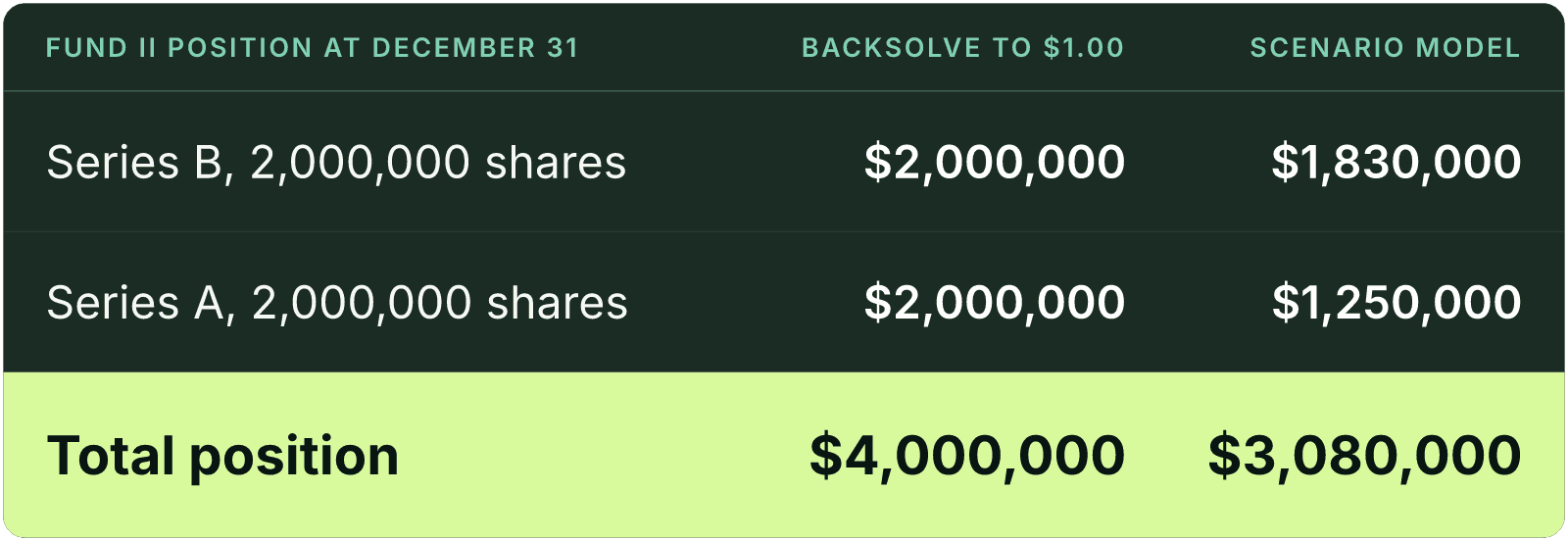
The fund's valuation team builds a scenario model from what the company can actually achieve: a sale near the cash and the IP if growth stalls, a modest strategic sale, and a smaller chance of a strong outcome. It doesn't start from the $1.00. The table compares that model with a backsolve that forces the Series B to the round price.
[](https://www.409.ai/uploads/pay_to_play_down_round_fund_year_end_mark_asc_820_insider_round_price_table_1_f8b4b24b5b.png)
The backsolve values the Series B at $1.00 and, because it lifts the equity value to get there, values the Series A at $1.00 as well. The scenario model puts the Series B at $0.915 and the Series A, now sitting behind $8 million of senior preference, at $0.625. The gap is $920,000 on one position, all of it in the direction the auditor will challenge first.
Now check the model against the decision the fund actually made. Had Fund II declined, its 2,000,000 Series A would have become 200,000 common shares, worth about $62,000 on the same scenarios. Participating turned $62,000 into $3,080,000 for a $2,000,000 check. A difference of about $3 million for $2 million of cash is exactly why insiders pay the round price even when the new shares alone are worth less: the price is rational for the package and says little about the Series B on its own.
The quarter's result follows from the numbers. Fund II started the quarter with a $2,800,000 mark and added $2,000,000 of cash, so a $3,080,000 position is an unrealized loss of $1,720,000. That's not a day-one loss on the new shares to explain away. It's the down round, recognised in the quarter the round happened.
The fund that doesn't participate
Sometimes the partners decide not to follow, because the fund is near the end of its life, the reserves are committed elsewhere or the company no longer fits. The valuation question is then simpler, and the loss bigger. Once the conversion is effective, the fund holds common (or the junior series the charter names), and it marks that security, not the Series A it used to own. Using the [Level 3 hierarchy](https://www.409.ai/articles/asc-820-level-3-fair-value-fund-portfolio-valuation) as usual, the common is valued through the same waterfall as everyone else's.
Two things are worth writing down in the file. First, the date the conversion took effect under the charter, because that's the date the unit of account changed. Second, the conversion ratio actually applied, since a one-for-ten cram down and a one-for-one conversion produce very different marks and the auditor will tie the share count to the cap table.
When a clean price exists: an outside lead
Everything changes if a new investor leads the round. A fund buying Series B at $1.00 with no existing stake to protect is paying for the Series B alone. If it's independent of the company and the existing holders, and the round was marketed rather than handed to it, its price is the evidence ASC 820 prefers, and calibrating to it under 820-10-35-24C is the right starting point.
So the first question in the file isn't "what was the price?" but "who set it, and what did they buy?" An outside lead at $1.00 supports a Series B mark near $1.00 at inception. An insider-only round at $1.00 supports much less, and the weight it gets should be argued the way any [insider-led round price](https://www.409.ai/articles/insider-led-round-fund-mark-asc-820-related-party-price-market-terms) is argued: whether the terms match what an outside buyer would accept, whether anyone else was offered the round, and whether the company had alternatives. A mixed round, with a small outside participant beside the insiders, sits in between; its weight depends on how much that participant bought and whether it negotiated the price.
The scenario model still needs its own support when the round price gets little weight. That usually means [peer multiples calibrated to the original entry price](https://www.409.ai/articles/peer-multiples-fund-level-3-mark-calibrate-entry-price-asc-820) and rolled forward, the cash runway after the new money, and the probabilities management and the board used when they approved a down round in the first place. The board minutes for that approval are often the best document in the file.
Timing: a round that closes after December 31
Pay-to-play rounds tend to be negotiated for weeks, and many close in January. If the term sheet was signed in December and the round closed after year-end, the question is whether the round is evidence of a condition that existed at December 31. A down round priced on the company's December cash position usually is; a round forced by an event in January usually isn't. We covered that test for an ordinary financing in [a January round and the December 31 mark](https://www.409.ai/articles/january-round-december-31-mark-asc-855-subsequent-events-fund), and it applies here too. What doesn't apply is the conversion: until the charter amendment is effective, the fund still holds Series A and marks Series A, even if it already knows it won't participate.
What the file needs before the auditor asks
Auditors working under SAS 143 test the method, the significant assumptions and the data behind an estimate. The [file a valuation firm's work needs to pass that test](https://www.409.ai/articles/fund-valuation-firm-sas-143-auditor-tests-management-specialist-file) is the same file here, with four additions:
- the pay-to-play clause itself and the conversion ratio, from the executed documents;
- the list of who bought in the round and how much, separating insiders from any outside participant;
- the reason the round price was given full, partial or no weight, tied to 820-10-30-3A;
- the participate-or-convert comparison, showing the model's value of each outcome against the check.
That last item does double duty. It's the cleanest evidence that the model is sensible, and it's the analysis the investment committee should have seen before it decided to write the check.
The takeaway
In a pay-to-play round, the price an insider pays buys two things: new shares and the survival of the old preferred. Mark the new series from a model that stands on its own, use the round price as a clean calibration point only when an outside lead set it, and show the auditor the participate-or-convert comparison that explains why the fund paid $1.00 for shares worth less. If you'd like that year-end analysis done independently of the deal team, 409.AI's [ASC 820 portfolio valuation](https://www.409.ai/products/asc-820) is scoped per portfolio and quoted on a call.