Compliance
Option Cash-Out in an Acquisition: Escrow, Earnouts and Section 409A
How a startup CFO or founder can hold back option payouts in an acquisition escrow or earnout without breaking Section 409A or the option plan terms today.
By 409.AI Team - 2026-10-16
# Option Cash-Out in an Acquisition: Escrow, Earnouts and Section 409A
Your startup signs an acquisition agreement. Founders and investors will be paid at closing, with part of the price held back in escrow for an indemnity period. Then the question lands on the finance lead's desk: do the option holders get their spread in full at closing, or does a slice of it sit in escrow too?
The answer matters for two reasons. One is tax: a holdback that is badly built can turn an option payout into deferred compensation that breaks Section 409A. The other is contract: in Delaware, an escrow that the option plan does not allow can cost the company real money. This article is for the founder, CFO or general counsel of a venture-backed company who has to paper the option side of a sale.
Why options need their own treatment
Stockholders are bound by a merger agreement. Option holders are not stockholders. They hold a contract right under the option plan and their award agreement, and that contract decides what they receive when the company is sold.
For an option with an exercise price at or above fair market value on the grant date, Section 409A generally stays out of the way. That is the reason a defensible grant-date price matters, as we explain in [the safe harbor and the qualified appraiser](https://www.409.ai/articles/409a-safe-harbor-price-vs-qualified-appraiser). The sale creates a new problem. If the buyer holds back part of what an option holder is owed and pays it later, the delay can look like a deferral of compensation.
The rule that makes holdbacks workable
Treasury Regulation [§1.409A-3(i)(5)(iv)](https://www.law.cornell.edu/cfr/text/26/1.409A-3) deals with what it calls transaction-based compensation. It covers payments tied to a change in control that arise because the company or a third party buys a service provider's stock or stock rights, or that are calculated by reference to the value of the company's stock. An option cash-out fits.
Such compensation can be treated as paid on a permitted payment date if it is paid on the same schedule and under the same terms and conditions as payments to shareholders generally. The regulation also caps the period: the relief applies only to the extent the compensation is paid no later than five years after the change in control event.
In practice, [law firm commentary on earn-outs and escrows](https://www.morganlewis.com/blogs/mlbenebits/2015/08/earn-outs-and-escrows-internal-revenue-code-sections-409a-and-83-2) reads this as three conditions for any holdback on option payments:
1. The option holder's share of the escrow or earnout is paid on the same schedule as the stockholders' share. 2. The terms match: if stockholders lose escrowed money to an indemnity claim, option holders lose a proportionate amount. 3. Everything is paid out within five years of closing.
Miss one, and the holdback needs a different exemption or a payment schedule that complies with 409A on its own.
A second tax point comes from Section 83. Amounts that are held back should remain subject to a substantial risk of forfeiture, or sit as a general unsecured claim against the company, so the holder is not taxed on money they cannot yet reach. Your tax counsel should confirm how the specific escrow works.
A worked example
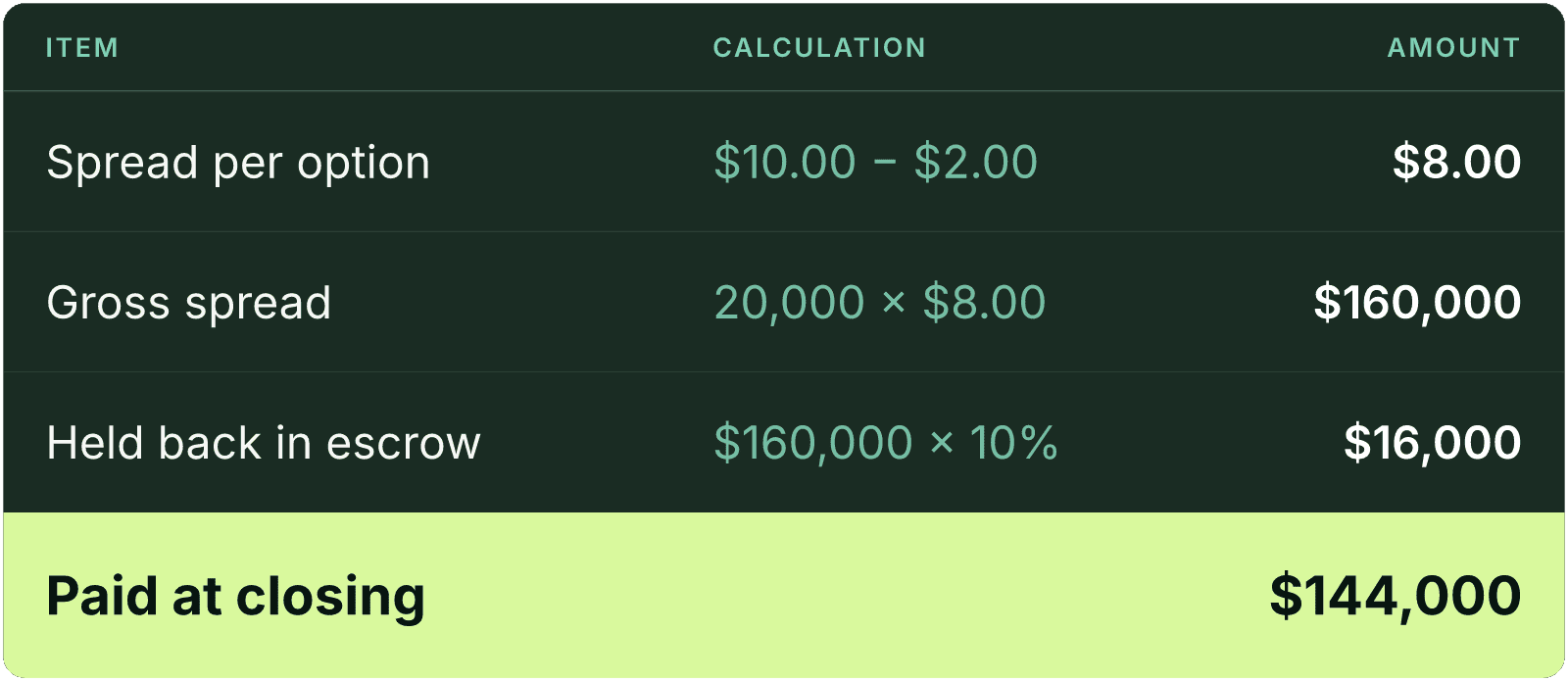
Suppose a company is acquired at $10.00 per common share. An employee holds 20,000 vested options with a $2.00 exercise price. The merger agreement puts 10% of the consideration into an indemnity escrow released after 18 months.
[](https://www.409.ai/uploads/option_cash_out_acquisition_escrow_earnout_section_409a_table_1_481c96a141.png)
The $16,000 is not lost. It is paid when and if the stockholders' escrow is released, at month 18, and it shrinks only if stockholders' escrow shrinks. That matches the same-schedule, same-terms test, and it is well inside the five-year limit.
The cash is ordinary compensation income to the employee, paid through payroll with withholding when it is received. If the same person had exercised and sold the shares before the deal, the result would differ, which is why [the tax timing on an NSO exercise](https://www.409.ai/articles/nso-exercise-private-company-withholding-exercise-date-value) deserves a look before signing. An ISO cashed out this way is a disqualifying event as well; see [what an early sale does to ISO treatment](https://www.409.ai/articles/iso-disqualifying-disposition-sell-early-ordinary-income-basis).
What the Delaware court said about escrows and options
The contract side is where companies get hurt. In *Fox v. CDX Holdings, Inc.*, decided by the Delaware Court of Chancery in July 2015, the merger agreement held back part of the consideration for option holders in an indemnification escrow, just as it did for stockholders. As [summarized by Weil](https://privateequity.weil.com/insights/key-takeaways-re-option-holders-rights-from-fox-v-cdx-holdings-inc), the court held that option holders could not be burdened by the escrow, because the option plan did not permit one. Options are not shares and option holders are not stockholders. Their rights come from the plan, and the plan said they were owed the spread.
The court noted that the plan could have been drafted to give cancelled options the same consideration as stockholders, less the exercise price. It was not. The Delaware Supreme Court affirmed the later damages judgment in 2016.
The lesson is practical. Before the merger agreement goes out, read the plan for three things: whether the board may cancel options for cash, whether the cash amount can be reduced by escrow, indemnity or earnout terms, and whether the holder must consent. If the plan is silent, get each holder's agreement, or pay the full spread and let the company bear the risk.
Earnouts: harder than escrows
An earnout pays only if the business hits a target after closing. Option holders can share in it under the same principle. It is paid on the same schedule and terms as the stockholders' earnout, and within five years. The risks are different:
- A promise to pay option holders "if and when stockholders are paid" is easier to defend than a separate bonus formula with its own targets.
- Continued employment as a condition for the option holder's share is a different animal from the stockholders' terms. It may mean the payment is no longer on the same terms, and it can drag in separate bonus and retention rules.
- Parachute payment limits can matter for senior people; see [the shareholder vote under Section 280G](https://www.409.ai/articles/section-280g-golden-parachute-startup-exit-shareholder-vote).
Earnouts also have an accounting side for the buyer. The seller's side is different, and we cover the buyer's valuation of contingent consideration in [earnout fair value under ASC 805](https://www.409.ai/articles/earnout-contingent-consideration-valuation-asc-805).
Where the 409A valuation fits in
The grant-date price is what keeps an option outside 409A in the first place. A buyer's diligence will ask for the valuation reports behind every grant, and a discounted option found late can add a separate 409A problem on top of the holdback question. The IRS describes the correction path for a discounted option in [Notice 2008-113](https://www.409.ai/articles/discounted-stock-option-correction-notice-2008-113). Fixing that before signing is far cheaper than negotiating it with a buyer's counsel in the final week.
If your grants are old or undocumented, an independent report can close the gap. A [409A valuation from 409.AI](https://www.409.ai/products/409a) starts at $899.
A checklist before you sign
- Read the plan for cancellation, escrow and consent language.
- Match option holders' escrow and earnout terms to the stockholders': same release date, same loss rules.
- Set the outside payment date well inside five years.
- Keep any employment condition out of the option holder's share unless counsel signs off.
- Confirm payroll can withhold on later releases, not just on closing day.
- Collect every grant's valuation report before the buyer asks.
None of this is hard on its own. The problem is that the option terms are usually the last item negotiated, and by then the plan's silence is expensive.