Compliance
Non-US Startup, US Employee: Why the Option Strike Price Still Needs a 409A Valuation
Founders outside the US: options for a US-taxpayer employee fall under Section 409A. How the strike price is tested, and what a discounted grant costs them.
By 409.AI Team - 2026-10-26
# Non-US Startup, US Employee: Why the Option Strike Price Still Needs a 409A Valuation
You incorporated outside the United States, your cap table has no Delaware entity on it, and your first US-based engineer asks about stock options. Local counsel drafts a plan, someone picks a strike price from the last funding round or a local tax valuation, and the offer goes out. Months later the engineer's accountant asks a question you can't answer: what was the 409A value of the common stock on the grant date?
This article is for founders and finance leads of companies outside the US who grant options to employees or contractors who pay US tax. It covers why Section 409A reaches you, what the strike price has to be measured against, and what a miss costs the person you hired, not the company.
The rule follows the taxpayer, not the incorporation
Section 409A of the Internal Revenue Code taxes deferred compensation that doesn't meet its timing rules. A stock option is deferred compensation unless it fits an exception. The exception sits in Treasury Regulation §1.409A-1(b)(5), and the first condition is simple: the exercise price can never be less than the fair market value of the underlying stock on the grant date. The regulation is [published by Cornell's Legal Information Institute](https://www.law.cornell.edu/cfr/text/26/1.409A-1) and is worth reading once.
Nothing in that exception asks where the issuer is incorporated. It asks whether the stock is "service recipient stock," which in plain terms means common stock of the company the person works for, or of a corporation in its controlling chain. The tax then falls on the person who performs the services. If that person is a US citizen, a green card holder or a US tax resident, the option is tested under 409A whether the paperwork came from Toronto, London, Tel Aviv or Berlin.
That catches non-US companies in three common ways:
- A US citizen working for you from abroad.
- An employee you relocate to the US, or who moves there on their own.
- A remote hire in Austin or Denver who works for a company with no US entity at all.
If you already read [what a 409A valuation is](https://www.409.ai/articles/what-is-a-409a-valuation-a-comprehensive-guide), you know the question it answers. The point here is that the question follows the grantee across the border.
What "fair market value" means when the stock isn't traded
For stock that doesn't trade, the regulation defines fair market value as "a value determined by the reasonable application of a reasonable valuation method." It then lists what a reasonable method takes into account: the value of the company's assets, the present value of its future cash flows, the market value of comparable businesses, recent arm's-length sales of its stock, control premiums and discounts for lack of marketability. A value is unreasonable if it ignores information that was material at the valuation date, and a past value stops being usable if it relates to a date more than 12 months earlier.
Three things in that standard matter to a non-US company.
The standard is US tax law. A valuation prepared to satisfy a local tax authority, a local share scheme or a statutory auditor was built for a different test. It may use the right ingredients, but nobody has checked it against 409A. If the engineer's grant is ever examined, the IRS will not ask whether the number met your home country's rules.
The presumptions are what give you certainty. The regulation presumes a valuation reasonable when it is an independent appraisal dated no more than 12 months before the grant, or, for the illiquid stock of a start-up, a written valuation made reasonably and in good faith by someone the company reasonably determines to be qualified. The IRS can rebut those presumptions only by showing the method or its application was "grossly unreasonable." Without one, the company carries the burden of showing the number was reasonable. Our piece on [the safe harbor price versus a qualified appraiser](https://www.409.ai/articles/409a-safe-harbor-price-vs-qualified-appraiser) compares the two routes.
The start-up presumption has limits. It isn't available if the company expects a change in control within 90 days after the grant or a public offering within 180 days. It also requires that the business has not been operating for ten years or more, and that the stock isn't subject to certain put or call obligations. A non-US company with a signed term sheet for an acquisition by a US buyer is the case where the shortcut disappears.
What a missed strike price costs, and who pays
If the strike price is below fair market value at the grant date, the option is a discounted option. It no longer sits inside the exception, so it is deferred compensation that has to meet 409A's timing rules. Almost no ordinary option does.
The tax result lands on the option holder. Under Section 409A(a)(1)(B), the person is taxed on the deferred amount when it vests, with an additional 20% tax and premium interest, whether or not they have exercised and whether or not they can sell a single share. The statute is available at [Cornell's US Code pages](https://www.law.cornell.edu/uscode/text/26/409A).
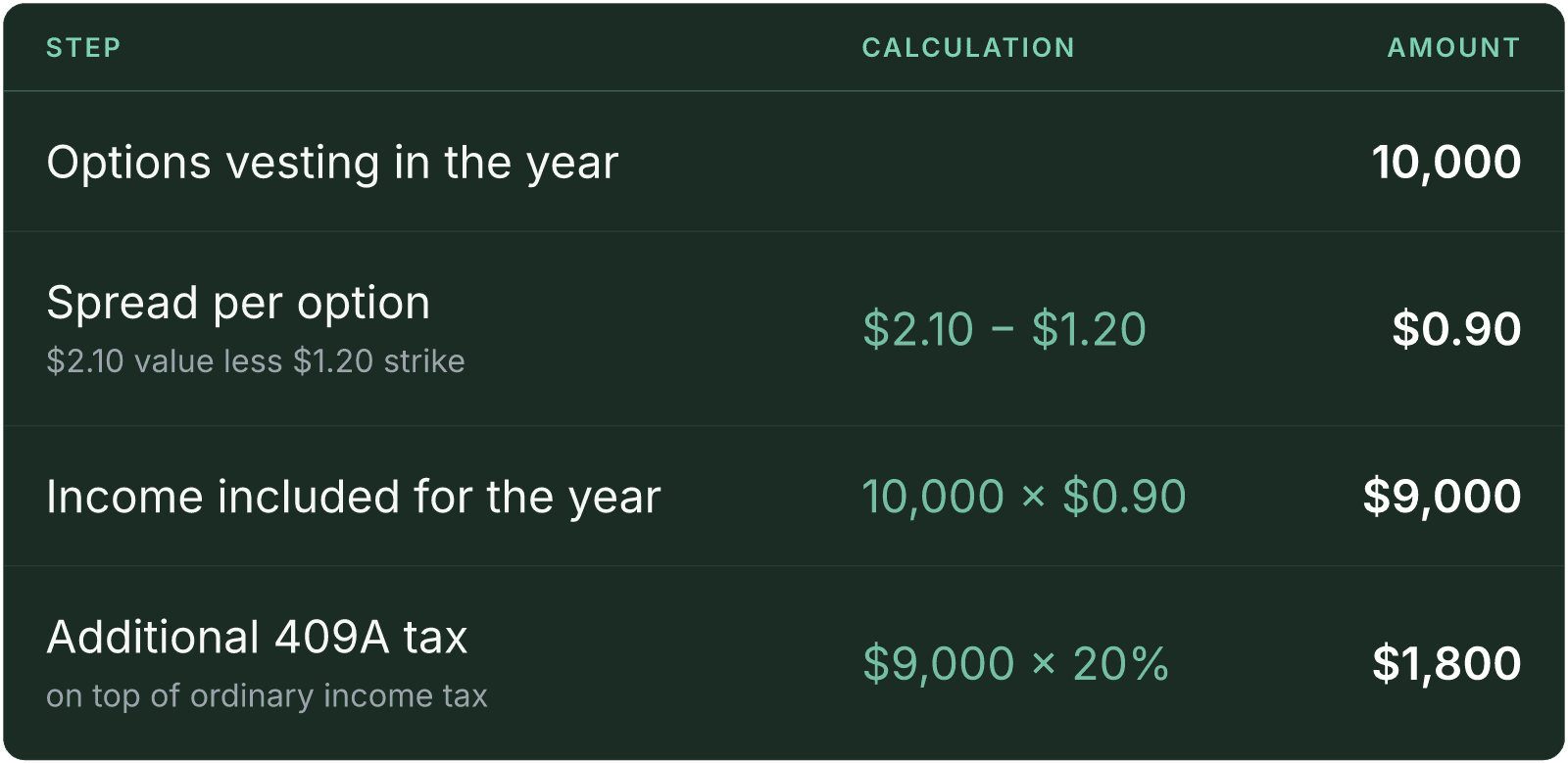
Here is a simplified example. A company outside the US grants 40,000 options to a US-based engineer at $1.20 a share. A later review shows the common stock was worth $2.10 on the grant date, so the option was granted at a discount. In the first year, 10,000 options vest and the stock is still worth $2.10 at year end.
[](https://www.409.ai/uploads/non_us_startup_us_employee_stock_options_409a_strike_price_table_1_073cb77bbe.png)
The $1,800 is on top of ordinary income tax on the $9,000 and any premium interest, and the same calculation repeats each year as more options vest and the spread moves. The engineer owes it in cash, on shares they may not be able to sell, because a private company's stock has no market. State taxes can add to the bill, and the figures above are an illustration, not tax advice.
The company's exposure is quieter but real. An engineer who receives a surprise tax bill tends to leave, and the other US-based staff compare notes. Whether the company has its own US reporting duties for the grant is a question for your US tax advisor.
The fix is cheaper before the grant
The IRS has published correction paths for mistakes caught early, and we walk through them in [our guide to correcting an incorrect 409A valuation](https://www.409.ai/articles/dealing-with-incorrect-409a-valuations) and [the deadline-based correction procedures](https://www.409.ai/articles/409a-valuation-deadline-correction-procedures). They work best when the option hasn't vested and the year hasn't closed. Getting the number right at grant is a good deal simpler.
A practical order for a non-US company with its first US-taxpayer grantee:
1. Establish who is a US taxpayer before the plan is approved. Ask each grantee. Nationality and residence both matter, and a hire's circumstances change. 2. Get a 409A appraisal before the board approves the grant, and date the grant after the report. The [board approval and grant date](https://www.409.ai/articles/option-grant-date-board-approval-409a-strike-price) guide explains why order matters. 3. Refresh it on its cycle or after a material event. A priced round, a large contract or an acquisition offer changes the value. See [how often to get a 409A valuation](https://www.409.ai/articles/409a-valuation-frequency-how-often-should-you-get-one). 4. Keep the local valuation too. Your home jurisdiction may require its own number, such as the HMRC valuation behind a UK EMI option. The two answer different questions and can differ. Our article on [UK EMI share options](https://www.409.ai/articles/emi-share-options-2026-uk-rules-hmrc-valuation) shows how that one works.
The same report covers every US-taxpayer grant in the period, so the cost per grantee falls as the team grows. A [409A valuation](https://www.409.ai/products/409a) from 409.AI starts at $899 and is built to the US standard whatever the company's home country.
What to do this week
List every current option holder and mark the ones who are US taxpayers. For each, find the grant date and the value used for the strike price. If the strike came from a funding round, a local valuation or a founder's estimate rather than a 409A appraisal, you have a gap, and it is cheapest to fix before the next vesting date. For the next hire, order the appraisal first and the offer letter second.