Financial Reporting
How to Value a Non-Compete in a Purchase Price Allocation
For the CFO or controller after an acquisition: how to value a seller's non-compete under ASC 805 with the with-and-without method, and what the auditor tests.
By 409.AI Team - 2026-11-21
# How to Value a Non-Compete in a Purchase Price Allocation
Your company just bought a founder-led business, and the two selling owners signed three-year non-competes at closing. The purchase agreement may even say $1 million of the price is "for" those covenants. Then the auditor asks how the non-compete in your ASC 805 allocation was measured, and the honest answer is that nobody measured it. The number in the contract is a negotiated figure, not a fair value.
This article is for the CFO or controller who owns the first purchase price allocation after a close, and for the valuation team building it. It explains when a non-compete has to be recognized at all, how the with-and-without method values it, why one input decides most of the answer, and what the file needs before the year-end audit.
When the non-compete gets its own line
A covenant not to compete is a contract, so it meets the contractual-legal criterion for an identifiable intangible asset, and ASC 805's illustrative list of marketing-related intangibles names noncompetition agreements alongside trademarks and domain names. Whatever its contract price, it's recognized at fair value on the acquisition date, and every dollar it takes comes out of goodwill.
Private companies have a way out. Under ASU 2014-18, a private company can elect not to recognize noncompetition agreements, or customer-related intangibles that can't be sold or licensed on their own, separately from goodwill. That election is made at the first deal in scope and then applies to the ones after it, which is why we argued it deserves a real decision in [the ASU 2014-18 election and your first add-on](https://www.409.ai/articles/asu-2014-18-private-company-election-first-add-on-goodwill-cost). Public companies can't use it. Neither can a private company that already chose not to, and many PE-backed platforms skip it because a future buyer or an IPO would want the full allocation anyway.
One scoping question comes before the valuation. If a seller stays on as an employee and the payment for the covenant depends on that employment continuing, part of what looks like deal consideration may be compensation for future service and fall outside the business combination. Read the employment agreement and the covenant together before you value anything.
The with-and-without method
A non-compete doesn't earn anything by itself. Its value is the cash flow it protects: what the business would lose if the sellers walked across the street and competed for the same customers. So the standard method compares two forecasts of the acquired business. One assumes the covenant holds. The other assumes it doesn't exist and the sellers compete. The difference, discounted, is the asset. PwC's fair value guide lists non-compete agreements among the assets typically measured this way, and notes that the tax amortization benefit belongs in the value ([PwC Viewpoint, FV 7.3.4](https://viewpoint.pwc.com/dt/us/en/pwc/accounting_guides/fair_value_measureme/fair_value_measureme__9_US/chapter_7_applicatio_US/73_business_combinat_US.html)).
The "without" forecast is where the work is. You have to say which customers would follow the sellers, how fast, and what the business would spend to fight back: price cuts, retention bonuses, new hires to replace the relationships. The losses usually peak early and fade, because a competitor needs time to build and the covenant's term caps how long the protection lasts anyway.
A worked example
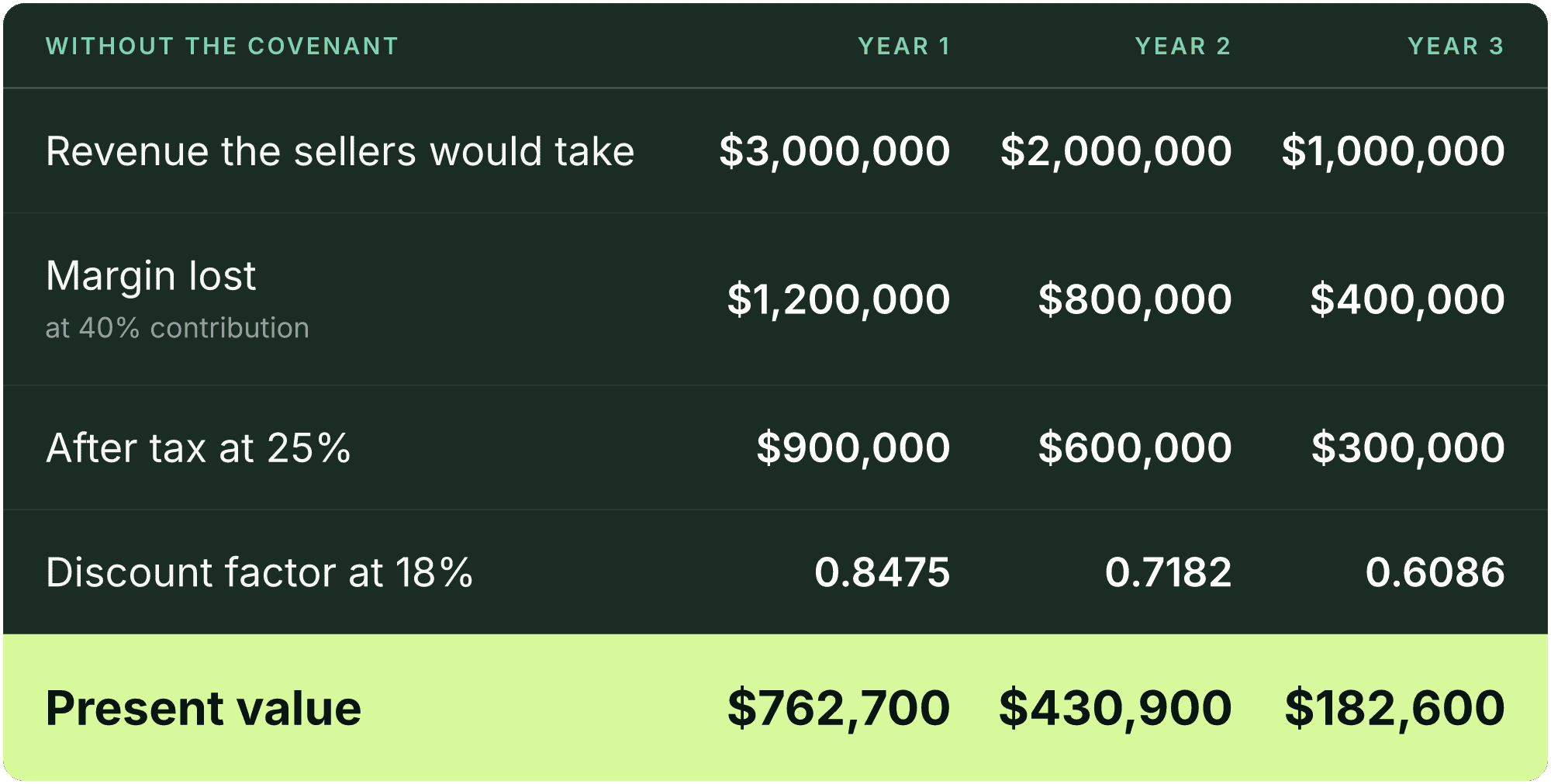
Take an illustrative services business bought for $25 million with $20 million of revenue. The two founders hold most of the key relationships. The team estimates that, competing without a covenant, the founders would take $3 million of revenue in the first year, $2 million in the second and $1 million in the third, after which the acquirer's own relationships would have caught up. Lost revenue carries a 40% contribution margin, higher than the business's average EBITDA margin, because the fixed costs stay when the customers leave.
The table below turns the lost margin into a present value at an 18% discount rate and a 25% tax rate.
[](https://www.409.ai/uploads/non_compete_agreement_valuation_purchase_price_allocation_with_and_without_method_asc_805_table_1_f85ddaa624.png)
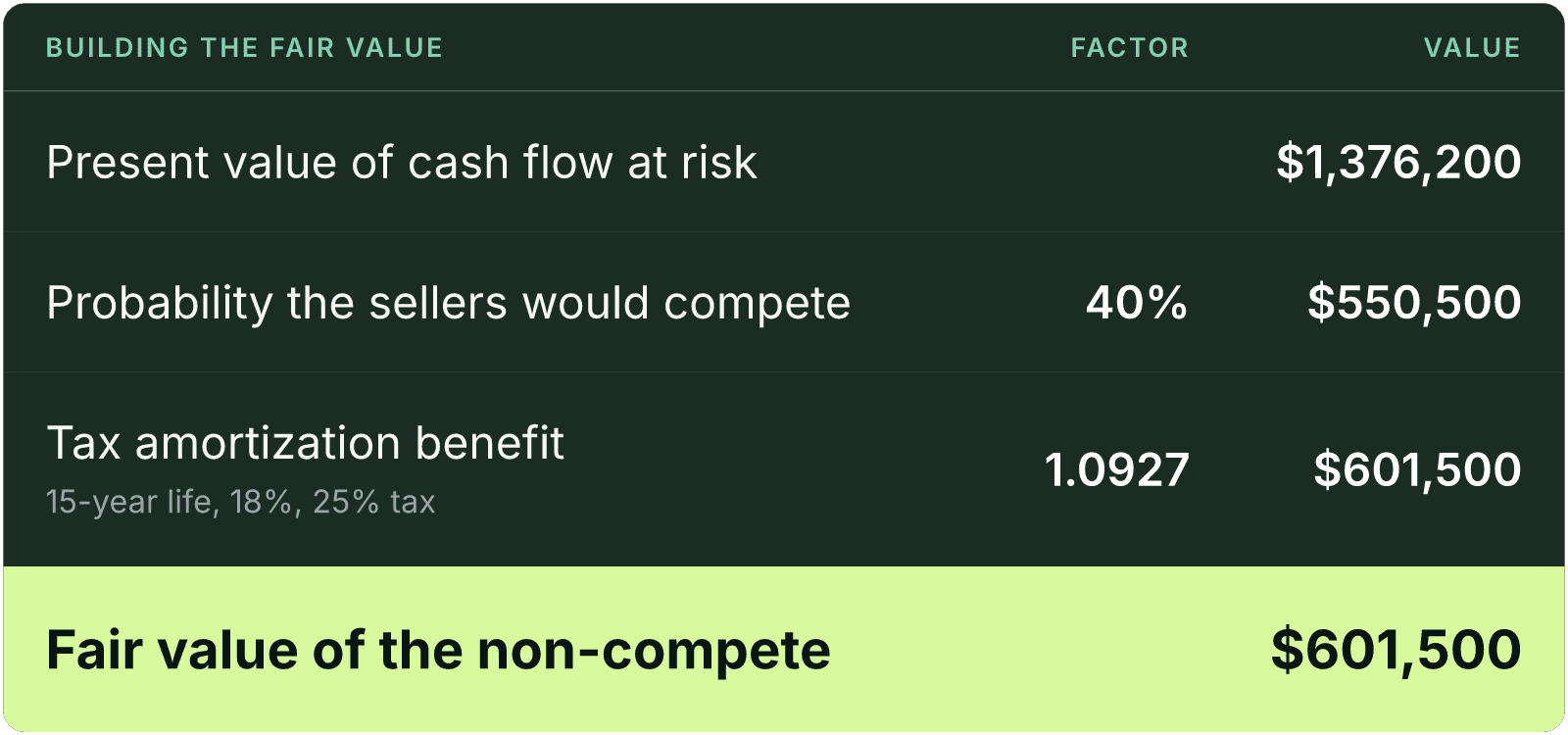
Those three years add up to $1.38 million of cash flow at risk. That is not yet the fair value, because it assumes the founders would certainly compete. They might not. The next table applies that probability and the tax amortization benefit.
[](https://www.409.ai/uploads/non_compete_agreement_valuation_purchase_price_allocation_with_and_without_method_asc_805_table_2_526e4883a3.png)
The non-compete comes in at about $600,000, not the $1 million in the purchase agreement, and goodwill absorbs the difference. The tax amortization factor reflects a market participant that buys the asset on its own and deducts it over 15 years, which is why most valuers include it even when your own deal was a stock purchase with no tax step-up.
Probability is the number the auditor pushes on
Change the 40% to 20% and the non-compete halves. Change it to 70% and it nearly doubles. No other input moves the answer that much, so it's the one that needs evidence, not a round number.
What makes a seller likely to compete? Age and health, and whether retirement is the plan. How much cash the deal put in their pocket, and whether they'd need outside money to start again. Whether they have the skills and the customer trust to win the business back, or whether the relationships really sat with the company. Whether they've competed before, and what their industry does.
Enforceability matters too, though less than people assume. The FTC's 2024 rule banning most worker non-competes never covered the sale of a business, and the FTC voted on September 5, 2025 to [dismiss its appeals and accede to the vacatur](https://www.ftc.gov/news-events/news/press-releases/2025/09/federal-trade-commission-files-accede-vacatur-non-compete-clause-rule) of the rule entirely. State law is the live question. California voids most non-competes, but [Business and Professions Code section 16601](https://leginfo.legislature.ca.gov/faces/codes_displaySection.xhtml?lawCode=BPC§ionNum=16601) lets an owner who sells the goodwill of a business, or all of their ownership interest, agree not to compete within a defined area. A covenant that's unusually broad in scope, territory or term can still be cut back by a court, so the file should say whose law governs and why the covenant is expected to hold.
Keep it consistent with the customer relationships
The non-compete and the customer relationships are valued from the same customers, and that's where allocations most often go wrong.
The multi-period excess earnings method for customer relationships uses an attrition rate, and that rate usually assumes the sellers are not out there taking clients. In other words, the customer relationship value already presumes the covenant holds. If the non-compete forecast then says the founders would take 15% of revenue in year one, the attrition curve and the "without" scenario need to describe the same customers. We walked through how attrition and contributory asset charges drive that asset in [valuing customer relationships with the MPEEM](https://www.409.ai/articles/customer-relationships-purchase-price-allocation-mpeem-contributory-asset-charges-attrition).
Two sanity checks help. A non-compete worth more than the customer relationships it protects is almost always wrong. And the implied return on each intangible should sit sensibly against the deal IRR and the WACC, which is the reconciliation in [our IRR, WACC and WARA walkthrough](https://www.409.ai/articles/purchase-price-allocation-reconcile-irr-wacc-wara-goodwill-return-asc-805). A non-compete is generally riskier than the business as a whole, so its rate rarely belongs below the WACC.
Book life, tax life and the deferred tax
For the books, the non-compete is amortized over the period it benefits, which is normally its contractual term. Our $601,500 covenant runs three years, so the acquirer expenses about $200,500 a year and it's gone by the end of year three.
Tax works differently. A covenant entered into in connection with the acquisition of a trade or business is a section 197 intangible under [26 U.S.C. 197(d)(1)(E)](https://www.law.cornell.edu/uscode/text/26/197), amortized ratably over 15 years, whatever its term. Section 197(f)(1)(B) adds that the covenant can't be treated as disposed of or worthless before the entire interest acquired with it is disposed of. So a three-year covenant in an asset deal keeps producing tax deductions for twelve years after it expires on the books.
That gap creates a temporary difference, and the deferred tax side of it feeds goodwill at the acquisition date. In a stock deal with no election there's no tax basis at all, which is the case we covered in [deferred taxes in a purchase price allocation](https://www.409.ai/articles/deferred-tax-liability-purchase-price-allocation-stock-deal-goodwill-asc-805). And if the deal is an asset purchase, the amount allocated to the covenant for tax shows up on Form 8594 under its own rules, so it won't necessarily match the book figure. [Our comparison of the two allocations](https://www.409.ai/articles/asc-805-vs-form-8594-two-purchase-price-allocations-one-asset-list) explains why one asset list should still feed both.
What goes in the file
An auditor testing a non-compete will want to trace each input to something outside the valuation model. Before fieldwork, the file should hold:
- the signed covenant, with its term, territory and scope, and the employment agreements of any seller who stayed;
- the analysis of whether any payment is compensation rather than consideration;
- the revenue the sellers could take, tied to a customer list showing who manages which accounts;
- the probability of competition, with the facts about each seller that support it;
- the governing law and why the covenant is expected to be enforceable;
- the reconciliation to the customer relationships' attrition and to the deal IRR and WACC.
That list is the same discipline that runs through [what auditors test in a purchase price allocation](https://www.409.ai/articles/purchase-price-allocation-cost-asc-805-what-auditors-test). If you want the whole allocation, non-compete included, built to survive that review, our [purchase price allocation service](https://www.409.ai/products/purchase-price-allocation) does exactly that.
The takeaway
Ignore the figure the lawyers wrote into the purchase agreement. The fair value of a non-compete is the cash flow the sellers could take, times the chance they'd actually try, plus the tax benefit a buyer of the asset would get. Get the probability right, tie the lost customers to the same list your customer relationship valuation uses, and the non-compete becomes one of the easier lines in the allocation to defend.