Equity
Net Exercise at a Private Company: Your 409A Price Sets the Share Count
Option holders and finance leads: see how a net exercise at a private company turns the 409A price into a share count, a payroll bill and an audit question.
By 409.AI Team - 2026-10-24
# Net Exercise at a Private Company: Your 409A Price Sets the Share Count
You have 10,000 vested options, a strike price of $2.00, and no spare $20,000 in your checking account. Your company offers a net exercise: instead of writing a check, you give up some of the shares you are buying. This article is for the option holder weighing that choice and for the founder or finance lead who has to run it.
The mechanics look simple. The 409A valuation sits underneath every number in them, and so does most of the risk.
What a net exercise does
In a net exercise, the company keeps back enough of the shares from your exercise to cover the exercise price. If it also withholds shares to cover payroll taxes, that is a separate step, often called net share settlement, and it follows the same logic. You pay nothing out of pocket. You end up with fewer shares than you exercised.
The company has to value the shares it keeps back. At a private company there is no market price, so the value is the fair market value of common stock on the exercise date, which is normally the most recent [409A valuation](https://www.409.ai/products/409a) or an update of it. A higher common stock value means fewer shares are needed to cover the same dollars. A lower one means more.
That is why the choice is a valuation question and not only a paperwork question. The same logic runs through [how the grant date price gets set](https://www.409.ai/articles/option-grant-date-board-approval-409a-strike-price), and the exercise date carries the same weight.
A worked example for nonstatutory options
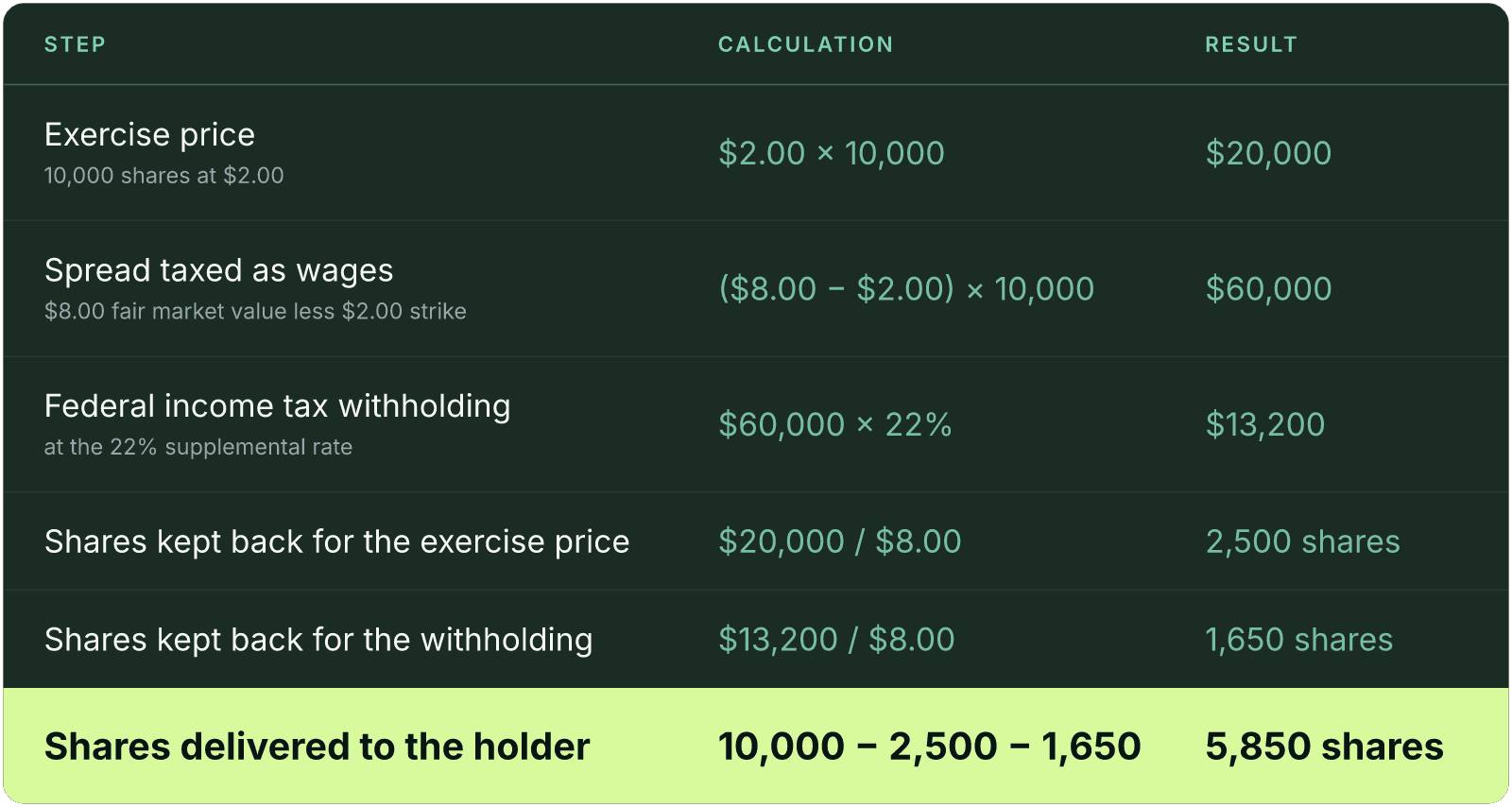
Take a nonstatutory option (NSO) on 10,000 shares with a $2.00 strike. The most recent 409A puts common stock at $8.00 a share on the exercise date. The example below uses federal income tax withholding at the 22% supplemental rate only. Social Security, Medicare and state withholding come on top and push the share count down further.
[](https://www.409.ai/uploads/net_exercise_private_company_options_409a_price_share_count_table_1_349db60e13.png)
The holder ends with 5,850 shares worth $46,800 at the $8.00 value, which is the $60,000 spread less the $13,200 of tax. No cash left the holder's account at exercise.
Now change one input. Suppose the company refreshes its 409A and common stock is worth $10.00 on the exercise date. The spread becomes $80,000, withholding becomes $17,600, and the shares kept back drop to 2,000 for the strike and 1,760 for tax. The holder receives 6,240 shares, each worth more. The share count moves while the holder's after-tax value simply tracks the new price, so the paperwork changes with the valuation, and a stale value makes it wrong.
The company still pays the tax in cash
Net exercise keeps cash out of the holder's pocket. It does not keep cash out of the company's. Withholding on an NSO exercise is a payroll obligation, and the employer must collect the tax and pay it over in money even when the wages are paid in something other than money. The regulation says so in plain words: the tax is withheld "notwithstanding the wages are paid in something other than money," and the employer pays it over in money ([Treas. Reg. 31.3402(a)-1](https://www.law.cornell.edu/cfr/text/26/31.3402(a)-1)).
In the example, the company wires $13,200 to the Treasury and keeps 1,650 shares. A startup that runs a net exercise for twenty employees in one quarter is funding the payroll deposits out of its own cash, and the shares it keeps back brought no cash with them. A finance lead should model that outflow before the plan permits net exercise, not after the first request lands.
The withholding rate also matters on the other side. The IRS default for supplemental wages is 22% up to $1 million in a year and a higher rate above that ([IRS Publication 15](https://www.irs.gov/publications/p15)). An executive with a large spread can cross the threshold in a single exercise, so the flat rate in a spreadsheet will not always match the bill.
Why a stale 409A turns into a payroll problem
Everything above assumes the value on the exercise date is the right one. If a priced round closed last month and the 409A still shows last year's price, the company under-withholds. The employer is liable for the tax it was required to withhold ([IRC section 3403](https://www.law.cornell.edu/uscode/text/26/3403)), and the error lands on the company, not the employee.
The exercise date value is the same one that decides [what an NSO exercise costs at a private company](https://www.409.ai/articles/nso-exercise-private-company-withholding-exercise-date-value). Before opening any exercise window, check three things:
- The 409A is current for the stage. A [material event such as a new round or an offer to buy the company](https://www.409.ai/articles/409a-valuation-frequency-how-often-should-you-get-one) can make it stale before its twelve months are up.
- The board approved the value being used on the exercise date, in writing.
- The payroll provider has the same number, so the withholding and the share count agree.
Incentive stock options need more care
ISOs behave differently, and net exercise is where companies get into trouble. An ISO exercise generally creates no regular income, although it can trigger the alternative minimum tax ([IRS Topic 427](https://www.irs.gov/taxtopics/tc427)). If you want the numbers, our walkthrough on [ISO exercise and AMT](https://www.409.ai/articles/iso-exercise-amt-2026-lower-phaseout-threshold) covers them.
The trouble is the word "modification." Under Treasury Regulation 1.424-1(e), a change that gives the option holder an additional benefit is a modification, and the regulation's own example includes more favorable terms for paying the exercise price, such as a right to tender previously owned stock ([Treas. Reg. 1.424-1](https://www.law.cornell.edu/cfr/text/26/1.424-1)). An ISO that is modified is treated as a new grant, and the old holding periods and rules do not carry over. Practitioners writing for company counsel also note that cashless exercise tied to an immediate liquidity program is generally viewed as an ISO modification that turns the participating portion into an NSO just before exercise ([Cooley](https://www.cooleygo.com/incentive-stock-option-modifications-key-considerations-and-traps-for-the-unwary/)).
Because of that, plans and amendments that allow net exercise often limit it to the NSO portion and say so in the text. That is a legal call for the company's counsel. The valuation point for everyone else: the 409A fair market value at grant was what decided how much of a grant counted against the [$100,000 ISO limit](https://www.409.ai/articles/iso-100k-limit-409a-grant-date-fair-market-value), and a net exercise is not a way to clean that up afterward.
What the auditor will ask
A company with audited statements will be asked how the net exercise is accounted for. Under ASU 2016-09, a company can withhold shares to cover taxes up to the maximum statutory rate in the employee's jurisdictions and keep the award classified as equity. The relief does not reach awards where withholding is not statutorily required, ISOs among them, and most plans written before the update only allowed the minimum, so the plan document may need an amendment first ([Withum on the ASU 2016-09 change](https://www.withum.com/resources/easier-ways-account-share-based-payments)).
Two practical points follow. The shares kept back are valued at the same exercise date number that the tax calculation uses, so the file should show one value, one source, one date. And an exercise that withholds more than the statutory maximum is a separate conversation with the auditor, so keep the withholding rate in the plan within the limit unless the finance team has decided otherwise on purpose. Our [ASC 718 checklist for the current price](https://www.409.ai/articles/asu-2021-07-409a-asc-718-current-price-checklist) shows where else the same value turns up in the audit file.
What to do before the next exercise window
If you are the option holder, ask three questions before you elect a net exercise. Is the option an NSO or an ISO? What common stock value will be used, and when was it set? How many shares will actually reach you, after both the strike and the tax? The table above is the template: ask for the same five lines from your company.
If you run the plan, put the answer in writing before you need it. Decide whether net exercise is allowed, for which options, at what withholding rate, and who confirms the exercise date value. Then make sure the 409A behind that value was current on the day the window opened. Most of the risk in a net exercise sits in an old valuation. A fresh one, tied to the exercise date, removes it.