Financial Reporting
NAV Facilities and Year-End Marks: When a Level 3 Mark Becomes a Covenant Input
For the CFO of a fund with a NAV facility: how a December 31 Level 3 write-down raises loan-to-value, what it can trigger, and what the policy and LPs need.
By 409.AI Team - 2026-11-14
# NAV Facilities and Year-End Marks: When a Level 3 Mark Becomes a Covenant Input
If you are the CFO of a private equity or later-stage venture fund that is past its investment period and has drawn on a NAV facility, your December 31 Level 3 marks do two jobs this year. They go into the financial statements your auditor tests. They also go into the loan-to-value certificate your lender reads. A write-down that is right for the first job can break a covenant in the second, and nothing about the loan has to change for that to happen.
This article walks through the mechanism, works the numbers on an illustrative fund, and sets out what the valuation policy and the LP report should say before the year-end file is closed.
What a NAV facility borrows against
A subscription line is backed by the LPs' undrawn commitments. A NAV facility is backed by the portfolio itself. The Institutional Limited Partners Association put it plainly in its [2024 guidance on NAV-based facilities](https://ilpa.org/wp-content/uploads/2024/07/ILPA-Guidance-on-NAV-Facilities-2024.pdf): "The borrowing base (i.e., the total size of the facility) is calculated by the net asset value of fund interests/portfolio companies."
The same guidance explains what happens when the ratio slips. If the facility exceeds the agreed loan-to-value (LTV) ratio, the terms "may require the borrower to repay the loan whole or in part to return to the prescribed LTV limit," or the facility "may sweep cash generated from the underlying assets to bring the LTV ratio back into compliance."
ILPA also notes when these facilities tend to appear: after the fund's commitments are largely drawn, after the investment period, or early in the harvest period. That is the fund with the least room to absorb a forced repayment. The reserves are mostly spent, and the next cash usually comes from an exit.
So the denominator of the covenant is your NAV, and your NAV is mostly your Level 3 marks. Every mark you move at year-end moves the ratio.
The arithmetic of a write-down
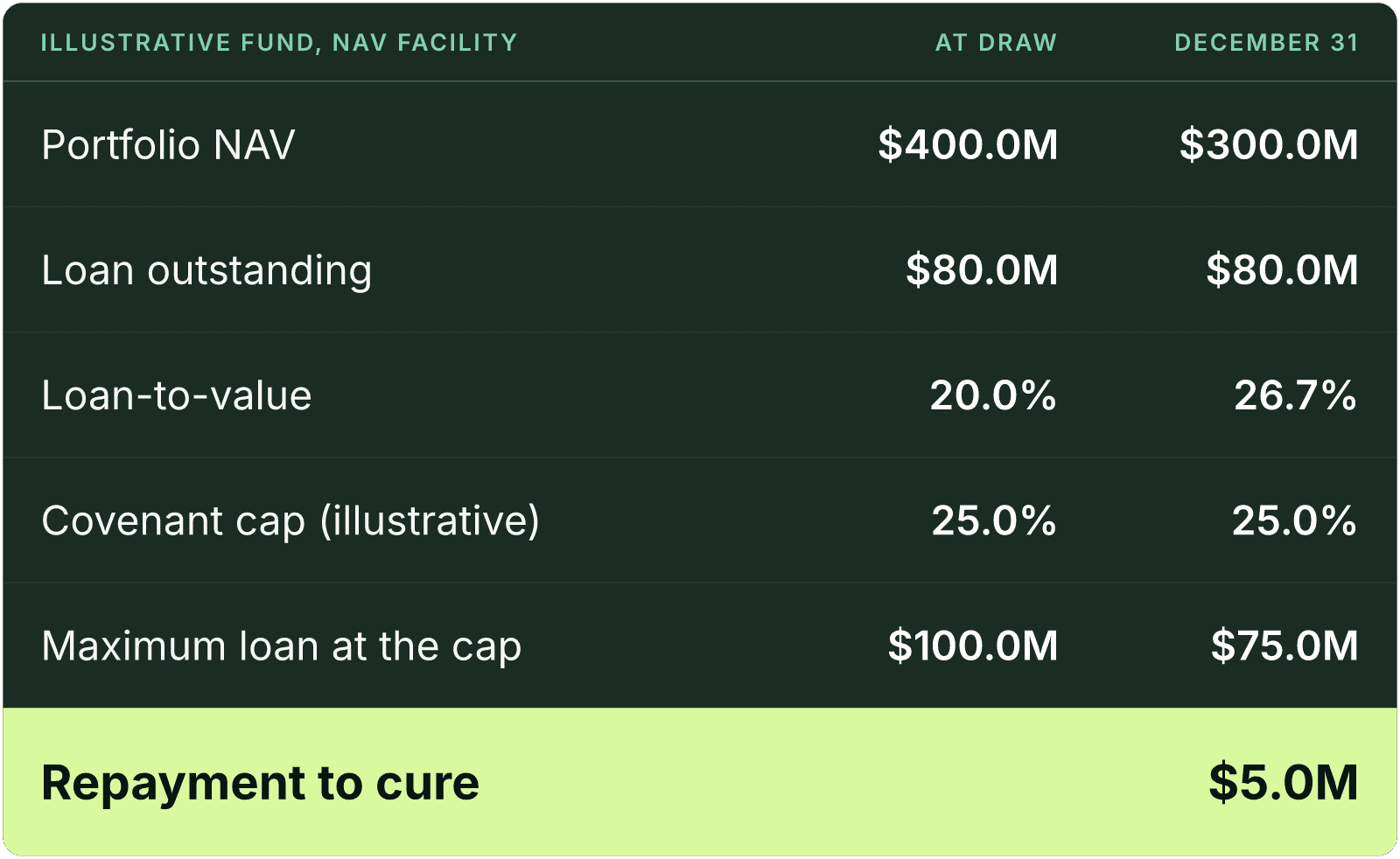
Take an illustrative fund. Its portfolio NAV was $400 million when it drew $80 million on a NAV facility, an initial LTV of 20%. Assume, for illustration only, that the credit agreement caps LTV at 25%. ILPA sets no LTV limit, and real facilities define both the cap and the borrowing base in their own terms.
At December 31, two portfolio companies have missed plan and a third has raised a down round. The valuation team's work supports marking the portfolio down 25%.
[](https://www.409.ai/uploads/nav_facility_year_end_level_3_marks_ltv_covenant_asc_820_fund_table_1_5dc28bc0ef.png)
Nothing in the loan changed. The fund borrowed no new money, and the rate and term stayed where they were. The $5 million shortfall exists only because the marks went down, and it has to be met from somewhere: cash on hand, a sweep of the next exit proceeds, a capital call if undrawn commitments remain, or, where distributions were funded by the facility, a recall.
That last point matters to LPs more than any other. ILPA's guidance notes that distributions from a NAV facility are often recallable, and that if the facility "falls out of compliance with the required LTV ratio, GPs can recall the distributed capital to pay down the facility." An LP who received an early distribution in 2025 may be asked to send some of it back because of a mark taken in December 2026.
The other direction is no comfort. A mark held up to protect headroom pushes the problem into the next year, when an exit price arrives below the carried value and the back-test makes the gap visible. We covered that test in [back-testing fund marks against exit prices](https://www.409.ai/articles/back-testing-fund-marks-exit-prices-asc-820-disposition-analysis).
The conflict your valuation policy has to name
Under ASC 820, fair value is an exit price: what a market participant would pay for the position in an orderly transaction at the measurement date. It is a market-based measurement, not an entity-specific one. The fund's financing is not an input. A market participant buying a portfolio company's preferred stock does not care how much headroom the seller has under its credit agreement.
The people who set the marks, though, usually do care. The same GP that recommends the year-end values signs the LTV certificate, and a breach has real costs: a forced repayment, a cash sweep that delays distributions, an unhappy LPAC, and questions in the next fundraise. That is a conflict of interest in the plain sense, and it sits alongside the ones most policies already name, such as NAV-based management fees and carried interest. (The fee conflict, and what enforcement cases show about it, is in [when your marks set your fees](https://www.409.ai/articles/fund-marks-set-fees-nav-based-fees-valuation-enforcement-policy). The carry mechanics are in [carried interest accrual at quarter-end](https://www.409.ai/articles/carried-interest-accrual-hypothetical-liquidation-fund-marks).)
The SEC's Division of Examinations is looking at exactly this ground. Its [fiscal year 2027 examination priorities](https://www.sec.gov/files/2027-exam-priorities.pdf), published in October 2026, say that for advisers to private funds, reviews will assess whether compliance policies address fund-level and investment-level risks, and list as examples "disclosures related to certain investments and allocations, use of debt and fund-level lines of credit." The same document names valuation among the core areas of a compliance programme it reviews, and says examinations will focus on whether conflict-of-interest policies are actually implemented. A NAV facility is fund-level debt, and its covenant runs on the valuation.
A policy that handles this well does four things.
1. It names the facility as a conflict. One sentence is enough: the fund has a NAV-based facility whose LTV covenant uses the fund's NAV, and covenant headroom is not a consideration in any fair value conclusion. 2. It separates the roles. The people who monitor the covenant and talk to the lender are not the people who approve the marks, or at least they are not the only ones. A valuation committee with a member outside the deal team, or an independent valuation of the largest positions, puts distance between the two. 3. It fixes the order of work. The marks are concluded first, documented and approved. The LTV calculation is run on the approved marks afterwards. A draft certificate that circulates before the marks are final invites the wrong conversation. 4. It records the result either way. If the approved marks breach the covenant, the file shows the marks were set on market evidence and the breach was handled under the credit agreement. If they leave the fund just inside the limit, the file shows the same, so nobody can later argue the marks were tuned to the threshold.
Our earlier piece on [what an auditor and the SEC read in a valuation policy](https://www.409.ai/articles/fund-valuation-policy-asc-820-audit-sec-exam) covers the rest of the document.
Timing: the certificate, the audit and late information
The LTV certificate and the audited financial statements rarely land on the same date. The credit agreement sets its own date for the NAV report or the LTV certificate, while a private fund's audit can run to the 120-day deadline under the custody rule (the timeline is in [the 120-day audit deadline and year-end marks](https://www.409.ai/articles/custody-rule-120-day-audit-deadline-fund-year-end-marks)). Read the reporting and cure provisions of your own agreement for the exact days.
Two things follow. First, a mark the auditor challenges in March may differ from the mark the lender saw in February. Decide now how the fund will tell the lender if an audit adjustment moves the ratio, and read what the credit agreement requires when a reported NAV is restated. Second, information that arrives after December 31 still has to be sorted under ASC 855: does it confirm a condition that existed at year-end, or reflect something new? A January financing at a lower price can be either. The test is set out in [a January round and a December 31 mark](https://www.409.ai/articles/january-round-december-31-mark-asc-855-subsequent-events-fund).
A practical step for the next six weeks: run the LTV calculation on a range of marks, not a point. If the plausible low end of the range breaches the covenant, the fund knows before the valuation committee meets that the conversation with the lender may be needed, and the committee can set the marks without that question in the room.
What LPs should see in the year-end report
ILPA's guidance asks GPs to give all LPs a standard set of disclosures once a NAV facility is in place. Among them:
- the rationale for the facility and the use of proceeds;
- the overall size of the facility and the amount borrowed to date;
- the LTV ratio at the initial date of borrowing;
- the interest rate, whether it is fixed or floating, and whether interest is paid in cash or in kind;
- the financial covenants, including cash sweeps, mandatory repayments and the LTV ratio;
- any consents required, and confirmation that they were obtained.
ILPA also recommends LPAC consent before a facility is put in place when the LPA does not explicitly permit one, and LPAC approval whenever proceeds will fund a distribution. Among the qualitative factors it asks LPs to weigh are "appropriate valuation processes and finance function oversight of compliance with facility covenants."
These recommendations are guidance, not law, and the fund's own LPA and side letters decide what is owed to whom. They are, however, what a sophisticated LP will ask for, and they sit naturally beside the performance figures in the year-end report. If the fund is also moving to ILPA's 2026 reporting templates, the facility's effect on NAV and on the IRR figures belongs in the same pack (see [ILPA's 2026 templates and your year-end marks](https://www.409.ai/articles/ilpa-2026-templates-year-end-marks-four-irrs-one-nav-fund-lp-report)).
A short explanation of how the facility's covenant interacts with the year-end marks, written in plain language, saves the LPAC from discovering it later in a recall notice.
The year-end file, in one place
For a fund with a NAV facility, the December 31 valuation file should let a reader answer three questions without asking anyone:
- How was each Level 3 mark set, and what market evidence supports it?
- Who approved the marks, and were the people who manage the facility kept out of that decision?
- What LTV did the approved marks produce, and what did the fund do with that result?
If the first answer is solid, the other two are mostly paperwork. If it is thin, the covenant turns a valuation question into a credit event. For positions where the evidence is hard to read, such as a company running short of cash, the approach in [how a fund marks a distressed portfolio company](https://www.409.ai/articles/fund-mark-distressed-portfolio-company-asc-820-scenarios-lender-first) applies here too.
An independent view of the largest marks is one of the simplest ways to show the lender, the auditor and the LPAC that headroom played no part in them. 409.AI prepares [ASC 820 portfolio valuations](https://www.409.ai/products/asc-820) for funds, scoped and quoted per portfolio.
The order is what to take away. Set the marks on market evidence, then run the covenant. If the covenant breaks, the marks were still right, and the fund deals with the breach under the credit agreement. Changing the marks to avoid the breach is not an option.