Equity
Unit Options at an LLC: Why Section 409A Still Asks for a Fair Market Value Strike
LLC founders granting unit options: Notice 2005-1 lets 409A treat them like stock options, so the strike must meet unit fair market value on the grant date.
By 409.AI Team - 2026-11-13
# Unit Options at an LLC: Why Section 409A Still Asks for a Fair Market Value Strike
If you run a startup organized as an LLC taxed as a partnership, you've probably heard that your company "doesn't need a 409A." For profits interests, the usual tool, that shorthand mostly holds. For unit options it doesn't. The moment you promise a first hire the right to buy membership units at a fixed price, you're writing a grant that the IRS lets you treat like a stock option under Section 409A. And a stock option only stays outside 409A when its exercise price is never below fair market value on the grant date.
This post is for the founder or finance lead of an LLC-taxed startup choosing what to grant its first employees, and for the attorney drafting the plan. It covers what the IRS actually said about partnership equity, how a unit option differs from a profits interest and from phantom units, and what the grant-date valuation has to show for each.
What the IRS said, and why it's still "interim"
Section 409A was written around corporations. Its final regulations define "service recipient stock" as common stock of a corporation, and the paragraph that was supposed to cover partnerships, [§1.409A-1(b)(7)](https://www.law.cornell.edu/cfr/text/26/1.409A-1), still reads "Arrangements between partnerships and partners. [Reserved]."
So the operative guidance is older. In [Notice 2005-1](https://www.irs.gov/pub/irs-drop/n-05-01.pdf), Q&A-7, the IRS said that 409A is not limited to employers and employees and can apply to deferred compensation between a partnership and a partner. Then it gave taxpayers a working rule: "until additional guidance is issued," they may treat "the issuance of a partnership interest (including a profits interest), or an option to purchase a partnership interest, granted in connection with the performance of services under the same principles that govern the issuance of stock."
Three consequences follow from that sentence and the ones after it:
- A profits interest that is properly not taxed at grant may also be treated as not deferring compensation for 409A purposes.
- A capital interest issued for services may be treated like an issuance of stock.
- The 409A rules for other stock-based compensation "may be applied by analogy" to equity compensation measured by partnership equity.
Notice that the word is "may." More than twenty years later the further guidance has not arrived, and the reserved paragraph is still empty. Your plan rests on an interim position the IRS has never withdrawn, which is a reason to follow it carefully rather than a reason to ignore it.
The stock option rule, applied to a unit
Under the same notice (Q&A-4) and the final regulations, a nonstatutory stock option is not deferred compensation if three conditions hold: the exercise price can never be less than the fair market value of the underlying stock on the grant date, the option is taxed under Section 83, and it carries no other deferral feature.
Read that through Q&A-7 and a unit option at an LLC sits outside 409A only if its strike is at least the fair market value of the units on the day of grant. Set it lower and the option can become deferred compensation that fails 409A. The cost lands on the employee: under [26 U.S.C. §409A(a)(1)](https://www.law.cornell.edu/uscode/text/26/409A), deferred amounts become taxable once vested, with an additional 20% tax and interest at the underpayment rate plus one point.
Two more differences from a C-corp are worth knowing before you choose:
- **No ISOs.** [Section 422](https://www.law.cornell.edu/uscode/text/26/422) incentive stock options are options to buy stock of a corporation. An LLC taxed as a partnership can only grant the nonstatutory kind, so the spread at exercise is ordinary income.
- **Exercise makes the employee a partner.** Under Rev. Rul. 69-184, a bona fide partner is not an employee of the partnership for payroll purposes. Once a hire exercises, their W-2 and withholding usually give way to a K-1 and estimated taxes, which surprises people who expected a paycheck to look the same.
Three grants, three different grant-date numbers
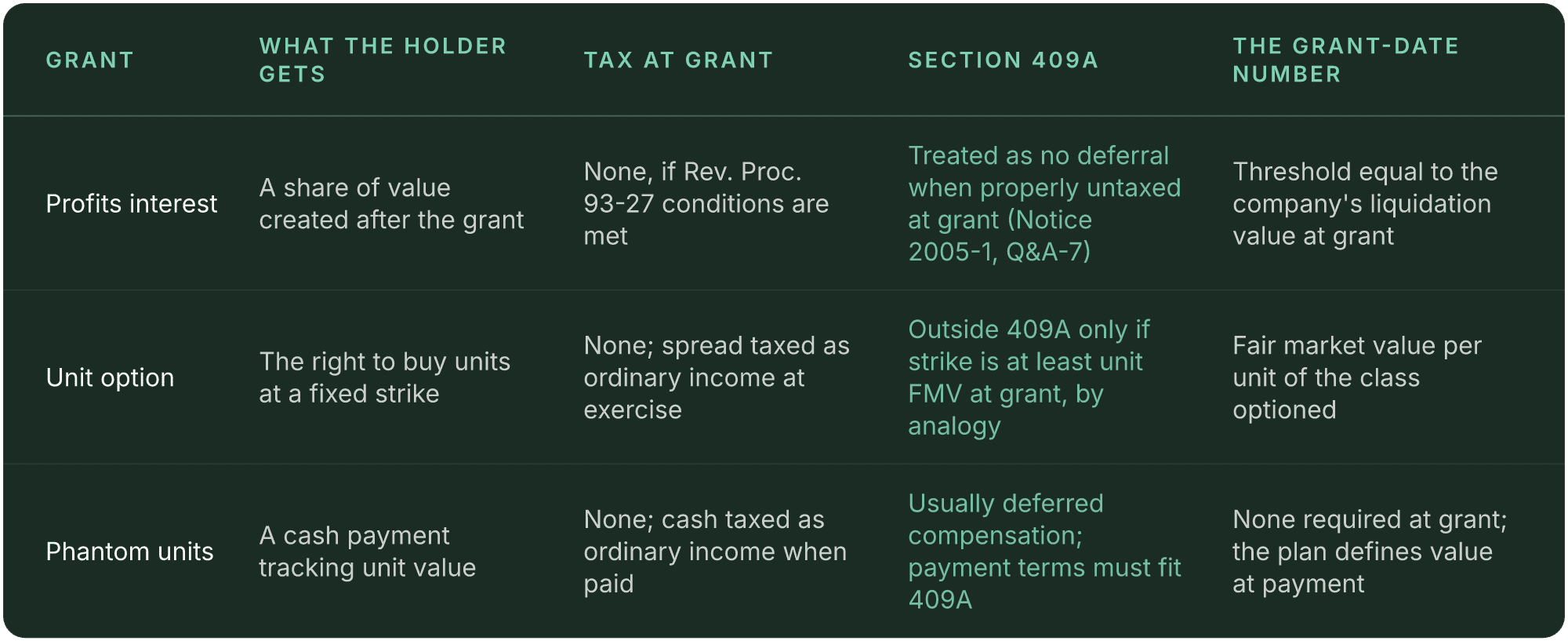
Most LLCs end up choosing among profits interests, unit options and phantom units. Here's how they compare on what the holder gets and what the grant-date valuation has to establish.
[](https://www.409.ai/uploads/llc_unit_options_409a_fair_market_value_strike_profits_interests_table_1_4bab03f7a9.png)
The table hides the point that matters most: the profits interest and the unit option need different numbers.
A profits interest's threshold is set at the value the existing members would receive if the company sold its assets at fair market value and liquidated on the grant date. That's a whole-company figure. Our [guide to profits interests and the hurdle valuation](https://www.409.ai/articles/profits-interests-llc-equity-hurdle-valuation) walks through how a threshold set too low turns part of the grant into a taxable capital interest.
A unit option's strike is a per-unit figure for the specific class of units under option. It answers a narrower question: what would a willing buyer pay for one of these units, held as a minority, illiquid interest, on this date?
Worked example: the strike on a common unit
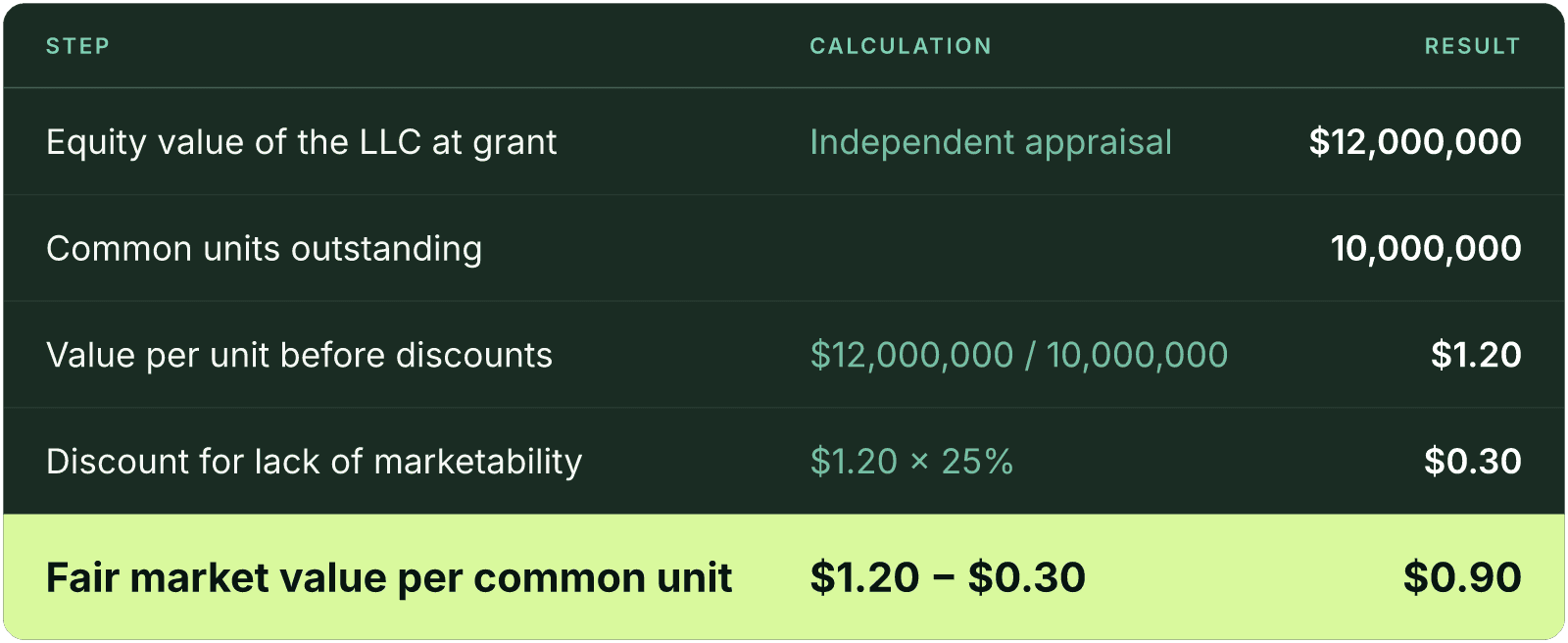
Take an LLC with 10,000,000 common units and no preferred units. An independent appraisal values its equity at $12,000,000 on the grant date. The company wants to grant its first engineer options on 200,000 common units.
[](https://www.409.ai/uploads/llc_unit_options_409a_fair_market_value_strike_profits_interests_table_2_48af94cdf3.png)
The minimum strike is $0.90 a unit. A strike of $0.50 because "it's an LLC and nobody checks" puts $0.40 a unit, or $80,000 across the grant, below fair market value, and that is the discount that can pull the option into 409A.
Compare the profits interest on the same day. Its threshold would sit at the $12,000,000 liquidation value, with no per-unit marketability discount, because it measures what the existing members would take out of a liquidation, not what a buyer would pay for one unit. The 25% discount here is illustrative; the right figure depends on the company's facts and how long it expects to stay private, which our article on the [discount for lack of marketability](https://www.409.ai/articles/discount-lack-marketability-dlom-409a-valuation) explains.
Real operating agreements are rarely this tidy. Preferred units with a liquidation preference, earlier profits interests with their own thresholds, and capital accounts all sit ahead of or beside the common units. When they do, the appraisal allocates equity value through the distribution waterfall, the same way a 409A for a C-corp allocates value between preferred and common stock.
Can an LLC rely on the 409A safe harbor?
For a corporation, the final regulations presume a valuation reasonable when it is an independent appraisal dated within 12 months of the grant, among other routes. That presumption shifts the burden to the IRS to show the value was grossly unreasonable. Our post on [what actually earns the 409A safe harbor](https://www.409.ai/articles/409a-safe-harbor-price-vs-qualified-appraiser) covers the conditions.
Those presumptions are written for stock of a corporation. For an LLC, you're applying them by analogy, as Q&A-7 permits. In practice that means doing everything the regulation would ask of a corporation: an independent appraiser, a date within 12 months of the grant, a fresh value after a material event such as a priced round, and a method that considers the company's assets, its expected cash flows, comparable companies and recent arm's length transactions in its units. You won't get a stronger position than the analogy gives you, but you won't get a weaker one either.
Where LLC equity plans go wrong
Copying a C-corp option plan. A template that refers to "shares," "ISOs" and the "Board" leaves the LLC with options on something it hasn't issued. The plan should name the class of units, the operating agreement provisions that apply on exercise, and the admission of the holder as a member.
Reusing the profits interest threshold as the strike. The two figures answer different questions. Setting the strike at $1.20, the undiscounted per-unit share of the threshold, only prices the option higher than it needs to be. Doing the reverse, and setting a threshold from a discounted per-unit value, can hand out part of a capital interest.
Letting the valuation go stale. The 12-month window and the material-event rule apply by analogy too. A unit option granted 14 months after the last appraisal, or two weeks after a priced round, has the same problem a stale 409A creates.
Forgetting the accounting. An LLC that issues financial statements under US GAAP accounts for unit options under ASC 718, and [ASU 2024-01](https://www.409.ai/articles/asu-2024-01-profits-interests-asc-718-private-companies) clarified when profits interests fall there too. The grant-date valuation that sets the strike usually feeds that measurement.
If you're weighing a conversion to a C-corp before a priced round, the conversion date brings its own valuation, discussed in our post on [LLC to C-corp conversions and QSBS](https://www.409.ai/articles/llc-to-c-corp-conversion-qsbs-valuation-section-1202). If a grant has already gone out below value, the IRS correction program for discounted stock rights, [Notice 2008-113](https://www.409.ai/articles/discounted-stock-option-correction-notice-2008-113), is built for corporate stock; how it extends to a unit option is a question for your tax counsel before year-end.
The takeaway
A profits interest needs a whole-company threshold. A unit option needs a per-unit fair market value for the class under option. Phantom units need payment terms that fit 409A. Pick the instrument first, then order the valuation that matches it, dated before the board or managers approve the grant.
409.AI prepares independent, expert-reviewed [409A valuations](https://www.409.ai/products/409a), with a 24-hour draft and a signed report in five business days.