Tax
Selling ISO Shares Early: How a Disqualifying Disposition Is Taxed
Holding ISOs in a private company and weighing a tender offer? See how a disqualifying disposition splits your gain into wages and capital gain, with an example
By 409.AI Team - 2026-10-14
# Selling ISO Shares Early: How a Disqualifying Disposition Is Taxed
If you hold incentive stock options in a private company, a tender offer or a secondary sale can arrive before the clock on your ISOs has run out. The offer is real money, the deadline is short, and the tax result depends on a date most option holders never wrote down. Sell too soon and the sale is a disqualifying disposition. That is not a penalty, and it is not always bad. It just changes which part of your gain is taxed as wages.
This guide is for employees, early hires and founders who hold ISOs and are weighing a sale of exercised shares. It walks through the rule, the arithmetic with a worked example, the case where the sale price is below the exercise-date value, and the reporting that trips people up.
The two dates that decide the outcome
An ISO gets its favorable treatment only if you hold the shares long enough. According to IRS Publication 525, you meet the holding requirement only if you don't sell until the later of one year after the stock was transferred to you or two years after the option was granted.
Two clocks, then, and the later one wins:
- One year from the exercise date.
- Two years from the grant date.
If you exercised in the same month you were granted, the two-year clock decides. If you were granted options three years ago and exercised last spring, the one-year clock decides. A sale before both have passed is a disqualifying disposition.
The usual setting is a company-run tender. A startup arranges for investors to buy shares from employees at a recent preferred-round price, and employees who exercised a few months earlier are eligible. We cover how those programs interact with the common stock price in [our guide to tender offers and secondary sales](https://www.409.ai/articles/tender-offers-secondary-sales-409a-valuation). The tax timing is a separate question, and the one this article answers.
How the gain is split
On a disqualifying disposition, the IRS splits your gain into two layers. Per Publication 525, if you have a gain, it is ordinary income up to the amount by which the stock's fair market value at exercise exceeded the option price. Any gain beyond that is capital gain.
Put plainly:
- **Ordinary income** is the spread at exercise: fair market value on the exercise date minus your strike price, times the shares.
- **Capital gain** is whatever you received above the exercise-date value. It is short-term if you held the shares one year or less and long-term if you held them longer.
The exercise-date fair market value of a private company's common stock is normally the current 409A value. That is why the 409A matters to your tax bill even though it never appears on the sale paperwork. In a disqualifying sale the whole exercise-date spread becomes ordinary income, so that value sets the wage portion. For the relationship between the two figures, see [409A valuation versus fair market value](https://www.409.ai/articles/409a-valuation-vs-fair-market-value).
A worked example
Say you hold ISOs on 5,000 shares with a $2.00 strike. You exercise when the 409A common value is $10.00, which is a spread of $8.00 a share, or $40,000. Your company then offers to buy your shares in a tender at $15.00. Compare three outcomes.
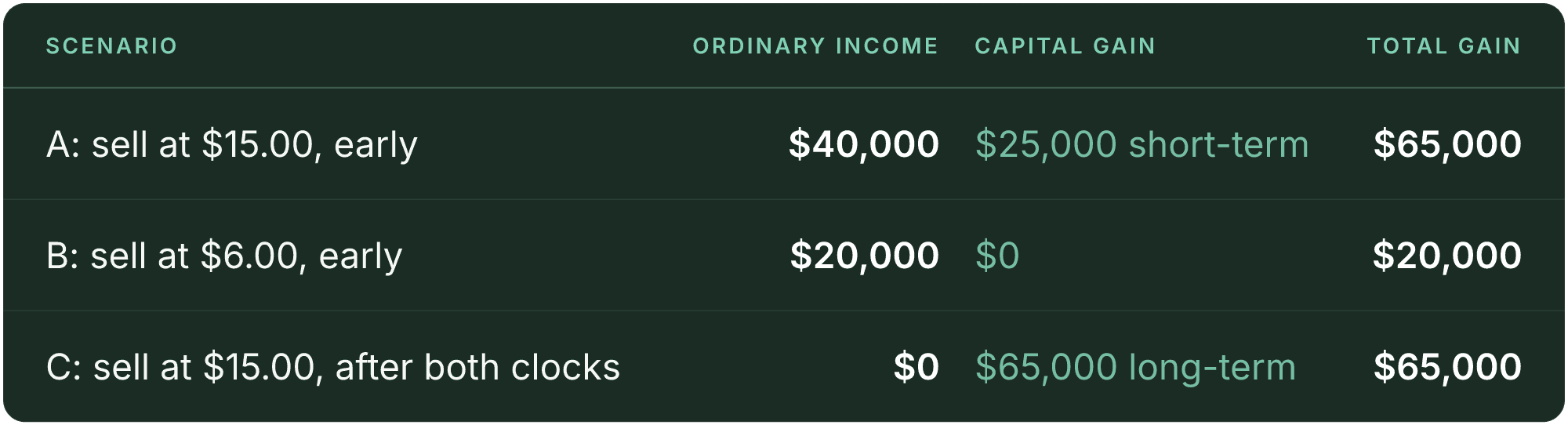
The table below shows each result. Scenario A is a sale at $15.00 within a year of exercise. Scenario B is a sale at $6.00, below the exercise-date value, also within the year. Scenario C is a sale at $15.00 after both holding periods have passed.
[](https://www.409.ai/uploads/iso_disqualifying_disposition_sell_early_ordinary_income_basis_table_1_b84614f5d5.png)
In Scenario A the total gain is the same $65,000 as in Scenario C, because (15 - 2) x 5,000 = $65,000 either way. What changes is the character. In the early sale, $40,000 is taxed like wages (the $8.00 spread x 5,000) and $25,000 is a short-term capital gain (the $5.00 above the exercise-date value x 5,000), and short-term gains are also taxed at ordinary rates. In the qualifying sale, the entire $65,000 is long-term capital gain.
The cost of selling early, then, is the gap between your ordinary rate and the long-term rate on the portion that would have qualified. For someone in a high bracket, that gap can be real money. For someone in a modest bracket, who also wants cash now, it can be small.
When the sale price is below the exercise-date value
Scenario B is the case that surprises people. You exercised at a $10.00 value, the company's fortunes cooled, and the tender is at $6.00. Your cash outlay was $2.00 a share, so you still have a gain of $4.00 a share, $20,000 in total.
Publication 525 says the ordinary income is limited to your actual gain. If you sold at a loss, you have a capital loss and no ordinary income. If you sold at a gain smaller than the spread, as here, the gain is the ordinary income. So $20,000 is wages, and nothing is left over as capital gain or loss.
The takeaway: the $40,000 spread you saw at exercise does not become taxable wages if the shares later sell for less. The ordinary income is capped at what you realized.
Basis, reporting, and the mistake to avoid
Three practical points cause most of the errors.
Your basis includes the ordinary income. Publication 525 states that your basis for capital gain or loss is the amount you paid on exercise plus the amount reported as wages. In Scenario A, that is $10,000 paid plus $40,000 of wages, or $50,000. Proceeds of $75,000 less that $50,000 basis leave the $25,000 capital gain.
The broker's form may show the wrong basis. Sale proceeds reported on Form 1099-B often list only the strike price as basis. If you file with that number, you will pay tax on the $40,000 twice, once as wages and once as capital gain. The fix is an adjustment on Form 8949 to the correct basis.
The wages show up in box 1 of your W-2. The IRS says your employer or former employer should report the ordinary income there. If it is missing, Publication 525 tells you to report it as wages on Schedule 1 (Form 1040), line 8k. Ask your payroll contact before you file, because the amount appears on the year of the sale, which is not always the year of the exercise.
Your employer separately files Form 3921 for the exercise itself. If you want a refresher on what that form shows and why you should keep it, see [Form 3921 and ISO exercise reporting](https://www.409.ai/articles/form-3921-iso-exercise-reporting-section-6039).
How this interacts with AMT
The alternative minimum tax is the other half of ISO planning. Publication 525 says no AMT adjustment is required if you dispose of the stock in the same year you exercise the option. Otherwise the adjustment goes on Form 6251, line 2i.
That gives you two common patterns:
1. Exercise and sell in the same calendar year. The spread is ordinary income under the disqualifying-disposition rule, and there is no AMT adjustment for those shares. 2. Exercise in one year, sell early in the next. The exercise year may carry an AMT adjustment, and the next year carries the disqualifying disposition. AMT paid on the earlier adjustment may produce a credit you claim on Form 8801. Run both years with a tax professional before you sign.
The exemption and phaseout figures move each year. For the current thresholds, read [our note on ISO exercise and AMT in 2026](https://www.409.ai/articles/iso-exercise-amt-2026-lower-phaseout-threshold).
Things worth checking before you accept a tender
A short list, because the decision is a date question first and a tax question second:
- Write down the grant date and the exercise date, then compute the later of one year after exercise and two years after grant. That is your qualifying date.
- Find the exercise-date value. It should match the 409A report in force on the day you exercised, which your company can provide.
- Ask whether the tender is open for a fixed window. If the window closes a few weeks before your qualifying date, the cost of selling early is the difference in tax on the spread, which you can now estimate.
- Remember the annual ISO limit. If a grant exceeded the $100,000 first-exercisable limit, the excess is treated as an NSO from the start, and none of this applies to those shares. The limit uses grant-date values, as we explain in [the ISO $100K limit and 409A](https://www.409.ai/articles/iso-100k-limit-409a-grant-date-fair-market-value).
- If you are comparing ISO and NSO treatment more broadly, [how ISOs and NSOs are taxed](https://www.409.ai/articles/iso-vs-nso-how-stock-options-are-taxed) lays out the basics.
The bottom line
A disqualifying disposition is not a mistake. It is a trade: you accept ordinary-income treatment on the exercise-date spread, and in return you get your cash on the company's timetable rather than the tax code's. The numbers above show that the total gain stays the same and only its character shifts, with a cap on the wage portion when the price falls below the exercise-date value.
Before you answer a tender, compute your qualifying date, find your exercise-date value, and ask your payroll team how the wages will be reported. The exercise-date value is the 409A value, so a defensible, current valuation protects you as well as the company. If your company needs one, [409.AI's 409A valuation](https://www.409.ai/products/409a) is built for founders and finance leads who want a report an auditor and the IRS can read.
*This article is educational and is not tax advice. Confirm your own numbers with a tax professional.*