Equity
ISO Grants to a 10% Owner: Why the Strike Price Is 110% of the 409A Value
Founders and finance leads: an ISO to a holder of more than 10% of the vote needs a strike at 110% of the 409A value and a five-year term. Here is the test.
By 409.AI Team - 2026-11-06
# ISO Grants to a 10% Owner: Why the Strike Price Is 110% of the 409A Value
A co-founder with a large stake asks a simple question before the next grant: can I get incentive stock options like everyone else? The answer is yes, with two changes that most option plans and most board decks forget. The strike price must be at least 110% of fair market value on the grant date, and the option can run for five years, not ten.
This article is for the founder, the CFO or the head of people who has to approve that grant, and for the CPA or attorney who gets the call when the numbers look wrong at exercise. The rule is short. The mistakes around it are expensive.
What the rule says
Section 422(b)(6) of the Internal Revenue Code applies a stricter test to an employee who, at the time of the grant, owns stock with more than 10% of the total combined voting power of all classes of stock of the employer, its parent or its subsidiaries. For that person, an option qualifies as an incentive stock option only if two things are true:
- the exercise price is at least 110% of the fair market value of the stock on the grant date, and
- the option cannot be exercised after five years from the grant date.
You can read the statute at [26 U.S.C. 422](https://www.law.cornell.edu/uscode/text/26/422). Everyone else gets the usual ISO terms: a strike price of at least 100% of fair market value and a term of up to ten years. The 10% owner is the only person for whom the premium and the shorter term apply.
Two details trip people up.
It is voting power, not economic ownership. A founder who holds 9% of the fully diluted shares but 14% of the votes, because the founder stock carries more votes per share than the preferred, is over the line. A founder with 14% of the economics and 8% of the votes is not. Read the charter, not only the cap table.
Ownership is counted with attribution. Section 422(b)(6) uses the ownership rules of [section 424(d)](https://www.law.cornell.edu/uscode/text/26/424). Stock owned by a spouse, siblings, ancestors and lineal descendants counts as the employee's, and stock held through a corporation, partnership, estate or trust is treated as owned proportionately by its owners or beneficiaries. Shares the person could buy by exercising options do not count toward the 10%. A co-founder whose spouse also holds founder shares can cross the threshold without anyone noticing.
The test is run at the grant date, for each grant. A founder at 12% of the votes today may be at 8% after the Series B, and the next grant is then an ordinary ISO. The old grant keeps the terms it was made with.
A worked example
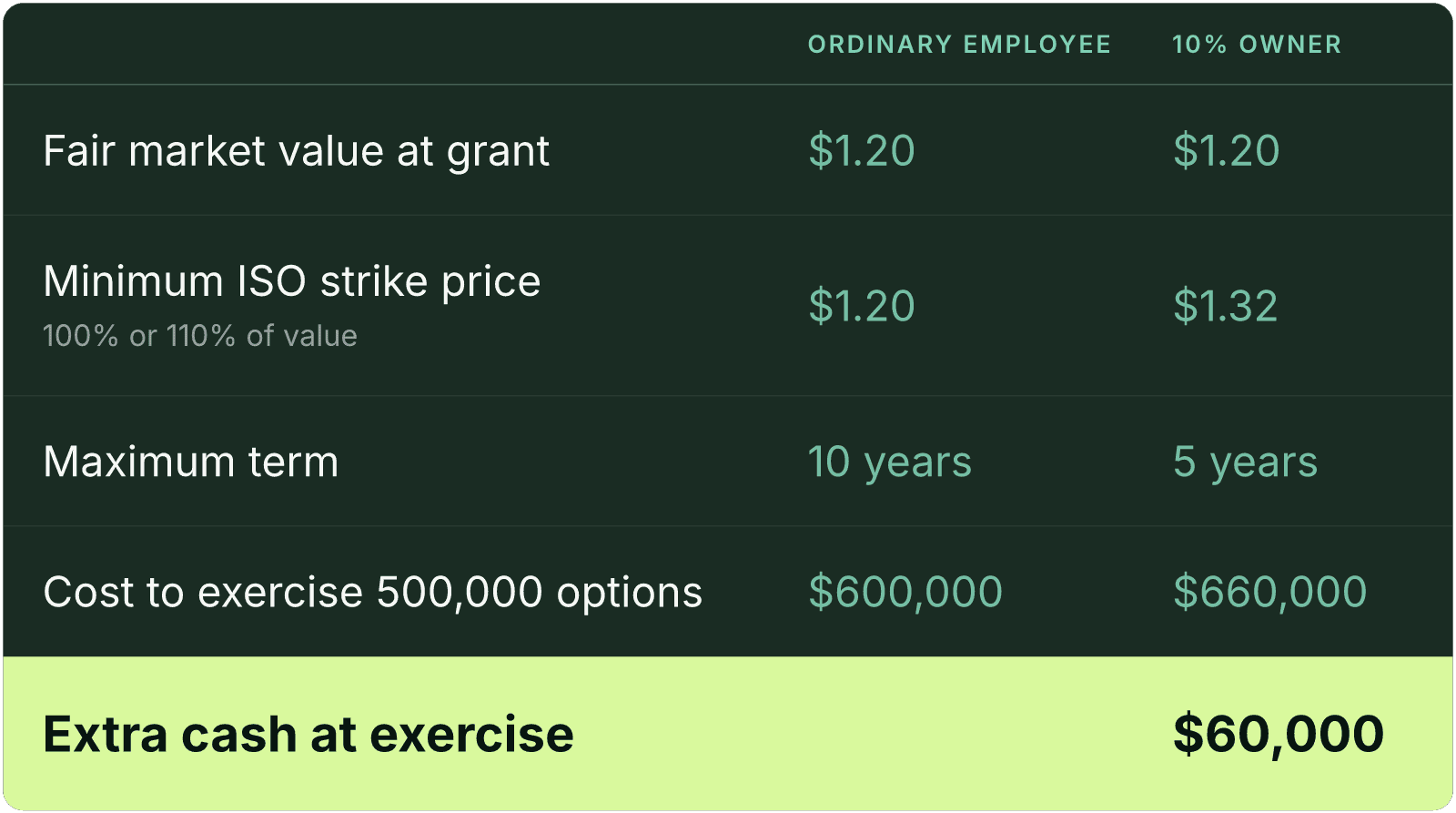
Take a company whose board adopts a $1.20 per share common stock value from an independent 409A valuation on March 1. The board wants to grant 500,000 options to a co-founder who holds 14% of the votes.
[](https://www.409.ai/uploads/iso_10_percent_owner_110_percent_strike_five_year_term_409a_table_1_9e1f8e79a0.png)
The table shows the premium. The co-founder pays $0.12 more per share, which is $60,000 on 500,000 shares, and has half the time to decide. The paragraph that matters for the plan is the next one: if the board sets the strike at $1.20 for this person, the option does not meet the ISO definition. It is taxed as a nonstatutory option, which means ordinary income at exercise on the spread and payroll tax withholding the company did not plan for.
Many plans already contain this language. Check that yours does, and check that the grant paperwork for a major shareholder picks it up. The grant template for staff is the wrong template here.
Why the 409A value matters more for this person
For a regular grant, a strike set at the 409A value sits in the safe harbor and the argument about price rarely starts. For a 10% owner the same value sets two numbers: the price the board approves and the 110% floor that decides ISO status. If the valuation is stale, the floor is wrong, and the damage lands on the one person who is also likely to be the largest option holder.
Three habits keep this clean.
1. Use a valuation that is current on the grant date. A report older than twelve months, or one that predates a priced round, a large bridge or a signed term sheet, loses its presumption of reasonableness. Our guide to [the 409A safe harbor and qualified appraisers](https://www.409.ai/articles/409a-safe-harbor-price-vs-qualified-appraiser) covers what the presumption needs. 2. Approve the exact price in the minutes. Board approval on the grant date, with the strike written as 110% of the stated value, avoids the later fight over which valuation applied. See [option grant dates and board approval](https://www.409.ai/articles/option-grant-date-board-approval-409a-strike-price). 3. Round up, never down. A strike of $1.319 is a failed test. Take the next cent.
If the exercise price on any option, ISO or NSO, falls below fair market value on the grant date, a separate problem appears under section 409A: the option can be treated as deferred compensation, with income tax, an additional 20% tax and interest due by the holder. The 110% rule is not a defense against that. The 409A value is. Our piece on [correcting discounted options](https://www.409.ai/articles/discounted-stock-option-correction-notice-2008-113) explains the correction path when a price turns out to be low.
The other limits still apply
Meeting the 110% test and the five-year term does not exempt the grant from the rest of the ISO rules.
The [$100,000 annual limit](https://www.409.ai/articles/iso-100k-limit-409a-grant-date-fair-market-value) counts the grant date fair market value of options first exercisable in a calendar year. For a 10% owner that value is still measured at fair market value, not at the 110% strike, so the limit is not stretched by the premium. Options above the limit are treated as NSOs.
The holder still has to be an employee from the grant until three months before exercise, and the exercise still creates an alternative minimum tax adjustment. With the lower phaseout threshold, that adjustment bites sooner than it used to; see [ISO exercise and AMT in 2026](https://www.409.ai/articles/iso-exercise-amt-2026-lower-phaseout-threshold) before the founder plans an exercise.
A five-year term also interacts with extension decisions. Extending the post-termination exercise window on a 10% owner's ISO is a modification that can reset ISO treatment, so the company should read [the rules on extending the exercise window](https://www.409.ai/articles/extending-post-termination-exercise-window-iso-nso-409a) before it agrees to anything.
Should the founder take an NSO instead?
Sometimes. An ISO to a 10% owner costs a 10% premium and shortens the term, and the main benefit, no regular income tax at exercise, only pays off if the founder holds the shares for the full ISO holding period: two years from grant and one year from exercise. A founder who expects to sell in a tender within a year, or who cannot fund the AMT, may do better with a nonstatutory option at 100% of fair market value and a ten-year term. The NSO costs less to exercise and lasts longer, and it brings withholding at exercise.
The choice is a tax planning call for the founder's own CPA. What the company can do is put both versions in front of the board with the dollar figures. Using the example above: $60,000 more cash to exercise and five years less time, against deferral of regular income tax on the spread.
A short checklist for the board
- Test every proposed ISO grant for voting power, with family and entity attribution, at the grant date.
- If the holder is over 10%, set the strike at 110% of the stated 409A value, rounded up, and the term at no more than five years.
- Confirm the plan and the award agreement allow it, and write both numbers into the minutes.
- Run the $100,000 limit on the grant date fair market value.
- Re-test at the next grant. The percentage moves with every round.
The 110% rule is one line of statute. It becomes a problem when the grant goes out on the staff template and nobody checks a voting percentage that changed in the last round. If you need a defensible value for the grant date, [409.AI prepares 409A valuations](https://www.409.ai/products/409a) that boards use to set these prices.