Financial Reporting
Insider-Led Round: Can a Fund Mark Its Position at the Price?
How an insider-led round affects a fund's Level 3 mark under ASC 820: who set the price, how much new money came in, and the file a fund CFO should keep.
By 409.AI Team - 2026-10-30
# Insider-Led Round: Can a Fund Mark Its Position at the Price?
A portfolio company closes a new round, and your fund was one of the investors that wrote a check. The lead is an existing investor, the price is up 50% on your last mark, and the pull to book the uplift is strong. If you are the fund CFO, controller or GP who signs the quarter-end marks, the question your auditor will ask is short: was that price set by the market, or by the people already in the cap table?
This article walks through how ASC 820 treats a price set mostly by insiders, which evidence moves it from a data point to an anchor, and how to document the mark so it holds up in the year-end Level 3 file.
What the standard says about related-party prices
ASC 820 defines fair value as the price in an orderly transaction between market participants at the measurement date. Two parts of that definition matter here.
First, ASC 820-10-30-3A lists the situations where a transaction price may not equal fair value. One of them is a transaction between related parties. The standard does not ban the price. It says the price may still be used as an input if the reporting entity has evidence that the transaction was entered into at market terms. The burden of that evidence sits with you, not with the company.
Second, ASC 820-10-35-54C to 35-54J deal with transactions that are not orderly. If the evidence shows a transaction was forced, or that the market was not given enough time to find a price, you weigh it less than other indications of value. A round closed in two weeks with a hard deadline and a single bidder invites that question.
An existing investor leading a round is not automatically a related-party transaction in the accounting sense, and it is not automatically a problem. Many insider-led rounds price fairly, because the insider has done the work and nobody else has better information. The point is that you have to show it, not assume it.
Three questions that decide the weight
Before the price goes into the model, answer these in writing.
Who set the price? A term sheet negotiated by a new investor that did its own diligence, with no stake in the company, is the strongest evidence. A price proposed by the existing lead and accepted by the others is weaker. A price that the founders and insiders agreed among themselves, with no outside party, is the weakest.
Did new money come in, and how much? Outside money at the same price and terms tells you someone with no prior position thought the price worked. A token outside check of 5% of the round tells you much less than an outside check of 40%. Look at the share of the round, and also at whether the new investor got anything extra: a warrant, a board seat, a better liquidation preference, a pro rata right on later rounds. Extras mean the headline price is not the whole price.
Was the process orderly? Look at how long the company marketed the round, whether other firms were invited, whether the round was a bridge to runway or a priced round with a data room, and whether the company had a cash deadline that limited its choices.
A worked example
Take a fund that holds 1,000,000 Series B preferred shares in a portfolio company, marked at $8.00 a share, or $8.0 million. In the quarter, the company closes a $24 million Series C at $12.00 a share. Existing investors, including the fund, fund $18 million of it. A new investor puts in $6 million, or 25%, on the same terms as everyone else.
For this example, assume the Series B ranks equally with the new Series C, so that the share price carries over without a waterfall adjustment. (A junior class needs one; the fund-mark waterfall article linked below covers it.) Assume also that the fund's own peer-multiple technique, calibrated to the previous price, indicates $9.00 a share at the measurement date.
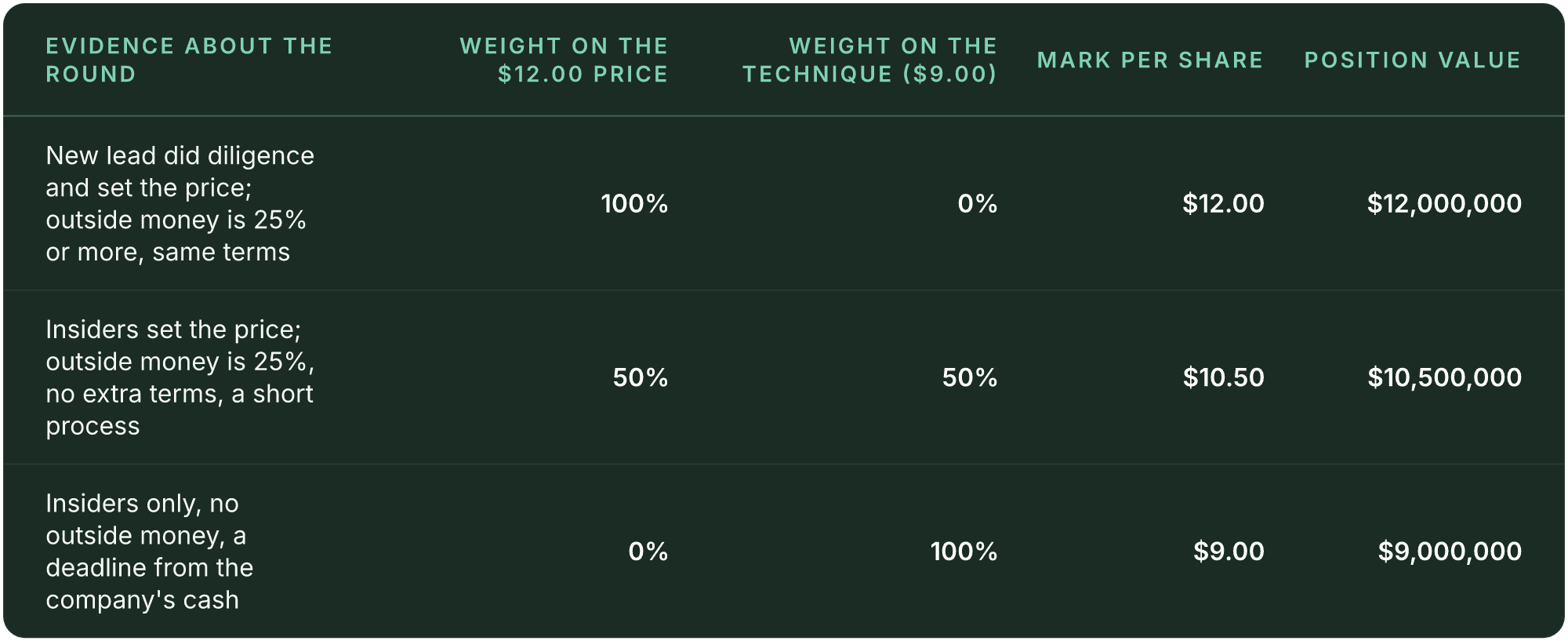
The same $12.00 price supports different marks depending on what you can show about it.
[](https://www.409.ai/uploads/insider_led_round_fund_mark_asc_820_related_party_price_market_terms_table_1_eb1019eb19.png)
The three weights are judgment, and they are illustrative. What an auditor tests is the support for the judgment: the term sheet history, the outside investor's diligence, the share of new money and the process. A mark that moves from $8.00 to $12.00 on a price alone, with an outside check of $6 million inside a $24 million round and no file on how the price was set, is the one that draws a comment.
The table shows why the answer is rarely all or nothing. The row you land in comes from the facts, and ASC 820 asks you to weigh the price against other indications of value, not to throw the price away.
Calibration still applies
Where you use a technique with unobservable inputs, such as a peer-multiple method, ASC 820-10-35-24C says to calibrate it. If the transaction price was fair value at initial recognition, the technique is calibrated so that it returns that price on the transaction date, and the calibrated inputs are rolled forward from there.
An insider-led round raises one wrinkle. If you cannot show the round priced at market terms, you cannot calibrate to its price with confidence. The calibration then rests on the evidence you do have, which may be the prior calibration date, the entry price or the last round that did have an outside lead. Say so in the file, and say which date you calibrated to and why.
The peer-multiple article linked below shows the mechanics. The point for an insider round is the choice of calibration date, which is a fact the auditor will test.
What not to do
Three patterns come up at audit, and all are avoidable.
Treating the headline price as the mark because the lead is "a top-tier firm." Reputation is not evidence of market terms. The investor's brand tells you little about whether the price was negotiated at arm's length from your fund's position.
Ignoring the structure. A round at $12.00 with a 1.5x liquidation preference, or with a warrant coverage that a prior round did not have, is not a $12.00 round for the old preferred class. Value each class by its rights, not by the headline.
Using the round as proof after the fact. If the mark was already set before the round closed, do not rewrite the file to cite the price as the support. The date of the evidence matters. If the round closed after the measurement date, ASC 855 decides whether it is a subsequent event that you reflect or one that you only disclose. The January-round article linked below covers that test.
The file to keep
For each position priced off an insider-led round, the Level 3 file needs six items, one page where possible:
1. The measurement date and the unit of account. 2. The round: price, size, date, and the investors who set the terms. 3. The share of new money, and what the new investor received. 4. The process: how long the company marketed, who was approached, and any cash deadline. 5. The weight you gave the price, the weight you gave the other technique, and the reason. 6. The calibration date and what it was calibrated to.
A policy that states in advance how the fund treats insider rounds makes this routine. The fund valuation policy article linked below sets out where that language belongs, and the SEC staff statement on private asset fair value, also linked below, shows how regulators read the calibration step. Funds that wrote the rule before the quarter started rarely have to argue it during the audit.
The takeaway
An insider-led round is evidence, and it can be good evidence, but ASC 820 asks you to show that it reflects market terms before you mark to it. At the next quarter-end, sort your rounds by who set the price and how much new money came in, write the weight you give each in one sentence, and keep the term-sheet history behind it. A mark you can explain in a sentence and support with a page is the one your auditor passes on the first request.
If you want a second set of eyes on a Level 3 mark before the year-end file goes to the auditor, [409.AI's ASC 820 valuation service](https://www.409.ai/products/asc-820) is built for fund CFOs and administrators preparing exactly that file.
Related reading on this blog: [calibrating peer multiples to the entry price](https://www.409.ai/articles/peer-multiples-fund-level-3-mark-calibrate-entry-price-asc-820), [marking a junior preferred position with a liquidation waterfall](https://www.409.ai/articles/fund-mark-junior-preferred-liquidation-waterfall-asc-820-latest-round-price), [weighing a secondary sale below your mark](https://www.409.ai/articles/secondary-sale-below-fund-mark-asc-820-orderly-transaction-weight), [back-testing marks against exit prices](https://www.409.ai/articles/back-testing-fund-marks-exit-prices-asc-820-disposition-analysis), [a January round and the December 31 mark](https://www.409.ai/articles/january-round-december-31-mark-asc-855-subsequent-events-fund), [the fund valuation policy](https://www.409.ai/articles/fund-valuation-policy-asc-820-audit-sec-exam) and [the SEC staff statement on calibration and NAV](https://www.409.ai/articles/sec-staff-statement-private-asset-fair-value-calibration-nav).