Tax
Inherited Private Company Shares: The Estate Tax Appraisal Becomes the Heirs' Basis
For executors and estate advisors: how Section 1014(f) and Form 8971 turn the date-of-death appraisal of private shares into the ceiling on the heirs' basis.
By 409.AI Team - 2026-11-12
# Inherited Private Company Shares: The Estate Tax Appraisal Becomes the Heirs' Basis
If you're the executor of a founder's or business owner's estate, or the estate attorney or CPA beside them, the appraisal of the private shares does two jobs at once. It sets the estate tax on Form 706. Then, through a rule most families never hear about until a sale, it caps the income tax basis the children or the trust inherit.
That second job is Section 1014(f), the basis consistency rule, and Form 8971 is how the IRS enforces it. Treasury finalized the regulations in September 2024 ([T.D. 9991, 89 FR 76356](https://www.govinfo.gov/content/pkg/FR-2024-09-17/pdf/2024-20429.pdf)), eight years after the proposed version. For an estate holding unlisted stock, the practical message is simple: the number on the estate tax return is the number the heirs live with when they sell.
What Section 1014(f) actually says
Under [Section 1014(a)](https://www.law.cornell.edu/uscode/text/26/1014), property acquired from a decedent generally takes a basis equal to its fair market value at the date of death (or at the alternate valuation date, if the executor elects it). That's the familiar step-up.
Section 1014(f), added in 2015, puts a ceiling on it. For property whose inclusion in the estate increased the estate tax, the heir's basis can't exceed the final value determined for estate tax purposes. Until that value is final, it can't exceed the value the executor reported to the heir on a Form 8971 statement.
The final regulations describe when a value becomes final: the value reported on the return once the IRS can no longer assess more tax, a value the IRS determines and the estate does not contest, a value settled by agreement with the IRS, or a value set by a court. If an examination raises the value of the shares, the heirs' basis rises with it. If the return reported a low number and nobody looked, the low number sticks.
There is no procedure for a beneficiary to challenge the value. The preamble to T.D. 9991 says Treasury declined to create one, though it may consider future guidance for a beneficiary with credible evidence of a substantial understatement.
Who has to file Form 8971, and when
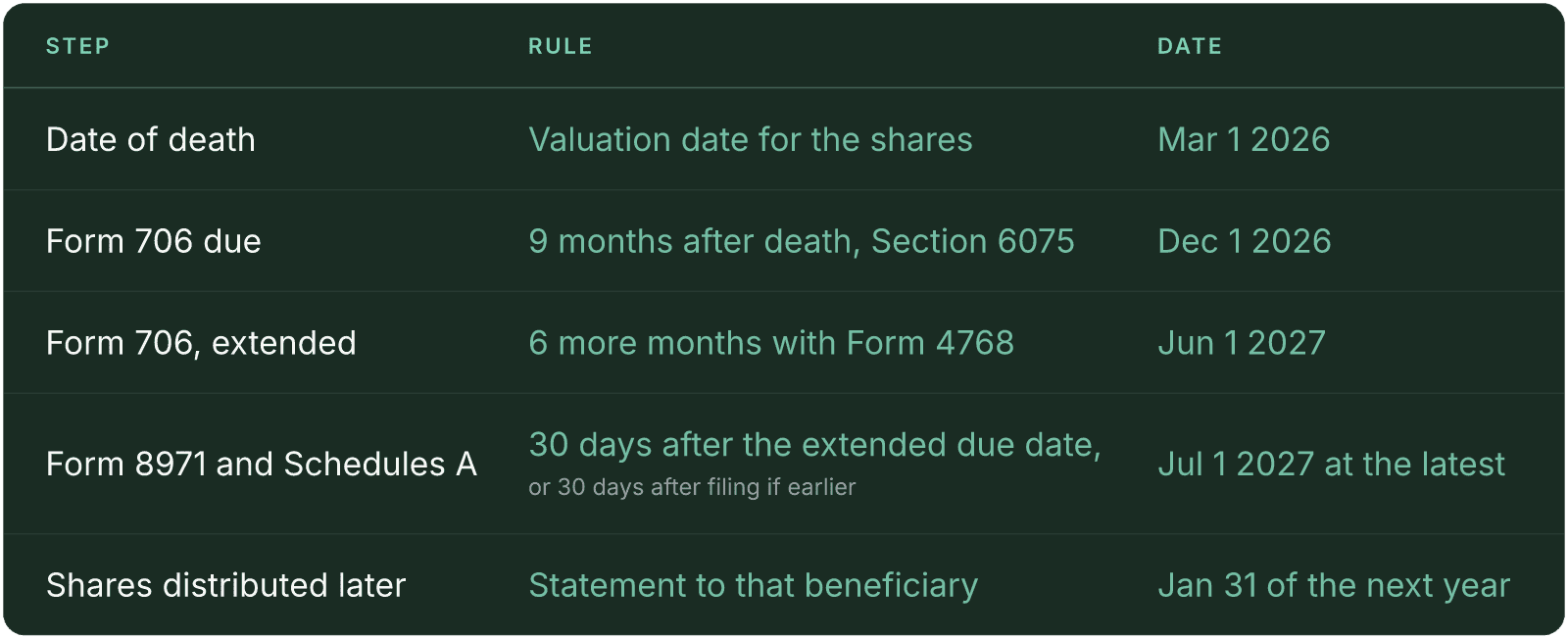
The duty sits with the executor of an estate that must file Form 706. According to the [IRS instructions for Form 8971](https://www.irs.gov/instructions/i8971), the form is due on the earlier of 30 days after the Form 706 due date (with extensions) or 30 days after the 706 is actually filed. Each beneficiary receives a Schedule A showing the estate tax value of what they received.
The final regulations changed the timing for property not yet distributed. A beneficiary who acquires property after that 30-day window gets their statement by January 31 of the year after they acquire it. An executor who already knows who will receive the shares may send the statement early.
Here's how the dates line up for a death on March 1, 2026:
[](https://www.409.ai/uploads/inherited_private_company_shares_form_8971_basis_consistency_estate_tax_value_table_1_e08f216570.png)
The table assumes the extension is taken and the 706 is filed on the last day. File the 706 in February 2027 and the Form 8971 clock runs from the filing date instead.
Trustees carry one more duty. If the shares pass into a trust and the trustee later distributes them, the trustee reports that transfer by January 31 of the following year. The proposed regulations would have imposed the same duty on every individual heir who gave the shares away; the final rules dropped it for everyone except trustees.
When the rule does not apply
Three exceptions matter most for a family holding private shares.
The estate owes no estate tax. With the basic exclusion at $15 million per person in 2026 ([Rev. Proc. 2025-32](https://www.irs.gov/pub/irs-drop/rp-25-32.pdf)), many estates owe nothing. If the gross estate plus adjusted taxable gifts is under the exclusion, no Form 706 is required and no Form 8971 either. A 706 filed only to elect portability of the unused exclusion to the surviving spouse also doesn't trigger Form 8971, according to the instructions.
The shares pass to the surviving spouse or to charity. Property that qualifies for the marital or charitable deduction didn't increase the estate tax, so it is outside the consistency rule, although the executor still reports it. The regulations are careful here: property that qualifies for only a partial deduction, such as a trust with a partial QTIP election, stays inside the rule.
The shares were sold or redeemed before distribution. A sale in which the estate recognizes gain or loss, or a redemption of a business interest for dollars before distribution, takes the property out of the reporting requirement because the heir no longer inherits a basis tied to the estate tax value.
None of this makes the date-of-death value optional. An estate below the exclusion still hands the heirs a basis equal to fair market value at death under Section 1014(a), and the heirs have to prove it when they sell. Without a contemporaneous appraisal, that proof is a reconstruction done years later, often after an acquisition price has made the old value look low.
A worked example: the trade-off in dollars
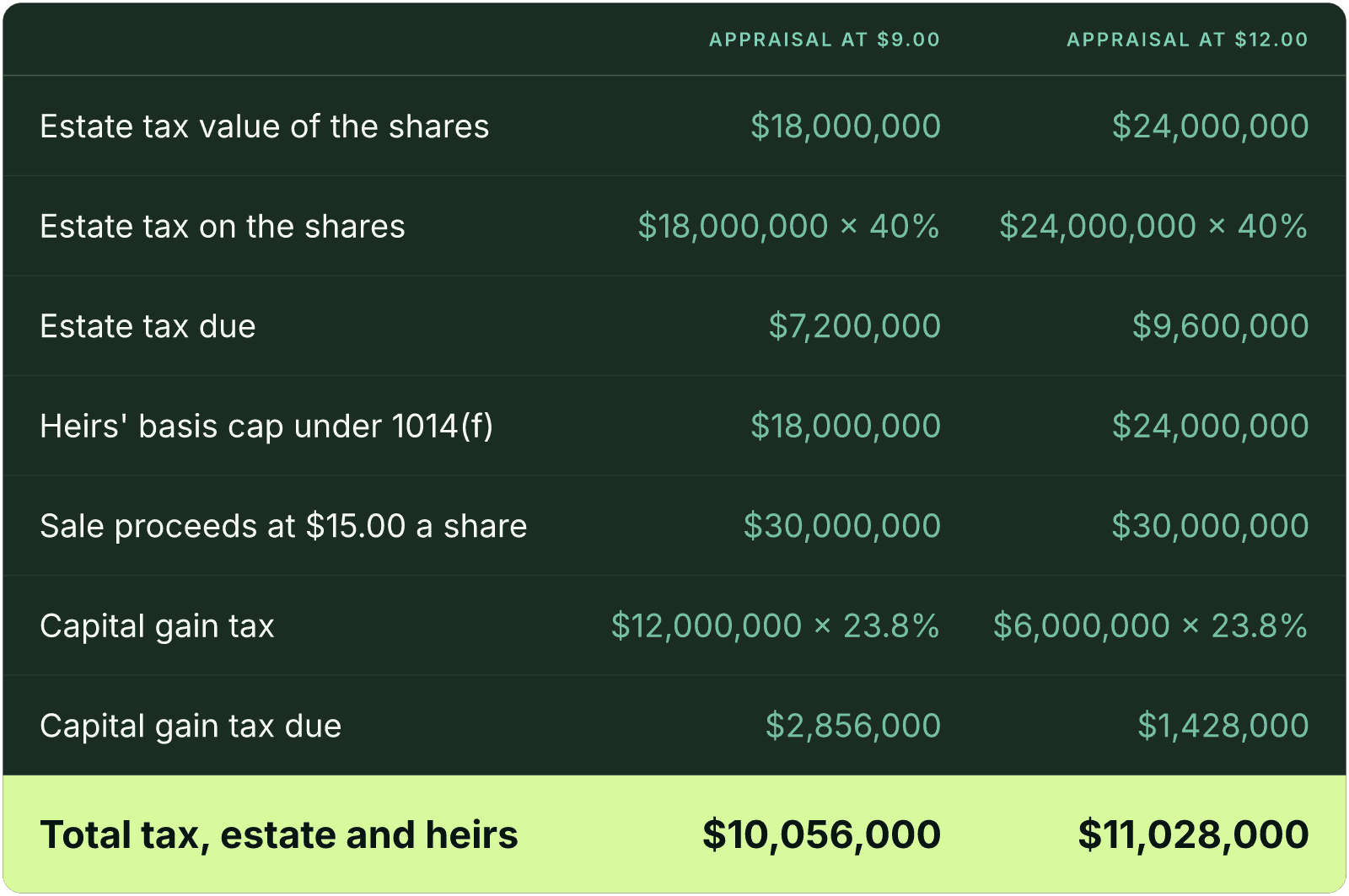
Take a founder who dies holding 2,000,000 common shares of a private software company, whose other assets already use up the $15 million exclusion, so every dollar of share value is taxed at the top estate tax rate of 40%.
The appraiser values the block at the date of death, including a discount for lack of control and a discount for lack of marketability. Suppose a defensible range runs from $9.00 to $12.00 a share. The children inherit the shares, and ten months later the company is acquired for $15.00 a share. Because inherited property is treated as held for more than a year ([Section 1223(9)](https://www.law.cornell.edu/uscode/text/26/1223)), the gain is long-term: 20% plus the 3.8% net investment income tax, or 23.8%, ignoring state tax.
[](https://www.409.ai/uploads/inherited_private_company_shares_form_8971_basis_consistency_estate_tax_value_table_2_c10bc3add6.png)
The lower value still wins, by $972,000, because the estate tax rate is higher than the capital gain rate. But the gap is much narrower than the 40% rate suggests: every dollar the appraisal leaves out saves 40 cents of estate tax and costs 23.8 cents of capital gain tax later. The net saving is about 16 cents on the dollar, not 40.
Now look at the risk side. A low value invites the examiner, and the estate faces a 20% accuracy penalty if the reported value is 65% or less of the correct one, and 40% at 40% or less (Section 6662(g) and (h)). The heirs face their own exposure: a basis reported above the final estate tax value is an "inconsistent estate basis" under Section 6662(b)(8) and (k), subject to the same 20% penalty. So the heirs can't quietly use the $12.00 figure on their own returns if the estate reported $9.00.
The net 16 cents is the real prize of an aggressive appraisal. Weigh it against penalties at 20% or 40% of the underpayment, and the case for a well-supported value in the middle of the range is strong.
What makes the date-of-death appraisal hold up
The standard is the same one that governs gifts: the price a willing buyer and a willing seller would agree on, both with reasonable knowledge of the facts ([26 CFR 20.2031-1(b)](https://www.law.cornell.edu/cfr/text/26/20.2031-1)). For unlisted stock, [26 CFR 20.2031-2(f)](https://www.law.cornell.edu/cfr/text/26/20.2031-2) points the appraiser to the company's net worth, earning power, dividend capacity and comparable public companies.
In practice, four questions decide whether the number survives.
What block is being valued? The estate holds a specific number of shares with specific rights. A 30% common stake in a company with preferred stock ahead of it is not 30% of the enterprise value. The discounts for lack of control and marketability apply to that exact block, and the support for them has to be specific to the company.
What was known at the date of death? A signed term sheet, a letter of intent, an active sale process: if it existed at death, it belongs in the analysis. An acquisition offer that arrived months later generally doesn't set the date-of-death value, but an examiner will ask whether it was foreseeable, and the appraisal should answer that question before it's asked.
Does a buy-sell agreement fix the price? A price in a shareholder agreement binds the estate tax value only if it meets Section 2703. Many family and founder agreements don't.
Is the 409A the right document? A recent 409A valuation is a useful data point, but it is prepared for option pricing under a different regulation, often for a different class of stock, and it isn't a qualified appraisal for estate tax purposes.
What to do if the estate is in this position now
Order the date-of-death appraisal early, before the 706 deadline compresses the work, and ask for the full report, not a letter. Decide on the alternate valuation date only after seeing both values: it is available only if it reduces both the gross estate and the estate tax.
When the 706 is filed, diary the Form 8971 date. Give each heir their Schedule A with a short explanation of what it means: it is the ceiling on their basis, and when they sell, their return should use it. A trustee who receives shares should keep the statement with the trust records, since a later distribution triggers a report of its own.
If you're the heir, keep the Schedule A with your tax papers. When the company is sold, your basis is the number on it, or the higher number the IRS sets if it raises the value on examination, and not a figure taken from the deal price.
409.AI prepares [gift and estate tax valuations](https://www.409.ai/products/gift-estate-tax) of private company shares for estates and their advisors, with the block-specific discounts and the documentation the 706 needs.
The takeaway
For an estate holding private shares, the appraisal isn't only an estate tax number. Section 1014(f) turns it into the heirs' basis, and the arithmetic shows why the lowest defensible value saves far less than it seems: about 16 cents on the dollar, against penalties that start at 20%. The appraisal worth paying for is the one that sits in the middle of a supportable range, documents what was known at death, and holds up through the statute of limitations, because that is the number the family will use when the shares are finally sold.
Further reading on the same estate: how the [alternate valuation date](https://www.409.ai/articles/alternate-valuation-date-section-2032-family-business-estate) can lower the value, how [Section 6166 deferral](https://www.409.ai/articles/section-6166-estate-tax-deferral-closely-held-business-valuation) spreads the tax on a closely held business, why [a buy-sell agreement price may not bind under Section 2703](https://www.409.ai/articles/buy-sell-agreement-price-section-2703-family-business-estate-tax), how the [Section 6662 valuation penalties](https://www.409.ai/articles/gift-tax-valuation-penalty-section-6662-65-percent-40-percent-discounts) are measured, how the [discount for lack of control](https://www.409.ai/articles/discount-lack-of-control-dloc-409a-gift-tax-valuation) is built, and why [a 409A is not a gift tax valuation](https://www.409.ai/articles/409a-vs-gift-tax-valuation-form-709-founder-stock).