Financial Reporting
ILPA's 2026 Templates and Your Year-End Marks: Four IRRs, One Year-End NAV
VC fund CFOs preparing a first LP report on ILPA's 2026 templates: which template applies, where four IRRs come from and why each ends on the Level 3 mark.
By 409.AI Team - 2026-11-07
# ILPA's 2026 Templates and Your Year-End Marks: Four IRRs, One Year-End NAV
If you're the CFO or controller of a venture fund, your first year-end LP report on ILPA's updated templates is due after December 31, 2026, and every return figure in it rests on one input: the fair value you assign to the portfolio on that date. The templates standardize how fees, expenses, cash flows and returns are laid out. They don't touch how a Level 3 position gets valued. That job stays with your valuation policy, ASC 820 and your auditor.
This article separates what the ILPA templates change from what they leave alone, and shows how a single year-end mark moves the numbers an LP will compare across funds.
Two templates, two different scopes
ILPA released the updated Reporting Template (v2.0) and a new Performance Template in January 2025. ILPA's release says the templates should be implemented beginning in Q1 2026, and the release is explicit that this is the first update to the Reporting Template since 2016 ([ILPA press release](https://ilpa.org/news/ilpa-releases-updated-reporting-template-and-new-performance-template-for-industry-adoption/)). People tend to speak of "the ILPA template" as one document. There are two, and they apply to different funds.
The Reporting Template covers fees, expenses and carried interest. Its updated version is intended to replace the 2016 template for funds still in their investment period during Q1 2026, and for funds that commence operations on or after January 1, 2026 ([ILPA Reporting Template page](https://ilpa.org/industry-guidance/templates-standards-model-documents/reporting-template)). Funds past their investment period as of Q1 2026 may keep providing the 2016 version.
The Performance Template standardizes return calculation. ILPA says it should be used on a go-forward basis for funds commencing operations on or after January 1, 2026 ([ILPA Performance Template page](https://ilpa.org/industry-guidance/templates-standards-model-documents/performance-template)). That is narrower than the Reporting Template. If your fund started in 2024, you may owe the new Reporting Template this year and not the Performance Template, unless an LP asks for it or your partnership agreement says otherwise.
Read your limited partnership agreement and side letters before you build anything. ILPA also describes both templates as a supplement to the standard reporting package, which includes financial statements prepared under U.S. GAAP, IFRS or another comprehensive basis ([ILPA Templates Hub](https://ilpa.org/industry-guidance/templates-standards-model-documents/ilpa-templates-hub)). The templates sit beside your audited statements. They don't replace them.
Where the "four IRRs" come from
The Performance Template reports IRR and TVPI/MOIC with designated breakouts for gross and net figures, each with and without the impact of fund-level subscription facilities ([ILPA press release](https://ilpa.org/news/ilpa-releases-updated-reporting-template-and-new-performance-template-for-industry-adoption/)). Multiply the two splits (gross or net, with or without the line) and you get four versions of the same fund's IRR.
The with-line and without-line versions exist because a subscription facility lets a fund pay for an investment now and call capital from investors later. The money is outstanding for less time, which generally lifts IRR and leaves the multiple much closer to where it was. Showing both lets an LP see how much of a return came from the borrowing and how much from the portfolio.
There's also a choice of method. ILPA publishes a Granular version, for GPs who use fund-to-investor cash flows and itemize each capital call, and a Gross Up version, for GPs who use fund-to-investment cash flows or don't itemize calls. ILPA's guidance is to pick the version that matches how you already calculate gross performance and call capital. That's a decision for your fund accountants and administrator, made once, before the first report.
Why every one of those figures ends on a mark
An IRR needs a stream of dated cash flows. For a fund that hasn't liquidated, the last item in that stream isn't cash. It's the fund's net asset value on the reporting date, treated as if the fund were wound up at that value. TVPI works the same way: distributions to date plus year-end NAV, divided by paid-in capital.
For an investment company, the portfolio in that NAV is carried at fair value, and for a venture fund most of it sits in Level 3. We covered the mechanics in [how a venture fund's financial statements work under ASC 946](https://www.409.ai/articles/asc-946-investment-company-venture-fund-financial-statements) and [what the Level 3 footnote has to say](https://www.409.ai/articles/asc-820-level-3-footnote-private-fund-asu-2018-13-nonpublic). The templates add no new valuation rule. They do put every metric on one page, in a standard layout, for an LP who may be comparing you with ten other managers.
So the template doesn't create the sensitivity to the mark. It makes the sensitivity visible and comparable.
A worked example
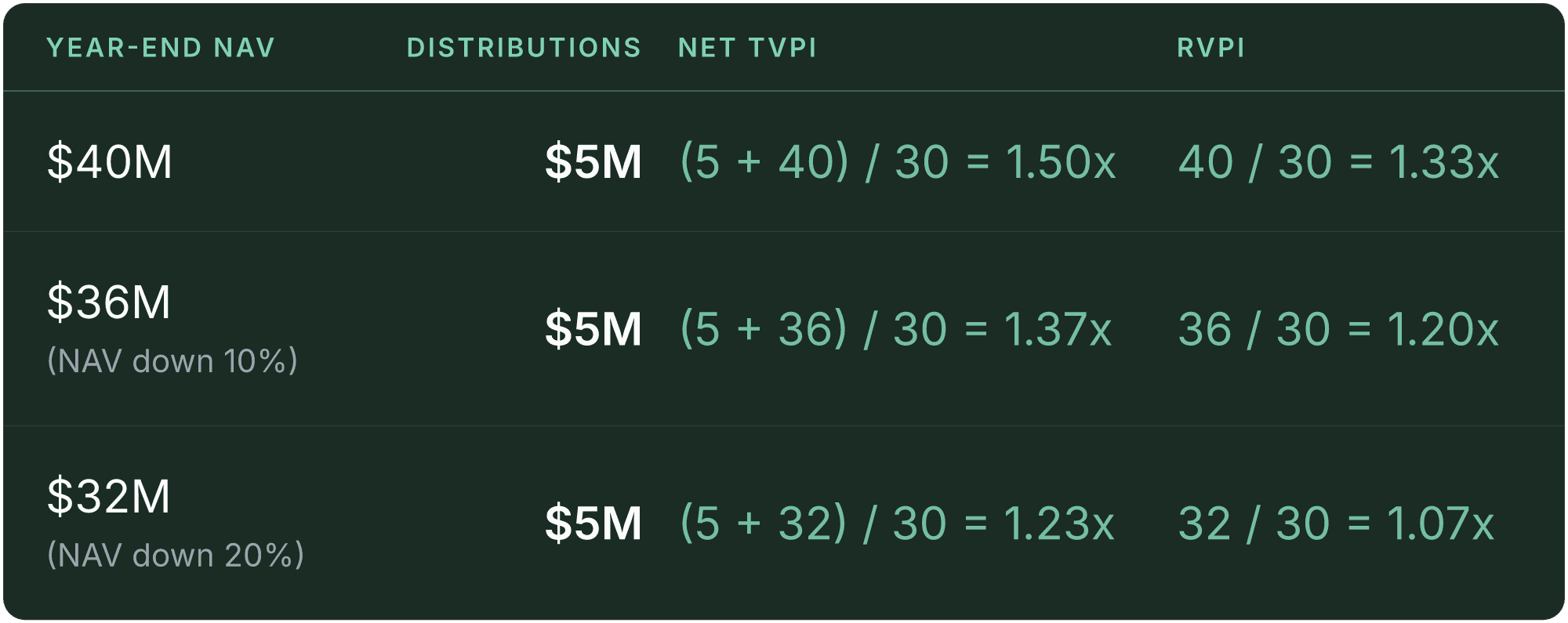
Take an illustrative fund, not a real one. Investors have paid in $30 million, the fund has distributed $5 million, and the portfolio carries a year-end NAV of $40 million. The table shows what happens to net TVPI and to the unrealized part of it (RVPI) as the year-end mark changes.
[](https://www.409.ai/uploads/ilpa_2026_templates_year_end_marks_four_irrs_one_nav_fund_lp_report_table_1_029efe7717.png)
A 10% change in NAV moves the multiple by 0.13x, or about 9% of its value, and the same year-end mark is the final cash flow in the IRR. For a fund still early in its life, with little distributed, the share of the return that is simply "the mark" is higher still. That's why LPs read the multiple together with DPI, which counts only cash returned.
The point for your close: a mark that is too high doesn't just overstate NAV. It shows up as a better IRR and TVPI in every column of the template, in the gross and the net, with and without the line. An auditor testing the marks is also testing the headline numbers your LPs will quote.
What the Reporting Template adds around the marks
The Reporting Template deals with the other side of the page. ILPA's release lists three changes: internal chargebacks broken out to identify expenses allocated or paid to the GP or related persons, more granular external partnership expenses aligned with the general ledger, and a single uniform level of detail for all GPs.
Two of these touch valuation work directly.
Valuation costs. If you pay an outside firm for quarterly Level 3 support, the template asks where that expense sits and who bore it. Our piece on [how fund marks set fees](https://www.409.ai/articles/fund-marks-set-fees-nav-based-fees-valuation-enforcement-policy) explains why that line draws attention when fees are charged on NAV.
Carried interest. The template reports carry, and carry accrued at year-end is itself a function of the marks, through a hypothetical liquidation at fair value. A change to a single position can move the accrual. See [how carried interest accrues on a hypothetical liquidation](https://www.409.ai/articles/carried-interest-accrual-hypothetical-liquidation-fund-marks).
A year-end checklist for the first report
Work through these in the order the dates fall.
1. Confirm scope. Check, fund by fund, whether the Reporting Template, the Performance Template, or both are required, and from which period. 2. Pick the Performance Template version that matches how you calculate gross returns and call capital, and write the reason in the file. 3. Freeze the valuation policy before the marks. A policy changed in December to fit the template will look like a change made to fit a result. Your [valuation policy should already say](https://www.409.ai/articles/fund-valuation-policy-asc-820-audit-sec-exam) who proposes marks, who approves them and what evidence supports them. 4. Map the accounting system to the template fields early. ILPA's guidance has been that preparers should begin mapping their accounting systems well before implementation. 5. Tie the template's ending NAV to the audited balance sheet. If the report and the statements disagree by even a small amount, an LP will find it, and you'll want the reconciliation ready before they ask. 6. Leave time for the audit. For funds that rely on the custody rule's audit route, the [120-day delivery deadline](https://www.409.ai/articles/custody-rule-120-day-audit-deadline-fund-year-end-marks) runs from the fiscal year-end, so the audited figures an LP report should tie to arrive late in the first quarter.
If you report to European LPs, the [IPEV Guidelines in effect for 2026 year-end](https://www.409.ai/articles/ipev-2025-valuation-guidelines-in-effect-2026-year-end-level-3-file) are the other reference an international investor may ask you to follow.
What to do before December 31
The templates change the page your numbers appear on. They leave the work of arriving at those numbers where it was. If a position carries a mark that rests on a stale round, a single data point or a model nobody has back-tested, the template will report that mark as faithfully as a good one, and report it in four versions of the IRR.
So spend the weeks before year-end on the positions that move NAV the most, and on the evidence file behind each. Decide the scope question for each fund now, so the template is a formatting task in January and not a research project. If you want an independent valuation for the year-end marks, [409.AI's ASC 820 valuation](https://www.409.ai/products/asc-820) is scoped to the portfolio and quoted on a call.