Financial Reporting
Phantom Shares Under IFRS 2: Why a Cash-Settled Award Needs a Fair Value Every Year End
For finance teams at IFRS private companies with phantom shares or cash SARs: why IFRS 2 needs a new fair value every year end, with a worked liability example.
By 409.AI Team - 2026-11-19
# Phantom Shares Under IFRS 2: Why a Cash-Settled Award Needs a Fair Value Every Year End
If you run finance at a private company that reports under IFRS and pays employees through phantom shares or cash share appreciation rights, your auditor will ask for a new fair value at every year end until the last award is paid. That surprises teams who expected a one-off grant valuation, as with options. The difference comes from a few paragraphs of IFRS 2, and it decides how volatile your profit line is, how many valuations you buy and what happens if you later swap the plan for real equity.
This article walks through those paragraphs with one worked example, so you can see the liability move before the auditor shows it to you.
Why cash settlement changes the accounting
IFRS 2 splits share-based payments by how they are settled. An equity-settled award (an option over real shares, say) is measured once, at grant-date fair value, and never remeasured. A cash-settled award is a promise to pay cash in an amount based on the value of your shares. That promise is a liability, and [IFRS 2](https://www.ifrs.org/issued-standards/list-of-standards/ifrs-2-share-based-payment/) treats it like one.
Paragraph 30 sets the rule. The company measures the services and the liability "at the fair value of the liability", and until the liability is settled it "shall remeasure the fair value of the liability at the end of each reporting period and at the date of settlement", with every change going through profit or loss. The standard text is reproduced word for word in Australia's [AASB 2](https://standards.aasb.gov.au/node/4694), which mirrors IFRS 2, if you want to read the paragraphs yourself.
Two words in that sentence carry most of the cost: "until settled". Vesting doesn't end the remeasurement. A phantom unit that vested two years ago and is still waiting for an exit gets a fresh fair value every year end, and the movement hits the income statement even though nobody is rendering any more service for it.
Which awards count as cash-settled
Paragraph 31 gives two examples. The first is the familiar share appreciation right that pays cash equal to the increase in the share price over a period. The second catches companies off guard: a right to shares "that are redeemable, either mandatorily (for example, upon cessation of employment) or at the employee's option". That is also cash-settled.
So the label on the plan doesn't decide the classification. A phantom share plan is cash-settled. So is a plan that issues real shares when the company is obliged to buy them back for cash when the employee leaves, or when the employee can force a buyback. If your articles of association or a shareholders' agreement give an employee a put, read it against paragraph 31 before you decide the award is equity.
Our comparison of [IFRS 2 and ASC 718](https://www.409.ai/articles/ifrs-2-vs-asc-718-share-based-payment) covers the classification split in more general terms. The rest of this piece stays on the cash-settled side.
What the fair value has to include
Paragraph 33 says the liability is measured, initially and at each reporting date, "at the fair value of the share appreciation rights, by applying an option pricing model", taking into account the award's terms and the service rendered to date. For a SAR, that usually means a Black-Scholes or lattice model fed with the value of one ordinary share at that date, the base price, the expected remaining term, volatility from comparable listed companies, the risk-free rate and any expected dividends. We go through how each of those inputs is set for a private company in [Black-Scholes inputs for private company options](https://www.409.ai/articles/black-scholes-inputs-private-company-stock-options).
A phantom share that pays the full value of a share (not only the growth) is simpler: its fair value tracks the value of a share, adjusted for anything the holder doesn't get, such as dividends before payout.
The hard input is the share value itself. A private company has no quoted price, so each year end needs an equity valuation allocated to the ordinary shares the awards refer to, with the preference stack and any marketability discount that the award terms make relevant. That is the same work as a grant-date valuation, repeated.
IFRS 2 also leaves no shortcut here. Under US GAAP, ASC 718-30-30-2 lets a nonpublic company elect to measure liability awards at intrinsic value, and our piece on [phantom stock and SARs](https://www.409.ai/articles/phantom-stock-sars-private-company-409a-asc-718) shows how much that simplifies a US plan. IFRS 2 has no equivalent policy election. Paragraph 33 asks for fair value, which for a SAR includes the time value that an intrinsic value ignores.
How vesting conditions are handled
The June 2016 amendments to IFRS 2 ([Classification and Measurement of Share-based Payment Transactions](https://www.efrag.org/system/files/sites/webpublishing/Meeting%20Documents/1603030957065004/09.04%20-%20Amendments%20to%20IFRS%202-%20Published%20Amendment.pdf), effective for annual periods beginning on or after 1 January 2018) added paragraphs 33A to 33D. They line the cash-settled treatment up with the equity-settled one:
- **Service conditions and non-market performance conditions** (a revenue target, an EBITDA target) stay out of the fair value. They change the number of awards counted instead, based on "the best available estimate of the number of awards that are expected to vest", trued up to the actual number at vesting (paragraphs 33A and 33B).
- **Market conditions** (a share price target) and **non-vesting conditions** go into the fair value itself, at grant and at every remeasurement (paragraph 33C).
Paragraph 33D then states the result: the cumulative expense "is equal to the cash that is paid". Every estimate along the way is temporary. What finally lands in profit or loss over the life of the award is the cash that leaves the bank.
That is a real contrast with US GAAP. ASC 718-10-25-20 recognises cost for an award with a performance condition only when the condition is probable. IFRS 2 asks for a best estimate each period, so an award whose target looks reachable starts building a liability earlier.
A worked example
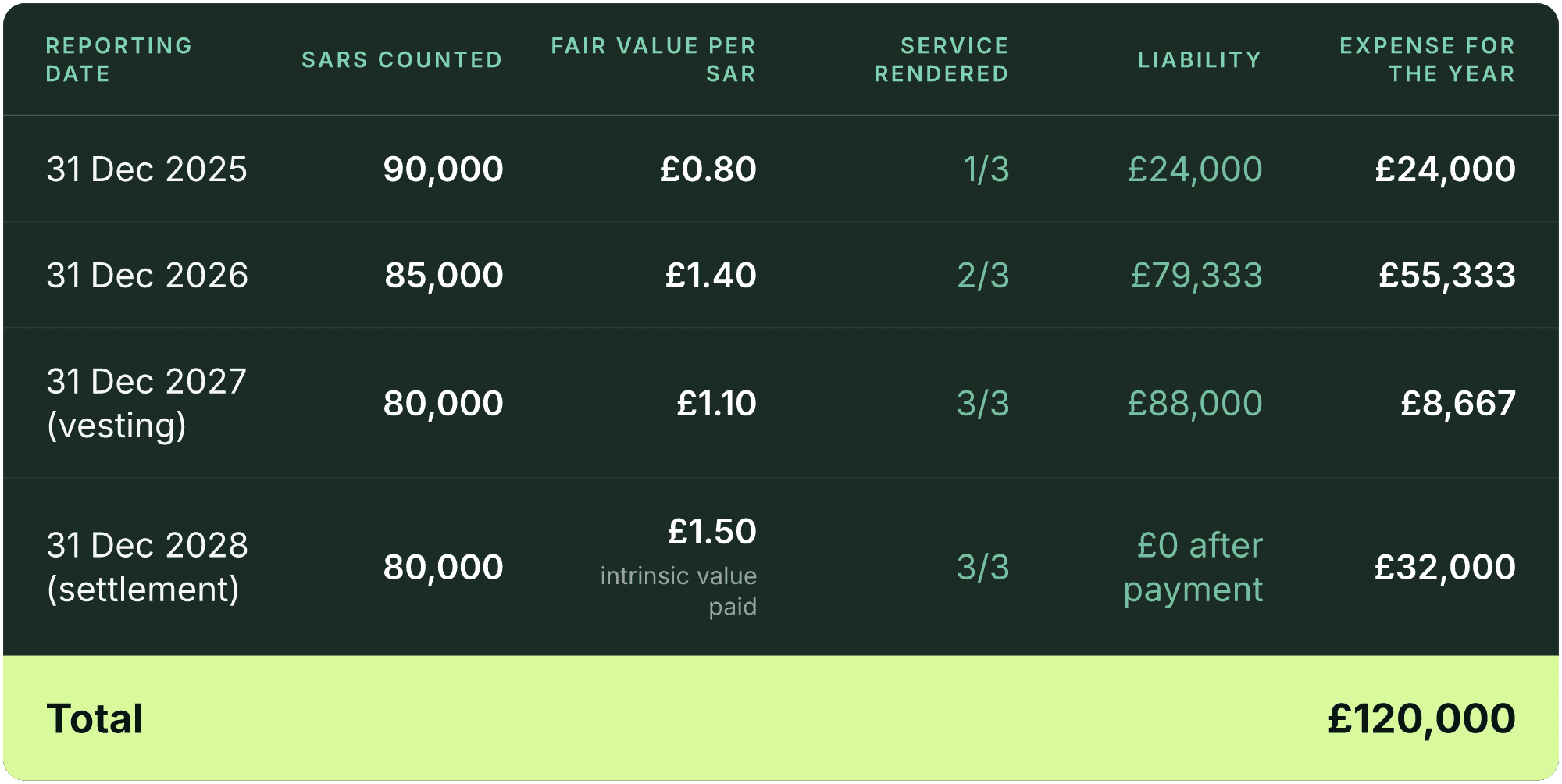
Here is an illustrative example. A UK private company reporting under IFRS grants 100,000 cash-settled SARs on 1 January 2025. The base price is £2.00 a share, the awards vest after three years of service, and each SAR pays the excess of the share value over £2.00 when it is exercised. At the first year end, management expects 90,000 SARs to vest; a year later, after more leavers, 85,000; at vesting, 80,000 actually vest. All 80,000 are exercised at 31 December 2028, when the share value is £3.50.
The fair value per SAR at each date comes from an option pricing model run on that date's share valuation. The table follows the paragraph 33A to 33D mechanics.
[](https://www.409.ai/uploads/ifrs_2_cash_settled_phantom_shares_sars_liability_remeasurement_fair_value_table_1_2769f1410c.png)
Three things stand out. The 2027 expense is small even though a third of the service was rendered that year, because the share valuation fell and the fair value dropped from £1.40 to £1.10. The 2028 expense of £32,000 arrives after vesting, with no service at all, purely because the shares were worth more at settlement. And the total, £120,000, is exactly 80,000 SARs times the £1.50 paid out, as paragraph 33D says it must be.
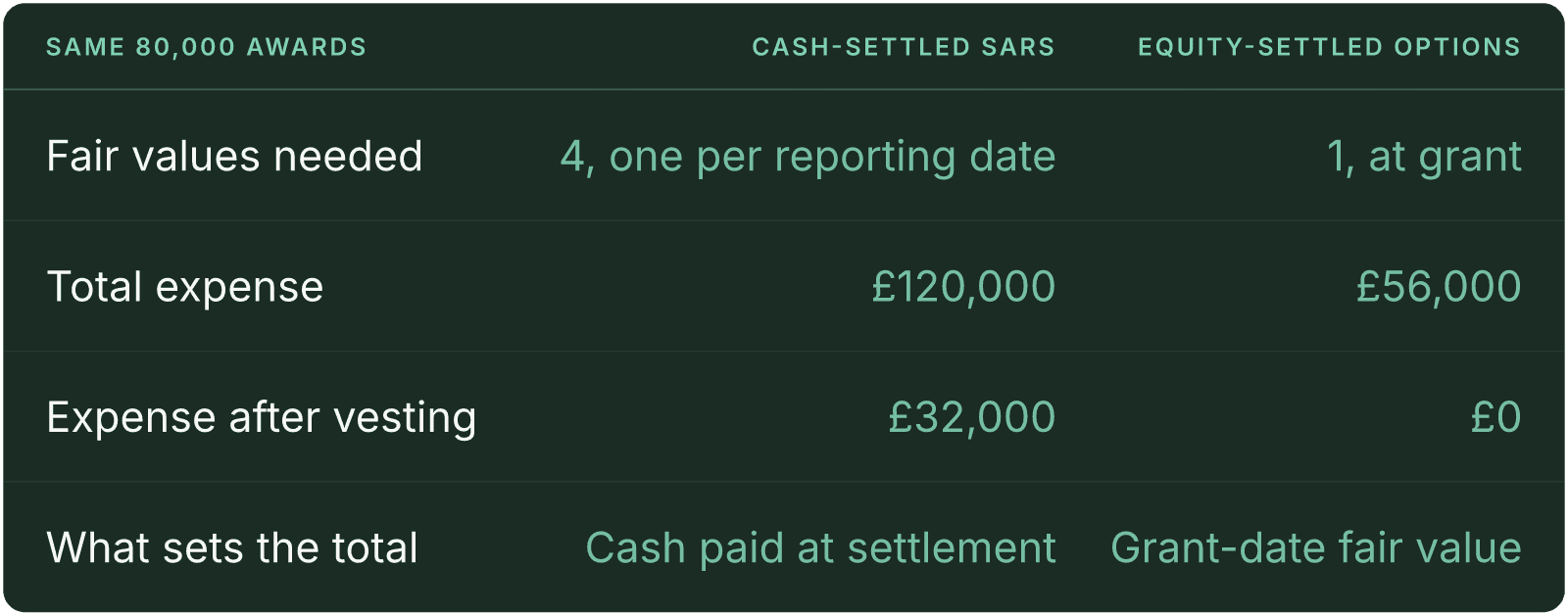
Now compare an equity-settled option on the same terms. Suppose the grant-date valuation gave £0.70 per option. The total charge would be 80,000 times £0.70, or £56,000, spread over the three service years and fixed from day one. The later movements in the share value would never touch profit or loss.
[](https://www.409.ai/uploads/ifrs_2_cash_settled_phantom_shares_sars_liability_remeasurement_fair_value_table_2_abf6494334.png)
The numbers are illustrative, but the pattern isn't. A cash-settled plan in a company whose value is climbing costs more in reported expense than the equivalent option plan, and it needs a valuation at every year end, including the years after vesting.
Turning a cash plan into equity
Companies often decide, before a fundraise or an exit, to replace a phantom plan with real options or shares. Paragraphs B44A to B44C, added by the same 2016 amendments, govern that switch:
1. From the modification date the award is equity-settled, measured at the fair value of the equity instruments granted at the modification date, not at the original grant date. 2. The liability is derecognised on that date. 3. Any difference between the liability removed and the equity recognised goes straight to profit or loss.
B44B applies the same rule if the modification changes the vesting period, and even if it happens after vesting. B44C extends it to a cash plan that is cancelled and replaced by equity instruments the company identifies as a replacement on their grant date.
In practice that means one more valuation: the fair value of the new equity instruments at the modification date. If the replacement awards are worth more than the liability they replace, the excess hits profit at once. Our article on [repricing underwater options under IFRS 2](https://www.409.ai/articles/ifrs-2-repricing-underwater-options-modification-incremental-fair-value) covers modifications of equity-settled awards, which follow different rules.
Net settlement for withholding tax
One last trap runs the other way. When an equity-settled award lets the company keep back shares to pay the employee's tax and pass that cash to the tax authority, the withheld part looks like a cash payment. Paragraphs 33E to 33H say the whole award stays equity-settled if it would have been without that feature, provided the company has a legal obligation to withhold. Where no withholding obligation exists, the exception doesn't apply at all. Shares withheld beyond the tax actually owed are accounted for as cash-settled when that amount is paid in cash to the employee.
What your year-end file needs
For each cash-settled plan, an auditor will expect to see the classification analysis (paragraph 31 if any shares are redeemable), the fair value per award at the reporting date with the model and its inputs, the share valuation behind it, the estimate of awards expected to vest, and the reconciliation of the liability from last year. The [IFRS 2 valuation report](https://www.409.ai/articles/what-is-an-ifrs-2-valuation-grant-date-fair-value-report-auditor-wants) we described for equity-settled grants covers most of this; a cash-settled plan simply needs it again every year until the last payment.
If your plan carries a share price target, the market condition belongs inside the fair value, which usually means a Monte Carlo model rather than Black-Scholes; [this comparison of option pricing models](https://www.409.ai/articles/black-scholes-lattice-monte-carlo-option-pricing-model-asc-718-market-condition) explains when each fits.
409.AI prepares [IFRS 2 valuations](https://www.409.ai/products/ifrs-2) for both grant-date and reporting-date measurements.
The takeaway
Before the year end, list every award your company will settle in cash, including real shares the company must buy back when someone leaves. Each one needs a fair value at 31 December, vested or not. Book that valuation before the audit fieldwork starts, and run the liability roll-forward on the new number: the movement since last year is an expense or a credit you will have to explain line by line.