Financial Reporting
How a Fund Buys Its First Level 3 Valuation: Scope, Quote and the December 31 File
Fund CFOs and emerging GPs: who orders a first ASC 820 valuation, what a firm needs to scope and quote it, and the year-end calendar for the audit file.
By 409.AI Team - 2026-11-03
# How a Fund Buys Its First Level 3 Valuation: Scope, Quote and the December 31 File
You are the CFO of a venture fund, or the controller of an emerging manager's first vehicle, and the audit engagement letter just arrived. Somewhere in the planning memo the auditor wrote that Level 3 positions will get the most attention. Until now the marks lived in a spreadsheet and the last round price did most of the work. Now someone has to buy a valuation, and nobody on the team has done it before.
This is a guide to that purchase, written for the person who has to run it: who orders the work, what a valuation firm needs from you before it can quote, how the engagement is scoped, and what the file looks like on December 31. It is not a guide to the method itself. For that, start with [ASC 820 and the Level 3 problem](https://www.409.ai/articles/asc-820-level-3-fair-value-fund-portfolio-valuation).
What you are actually buying
ASC 820 defines fair value as the price that would be received to sell an asset in an orderly transaction between market participants at the measurement date. For a fund that reports as an investment company under ASC 946, every portfolio company holding is carried at that price. A startup's preferred shares rarely trade, so the inputs are unobservable and the position is Level 3. Why that classification follows, and what it triggers in the footnotes, is covered in the [Level 3 classification article](https://www.409.ai/articles/asc-820-level-3-classification-significant-unobservable-input).
A valuation report for a Level 3 position is the written support for one number: your mark at a date. It documents the technique chosen, the inputs, how the model was calibrated to the entry price or a recent round, how value was allocated across the share classes you hold, and why the result is reasonable. The firm gives you an independent, documented analysis. It does not give you the fair value. Management owns the mark and signs the financial statements, and the auditor will treat the report as evidence behind your number, not as a substitute for it.
Nothing in ASC 820 says a fund must hire an outside firm. Many funds mark everything in-house and the auditor tests those marks directly. The reasons to buy a report are practical: a position large enough to matter to NAV, a complex security (a SAFE next to preferred next to a warrant), a conflict of interest the auditor will question, or a team with no one who has built a Level 3 model before. If you are weighing those options, the [comparison of administrators, in-house teams and independent firms](https://www.409.ai/articles/fund-level-3-valuation-administrator-in-house-independent-firm-sec-exam-file) lays out who does which job.
Who orders it
In practice three people start the request, and the right one depends on how the fund is run.
The CFO or controller orders it when the fund has finance staff. They own the financial statements and the audit, so they own the evidence behind the marks.
The GP of an emerging manager orders it when there is no finance team yet. The same person who sources the deals is now responsible for fair value, which is exactly why an outside view helps with the auditor.
The fund administrator sometimes coordinates the request, because it already collects the portfolio company financials for NAV. Coordinating is not the same as valuing. The administrator calculates NAV from the marks you give it, and the engagement letter with the valuation firm should still be signed by the manager or the fund.
Whoever signs, the firm will ask one more thing early: who approves the mark. A valuation committee, a named partner, the CFO alone. Write that down before the first call, because the auditor will ask the same question.
What a firm needs before it can quote
A quote for a portfolio valuation is not a price list lookup. The work varies with the portfolio, so a firm scopes it from facts you can gather in an afternoon. Expect to be asked for:
- the list of positions, with security type, cost, date of investment and current carrying value;
- the valuation date or dates, and whether this is a one-time year-end exercise or a recurring quarterly one;
- the latest financing round for each company, with the term sheet or the capitalisation table showing who holds what;
- recent financial statements and the current budget or forecast;
- your existing valuation policy, if you have one, and the last audited statements, if there is a prior year;
- anything unusual: a down round, an insider-led round, a signed but unclosed sale, convertible instruments, a borrower in default.
The last item matters most. A position with a clean priced round last quarter can be supported with a calibrated, relatively short analysis. A position with three classes of preferred and a pending sale needs a scenario model, and the scope grows with it.
How scope drives the quote
The engagement is scoped per portfolio, not sold at a flat price per position, which is why ASC 820 work is quoted on a call. [409.AI's ASC 820 service](https://www.409.ai/products/asc-820) works the same way: it is scoped per fund and quoted after a conversation, and no price is published. What moves the quote is easy to list:
1. How many positions need a full report and how many can be supported with a lighter update. 2. How complex each security is: common, one class of preferred, a stack with different liquidation preferences, warrants, convertible notes. 3. How much data exists and how fast it arrives. 4. Whether this is a first valuation, which needs the calibration work built from scratch, or a refresh of a model the firm already holds. 5. How many dates: one year-end, or four quarter-ends.
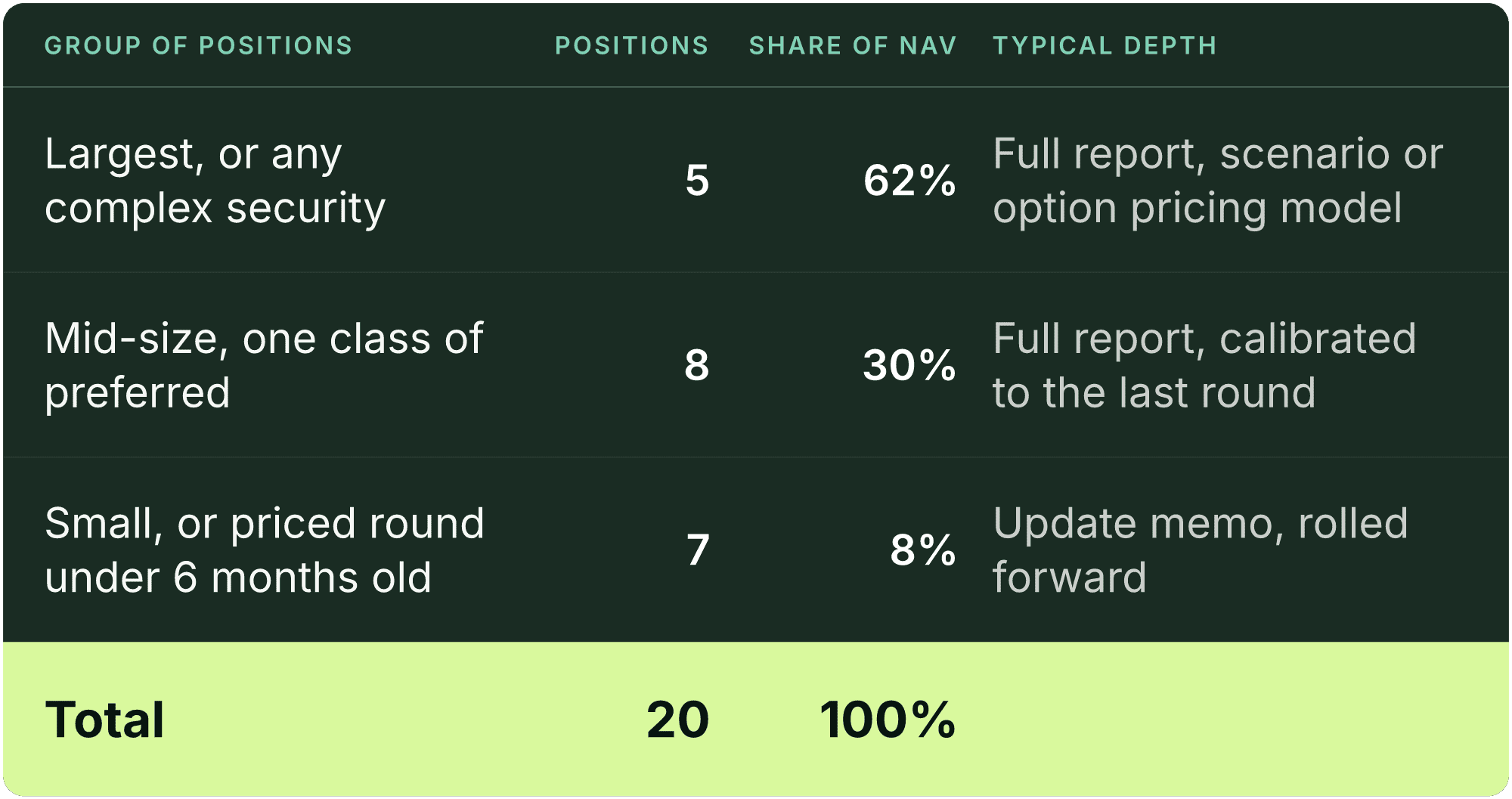
Here is how a scoping conversation might split an illustrative fund. The numbers are an example, not a benchmark, and the depth column is a judgment you agree with the firm and your auditor, not a rule of ASC 820.
[](https://www.409.ai/uploads/how_fund_buys_first_level_3_valuation_asc_820_scope_quote_december_31_file_table_1_cc2a26c0d9.png)
The table shows why the first call should start from NAV, not from the number of positions. Five positions carry most of what the auditor will care about. Putting the deepest work there, and a shorter roll-forward on the small ones, is how a first-year budget stays proportionate. If the auditor sees only a sample of positions, ask the audit team early which ones it expects to test, so the scope does not miss them.
Timing: work backward from the audit
For a calendar-year fund the measurement date is December 31, and the clock that matters is the audit. A private fund adviser that relies on the audit provision of the SEC custody rule must distribute audited financial statements to investors within 120 days of the fiscal year-end, which is April 30 for a December 31 year-end ([17 CFR 275.206(4)-2](https://www.ecfr.gov/current/title-17/chapter-II/part-275/section-275.206(4)-2)). We walk through that deadline in the [custody rule article](https://www.409.ai/articles/custody-rule-120-day-audit-deadline-fund-year-end-marks). Not every fund relies on that provision, and your fund documents may set their own date, but the arithmetic is the same: the audit needs the marks well before the deadline.
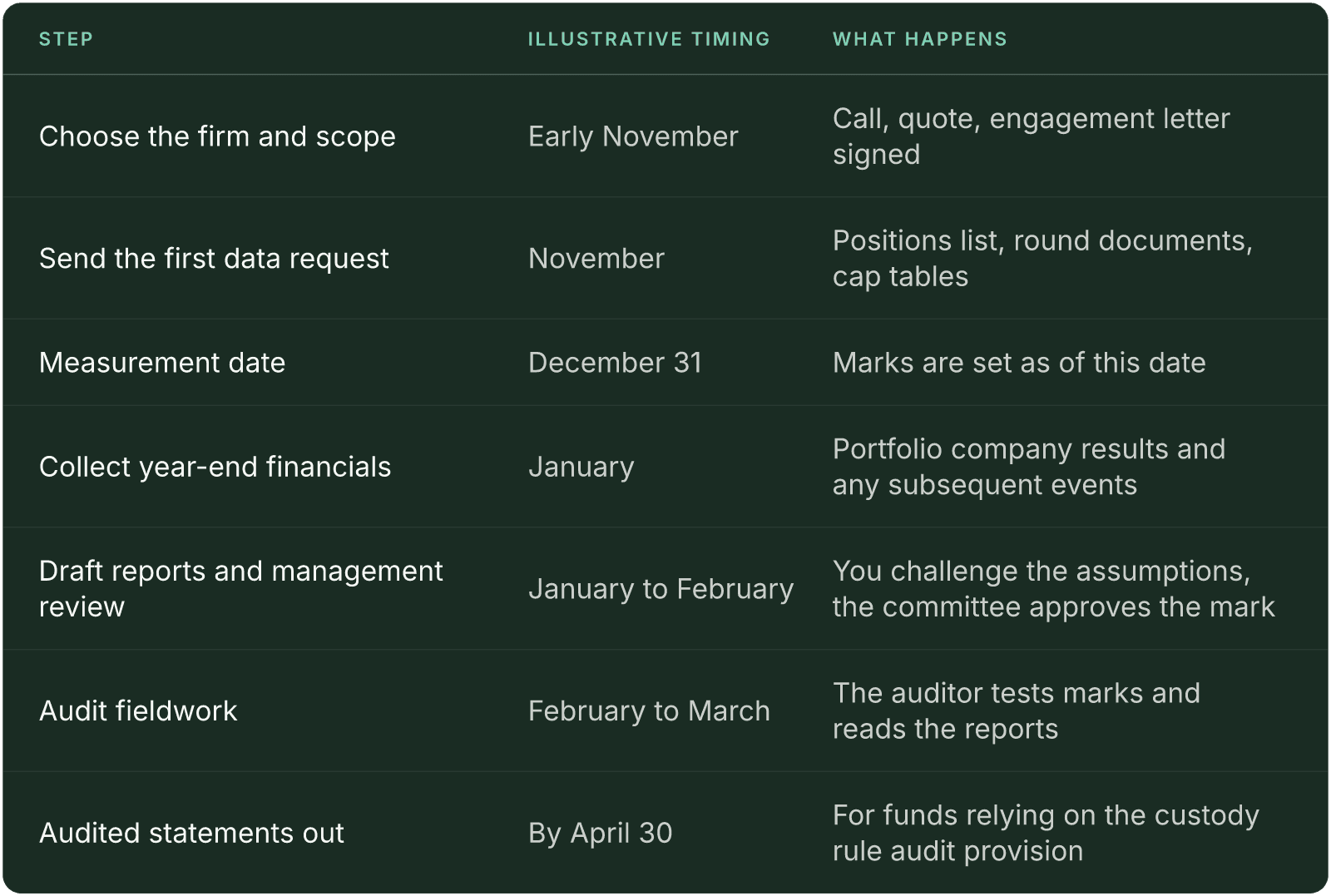
Counting back from the deadline gives an illustrative calendar for a first valuation.
[](https://www.409.ai/uploads/how_fund_buys_first_level_3_valuation_asc_820_scope_quote_december_31_file_table_2_752cce03f1.png)
Two points make the calendar less forgiving than it looks. The valuation is as of December 31, but companies report late, so the year-end financials the model needs often arrive in January. And information that arises after the measurement date, such as a round that closes in January, has to be weighed under the subsequent events guidance. The [article on a January round and a December 31 mark](https://www.409.ai/articles/january-round-december-31-mark-asc-855-subsequent-events-fund) shows how that plays out. A fund that starts the conversation in December is already behind.
What lands in the December 31 file
By the time the auditor arrives, the file for each Level 3 position should be something a reviewer who knows nothing about the company could follow. A workable file holds:
- the valuation report, with technique, inputs, calibration and share-class allocation;
- the source documents behind the inputs: the round terms, the financials, the capitalisation table;
- the management review: who challenged what, and the date the mark was approved;
- a short bridge from the prior mark to this one, with the reason for the change;
- the specialist information the auditor asks for about the firm, since under the auditing standard on accounting estimates (SAS 143) the audit team evaluates the competence, objectivity and work of a management specialist. The [article on what the auditor tests about the valuation firm](https://www.409.ai/articles/fund-valuation-firm-sas-143-auditor-tests-management-specialist-file) lists the requests;
- the disclosures built from the work: the Level 3 table and the narrative on unobservable inputs ([the footnote requirements for private funds](https://www.409.ai/articles/asc-820-level-3-footnote-private-fund-asu-2018-13-nonpublic)).
If you adopt a written valuation policy at the same time, which a first valuation is a good moment to do, the [policy article](https://www.409.ai/articles/fund-valuation-policy-asc-820-audit-sec-exam) covers what it should say and how it connects to the file.
Questions to ask before you sign
A short list keeps the first conversation useful:
- Who at the firm will do the work and who reviews it?
- Will the report be calibrated to the price we paid, and how?
- What do you need from us, and by which date, to deliver before fieldwork?
- Will you support the audit questions, and is that time included or billed separately?
- Does the firm have any relationship that the auditor would see as a conflict?
- What happens to the scope if a position turns out to be more complex than the data request showed?
What to do this month
Build the position list with security type, cost and carrying value, and mark the five that carry most of NAV. Send that list, with your audit timeline, to two or three firms and ask each for a scoped quote. Ask your auditor which positions it plans to test. With the quote in hand and the engagement signed by the end of November, December 31 is a measurement date and not a scramble.