Tax
GST Exemption on a Gift of Private Shares: The Appraisal Sets the Inclusion Ratio
Founders and estate attorneys funding a dynasty trust with private shares: how the appraised value sets the GST inclusion ratio, and what an audit can cost.
By 409.AI Team - 2026-11-15
# GST Exemption on a Gift of Private Shares: The Appraisal Sets the Inclusion Ratio
If you're a founder or a family-company owner putting private shares into a dynasty trust before December 31, or the estate attorney or CPA preparing the Form 709 for that gift, one number on the return does double duty. The appraised value sets the gift. It also sets how much generation-skipping transfer (GST) exemption the trust needs, and that second use outlives the first by decades.
Get the allocation right and the trust can pay out to grandchildren and later generations free of GST tax. Get it slightly wrong, usually because the IRS later decides the shares were worth more than the appraisal said, and every future distribution or termination is taxed at a fraction of the 40% rate, forever. The fraction is called the inclusion ratio, and the value of private stock is what drives it.
Two exemptions, one value
In 2026 each person has a $15,000,000 basic exclusion amount for gift and estate tax ([Rev. Proc. 2025-32](https://www.irs.gov/pub/irs-drop/rp-25-32.pdf)). The GST exemption isn't a separate number you look up: under [26 U.S.C. 2631(c)](https://www.law.cornell.edu/uscode/text/26/2631) it "shall be equal to the basic exclusion amount" for the year. So a founder who has made no earlier gifts has $15,000,000 of each.
They are spent differently. Gift exemption is used up automatically by every taxable gift. GST exemption has to be allocated to a transfer, either by you on a Form 709 or by a deemed allocation the Code makes for you, and once made, "Any allocation under subsection (a), once made, shall be irrevocable" (Section 2631(b)).
If you've read our guide to [gifting startup equity under the $15M exemption](https://www.409.ai/articles/gifting-startup-equity-2026-estate-tax-exemption), this is the part of the same return that decides what happens one generation further down.
How the inclusion ratio works
[Section 2642(a)](https://www.law.cornell.edu/uscode/text/26/2642) defines the inclusion ratio as one minus the "applicable fraction." The numerator of that fraction is the GST exemption allocated to the trust. The denominator is the value of the property transferred to it.
[Section 2641](https://www.law.cornell.edu/uscode/text/26/2641) then sets the GST tax rate on the trust as the maximum federal estate tax rate times the inclusion ratio. At today's 40% top rate:
- Allocate exemption equal to the value, and the fraction is 1, the inclusion ratio is 0, and the GST rate is 0%.
- Allocate nothing, and the inclusion ratio is 1: full 40% GST tax when the trust skips a generation.
- Allocate 80% of the value, and the inclusion ratio is 0.2: an 8% GST rate on everything the trust later passes down.
The trap is in the denominator. For an allocation made on a timely filed return, Section 2642(b)(1) values the property at "its value as finally determined for purposes of chapter 12," the gift tax chapter. Not the value you reported. The value that survives an audit.
For cash or public stock those are the same number. For shares of a private company they often aren't, because the value rests on judgments the IRS can contest: the method, the weight on a recent round, the [discount for lack of control](https://www.409.ai/articles/discount-lack-of-control-dloc-409a-gift-tax-valuation) and the marketability discount on the exact block transferred.
A worked example: stated amount or formula
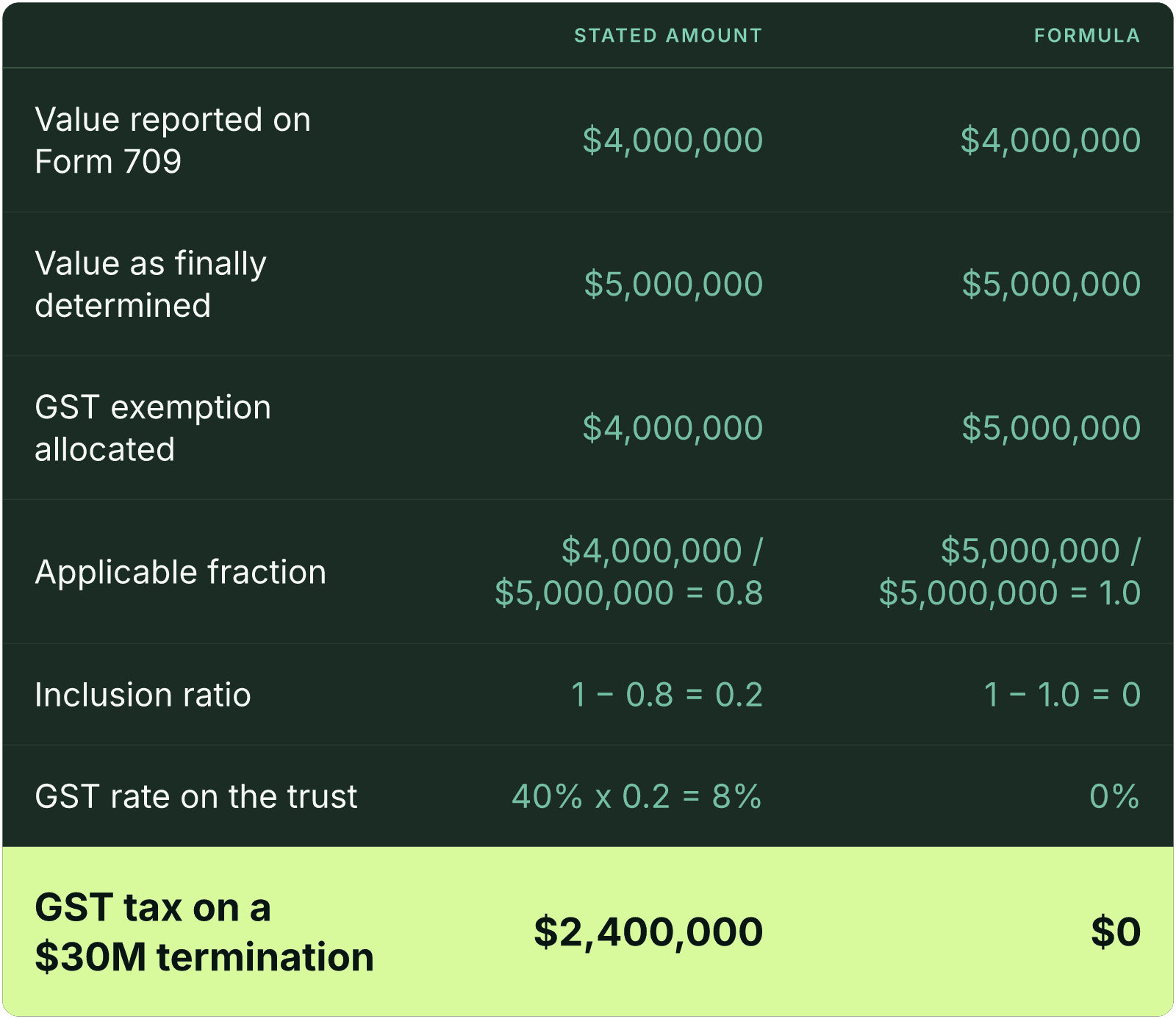
Take a founder who gives 1,000,000 shares of common stock to a dynasty trust for children and grandchildren in December 2026. A qualified appraisal values the block at $4.00 a share, so the Form 709 reports a $4,000,000 gift. The figures below are illustrative.
On Schedule D the preparer allocates GST exemption. There are two ways to word it. A stated amount allocates $4,000,000. A formula allocates "the amount necessary to produce an inclusion ratio of zero," which [Treas. Reg. 26.2632-1(b)(4)(i)](https://www.law.cornell.edu/cfr/text/26/26.2632-1) expressly permits: "an allocation of GST exemption may be made by a formula."
Two years later the IRS examines the return and the parties settle at $5.00 a share. The trust grows, and when the children's generation's interests end, it holds $30,000,000.
[](https://www.409.ai/uploads/gst_exemption_allocation_private_shares_dynasty_trust_inclusion_ratio_table_1_e73affd643.png)
The audit moved the gift by $1,000,000. With the stated amount, it moved the trust's future tax by $2,400,000, because the 8% rate applies to everything the trust becomes, not to the $1,000,000 adjustment. A dynasty trust funded with startup stock is built to grow, so the leak grows with it.
The formula version spends $1,000,000 more of the founder's GST exemption, which it had to do anyway to keep the trust exempt, and leaves the inclusion ratio at zero. The same regulation adds that an allocation "is void to the extent the amount allocated exceeds the amount necessary to obtain an inclusion ratio of zero," so over-allocating as a cushion doesn't help; the excess simply doesn't count. The regulation also makes the allocation "irrevocable after the due date of the return," which is why the wording has to be right when the return goes in.
The higher gift value draws on the basic exclusion too. With $15,000,000 available, the extra $1,000,000 creates no gift tax here, only less exclusion later. Whether the formula fits a given trust, and how it interacts with other gifts that year, is the attorney's call. The appraisal decides how much rides on that call.
The deemed allocation already works like a formula
Many gifts never get a hand-written allocation. Under [Section 2632(c)(1)](https://www.law.cornell.edu/uscode/text/26/2632), when a person makes an indirect skip to a trust that counts as a "GST trust," any unused GST exemption "shall be allocated to the property transferred to the extent necessary to make the inclusion ratio for such property zero." Section 2632(b)(1) says the same for a direct skip, such as a gift straight to a grandchild.
That wording is a formula, and Section 2642(b)(1) applies the finally determined value to deemed allocations as well. So the automatic rule protects the inclusion ratio by drawing more exemption if the value rises. The risk returns when the donor elects out of the automatic rule under Section 2632(c)(5), which practitioners do for some trusts, and then allocates a stated dollar amount, or when the trust doesn't meet the GST trust definition and nobody allocates at all.
A late allocation pays today's price
Forgetting the allocation is the expensive version, and private stock makes it more expensive. If the allocation isn't on a timely return and isn't deemed, Section 2642(b)(3) values the property "as of the time such allocation is filed." [Treas. Reg. 26.2642-2(a)(2)](https://www.law.cornell.edu/cfr/text/26/26.2642-2) lets the donor elect the value on the first day of the month of the late allocation instead, which helps only a little.
Go back to the founder's 1,000,000 shares. If no exemption was allocated in 2026 and the company prices a Series B in 2028 that supports $12.00 a share for the common, a late allocation needs $12,000,000 of exemption, three times the $4,000,000 a timely one would have used. The growth the trust was set up to move out of the estate is now paid for with exemption.
When the allocation has to wait: GRATs
One structure can't take an allocation at the gift date at all. Under Section 2642(f), when a transferred property would be in the donor's estate if the donor died during a period after the transfer (the estate tax inclusion period, or ETIP), the allocation "shall not be made before the close of the" ETIP. A [GRAT funded with private stock](https://www.409.ai/articles/grat-private-company-stock-valuation-annuity-gift-tax) is the common case: the grantor's annuity keeps the shares in the estate for the term.
That changes which value matters. The GST allocation is measured when the term ends, after any round or growth during the term, not at the low value that made the GRAT attractive. Planners who want grandchildren to benefit from a pre-round value often use a different vehicle, such as a [sale to a grantor trust](https://www.409.ai/articles/sale-to-idgt-private-stock-appraisal-note-afr-gift-tax), where the trust is funded with a gift that can take an allocation right away.
What the appraisal has to carry
None of this works without a value that holds up, and the inclusion ratio raises the stakes beyond the gift tax itself. Three points belong on the checklist for the attorney and CPA.
The valuation date is the gift date. Under [26 CFR 25.2512-1](https://www.law.cornell.edu/cfr/text/26/25.2512-1), value is the price between a willing buyer and a willing seller on the date of the gift. A December gift needs a December value, which a stale 409A doesn't give; our piece on [why a 409A isn't the gift report](https://www.409.ai/articles/409a-vs-gift-tax-valuation-form-709-founder-stock) walks through what gets rebuilt.
Adequate disclosure is what makes the value final. The phrase "finally determined" only settles when the IRS can no longer adjust the gift. Under [Treas. Reg. 301.6501(c)-1(f)](https://www.law.cornell.edu/cfr/text/26/301.6501(c)-1), the three-year limitation period starts only if the return adequately discloses the gift, including a qualified appraisal that meets paragraph (f)(3). Without it, the value, and with it the trust's inclusion ratio, stays open. Our guide to [adequate disclosure on Form 709](https://www.409.ai/articles/form-709-adequate-disclosure-founder-stock-gift) covers what the appraisal must contain.
Discounts should be defended, not stretched. An aggressive discount lowers the gift and the exemption used today, then exposes the trust if it's cut on audit. A stated-amount allocation turns that cut into a permanent GST rate; a formula turns it into more exemption used. Neither is free, and an undervaluation large enough can add the [Section 6662 valuation penalties](https://www.409.ai/articles/gift-tax-valuation-penalty-section-6662-65-percent-40-percent-discounts) on the gift tax side.
The takeaway
For a gift of private shares to a dynasty trust, read the GST allocation on Schedule D before the return is signed and ask one question: if the value goes up on audit, does this allocation go up with it? If the answer is no, the appraisal isn't only setting this year's gift. It's setting a tax rate on the trust for as long as it lasts.
409.AI prepares [gift and estate tax valuations](https://www.409.ai/products/gift-estate-tax) for private company shares, with the qualified appraisal content the Form 709 needs, reviewed by a valuation expert.