Tax
Funding a GRAT With Private Stock: How the Valuation Sets the Annuity and the Gift
A GRAT can pass stock growth to your family at little gift tax cost, if the private shares are valued right. What founders and estate advisors need to see.
By 409.AI Team - 2026-11-01
# Funding a GRAT With Private Stock: How the Valuation Sets the Annuity and the Gift
A founder with $5 million of stock and a 10% chance of a large exit usually asks the estate attorney the same question: can I move the upside to my children without spending my exemption? A grantor retained annuity trust, or GRAT, is the standard answer. With private company stock it comes with a catch. The whole structure rests on one number, the fair market value of shares that have no market price, and that number is a valuation opinion someone can challenge.
This article is for the founder or owner funding a GRAT and for the estate attorney, wealth advisor and CPA who build it. It shows where the valuation enters, what happens when the IRS disagrees with it, and what the appraisal has to say.
How a GRAT works, in one paragraph
You transfer property to a trust and keep the right to a fixed annuity for a set number of years. When the term ends, whatever is left passes to the people you named, usually children or a trust for them. Under IRC section 2702, the gift is measured as the value of what you gave away minus the value of the annuity you kept. The annuity is valued with the section 7520 rate for the month of the transfer, which is [6.20% for November 2026](https://www.irs.gov/pub/irs-drop/rr-26-21.pdf) (Rev. Rul. 2026-21, Table 5). If the stock grows faster than that rate, the excess stays in the trust and passes with no further gift tax. If it grows slower, the stock comes back to you and little is lost except the legal fees.
Courts accepted the "zeroed-out" version, where the annuity is sized to equal the value of the stock so the taxable gift is close to nothing, in *Walton v. Commissioner*, 115 T.C. 589 (2000). Most private-stock GRATs are built that way.
Where the valuation enters
Three places, and each one needs an appraisal rather than a guess.
At funding. The size of the annuity is a fraction of the stock's value on the day you fund the trust. For a public stock that is the closing price. For a private company it is the fair market value of the exact block you contribute, which means the discounts for lack of control and lack of marketability apply to that block. We cover those in [Discount for Lack of Control](https://www.409.ai/articles/discount-lack-of-control-dloc-409a-gift-tax-valuation) and [Discount for Lack of Marketability](https://www.409.ai/articles/discount-lack-marketability-dlom-409a-valuation). Your latest 409A is a starting point, not the answer, as [this comparison of a 409A and a gift tax valuation](https://www.409.ai/articles/409a-vs-gift-tax-valuation-form-709-founder-stock) explains.
At each annuity payment. The trust can pay you in cash or in kind. Paying in shares means someone has to value the shares on the payment date, so a GRAT with a three-year term can need three more valuations beyond the first.
At the end of the term and on Form 709. The gift is reported on Form 709, even when the taxable gift is zero, because it is a gift of a future interest. A report that carries a qualified appraisal and meets the adequate disclosure rules starts the three-year assessment clock. One that does not leaves the value open. [Adequate Disclosure on Form 709](https://www.409.ai/articles/form-709-adequate-disclosure-founder-stock-gift) covers the content the regulation requires.
A worked example
Take a founder who contributes stock appraised at $5,000,000 to a two-year GRAT in November 2026, with the 6.20% rate. Payments are made at the end of each year. This is an illustration with round numbers, not a quote for any client.
To zero out the gift, the annuity has to have a present value of $5,000,000 at 6.20% over two years. That works out to $2,734,830 a year, paid for two years. The taxable gift at funding is about zero.
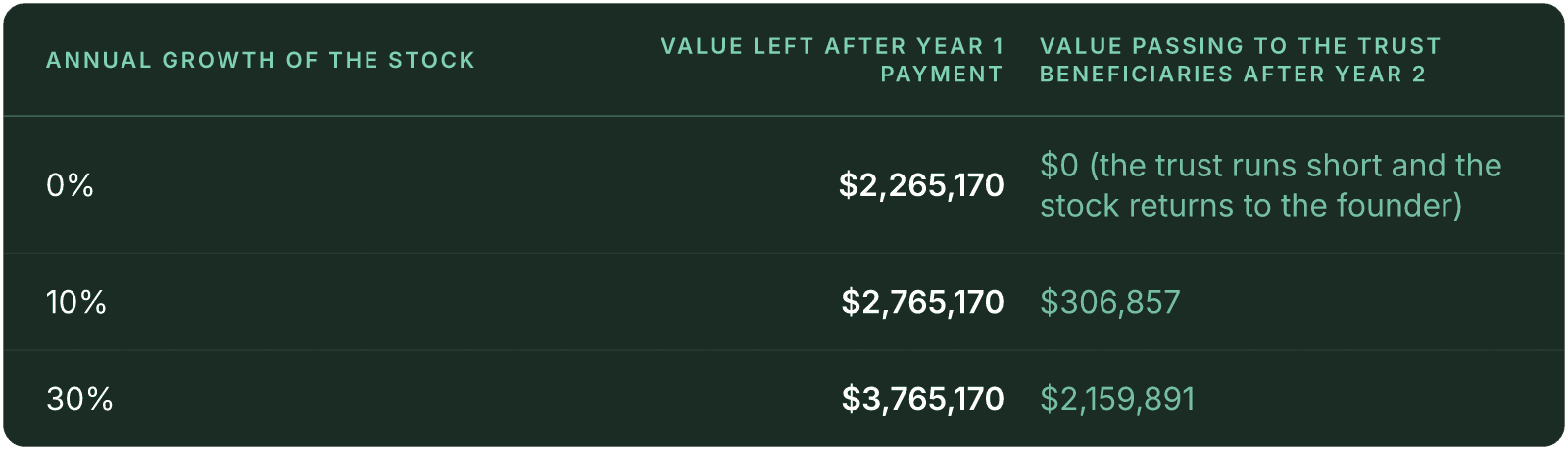
What reaches the children depends on how the stock performs. The table assumes the annuity is paid in shares at their value on each payment date and that the stock grows at a constant rate.
[](https://www.409.ai/uploads/grat_private_company_stock_valuation_annuity_gift_tax_table_1_902599f119.png)
The 10% row is the instructive one. The stock beat a 6.20% hurdle by under four points and the family still received $306,857 without using any exemption. The 30% row is the case people have in mind when they talk about a startup GRAT: more than $2 million moved at a gift tax cost of roughly the attorney's fee.
The 0% row shows the downside. If the company does not grow, the trust cannot make the second payment and the founder gets everything back. The cost of trying is small. That asymmetry is why the structure is popular with founders whose value is expected to change quickly, such as a company close to a priced round or an acquisition.
What if the IRS says the stock was worth more?
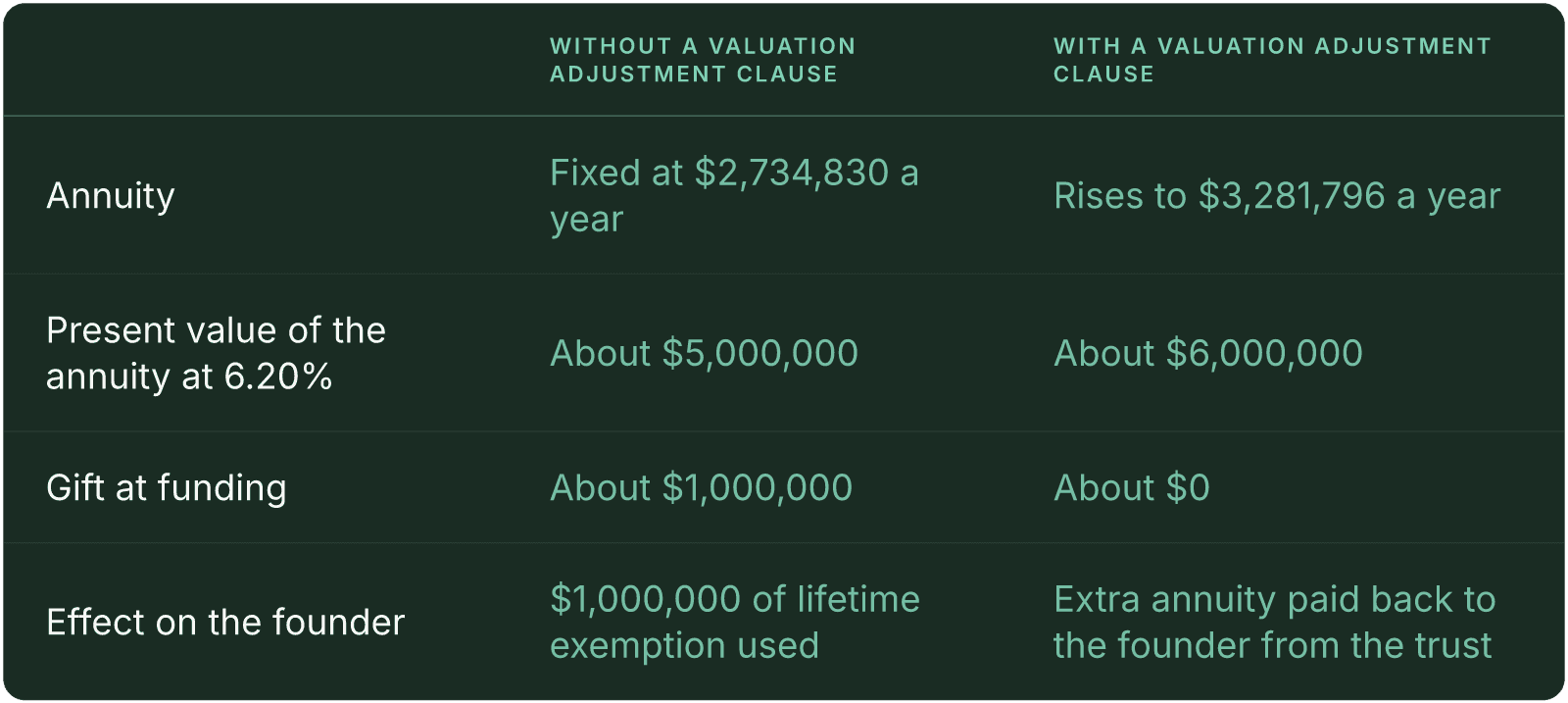
This is where private stock differs from public stock. Suppose the IRS later argues the stock was worth $6,000,000 on the funding date, not $5,000,000.
[](https://www.409.ai/uploads/grat_private_company_stock_valuation_annuity_gift_tax_table_2_a01709d80b.png)
The regulation anticipates the problem. A qualified annuity may be stated as a fixed fraction of the initial value "as finally determined for federal tax purposes," and the trust instrument must include provisions that adjust the annuity if the value is incorrectly determined (Treas. Reg. [25.2702-3(b)](https://www.law.cornell.edu/cfr/text/26/25.2702-3)). In practice that means the annuity is written as a percentage of the finally determined value, not a dollar amount, and the trust pays any shortfall after the value is settled.
The clause protects the structure. It does not make the appraisal optional. A sloppy valuation that is later raised still forces the trust to pay a larger annuity from a smaller pool of assets, and in the 0% and low-growth cases that can empty the trust.
Other rules the appraisal has to fit
A few features of the regulation matter when you pick the term and the stock:
- **The annuity can grow, but only by 120% a year.** Each year's payment may not exceed 120% of the prior year's (Treas. Reg. 25.2702-3(b)(1)(ii)). The founders who want to back-load payments to keep more stock in the trust for a coming round run into this limit.
- **No notes.** A promissory note issued in place of a payment does not count as payment of the annuity.
- **No additional contributions.** The trust cannot take more stock later. A second tranche goes into a second GRAT, with its own valuation.
- **Survive the term.** The term must be fixed, and if the grantor dies during it, part of the trust is included in the estate. The estate tax value of those shares is then a valuation question of its own; the [alternate valuation date](https://www.409.ai/articles/alternate-valuation-date-section-2032-family-business-estate) can matter.
What to ask for before you fund
A GRAT lives or dies on whether the numbers survive an audit, so the order of work is: engage the appraiser first, fund second. The report should be a qualified appraisal of the exact block, as of the funding date, and it should state the discounts applied and why. If the company is mid-round, the appraiser needs to know, because a signed term sheet changes the value of the stock you contribute.
Check four things in the report:
1. The valuation date equals the date the trust is funded. 2. The block valued is the block contributed, with its voting rights and transfer restrictions. 3. Each discount is explained with data, not a flat percentage. 4. The report is written to meet the adequate disclosure content, so the Form 709 can attach it.
If the plan also involves QSBS, the trust's structure matters for the Section 1202 exclusion; see [IRC 643(f) and QSBS trust stacking](https://www.409.ai/articles/qsbs-trust-stacking-irc-643f-treasury-guidance). For the wider gifting picture in 2026, including the $15 million exemption, read [Gifting Startup Equity in 2026](https://www.409.ai/articles/gifting-startup-equity-2026-estate-tax-exemption).
The takeaway
A GRAT turns a prediction about your company into a trade with almost no downside, but only if the stock is valued correctly on the day you fund the trust and on every day you pay from it. Buy the appraisal before the trust is signed, size the annuity as a percentage of the finally determined value, and file the Form 709 with the report attached. For a gift valuation built for Form 709, see [409.AI Gift & Estate Tax valuation](https://www.409.ai/products/gift-estate-tax).
This article is educational and is not legal or tax advice. Your estate attorney drafts the trust and your CPA files the return.