Tax
Gifting Shares Before an Acquisition: Why the Deal Talks Set the Gift Value
Founders gifting private shares while a buyer is at the table: why deal talks set the gift tax value, what the appraisal weighs and the Form 709 penalty risk.
By 409.AI Team - 2026-11-19
# Gifting Shares Before an Acquisition: Why the Deal Talks Set the Gift Value
You own a large block of your company's common stock, a buyer has started talking to the board, and your estate attorney says the time to move shares into a trust for your children is now, before the price goes up. That advice is half right. A gift made while a sale is being negotiated is valued with the negotiation in view, and the number the IRS will defend is usually much closer to the deal price than to your last 409A. This article is for the founder or owner making that gift and for the attorney, wealth advisor or CPA beside them: how the gift tax value is set when an acquisition is in the air, what an appraisal has to weigh, and where the risk sits on the Form 709.
The rule: the value on the gift date, with what a buyer would know
A gift of property is measured at its value on the date of the gift. The regulation defines that value as the price at which the property would change hands between a willing buyer and a willing seller, neither under any compulsion to act, "both having reasonable knowledge of relevant facts" ([26 CFR 25.2512-1](https://www.law.cornell.edu/cfr/text/26/25.2512-1)).
The last five words carry the whole problem. The hypothetical buyer is not a stranger reading your website. The courts presume that buyer is prudent, makes a reasonable investigation and asks the seller for information that is not public. In Estate of Kollsman (T.C. Memo. 2017-40) the Tax Court applied that standard even to facts the actual owner did not know. If your board has a signed exclusivity letter, the hypothetical buyer of your shares would have asked about it and found it.
The general rule against hindsight still holds. Since Ithaca Trust Co. v. United States, 279 U.S. 151 (1929), a value is fixed as of the valuation date without regard to what happened afterwards. But a later event may be considered when it was reasonably foreseeable on that date (Trust Services of America v. United States, 885 F.2d 561 (9th Cir. 1989)), and a later sale can be used as evidence of what a buyer would have paid on the earlier date (Estate of Gilford v. Commissioner, 88 T.C. 38 (1987)). So the closing price of a deal that was being negotiated on the gift date is admissible, and an appraisal that ignores the negotiation is exposed.
What the IRS said about a gift made during merger talks
The clearest statement is IRS Chief Counsel Advice [201939002](https://www.irs.gov/pub/irs-wd/201939002.pdf), released in September 2019. A co-founder and board chairman transferred shares of his public company into a grantor retained annuity trust. Shortly afterwards, the company announced a merger that followed a search among several parties and a period of exclusive negotiations that had started before the transfer. The donor valued the gift at the trading price on the gift date.
Chief Counsel concluded that a hypothetical willing buyer and seller would consider the pending merger, and that the quoted price therefore did not represent fair market value. The memo relied on the exclusivity agreement, correspondence between the two companies and the board minutes, which together showed that on the gift date a buyer "could have reasonably foreseen the merger." It also cited Silverman v. Commissioner (T.C. Memo. 1974-285, aff'd, 538 F.2d 927 (2d Cir. 1976)), where the Tax Court rejected an appraisal of gifted preferred stock because the expert ignored the planned public offering.
A Chief Counsel memo cannot be cited as precedent, and that case involved a listed stock. For a private company the point is stronger, not weaker: there is no market price to fall back on, so the appraisal itself must account for every relevant fact on the gift date, and the deal file is the most relevant fact there is.
Why your 409A is not the answer here
A 409A report exists to support an option strike price. It values common stock under the methods of [26 CFR 1.409A-1(b)(5)(iv)](https://www.law.cornell.edu/cfr/text/26/1.409A-1), and it stops being reasonable when something material happens after its date, such as a letter of intent. We covered the option side of that in [what a signed LOI does to a months-old 409A](https://www.409.ai/articles/letter-of-intent-409a-stale-option-grants-before-acquisition-closes).
For the gift, the gap is wider. The gift appraisal values the exact block you transfer, on the exact day you transfer it, with the discounts for lack of control and marketability that block actually deserves, as explained in [why a 409A skips the control discount and a gift tax return can't](https://www.409.ai/articles/discount-lack-of-control-dloc-409a-gift-tax-valuation). And when a buyer is in the room, the marketability discount shrinks: a block that may turn into cash at a known price within months is far easier to sell than a block with no exit in sight. The broader differences are in [can I use my 409A for a gift tax return](https://www.409.ai/articles/409a-vs-gift-tax-valuation-form-709-founder-stock).
A worked example: one gift, four deal stages
Take a founder with 3,000,000 shares of common stock who wants to give 600,000 shares to a trust for two children. The company's latest 409A puts common at $1.80. A strategic buyer is discussing a price that, after the preferred stock takes its liquidation preferences, would pay about $7.50 per common share at closing.
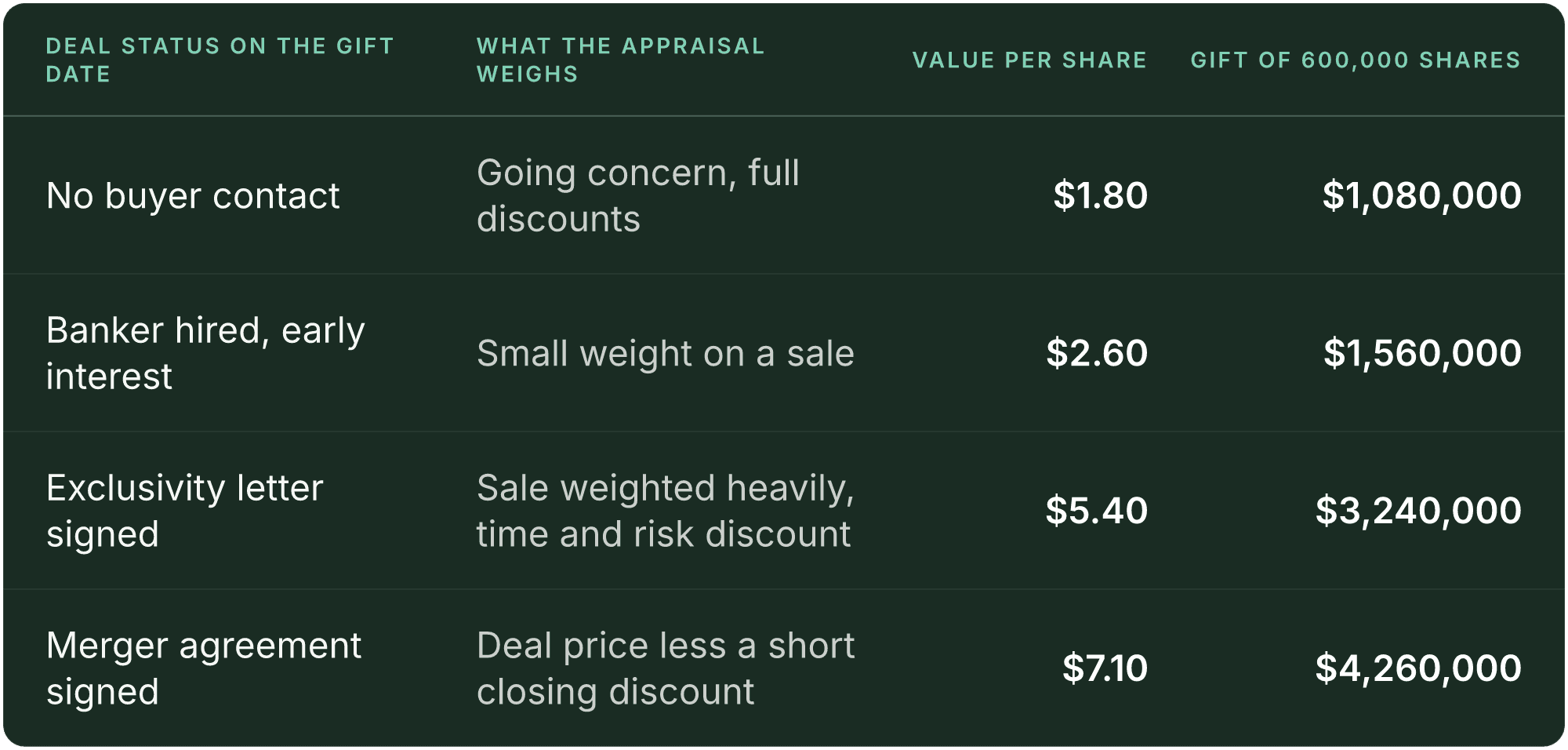
The table shows how an appraisal might value the same 600,000 shares depending on how far the deal had gone on the gift date. The per-share figures are illustrative, after the discounts the block would carry; a real appraisal builds them from the deal documents and the waterfall.
[](https://www.409.ai/uploads/gifting_shares_before_acquisition_pending_merger_gift_tax_value_table_1_c2fa874c3c.png)
Between the first row and the third, the reported gift triples. That difference is the whole reason for the planning, and it is also exactly what an examiner will look for. If the founder files at $1,080,000 when the correct value on the day of an exclusivity letter was $3,240,000, the reported value is 33% of the correct one.
Where the risk lands on the Form 709
Two things follow from an understated value.
The first is the penalty. Under Section 6662, a value on a gift tax return of 65% or less of the correct value is a substantial valuation understatement with a 20% penalty on the underpayment, and 40% or less is a gross understatement with a 40% penalty, once the underpayment from the misstatement exceeds $5,000 ([26 U.S.C. 6662(g) and (h)](https://www.law.cornell.edu/uscode/text/26/6662)). The 33% in the example sits on the wrong side of both lines. The thresholds are explained in [gift tax valuation penalties](https://www.409.ai/articles/gift-tax-valuation-penalty-section-6662-65-percent-40-percent-discounts).
Many founders assume the penalty does not matter because the $15 million basic exclusion amount for 2026 covers the gift. The exclusion absorbs the tax, but the extra $2,160,000 of value still uses up exclusion the founder thought was left for later gifts or the estate. If earlier gifts have already used most of it, the understatement becomes tax due, with interest and the penalty on top.
The second is the statute of limitations. The three-year period to assess gift tax runs only if the gift is adequately disclosed, which for private stock means a qualified appraisal or a detailed description of how the value was reached ([26 CFR 301.6501(c)-1(f)](https://www.law.cornell.edu/cfr/text/26/301.6501(c)-1)). An appraisal that never mentions the negotiations is hard to call adequate disclosure of the relevant facts. The requirements are covered in [adequate disclosure on Form 709](https://www.409.ai/articles/form-709-adequate-disclosure-founder-stock-gift).
The income tax trap behind the gift tax one
There is a separate risk when the deal is close to done. In Ferguson v. Commissioner, 174 F.3d 997 (9th Cir. 1999), shareholders gave stock to charity after a merger agreement had been signed and a tender offer had started. The court held that the shares had already ripened into a right to receive cash and the deal was "practically certain" to proceed, so the donors were taxed on the gain under the assignment of income doctrine. The same logic applies to a gift to family: give away shares that are already, in substance, a claim on the sale proceeds, and the gain may stay with you.
For a gift into a grantor trust, such as a GRAT or a sale to an intentionally defective grantor trust, the donor pays the income tax on the trust's gain anyway, so this matters less. For a gift to a non-grantor trust or directly to children, it can decide the whole plan. Gifts to charity before a sale raise the same question, discussed in [donating private company stock to charity](https://www.409.ai/articles/donating-private-company-stock-charity-qualified-appraisal).
What a defensible pre-deal gift looks like
The safest gift is the one made before any buyer contact, at a value supported by a qualified appraisal dated on the gift date. When that window has passed, the gift can still make sense, because even a value that weighs the deal heavily is usually below the closing price, and growth after the gift date leaves your estate. What changes is how the appraisal is built.
It should state the deal status on the gift date and attach or describe the evidence: whether a banker was engaged, the indications of interest received, the exclusivity letter and its terms, the board minutes. It should model the sale scenario with an explicit probability and timing, run the preference waterfall to the common shares, and explain each discount in light of the expected exit. And the gift date must be real: the transfer documents signed and the shares assigned on that day, not a date picked after the fact. The [Gift & Estate Tax valuation](https://www.409.ai/products/gift-estate-tax) we prepare for Form 709 is built this way, for the block transferred, on the day it was transferred.
Two planning points for the advisors. If the stock is qualified small business stock, it keeps that status and its holding period in the hands of a donee who receives it by gift ([26 U.S.C. 1202(h)](https://www.law.cornell.edu/uscode/text/26/1202)), which is why gifts to non-grantor trusts before an exit are common; the limits on that strategy are in [IRC 643(f) and QSBS trust stacking](https://www.409.ai/articles/qsbs-trust-stacking-irc-643f-treasury-guidance). And if the plan uses a GRAT, the annuity is set from the same appraisal, so an understated value there also distorts the annuity, as covered in [funding a GRAT with private stock](https://www.409.ai/articles/grat-private-company-stock-valuation-annuity-gift-tax).
The takeaway
The value of a gift made during acquisition talks is not your last 409A and not a number chosen before the banker called. It is what an informed buyer would have paid on that day, knowing what your board knew. If the exclusivity letter is already signed, plan on an appraisal that prices the deal in, report that value on the Form 709 with the deal facts disclosed, and let the remaining gap between the appraised value and the closing price be the benefit the gift delivers.