Financial Reporting
Valuing the Warrants Your Fund Holds: Why a Black-Scholes Mark Moves With Term and Volatility
Fund CFOs holding portfolio company warrants: how a Black-Scholes Level 3 mark moves with term and volatility, plus the support your auditor will ask for.
By 409.AI Team - 2026-10-28
# Valuing the Warrants Your Fund Holds: Why a Black-Scholes Mark Moves With Term and Volatility
A venture debt fund or a venture fund that took warrants alongside a loan or a round has a line on the schedule of investments that is easy to ignore: a warrant struck at last year's price, carried at a number that nobody has looked at since the closing. The auditor will look at it. It is a Level 3 instrument, the inputs are judgment calls, and two of them can move the mark by a third without any change in the portfolio company.
This article is for fund CFOs, controllers and valuation committee members who hold warrants in portfolio companies and have to defend the quarter-end mark. It walks through what drives the value, which inputs the auditor presses on, and what a 100,000-share warrant looks like when each input moves.
A warrant is an option, so it is never worth zero while it can still pay
The shortcut many schedules use is intrinsic value: the underlying share price minus the strike, times the shares. A warrant struck at $5.00 on a share worth $4.00 is carried at zero. A warrant struck at $5.00 on a share worth $6.00 is carried at $1.00 a share.
Intrinsic value understates both. The holder of a warrant can wait. If the company's equity value rises before the warrant expires, the holder gains, and if it falls, the holder loses only the premium. That asymmetry is time value, and a market participant paying for the warrant would pay for it. ASC 820 asks for the price at which the warrant would sell between market participants at the measurement date, not the value of exercising it today.
Funds that disclose their method in public filings say the same thing in practice. The [Venture Lending & Leasing funds](https://www.sec.gov/Archives/edgar/data/1717310/000171731024000023/vll9-20240331.htm), for one, describe valuing their warrants with a modified Black-Scholes model, with volatility drawn from public companies in the portfolio company's industry and an expected life based on their own history. Others, such as [ATEL 15](https://www.sec.gov/Archives/edgar/data/0001519117/000114420414049499/v385907_atel15-10q.htm), classify the result in Level 3. These filings are examples of practice, not authority, but they show the shape an auditor expects to see.
The five inputs, and who pushes on which
A Black-Scholes warrant mark has five inputs. Three are mechanical and two carry the argument.
Strike price and share count. Read the warrant, not the term sheet. Strike adjustments, anti-dilution resets and exercise caps all sit in the instrument. A warrant on "up to $500,000 of Series C" converts to a share count only at the strike, so check which one the fund actually holds.
Risk-free rate. The Treasury constant maturity rate for the term you chose. This is rarely contested, but it must match the term input, not a default five-year rate.
Underlying value per share. This is the first real judgment. A warrant on a preferred series has that series as its underlying, with its liquidation preference and seniority, not the common stock. The value comes from the company's equity allocation: a current-round price, or an [option pricing model backsolve](https://www.409.ai/articles/409a-allocation-methods-opm-pwerm-backsolve) to the most recent financing. If the fund also holds the company's preferred, the two marks must use the same equity value, or the auditor will find the gap. When the series sits below another in the stack, the [liquidation waterfall](https://www.409.ai/articles/fund-mark-junior-preferred-liquidation-waterfall-asc-820-latest-round-price) can move the underlying value more than any other change in the quarter.
Expected term. The warrant may run ten years, but few warrants live that long. Companies get acquired, go public, refinance or fail, and warrants are exercised or lapse when they do. Funds that publish their approach commonly use an expected life shorter than the remaining contractual term, based on their own experience with how long warrants stay outstanding. Whatever you pick, the file should show where the number came from, and the fund's own exit history is the best source. A [back-test of past marks against actual exit prices](https://www.409.ai/articles/back-testing-fund-marks-exit-prices-asc-820-disposition-analysis) gives you that history.
Volatility. A private company has no traded equity, so volatility comes from public peers. The common approach is the average of comparable public companies' volatility over a period matching the expected term. Peer selection decides the answer. A software company compared with a basket of mature software names will show a lower figure than the same company compared with recent IPOs. The file should say why the peers are comparable in size, stage and business model, and why no better set exists.
One warrant, five sensitivities
Take a warrant on 100,000 shares of a portfolio company's Series C preferred. The numbers are invented for the example and describe no real position. The strike is $5.00. The fund's equity allocation puts the Series C at $6.00 a share. The risk-free rate is 4.0%. The base case uses an expected term of four years, a 60% volatility, and no discount for marketability.
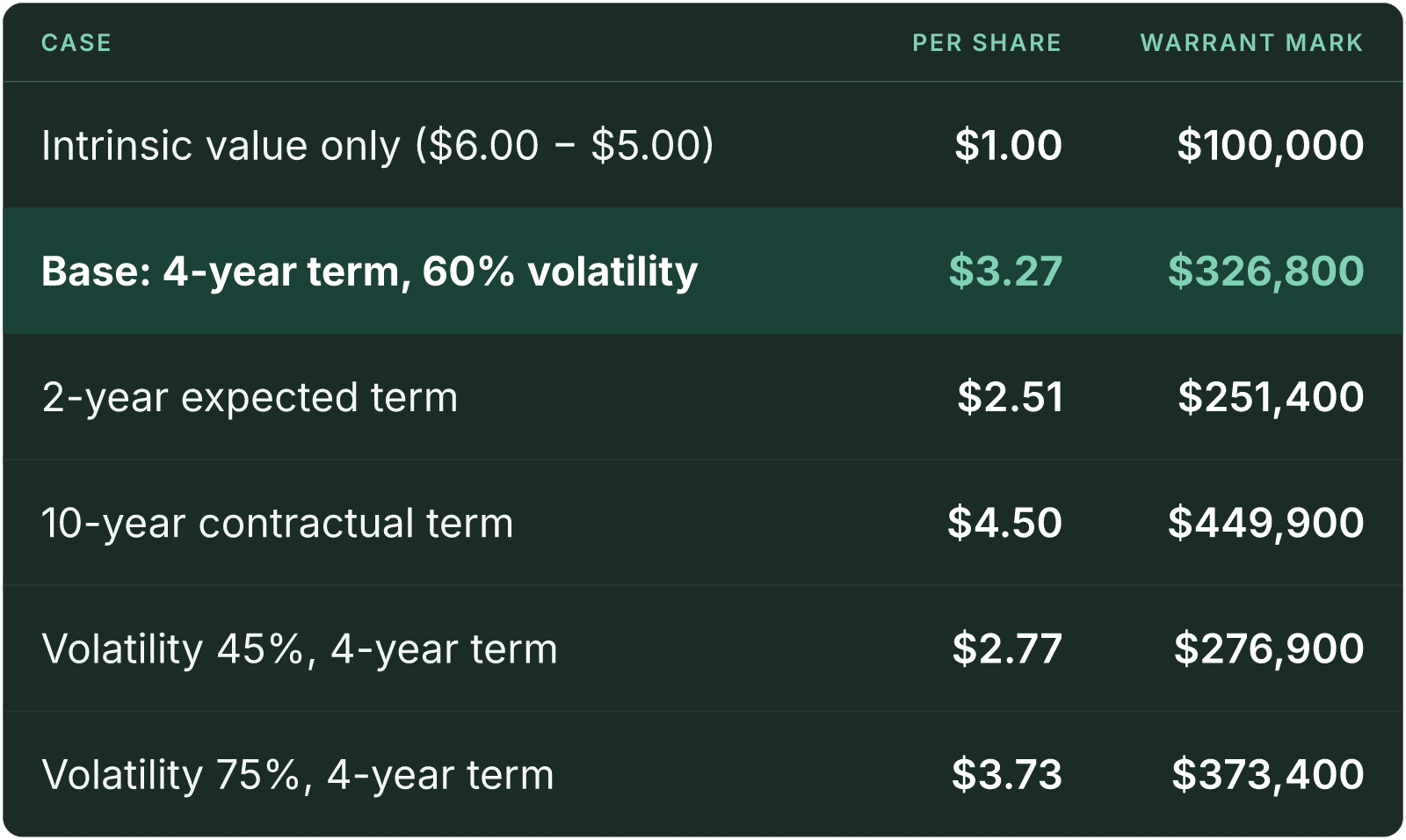
The next table holds everything constant except the one input named in each row.
[](https://www.409.ai/uploads/fund_warrant_mark_asc_820_black_scholes_expected_term_volatility_table_1_0a202fe07e.png)
The first row is what the schedule shows if nobody ran a model. The base case is more than three times larger. Moving the term from four years to ten adds $123,100, and moving volatility by fifteen points either way moves the mark by about $47,000 up or $50,000 down. Neither change involves new information about the company. Both are choices, which is why the auditor asks for the support behind each.
The pattern is consistent with what funds report in their own disclosures: a higher volatility or a longer assumed term increases the value of the warrant. The size of the effect is what the example shows. If you choose the long contractual term because it is the number in the contract, you are valuing the warrant as though it will never be exercised, acquired or lapse early, and the mark will read high against the fund's own history.
The underlying value moves it too
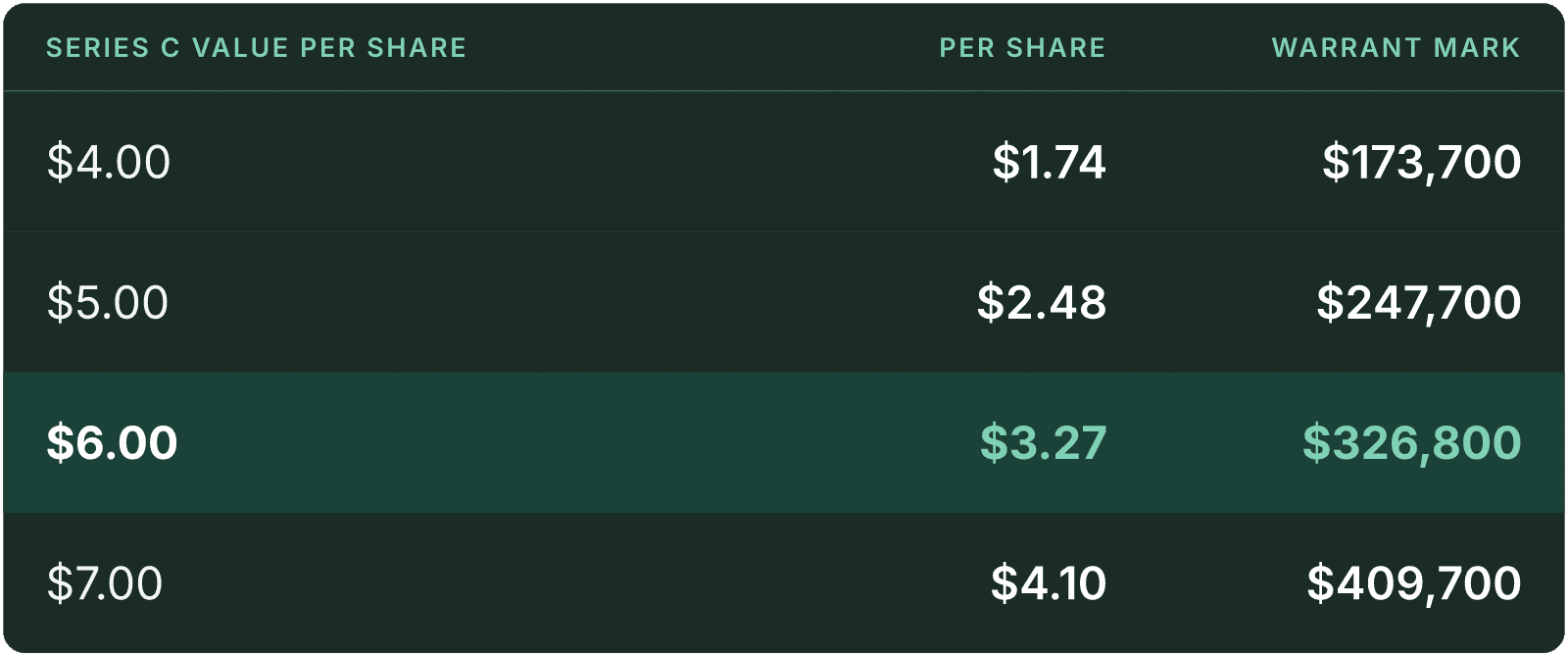
The second table holds term and volatility at the base case and changes only the value of the Series C share.
[](https://www.409.ai/uploads/fund_warrant_mark_asc_820_black_scholes_expected_term_volatility_table_2_9935947af2.png)
Even at $4.00, below the $5.00 strike, the warrant carries $173,700, because four years remain for the shares to recover. A schedule that carried it at zero would have understated the position by that amount. And at $5.00, where the warrant is exactly at the money, it is worth $247,700 although its intrinsic value is zero.
The table also shows the direction of the risk. A $1.00 move in the underlying moves the mark by roughly $80,000 here, but the change is not linear: the warrant gains less per dollar as it falls and more as it rises. That is worth saying to a valuation committee that expects the warrant to track the preferred one for one.
What the auditor asks for
Expect four requests, and prepare the file so each is answered before it is asked.
1. The model and why it fits. Black-Scholes is a closed-form model and treats the warrant as a European option, exercisable only at expiry. For most venture warrants that is an acceptable simplification, and the file should say so. Where the instrument has features that break it, such as a reset on a down round or a cash payment on an acquisition, say how the mark accounts for them or why they are immaterial. 2. The source of each input, with a date. Volatility from a named peer set, term from the fund's history, the underlying from the equity allocation the fund also uses for its other positions in the company. 3. Consistency with the rest of the file. A warrant marked on a $6.00 Series C while the fund's [convertible note in the same company](https://www.409.ai/articles/fund-mark-safe-convertible-note-asc-820-quarter-end) assumes a lower equity value will not survive review. 4. A sensitivity. Show the mark at the term and volatility ranges above. It tells the reviewer you know the mark is a range, and it turns an open-ended argument into a short discussion of which end of the range the evidence favors. This belongs in the [valuation policy and its supporting file](https://www.409.ai/articles/fund-valuation-policy-asc-820-audit-sec-exam) before the audit starts.
A discount for lack of marketability on top of the model is a separate argument, not a default. If the fund applies one, it needs a reason a market participant would price in, and the characteristics of the instrument decide that, not the fact that the company is private. Many funds apply none to a warrant whose value already reflects a shortened term.
The takeaway
Before the next quarter-end, pull every warrant on the schedule and write three numbers beside it: the expected term, the volatility and the peer set that produced it. If any of the three reads "same as last quarter" with no source, that is the mark an auditor will open first. Rebuild it from the fund's exit history and a dated peer set, run the sensitivity table once, and keep it in the file. The company side of the same instrument, where the warrant lands on the cap table, is covered in our piece on [venture debt warrants and the 409A](https://www.409.ai/articles/venture-debt-warrants-valuation-409a-cap-table).
If you want a second pair of eyes on a Level 3 warrant mark before the audit, [409.AI's ASC 820 valuation service](https://www.409.ai/products/asc-820) starts at $2,999 for one to five assets.