Financial Reporting
One Portfolio Company, Three Securities: What Unit of Account Does to a Fund's Level 3 Marks
Fund CFOs holding a loan, warrants and preferred in one company: how the unit of account is set, when a group mark holds up, and how to allocate it back.
By 409.AI Team - 2026-11-01
# One Portfolio Company, Three Securities: What Unit of Account Does to a Fund's Level 3 Marks
Your fund lent a portfolio company $5 million, took warrants alongside the note, and later led its Series B. At quarter-end, the controller opens the valuation file and finds three positions in one company. The question that sits underneath every number in that file is deceptively plain: what, exactly, are you valuing? The answer is the unit of account, and for a fund with a loan, a warrant and a preferred position in the same company it changes how the marks are built, how they are allocated and what the auditor tests.
This article is for fund CFOs, controllers, GPs and administrators who hold more than one security of the same portfolio company at a Level 3 mark. It explains how the unit of account is set, when a fund can defend measuring the holdings together, and what has to happen afterward so the schedule of investments still shows each security at its own fair value.
Unit of account comes from somewhere else
ASC 820 tells you how to measure fair value. It does not, for the most part, tell you what is being measured. The unit of account is set by the Topic that requires or permits the fair value measurement, unless ASC 820 itself says otherwise. You can read the framework in [Deloitte's roadmap on the fair value application framework](https://dart.deloitte.com/USDART/home/codification/broad-transactions/asc820-10/roadmap-fair-value-measurements-disclosures/chapter-3-application-framework/3-2-fair-value-application-framework).
For an investment company, that Topic is ASC 946, and it says little about how to count holdings in a single company. The investment is the thing on the schedule of investments, usually each security by class. Beyond that the Codification leaves a gap, which is why practitioners turn to the AICPA's Valuation of Portfolio Company Investments of Venture Capital and Private Equity Funds guide. It is nonauthoritative, but auditors read it and cite it.
The guide frames the decision around economic best interest. In the words of a [BDO summary of the guide](https://www.bdo.com/getmedia/0b7cb77a-cd59-421f-9d96-c9d0f753eff6/FS_AM_Valuation-Portfolio-Company-Investments_Insight_1-19_WEB.pdf?ext=.pdf), when a fund holds both debt and equity, or several classes of equity, in one portfolio company, it should consider how a market participant would likely sell the investments to maximize overall return. If that buyer would take the whole position, the unit of account may be the group of investments collectively. If each security would trade on its own, each one is valued separately.
Note what that sentence does and does not say. It does not say the group is the default, and it does not say a fund may pick whichever answer produces the steadier number. It says the unit follows the assumed transaction, and the assumed transaction has to be something a market participant would actually do.
Two tests before you group anything
A fund that wants to measure the loan, warrant and preferred together should be able to answer two questions in writing.
Would a buyer take them as a package? Think about who the market participant is. A buyer of a company's senior note is often a credit investor who does not want equity. A buyer of the preferred wants the equity risk and may not want the loan. If the securities carry rights that only work together, such as a warrant that detaches only on repayment, or a loan whose conversion feature is the equity position, the package case gets stronger. If each could be sold on its own tomorrow without disturbing the others, the case for a group is thin.
Is there evidence for the package price? A group measurement still needs inputs. If the only thing supporting a higher group value is a belief that the whole is worth more than the parts, the auditor has nothing to test. The most useful evidence is a transaction in the company's own securities, a recent term sheet for a combined deal, or a pattern in your own past exits.
Your own exit history matters here. If the last three times the fund left a position it sold the loan to a lender and the equity in a secondary sale, the file already shows how this fund's market participants behave. The method in [Back-Testing Fund Marks Against Exit Prices](https://www.409.ai/articles/back-testing-fund-marks-exit-prices-asc-820-disposition-analysis) gives you a way to pull that evidence together.
A worked example
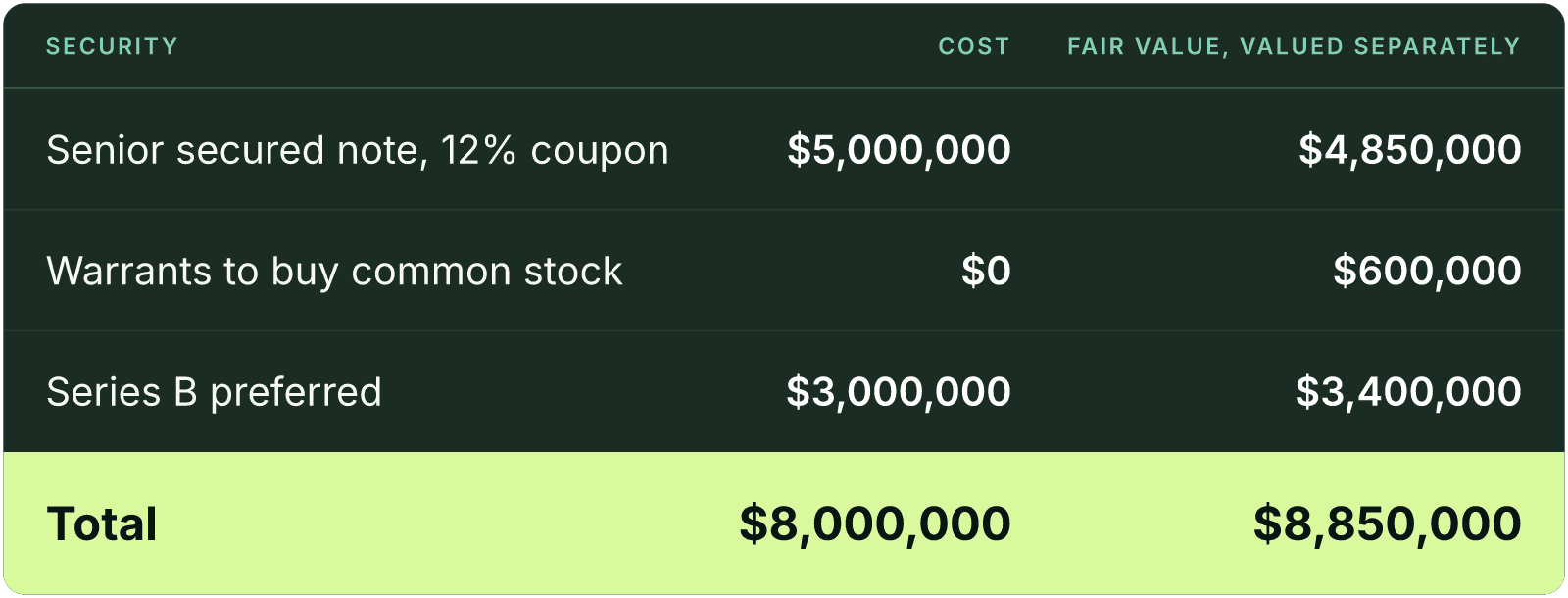
Take a fund with these positions in one company at December 31. The numbers are illustrative, not a real client.
[](https://www.409.ai/uploads/fund_multiple_securities_one_portfolio_company_unit_of_account_asc_820_loan_warrant_preferred_table_1_841f72988c.png)
Each line has its own technique. The note is measured with a yield method: the contractual cash flows discounted at a rate that reflects the company's credit today, not the rate at signing. The fund's note is worth less than par because the company's credit has weakened since the loan was made, so the discount rate sits above 12%. The warrants are an option on common stock, valued with a model as described in [Valuing the Warrants Your Fund Holds](https://www.409.ai/articles/fund-warrant-mark-asc-820-black-scholes-expected-term-volatility). The preferred is valued from an equity allocation that respects its liquidation preference, which is why it rarely equals the round price per share. That point is the subject of [Your Fund Paid $4.00 a Share](https://www.409.ai/articles/fund-mark-junior-preferred-liquidation-waterfall-asc-820-latest-round-price).
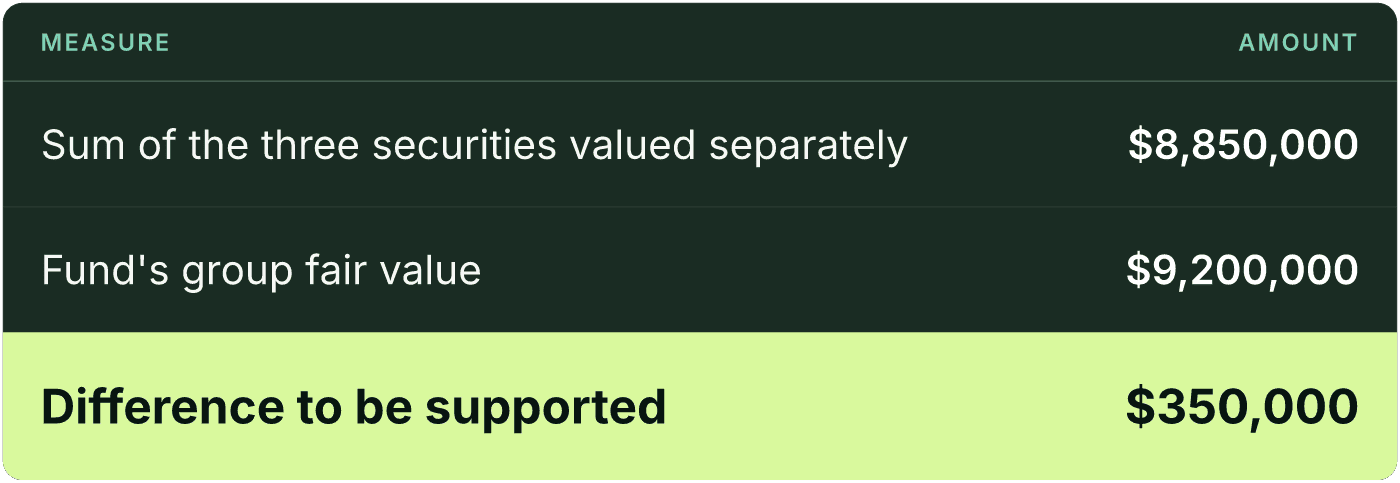
Now suppose the fund concludes a buyer would take everything at once, and a group valuation supports $9,200,000 for the three positions together.
[](https://www.409.ai/uploads/fund_multiple_securities_one_portfolio_company_unit_of_account_asc_820_loan_warrant_preferred_table_2_7ac9737902.png)
That $350,000 is 4% of the separate total, and it is the number an auditor will ask about first. What does the buyer of the package pay for that a buyer of the pieces does not? If the answer is a real, observable feature, such as a control position that can only be sold together, the difference may hold. If the answer is a general sense that the sum is worth more, it will not.
The more common outcome, in practice, is that the group and the parts land close together once the inputs are consistent. Which brings up the harder problem.
The inputs have to agree across the securities
Valuing three securities of one company separately creates a trap. The equity techniques depend on an enterprise value. The debt technique depends on a credit view. If the enterprise value that supports the preferred implies a company that could easily repay the note, but the note is discounted as if the company were struggling, the file contradicts itself.
A reviewer should be able to reconcile the marks through the capital structure. Start from the enterprise value. Subtract the debt at its fair value. Allocate the remainder across the equity classes, warrants included. If the pieces do not add back to the enterprise value you used, one of the inputs is wrong. The same discipline applies in stress cases, and [How a Fund Marks a Portfolio Company That Is Running Out of Cash](https://www.409.ai/articles/fund-mark-distressed-portfolio-company-asc-820-scenarios-lender-first) shows how the loan moves first when the company weakens, while the equity holds an option value that the loan does not.
After a group measurement, allocate back
Even a fund that measures the group has to report by security. The schedule of investments lists each holding, and the fair value hierarchy disclosures are by class. So a group value is not the end of the work. It has to be allocated to the note, the warrants and the preferred, on a basis you can explain, and the allocation has to be repeatable next quarter.
Two practical points follow. First, allocate in proportion to the separate fair values unless you have a reason to do otherwise, and write the reason down. Second, keep the allocation method steady from one quarter to the next. A change in method between quarters is itself a disclosure question and a conversation with the auditor. For what the footnote itself requires of a nonpublic fund, see [What a Private Fund's Level 3 Footnote Must Say](https://www.409.ai/articles/asc-820-level-3-footnote-private-fund-asu-2018-13-nonpublic).
When the company lists, the answer flips
All of this is the private-company picture. When a portfolio company lists, any shares you hold in the public class are Level 1, valued at the quoted price times the number of shares. ASC 820 does not allow a blockage factor for that position, a rule covered in [Control Premium or Blockage Discount?](https://www.409.ai/articles/control-premium-vs-blockage-factor-fund-majority-stake-asc-820-mark). Any warrants or debt that remain private still need their own marks. So the unit-of-account question does not disappear at the IPO. It splits.
What to put in the file this quarter
For every portfolio company where the fund holds more than one security, add a short paragraph to the valuation memo that states the unit of account and why. Name the assumed transaction. Say whether a market participant would take the securities together or separately, and what evidence supports that view: a past exit, a term sheet, a conversation with a lender. If you value the group, show the allocation back to each security and the reconciliation to enterprise value. If you value the securities separately, show that the inputs agree.
An auditor who reads that paragraph first will spend the rest of the review testing numbers instead of testing your reasoning. If you want a second set of eyes on the unit of account in a multi-security position before the year-end mark, [409.AI's ASC 820 valuation service](https://www.409.ai/products/asc-820) is built for exactly that file.