Compliance
When Your Marks Set Your Fees: What Valuation Enforcement Cases Teach a Fund Policy
Fees on NAV make a Level 3 mark a fee input. For fund CFOs and CCOs: what SEC valuation cases show and what a policy should say before year-end marks.
By 409.AI Team - 2026-10-23
# When Your Marks Set Your Fees: What Valuation Enforcement Cases Teach a Fund Policy
A fund's management fee often runs on net asset value. A fund's Level 3 marks drive that net asset value. So the same person, or the same firm, can end up choosing a price and collecting a fee on it. This article is for the CFO or chief compliance officer of an adviser whose fees are computed on NAV, or one that moves assets into a continuation vehicle, and who is about to review the valuation policy before the year-end audit.
The enforcement record is not abstract. It runs from criminal-scale mismarking to a plain failure to write the policy down. The common thread is the conflict, and the answer to it is mostly paperwork that exists before anyone asks.
The conflict in one calculation
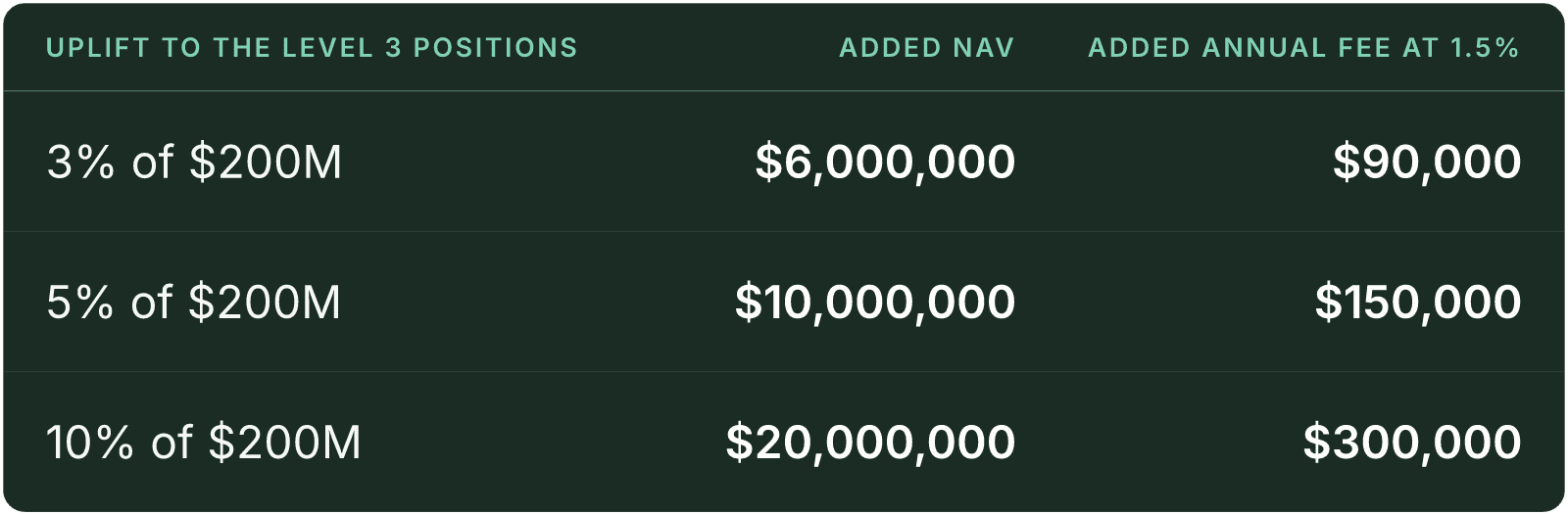
Take an adviser with a fund at $400 million of NAV, of which $200 million sits in Level 3 positions. The management fee is 1.5% of NAV. Nobody has to act in bad faith for the incentive to exist. A mark that moves up moves the fee up with it.
[](https://www.409.ai/uploads/fund_marks_set_fees_nav_based_fees_valuation_enforcement_policy_table_1_3a85385f01.png)
The figures are illustrative, not a real fund. The point of the table is the direction: every dollar of unsupported mark is also a dollar of fee base, and carried interest accrual, covered in [how a Level 3 mark moves the GP's share](https://www.409.ai/articles/carried-interest-accrual-hypothetical-liquidation-fund-marks), points the same way. The fee is repeated every year the mark stands. A regulator reading your file will see the same arithmetic you just did.
What the cases show
Four SEC matters, each decided on its own facts, show how the conflict has been charged. Each description below comes from the SEC's own release or order.
Prices passed off as someone else's
In July 2015 the SEC announced a settlement with AlphaBridge Capital Management and its two owners. [The SEC said](https://www.sec.gov/newsroom/press-releases/2015-134) that AlphaBridge told investors and its auditor it obtained independent quotes from broker-dealers for thinly traded mortgage-backed securities. In fact it gave its own valuations to broker-dealer representatives to pass off as theirs. The inflated values caused the funds to pay higher management and performance fees, and AlphaBridge and its owners agreed to pay $5 million combined.
The lesson for a policy is narrow and practical. A broker quote is only independent if the broker built it. If your process asks a counterparty for a quote and a person on the portfolio team supplies the number, the quote is a mark with a second signature.
Quotes in exchange for trades
In 2018 the SEC sued Premium Point Investments. [Its litigation release](https://www.sec.gov/enforcement-litigation/litigation-releases/lr-25532) describes a scheme from at least September 2015 through March 2016 in which the adviser allegedly received inflated broker quotes for mortgage-backed securities in exchange for sending trades to the broker-dealer. It also used "imputed" mid-point valuations. The court entered a final judgment by consent in September 2022, and the principal was ordered to pay a $450,000 civil penalty.
Here the policy lesson is about relationships. If a broker that supplies marks also receives your order flow, the file should say so, and the quote should be treated as less than independent.
Portfolio managers and a supervisor
In May 2018 the SEC [settled with Visium Asset Management](https://www.sec.gov/newsroom/press-releases/2018-81). Two portfolio managers had falsely inflated the value of securities held by the hedge funds, which overstated returns and NAV. The funds paid about $3.15 million in excess fees as a result. Visium agreed to disgorgement of more than $4.7 million plus interest and a penalty of more than $4.7 million. Its CFO paid a $100,000 penalty and accepted a 12-month suspension after the SEC charged him with failing to reasonably supervise the portfolio managers. One of the managers was convicted in a parallel criminal case.
The supervision charge is the one a finance officer should read twice. It reaches the person who signs the NAV, not only the person who chose the price.
A policy that said too little
The Sciens matter has no allegation of a planted price. In May 2023 the SEC [charged Sciens Investment Management and Sciens Diversified Managers](https://www.sec.gov/enforce/ia-6315-s) with failing to adopt and implement reasonably designed written valuation policies and procedures. Sciens billed its private funds quarterly on NAV, at 2% a year for outside investors in the main fund, and virtually all of that fund's portfolio was Level 3. The [order](https://www.sec.gov/files/litigation/admin/2023/ia-6315.pdf) found that the compliance manual gave only minimal guidance on valuing Level 3 investments. It named no valuation techniques, lacked procedures for consistency and for the conflict of the adviser valuing what it manages, and did not address calibration. The firm settled without admitting or denying the findings, accepted a $275,000 civil penalty and agreed to retain an independent compliance consultant.
Two paragraphs of the order matter beyond the penalty. First, the SEC treated the auditor's qualified opinions as notice. The fund's auditors had been unable to obtain enough evidence for the fair value of a material Level 3 investment, and the order says Sciens "had notice" that its procedures may have been insufficient. Second, the later write-down of about $32.9 million led to retroactive adjustments in 2020 to the management fees for the years 2016 through 2019. A mark that moves also moves the fee you already collected.
A mutual fund and a hedge fund, inflated
In June 2023 the SEC filed a settled action against Infinity Q Capital Management. [The complaint alleges](https://www.sec.gov/litigation/litreleases/lr-25750) that from at least February 2017 through February 2021 the NAVs of its mutual fund and private fund were materially and falsely inflated through a mismarking scheme run by its chief investment officer. We cite it for scale, not for a policy point: a policy does not stop a person determined to override it. What a policy can do is make an override visible, because someone other than the portfolio manager has to see the number.
What regulators have said they are watching
The people deciding where to look have said where. In an interview reported in a [December 2025 Debevoise & Plimpton client note](https://www.debevoise.com/insights/publications/2025/12/recent-remarks-signal-renewed-focus-on-private), the U.S. Attorney for the Southern District of New York named "marks on assets with no trading when things are moved around from vehicle to vehicle" as something to watch for. He added that "the opportunity to pick a price that benefits the house over investors is pretty high." The note reads those remarks as particularly relevant to less liquid assets moving between affiliated vehicles, such as continuation funds.
That is a statement of interest, not a rule. It still tells you which transfer a prosecutor would read first. If your adviser is moving a position from one fund to another, the price needs a record that does not depend on who stands on both sides of the trade. We covered the mark side of that situation in [what happens when a continuation fund prices below your carrying NAV](https://www.409.ai/articles/continuation-fund-price-below-nav-asc-820-quarter-end-mark).
What a policy should say about the conflict
The Sciens order is, in effect, a list of what a policy was missing. Read next to the others, it gives an agenda for the year-end review. The broader framework is in our article on [what a fund valuation policy has to fix in advance](https://www.409.ai/articles/fund-valuation-policy-asc-820-audit-sec-exam), and the process functions are laid out in [the four functions of SEC Rule 2a-5](https://www.409.ai/articles/sec-rule-2a-5-fair-value-process-private-fund-valuation-policy). For the fee conflict specifically:
- **Name the techniques.** For each type of Level 3 position, say which technique is used and what drives its inputs. "Fair value per ASC 820" is the definition, not the procedure.
- **Separate the proposer from the approver.** The person who sources a mark should not be the person who approves it, and the person whose compensation rides on NAV should not be the only approver.
- **Say how quotes are tested.** Record who built each broker quote, whether the broker also receives order flow, and what is done when a quote is stale or cannot be supported.
- **Require calibration.** The order faults the absence of any procedure to adjust the adviser's own data to what market participants would use. The calibrated yield or multiple at entry is the anchor for every later mark. The [SEC staff statement on private asset fair value](https://www.409.ai/articles/sec-staff-statement-private-asset-fair-value-calibration-nav) takes the same position on calibration.
- **Write the affiliated-transfer rule.** For a transfer between vehicles, say who sets the price, what outside evidence is required, and who reviews it. Put the date and the evidence in the file at the time, not later.
- **Treat the auditor's findings as notice.** A qualified opinion, a scope limitation or a repeated audit adjustment on a position goes to the valuation committee with a written response. The Sciens order shows how that history reads afterward.
- **Define what happens when a mark is wrong.** Say how the fee is trued up and how investors are told, before a case forces the question. Back-testing against actual exits, as in [back-testing fund marks against exit prices](https://www.409.ai/articles/back-testing-fund-marks-exit-prices-asc-820-disposition-analysis), finds the pattern early.
An outside specialist can help with independence, but it does not move the responsibility. The auditor's questions about that file are in [what the auditor tests about an outside valuation firm](https://www.409.ai/articles/fund-valuation-firm-sas-143-auditor-tests-management-specialist-file).
Before the December 31 marks
Valuation committees meet before year end. Put one extra item on that agenda: for each Level 3 position, list who proposed the mark, who approved it, what evidence supports it, and whether the fee or the carry depends on it. Where the same person fills both roles, either change the process or write down why not. Where a position moved between vehicles this year, pull the pricing record and read it as a regulator would.
None of this requires a different valuation. It requires a file that shows the price was not set by the party that benefits from it. If you want an independent view of the Level 3 inputs before the audit, 409.AI's [ASC 820 valuation service](https://www.409.ai/products/asc-820) supports funds with the calibration, the scenarios and the documentation. For the underlying framework, see [ASC 820 and the Level 3 problem](https://www.409.ai/articles/asc-820-level-3-fair-value-fund-portfolio-valuation).