Financial Reporting
How a Fund Marks a SAFE or Convertible Note at Quarter-End
Fund CFOs and controllers: how to mark a SAFE or convertible note under ASC 820 with a scenario-weighted model, a worked example and the file auditors ask for.
By 409.AI Team - 2026-10-15
# How a Fund Marks a SAFE or Convertible Note at Quarter-End
A venture fund's early-stage book is full of instruments that are not shares yet. A $500,000 post-money SAFE sits next to a convertible note with eight months left on it, and both have to carry a Level 3 mark on the quarter-end statement. For a fund CFO, controller or GP, the awkward part is that cost is a fine answer on day one and an unreliable one by the next quarter.
The auditor will not accept "held at cost" without evidence that cost still describes the instrument. This article walks through what the instrument is worth to a market participant, how the terms drive the answer, and what the file should show.
Why cost stops working
ASC 820 defines fair value as the price a market participant would pay to acquire the asset at the measurement date. The price you paid is the best evidence on the day you paid it. After that, the company hits a milestone or misses one, a priced round is announced or falls through, and the instrument you hold is closer to converting or closer to nothing.
A SAFE has no maturity date and no interest. Y Combinator's own description says it stays outstanding until it converts or terminates, so there is no accrual to add and no due date to anchor a value. A convertible note is different: it has a stated rate, a maturity date and often a discount, so its value moves with accrued interest, the conversion terms and the borrower's ability to repay.
Both are Level 3 positions in most cases, because the inputs that matter (the timing and price of the next round, the odds of an exit, the recovery in a wind-down) are not observable. The disclosure points in our piece on [what makes an input significant and unobservable](https://www.409.ai/articles/asc-820-level-3-classification-significant-unobservable-input) apply here without change.
Start with what the instrument pays
The terms decide which outcomes you model. Under Y Combinator's standard post-money SAFE, there are three.
Equity financing. The SAFE converts into preferred stock when the company raises a priced round. If the round values the company above the cap, the holder converts at the cap price, and the ownership received equals the purchase amount divided by the cap. A $500,000 SAFE with a $10 million post-money cap converts into 5% of the company's capitalization at the cap price. If the round prices the company at $15 million on the same basis, those shares are worth $750,000 at the round price.
Liquidity event. On an acquisition or IPO, the holder receives the greater of its purchase amount or the amount it would have received on conversion. That is a floor of 1x, subject to the SAFE's ranking behind debt and alongside preferred stock and other SAFEs.
Dissolution. The holder is owed the purchase amount, but the SAFE ranks behind creditors, so the recovery in a real wind-down is often a fraction of that.
A convertible note adds three terms the SAFE lacks: interest that accrues to the conversion or maturity date, a maturity date at which the lender can ask for repayment, and a discount to the round price in addition to or instead of a cap. Each one changes the payoff in one or more scenarios, so each one belongs in the model.
The scenario-weighted approach
For these instruments, a probability-weighted expected return method is the standard tool because the payoffs are discrete and the timing differs by scenario. The steps are the same every quarter:
1. List the realistic outcomes from the terms: conversion at the next round, a sale, a wind-down, and for a note, repayment or extension at maturity. 2. Estimate the payoff in each, from the instrument's terms and the company's capital structure at that outcome. 3. Assign a probability and an expected date to each. 4. Discount each payoff to the measurement date at a rate a market participant would require for a position of this risk.
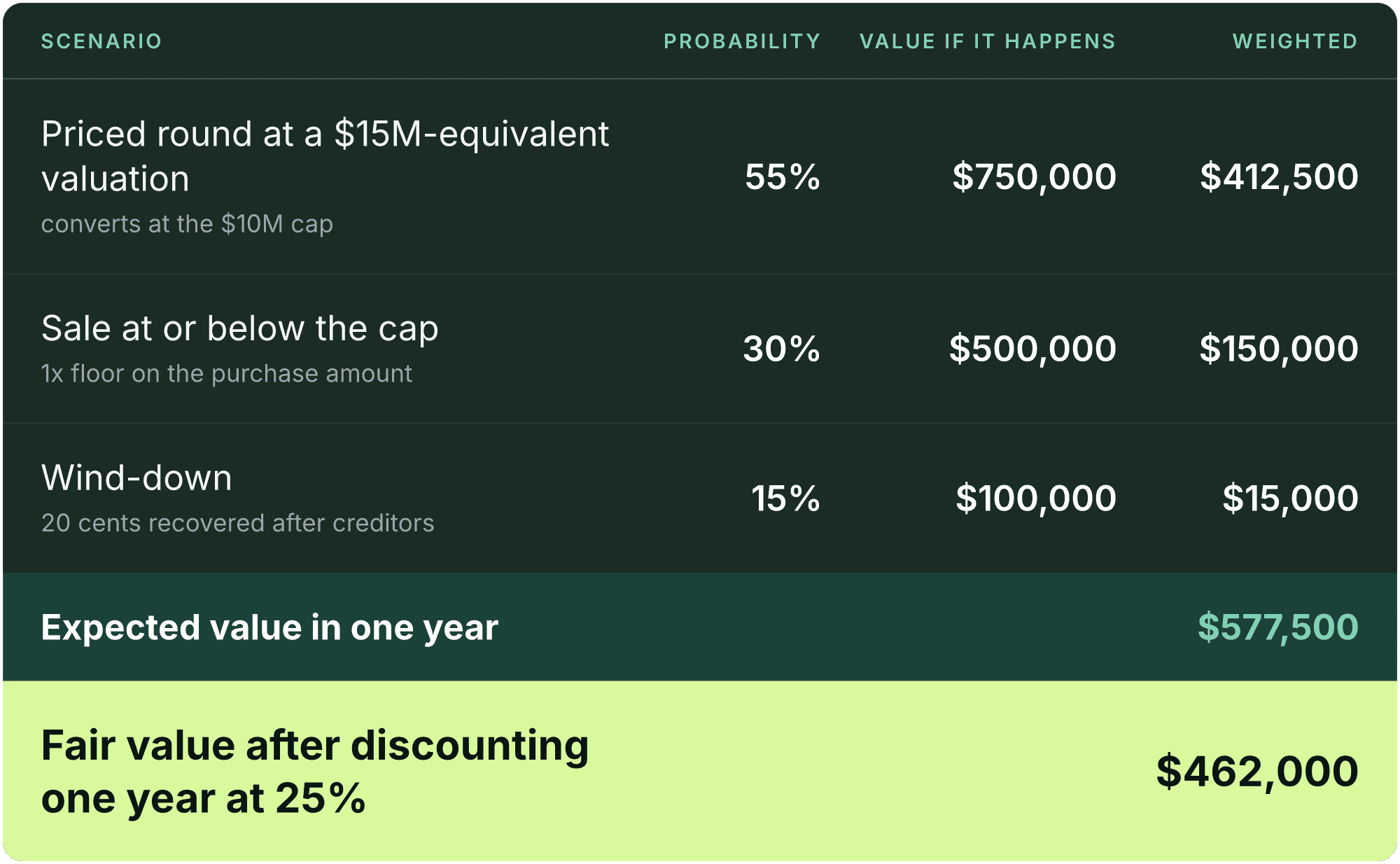
Here is the output for the $500,000 SAFE above at a quarter-end where the company has missed a hiring and revenue milestone and its round has slipped.
[](https://www.409.ai/uploads/fund_mark_safe_convertible_note_asc_820_quarter_end_table_1_6fb7636d3a.png)
The expected value looks healthy. The fair value is $38,000 below cost because time and risk matter: the cash arrives in a year, the required return is high, and a 15% chance of recovering a fifth of the money pulls the average down. The table is an illustration, and the probabilities and the rate are the judgment calls an auditor will test.
The point of the exercise is the sensitivity. If the round closes next month instead of next year, the same payoffs discount to a much higher value. If the odds of a wind-down double, the mark drops further. The file should show both, not only the answer.
Calibrate at the investment date
ASC 820 expects a valuation technique to be calibrated to the transaction price when a position is acquired at a price that is fair value at initial recognition. For a SAFE, that means choosing the probabilities, timing and discount rate at the investment date so that the model returns the $500,000 you paid, then moving only the inputs that changed.
The SEC staff's September 2026 statement put the same expectation in plain terms, and we covered it in [the staff's position on calibration and entry price](https://www.409.ai/articles/sec-staff-statement-private-asset-fair-value-calibration-nav). A model that was never calibrated to the price paid cannot show that a later move in the mark comes from new information rather than a new opinion.
Calibration also protects you from the opposite mistake. When a company announces a priced round, the SAFE's value does not jump to a face-value multiple of the headline valuation. Conversion happens at the cap or discount, and the preferred it converts into carries the round's rights. Its value follows the new round price per share and the number of shares you will actually receive.
What changes between quarters
Three events do most of the work.
A priced round closes. The SAFE converts and the position becomes preferred stock. Its mark then follows the fund's approach for preferred shares: the round price is strong evidence, adjusted for the rights and for time since the round. Our guide to [valuing a single position without information rights](https://www.409.ai/articles/spv-single-position-fair-value-asc-820-no-information-rights) covers what to do when the company gives you little to work with.
A round is announced but not closed. Term-sheet terms are evidence of the conversion price, and the probability of closing moves toward one. Moving the probability from 55% to 85% is a legitimate input change. Moving the mark to the headline valuation before the paperwork is signed is not.
A note nears maturity. The value of the position now depends on repayment capacity. If the company cannot repay and the holder will extend, the extension terms (a new rate, a new maturity, extra warrants) are the new payoff. If conversion at the discount is the realistic path, the accrued interest converts with the principal and belongs in the share count.
What the auditor will ask for
An auditor following the retrospective review required for estimates will compare the prior mark to what happened since. The file for each position should hold:
- the instrument's key terms, with the cap, discount, interest, maturity and ranking identified,
- the scenarios, the probabilities and the rate, each with the evidence behind it,
- the calibration at the investment date,
- a comparison of the new mark to the prior one with the input changes named,
- the company information used (round status, runway, milestones) and its date.
Your valuation policy should say that early-stage convertibles are marked on this method and who approves a probability change. If the policy is silent, [the valuation policy checklist](https://www.409.ai/articles/fund-valuation-policy-asc-820-audit-sec-exam) is a good place to start before the next audit cycle.
The takeaway
Hold a SAFE at cost only while you can show that cost still reflects the likely payoff, and write that evidence down. When it stops reflecting the payoff, the scenario-weighted model gives you a mark you can defend because every input is tied to a term of the instrument or a fact about the company. Keep one calibrated model per position, change only what the quarter changed, and keep the previous quarter's version beside it.
If your fund's convertible positions need an independent Level 3 valuation with a report your auditor can rely on, see [409.AI's ASC 820 valuations](https://www.409.ai/products/asc-820). For the founder side of the same instruments, our piece on [how SAFEs affect a 409A valuation](https://www.409.ai/articles/how-safes-affect-your-409a-valuation) shows what the company's own valuation does with them.